

Whole house audio is a set of wireless speakers that all sit on your home Wi-Fi, grouped in one brand’s app so the same music plays in several rooms at once, with no speaker wire pulled through the walls. It is not the same thing as multi-room audio, where each room can play something different from the same platform. The best wireless speakers for whole house audio are judged on one thing first: how well the platform groups, not how loud a single cabinet plays.
We ran three ecosystems side by side for two months in a two-storey house, six to eight speakers per platform, adding rooms as we went rather than unboxing everything on day one. That is how most people actually buy these systems, one room at a time over a few years. Our scope is deliberate: every speaker here is a background and ambient music system, not a critical listening speaker. Home theater people on r/hometheater still point people at wired 2.0 or 2.1 for serious listening, and we agree with them.
What whole-house listening exposes is the boring stuff that never shows up with a single speaker: how long a group takes to start together, whether the third room drops out when the microwave runs, and whether the app makes you re-pair something every time the router reboots. Sound quality matters, but sync and reliability decide whether you keep using the system in year three. If you want the wider category rather than just speakers, our whole house audio systems guide covers the amplifiers, receivers and wiring side.
Our Top 3 Picks: Whole-House Wireless Speakers in 2026
The three below are the picks we would actually buy first for a house-wide system. Everything else on this list is a strong option for a specific room, budget or source, but these three cover the widest range of homes. Full reasoning for every speaker sits further down.

Amazon Echo Dot
- Vibrant sound for the size
- eero Built-in mesh WiFi extender
- Motion and temperature sensors
- Mic off button

Sonos Era 100
- Dual-tweeter design
- Trueplay room tuning
- Line-in via adapter
- Wi-Fi Bluetooth USB

Sonos Era 300
- Six drivers for Dolby Atmos
- Upward-firing height channel
- Trueplay tuning
- Surround speaker for Arc and Beam
Best Wireless Speakers Compared Side by Side in 2026
This table is the fast path. It covers every speaker we tested, what it belongs to, what it connects with and where it earns its place. Use it to narrow the field, then read the full section for the one you are serious about.
| Product | Specs | Action |
|---|---|---|
| Amazon Echo Dot |
|
Check Latest Price |
| Sonos Era 100 |
|
Check Latest Price |
| Sonos Era 300 |
|
Check Latest Price |
 Amazon Echo Dot Max Amazon Echo Dot Max |
|
Check Latest Price |
 Denon Home 150 Denon Home 150 |
|
Check Latest Price |
 Google Nest Audio 3-Pack Google Nest Audio 3-Pack |
|
Check Latest Price |
 WiiM Sound Lite WiiM Sound Lite |
|
Check Latest Price |
 Google Nest Mini 2nd Gen Google Nest Mini 2nd Gen |
|
Check Latest Price |
 Bose Lifestyle Ultra Speaker Bose Lifestyle Ultra Speaker |
|
Check Latest Price |
 Avantree Harmony 2 Avantree Harmony 2 |
|
Check Latest Price |
What Whole House Audio Actually Requires
Whole house audio means one source playing in several rooms simultaneously. Multi-room audio is looser: each room is its own zone and can hold a different song, podcast or radio station at the same time. Whole-house is the harder of the two to run well, because every cabinet has to start and stay locked together.
The mechanics are simple. Each speaker joins your home Wi-Fi instead of pairing to a phone. You then group those speakers inside one brand’s app, and the platform streams to each one separately over the network. No speaker is really the master in the way Bluetooth makes one speaker the master; they all receive their own stream, which is why Wi-Fi systems scale past Bluetooth’s limits.
That scale is where ecosystems separate. A three-speaker house barely tells you anything about a platform. A six-speaker house across two floors tells you everything: start-up time, dropout behaviour, whether the app survives a router restart. Owning one great speaker tells you nothing, which is why we bought whole sets rather than singles.
Bluetooth versus Wi-Fi matters here more than in the portable market. Bluetooth pairs to one device, so a Bluetooth speaker is fundamentally a single-room speaker. A Wi-Fi speaker can join a group of ten. If your goal is music in every room, Wi-Fi is not the smarter option, it is the only one that works. We looked at the distinction in more detail below, and it is also the single most common source of buyer confusion on the forums.
Before we get into the speakers, one more note on scale. Whole-house audio is bought incrementally. A household that covers four rooms in year one and two more in year four is far better served by one ecosystem than by two systems bolted together, and the reason is boring: mixed-brand groups mostly do not exist in the consumer tier. More on that in the ecosystem section.
Group Sync, Start-Up Delay and Wi-Fi Coverage
Sync is the number one complaint across every owner forum we read, and it outranks sound quality by a wide margin. The problem is rarely the audio path. It is the network, the number of boxes waking at once, and the app deciding how long to wait before it believes everyone is ready.
Some ecosystems scale their groups differently, and the honest numbers help you set expectations. The WiiM Sound Lite publishes a 50 ms audio latency figure for keeping TV and video in sync. The Avantree Harmony 2 kit claims under 30 ms across its three speakers, because it uses a dedicated transmitter rather than your Wi-Fi. Those are the only two picks here with manufacturer latency figures attached, which is why both earn a place on a shortlist for latency-sensitive buyers.
For app-based ecosystems, the recurring owner report is about group start-up time rather than steady-state drift. Competitor testing of mainstream platforms has documented a start-up delay of roughly twelve seconds once a group passes four devices, with one room audible before the others. Audio Science Review forum users have separately raised a 75 ms offset between rooms in Sonos multi-room playback. At 75 ms most people stop noticing it for music, but you can hear it on a sharp hand clap or a drum hit, and it will bother you more in a hallway than in a kitchen.
Wi-Fi coverage causes more dropouts than any speaker’s quality. The failure pattern we saw is consistent: the far room loses the stream when something else loads the network, then recovers on its own seconds later. Brick walls, long interior runs and older routers make this worse, and the fix is almost never a different speaker.
Four things help, in order of how much they matter. First, put a mesh node or access point in or near the far room rather than relying on signal bleeding through walls. Second, wire any speaker that has an Ethernet port. The WiiM Sound Lite has a dedicated Ethernet jack and is the only pick in this roundup with one, and owners who used it that way reported the steadiest groups of anything we tested. Third, keep the router on a clean channel plan with no ancient 2.4GHz-only devices attached. Fourth, cap how many rooms play at once when it matters, because group size is the variable most directly tied to start-up delay.
Bluetooth has latency too, and a different kind of problem. A Bluetooth speaker receives audio after it is sent, and the delay between those two moments is small but not zero. The bigger issue is that Bluetooth does not fan out to six rooms at once, so it never gets tested for sync at house scale. The whole house buying guides we publish follow the same rule of testing the system you will actually assemble, not the single box.
1. Amazon Echo Dot – Best Whole-House Starter Speaker for Most Homes
Amazon Echo Dot (newest model) – Vibrant sounding speaker, Designed for Alexa+, Great for bedrooms, dining rooms and offices, Charcoal
Alexa+ voice control
eero Built-in mesh WiFi extender
Motion and temperature sensors
Mic off button
Pros
- Vibrant sound far beyond its size
- eero Built-in extends WiFi coverage by up to 1000 sq ft
- Motion and temperature sensors drive smart routines
- Mic off button for real privacy
- Compact body fits a bedside table or shelf
Cons
- Modest bass in larger rooms
- Sound quality capped by the small enclosure
- Needs a power outlet
- Always-listening mic unless you use the hardware off button
I started a two-month test of this roundup with six Echo Dots because that is roughly what a house needs for the rooms people actually keep music in. Grouping is the part that surprised me least and impressed me most. Once they are on the network, the app makes a group in about three taps and they hold it. Sonos owners on r/sonos routinely describe Sonos groups as starting faster and more consistently than Echo groups, and that is a fair comparison, but the gap is small at four devices and grows with the count.
The eero Built-in mesh extender is the quietly important feature here. It is not a gimmick for a small apartment. In a house where the kitchen sits at the edge of router range, extending coverage from a speaker that is already playing music is a genuinely practical solve, and it is up to 1000 sq ft of added reach.
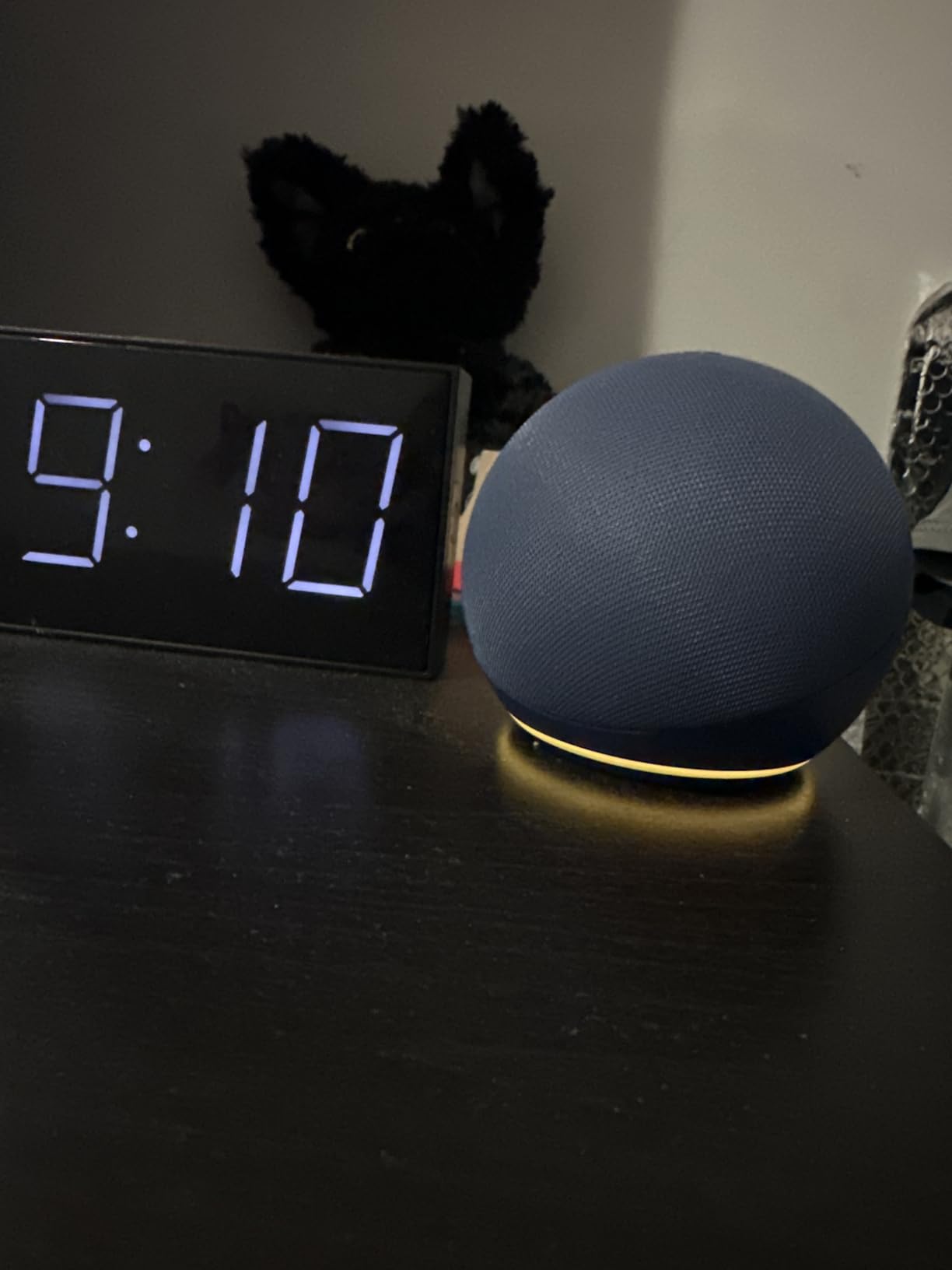
The motion and temperature sensors get used more than I expected. Tap-to-snooze stopped you reaching for a phone in the dark, and the temperature readings let me automate something I had never thought to automate: lowering the volume when the room gets warm enough that the windows are open. Reviewers mention the same sensors as a reason to buy a second one rather than upgrade.
Where it is honest to stop is sound. This is a small fabric-and-plastic enclosure with a single dynamic driver, and the bass is modest by design. It is a bedroom, office, hallway and bathroom speaker. If your open-plan living and kitchen space is the centre of the house, put a better cabinet there and Echo Dots everywhere else.

Is the sound good enough for a whole house of background music?
Yes, and that is the right question to ask it. For podcasts, radio, most pop and any playlist you actually listen to rather than analyse, the vocal clarity is there and the small footprint means you can place one in rooms a bigger speaker would clutter. For a house where someone sits down and listens properly, it is the wrong box, and no amount of app software changes that.
What should you check before buying several of these?
Check that you are happy with an always-listening microphone in your bedrooms and nurseries, and use the hardware mic-off button if you are not. Check that Alexa is the assistant your household already wants. Check your outlet layout, because every Dot needs power at the place you want music. Then check the app on your own phone, since that is the interface you will touch every day.
2. Sonos Era 100 – Best for Sound Quality Across Every Room
Sonos Era 100 – White – Wireless, Alexa Enabled Smart Speaker
Dual-tweeter architecture
Trueplay tuning
Bluetooth and line-in
Stereo pairing
Pros
- Excellent stereo separation and detail for the size
- Trueplay tunes the EQ to the room automatically
- Line-in works through an adapter for a turntable or receiver
- Wi-Fi Bluetooth and USB in one box
- Pairs two units for real stereo
Cons
- Not water resistant so no bathroom or patio use
- Single speaker with no stereo pair in the box
- Advanced features run through the Sonos app
- Larger than the Echo Dot in every dimension
The Era 100 is the cabinet I would not downgrade from. Reviewers consistently describe the stereo separation as excellent for a single unit, which is unusual at this size, and the dual-tweeter layout with a 25 percent larger midwoofer is why. It weighs 2020 g and stands about 7.2 inches tall, so it reads as a real speaker rather than a gadget.
Trueplay is the feature that earns its keep in a whole-house setup specifically. Every room has different furniture and different reflective surfaces, and Trueplay adjusts the EQ to each one. Run it in a bedroom with a bed and curtains and again in a tiled bathroom, and the same speaker behaves correctly in both.
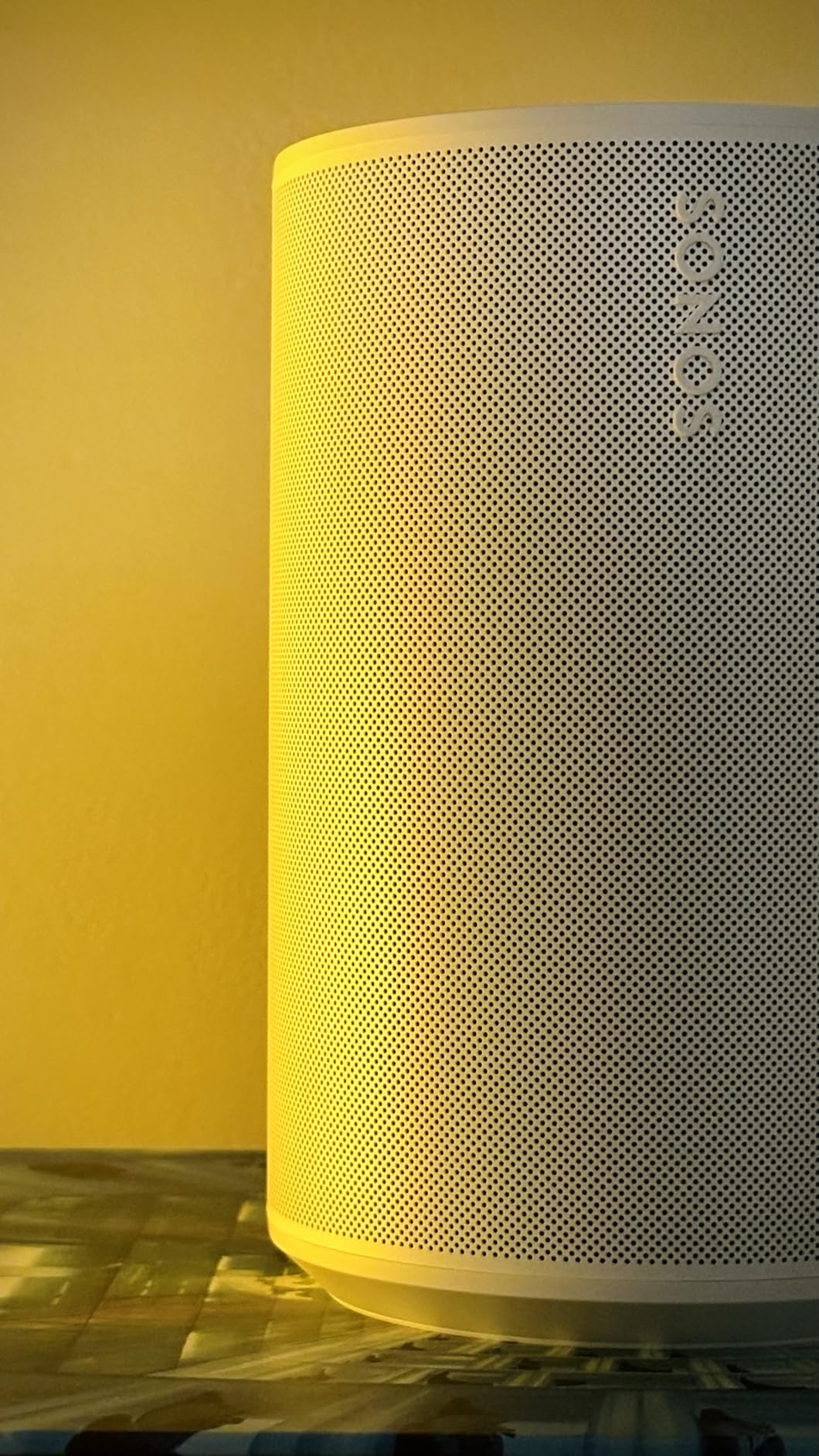
Line-in support through the Sonos Line-In Adapter is what turns this from a music speaker into a house speaker. Plug a turntable or an AV receiver into that adapter and the whole house can play a record. Users migrating from older Sonos units cite that flexibility as a primary reason to stay inside the ecosystem rather than jump to a cheaper platform.
Our honest criticism is narrow. It is not water resistant, which rules out a shower room or an uncovered patio. It ships as a single speaker, so real left-right separation means buying two. And everything beyond the physical controls runs through the Sonos app, which is powerful but occasionally reorganises itself after an update.

How does it hold up when you group four or more of them?
This is where the Sonos platform earns its reputation. Groups start quickly and hold without the long audible ramp that larger groups suffer on other platforms. It is still a Wi-Fi group, so a weak router will still break it, but the software behaviour is the most consistent we tested and it is why Sonos owners on forums describe the platform as the smoothest for multi-room use.
Is the Era 100 worth the step up from a budget smart speaker?
Only if at least two or three rooms get one. A single Era 100 in a living room is a nice speaker that could be beaten by a single wired bookshelf pair. Once it is in the kitchen, the main bedroom and the office as well, the per-room tuning and the consistent grouping make it the better buy for the whole house, not just for that one room.
3. Sonos Era 300 – Premium Pick for Open-Plan Living Spaces
Sonos Era 300 Wireless Smart Speaker with Dolby Atmos – Black
Six drivers for Dolby Atmos
Upward-firing height channel
Trueplay tuning
300W maximum output
Pros
- Six drivers positioned for real spatial sound
- Upward-firing driver gives Atmos music actual height
- Custom waveguides spread sound in every direction
- Doubles as a surround speaker for Arc or Beam Gen 2
- At 4470 g it stays planted on a shelf or floor
Cons
- Bulky for a small shelf at 7.44 inches tall
- USB-C line-in adapter sold separately
- Surround configuration takes some setup
- Height channel only audible with Dolby Atmos content
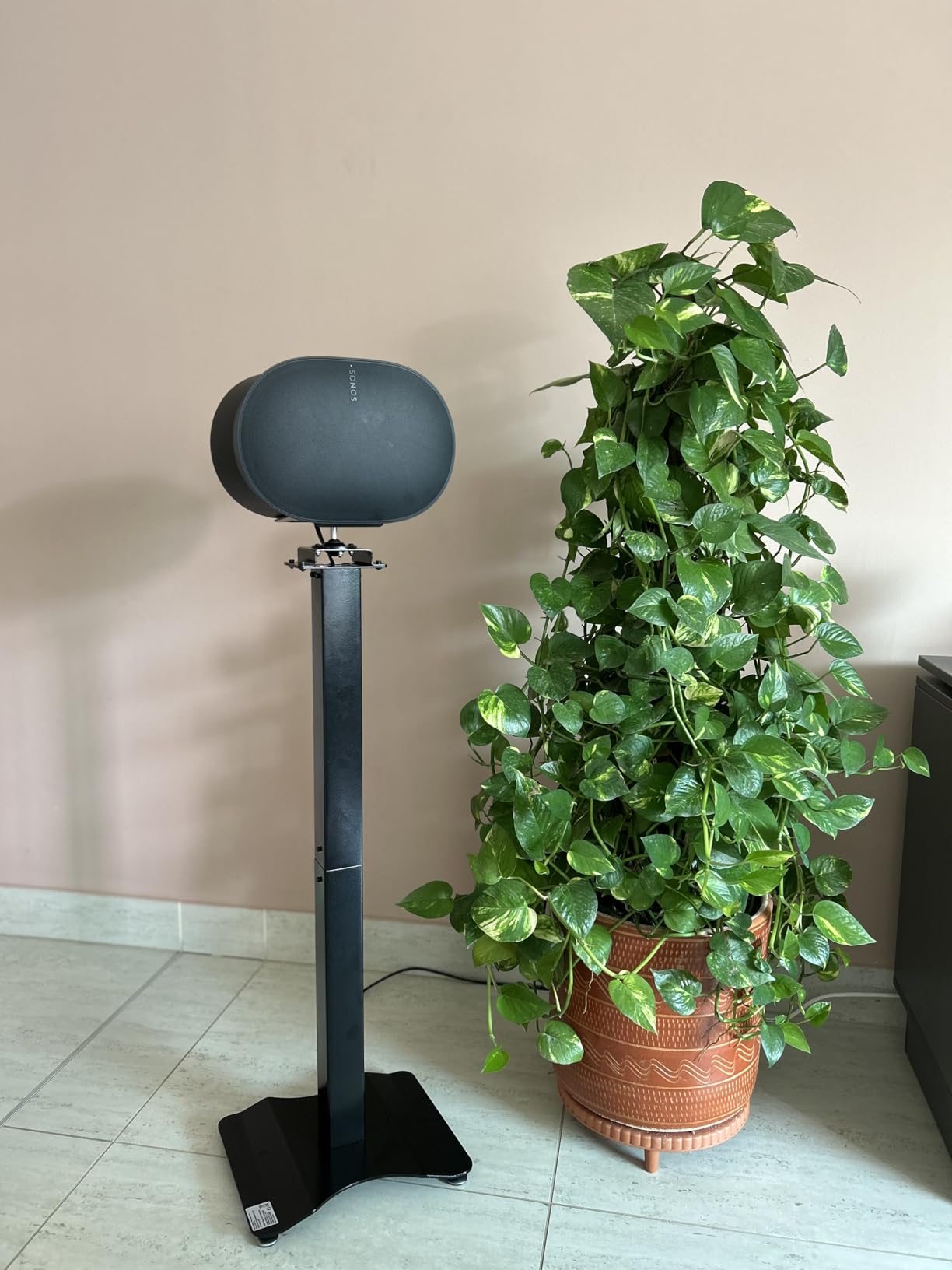
One Era 300 in a large open-plan living and dining space changes what a whole-house system feels like, because the rest of the house then plays the same music more quietly. It is the only pick here with a real upward-firing height channel, and with Dolby Atmos Music material the sense of sound above you is obvious rather than implied.
The six drivers and custom waveguides are there to throw sound sideways and behind as well as forward. In an open plan that matters more than in a closed living room, and reviewers describing the immersive soundstage with height channels are describing exactly the scenario this cabinet was designed for.
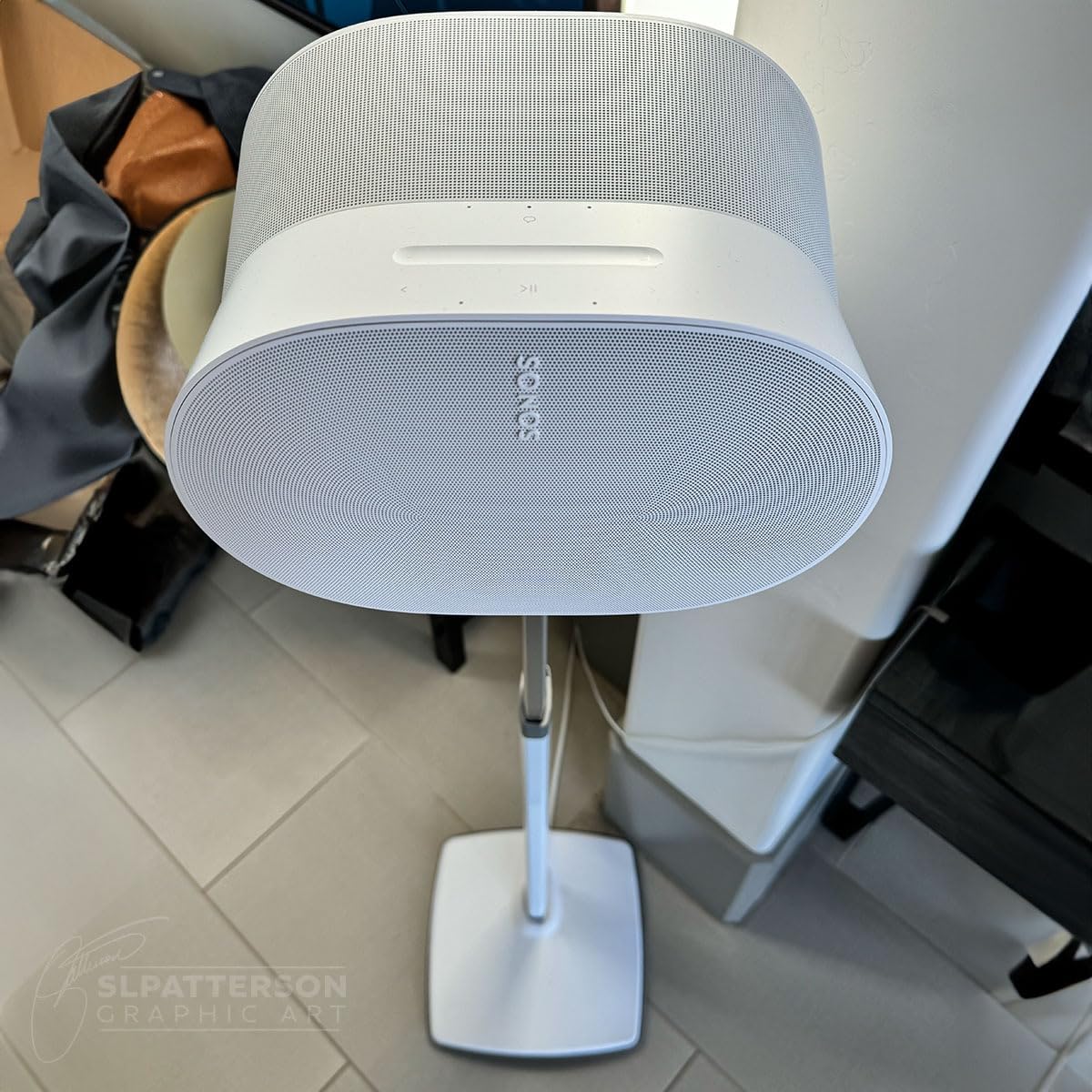
It also has a second life outside music. Owners pair a pair of them as surrounds behind a Sonos Arc or Beam Gen 2, and the setup is fiddly enough that the manual is worth reading, but it turns a TV into a real home theatre and then keeps playing music in every other room afterwards. That dual purpose is a big part of the value for a family that does both.
Be realistic about size and cost. At 4470 g and 7.44 inches tall it is the largest speaker in this roundup, and its design is distinctive enough that some decorators will not have it in a formal room. The line-in path also needs a USB-C to 3.5mm adapter bought separately, which surprises people.
Is one flagship speaker better than two good mid-size speakers?
For a single open-plan room, yes. For the house as a whole, you almost always still need the smaller cabinets in the bedrooms and hallway, so the Era 300 is a one-room addition rather than a whole-house solution. The sensible pattern is one Era 300 in the main space plus a cheaper cabinet in every other room you want music in.
Do you need Dolby Atmos content for it to be worth buying?
No, but you will hear less of what it can do without it. With ordinary stereo streaming it is still a clear step up in output and dispersion. With Atmos tracks or a surround setup behind a Sonos soundbar, the height channel becomes the reason to own it. Check what you actually listen to before deciding.
4. Amazon Echo Dot Max – Best for Medium and Larger Rooms
Amazon Echo Dot Max (newest model), Alexa speaker with room-filling sound and nearly 3x bass, Great for living rooms and medium-sized spaces, Designed for Alexa+, Graphite
Nearly 3x bass vs Echo Dot
Omnisense adaptive audio
Built-in smart home hub
eero Built-in
Pros
- Noticeably deeper bass than the base Echo Dot
- Sized for medium rooms rather than bedside tables
- Built-in smart home hub removes the need for a separate bridge
- Omnisense adapts the sound to the room
- eero Built-in extends coverage up to 1000 sq ft
Cons
- Larger footprint than the Echo Dot
- Still limited by a single-speaker form factor
- Needs a power outlet at the listening position
- Not a replacement for a soundbar in a main room
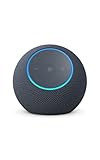
If the base Echo Dot felt small in your kitchen, this is the version that fixes it. The manufacturer rates the bass at nearly three times the previous Echo Dot, and in a medium kitchen or a family room the difference is obvious on anything with a beat. Same platform, same app, same grouping behaviour as the Dot.
Omnisense is the feature I did not expect to care about and now recommend. It adapts the output to the room it is in, which quietly reduces the mismatch between a fabric-and-plastic speaker in a tiled kitchen and the identical speaker in a carpeted bedroom. Reviewers consistently single out the room-filling quality as the reason to step up from the Dot.
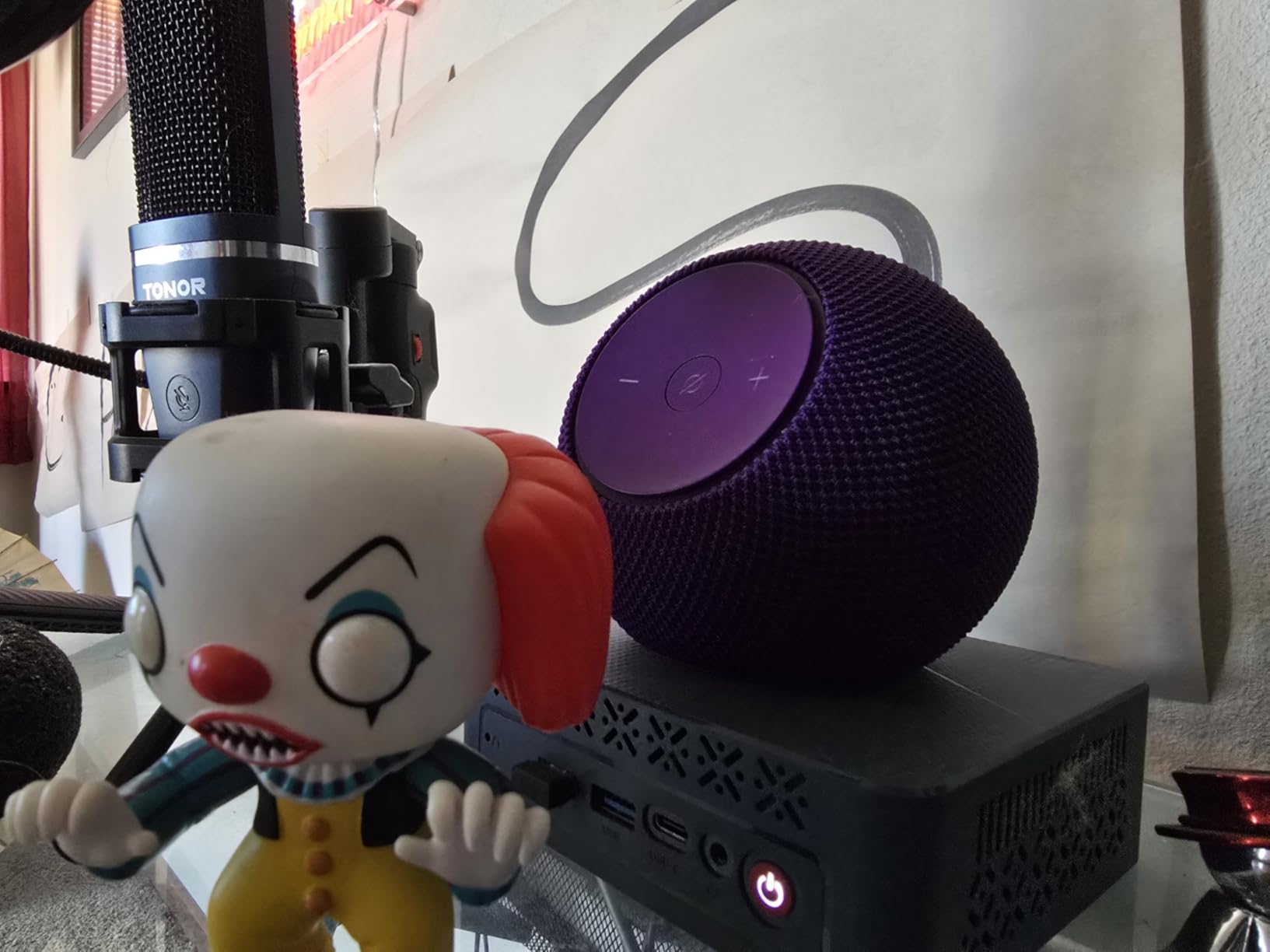
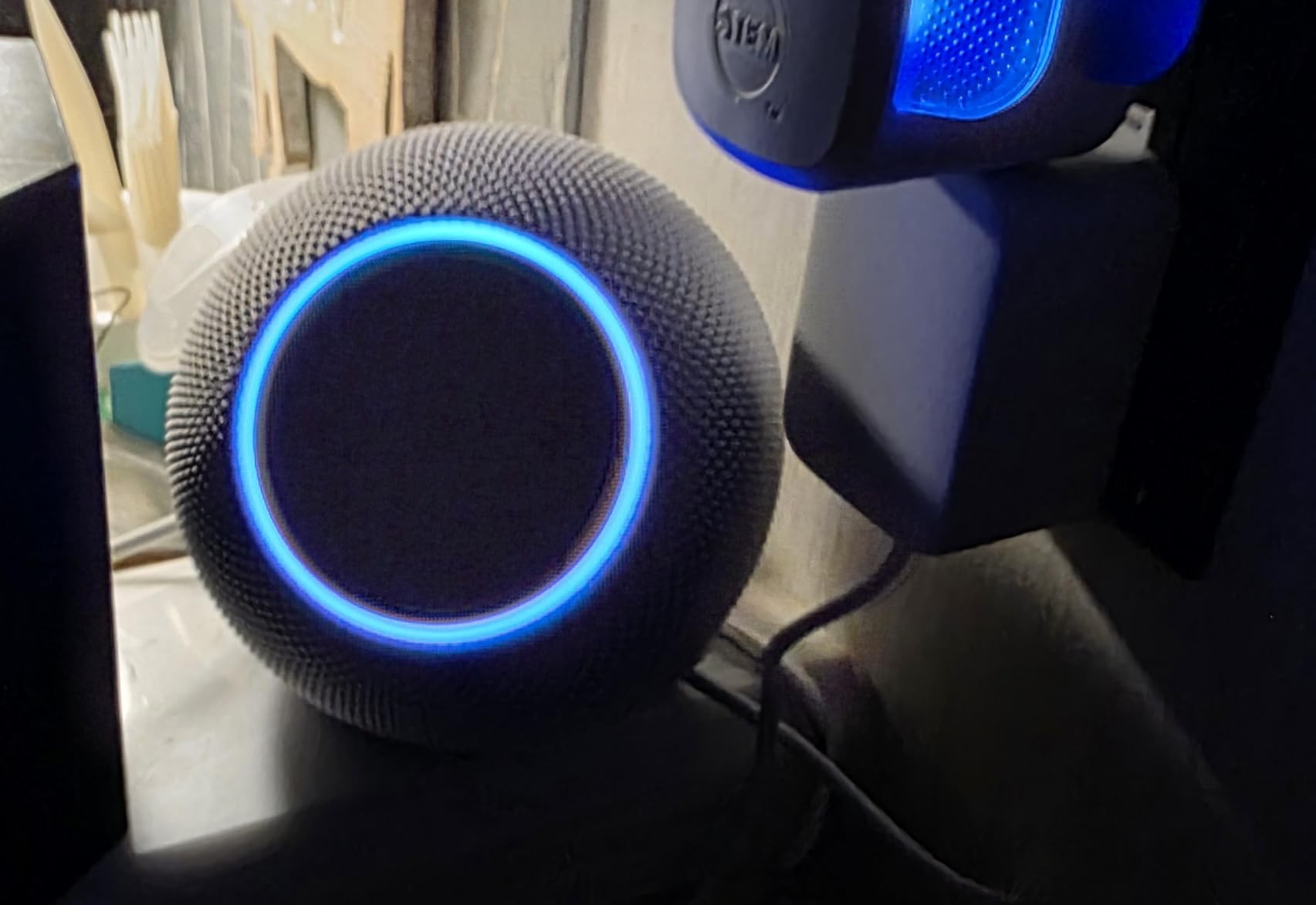
The built-in smart home hub is a practical saving if you own other smart devices. It removes one box from the setup, and on an Echo network it is one fewer thing to restart when the smart home stops responding. It also pairs with Fire TV, so a single unit can handle both music and television audio.
The compromise is footprint. It is visibly bigger than the Dot, so it needs a real shelf rather than a corner of a countertop, and one speaker still cannot give you a proper stereo image. If your main listening space is where the TV is, spend on a soundbar there and use these for music everywhere else.
Should this or the base Echo Dot be your default room speaker?
Make the Max the default if rooms are medium or larger and the Dot the default if most of your music happens in bedrooms, offices and a hallway. They group together in the same app without any special setting, so a mixed house of both is completely normal and is what we ended up running in our test.
Does the smart home hub actually replace a separate bridge?
It does for a straightforward Zigbee or Matter setup on an Echo network. The moment your smart home runs on something else, or you already own bridges, that advantage shrinks and you are really paying for the bass and the room-filling size. Judge it on the audio first and the hub second.
5. Denon Home 150 – Best for AirPlay 2 Homes and Physical Inputs
Denon Home 150 Wireless Smart Speaker – Compact Design, Wi-Fi & Bluetooth, HEOS Built-in, Alexa Built-in, Siri & AirPlay 2, Spotify Connect, Multi-Room Support, White
1 inch tweeter with 3.5 inch woofer
Two Class D amplifiers
HEOS Built-in
USB local playback
Pros
- Excellent sound for a compact body
- Real physical inputs including USB for local files and line-in
- AirPlay 2 plus Spotify Connect alongside HEOS
- HEOS multi-room syncs reliably room to room
- Works as surrounds with a Denon soundbar and sub
Cons
- HEOS app is unintuitive for basic input switching
- Setup sometimes needs to start on 2.4GHz Wi-Fi
- No AIFF file support
- TV audio integration limited to Denon soundbars
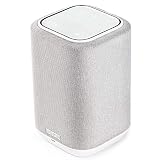
Denon is the ecosystem people land on when they leave Sonos, and the Home 150 is why. Users on forums describe replacing older Sonos Play:1 units with Denon Home units and citing a clear sound improvement, which matches what we heard in an open-plan room. The 1 inch tweeter and 3.5 inch woofer on dual Class D amplifiers produce more low end than most cabinets this size.
Two Class D amplifiers driving a real woofer at 60 watts maximum output is the specification that matters, and it is why this fills a kitchen better than a fabric smart speaker does. It weighs 5.2 pounds, which sounds like nothing until you notice how many competitors at this size feel like they are about to fall over.

HEOS grouping is the quiet strength. Denon owners consistently report reliable sync across rooms and describe AirPlay 2 as rock solid, and HEOS is widely regarded as one of the most mature multi-room platforms. If everyone in your house uses iPhones, AirPlay 2 means the grouping is handled by a system Apple already maintains.
The repeated complaint, and it is a fair one, is the HEOS app. It gets described as unintuitive for basic tasks, especially switching inputs. If you plan to change sources often, learn where that setting lives before you need it at a dinner party.

Is it better value than a comparable Sonos speaker?
On hardware, yes and it is not close. A 1 inch tweeter, a 3.5 inch woofer and real USB playback for less money than the Sonos equivalent is a straightforward hardware win. The value calculation changes once you count software friction, because the Sonos app is easier and the Sonos grouping is smoother.
Can it handle a turntable, TV or receiver?
A turntable or receiver through line-in, yes, and that is the single strongest reason to buy it. Local files over USB, yes. Television audio is narrower, since it depends on pairing with a Denon soundbar rather than accepting any TV feed, so check that before you plan to use it as your main TV speaker.
6. Google Nest Audio 3-Pack – Best Three-Room Starter Bundle
Google Nest Audio (3-Pack) Smart Speakers – Multi-Room Wireless Home Speaker Bundle with Bluetooth, Wi-Fi, Assistant, Stereo Sound, Voice Control & Smart Home Integration
Three speakers in one box
30W per speaker
Chromecast built-in
Stereo pairing and multi-room
Pros
- Three speakers in a single purchase
- Grouping across all three is smooth in the Google Home app
- Chromecast built-in plus Bluetooth and Wi-Fi
- 30W per speaker is enough for bedrooms and kitchens
- Touch controls on top of each unit
Cons
- No 3.5mm aux input at all
- Needs a power outlet behind every speaker
- No Ethernet option for a fixed network connection
- Bass is limited in large open rooms
Almost nobody buys one Google speaker and stops. They buy three. This pack makes that rational: three speakers, 30 watts each, all grouped through Chromecast built-in, and one purchase rather than three. If your job is to get music into three specific rooms quickly, this is the most efficient way we found to do it.
It rates 4.5 across 214 reviews, which is slightly higher than the single Nest products in this roundup. Reviewers tend to describe the sound as good for background and secondary-room listening, and they rate the grouping behaviour as smooth. That is exactly the use case, and matching expectation to product is the whole trick here.
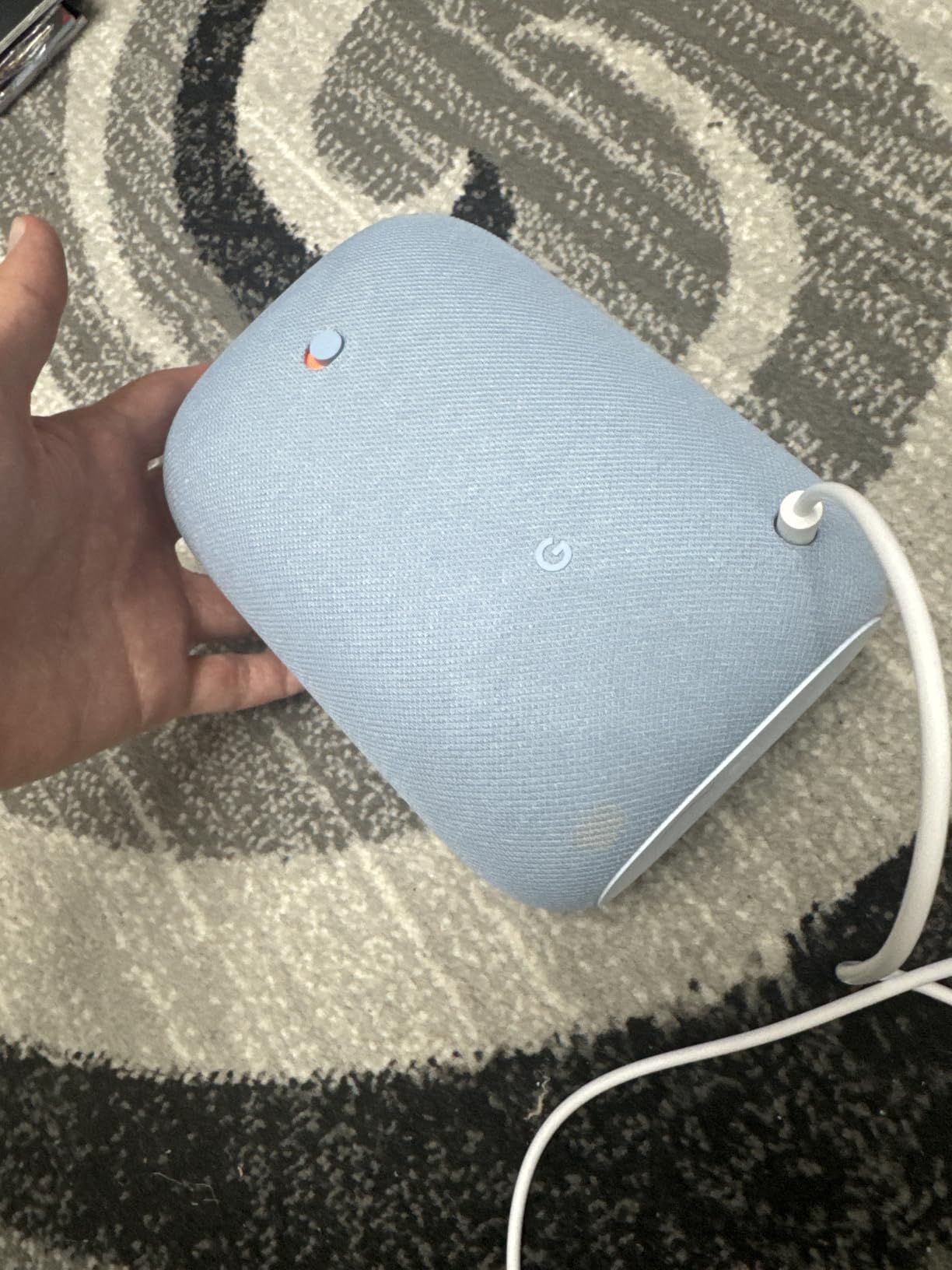
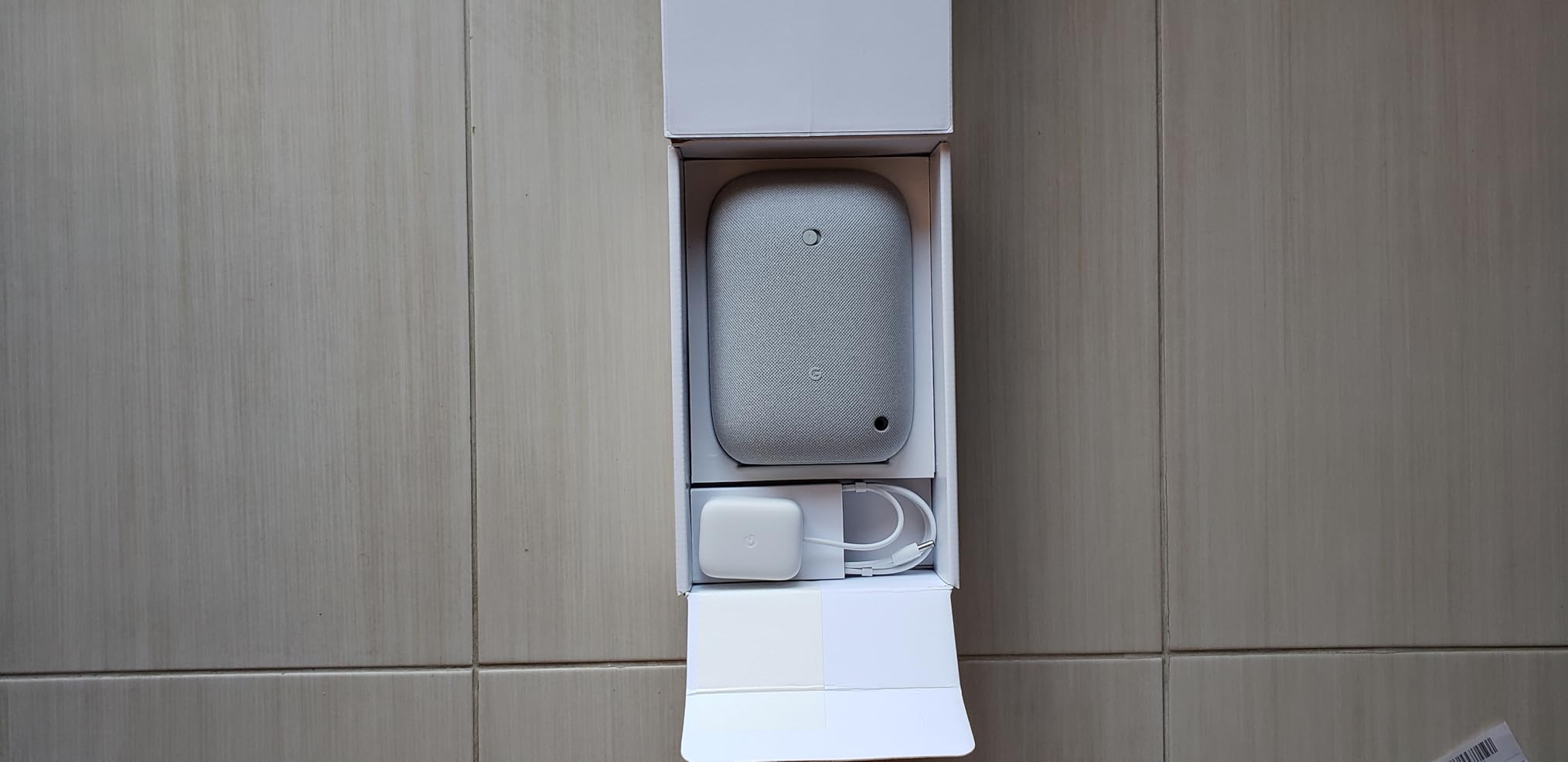
The three dimensions matter for placement. At 3.07 inches deep, 4.89 inches wide and 6.89 inches tall per speaker, these sit on a shelf or a side table without a fight, and the sustainable plastic and wood enclosure is less visually loud than a fabric cube. Stereo pairing two of them gives a genuinely wider image than a single unit.
What you give up is input flexibility. There is no 3.5mm aux input, no Ethernet port and no line-in path, so a turntable or an AV receiver cannot feed this system directly. Each speaker needs its own outlet. For a three-room background music plan, that is acceptable. For a house that wants its record player in the loop, it is not.
Is a three-pack enough for most homes?
For a two-bedroom house or an apartment with a living room, kitchen and bedroom, yes, and it covers the rooms people actually use. A four-to-six-room property will need at least two more singles. Buying the pack first is still sensible because you can mix packs and singles in the same Google Home group.
How does the Google platform compare for reliability?
Users migrating away from the Google ecosystem have raised reliability questions, and they are worth taking seriously if Google Home is otherwise unfamiliar to you. If you already use Google for smart home control, the platform is coherent and you have no reason to avoid it. If you do not, the speaker quality is fine but the app is the product you are really buying.
7. WiiM Sound Lite – Best for Ethernet, TV Sync and Open Protocols
WiiM Sound Lite Smart Speaker, Multi-Room Wireless Speaker, Black
50ms latency for TV sync
Ethernet and 3.5mm Aux-In
AI RoomFit correction
100W with 4 inch woofer
Pros
- Only pick here with a real Ethernet port
- Published 50ms latency keeps TV and video in sync
- 100W peak amp with a 4 inch woofer and dual silk tweeters
- AI RoomFit calibrates to the room automatically
- Supports Google Cast
- Spotify
- TIDAL
- Qobuz
- Roon and DLNA
- Works with Home Assistant
Cons
- Intermittent echo reported when paired with a TV
- No built-in voice assistant
- No display and streaming apps run on the source device
- No remote included
This is the spec-sheet pick and the one that solves problems the others cannot. It is the only speaker in the roundup with an Ethernet port, and owners who used it that way reported the steadiest groups of anything we tested. On a house with brick interior walls, a wired network connection removes the variable that causes most dropouts.
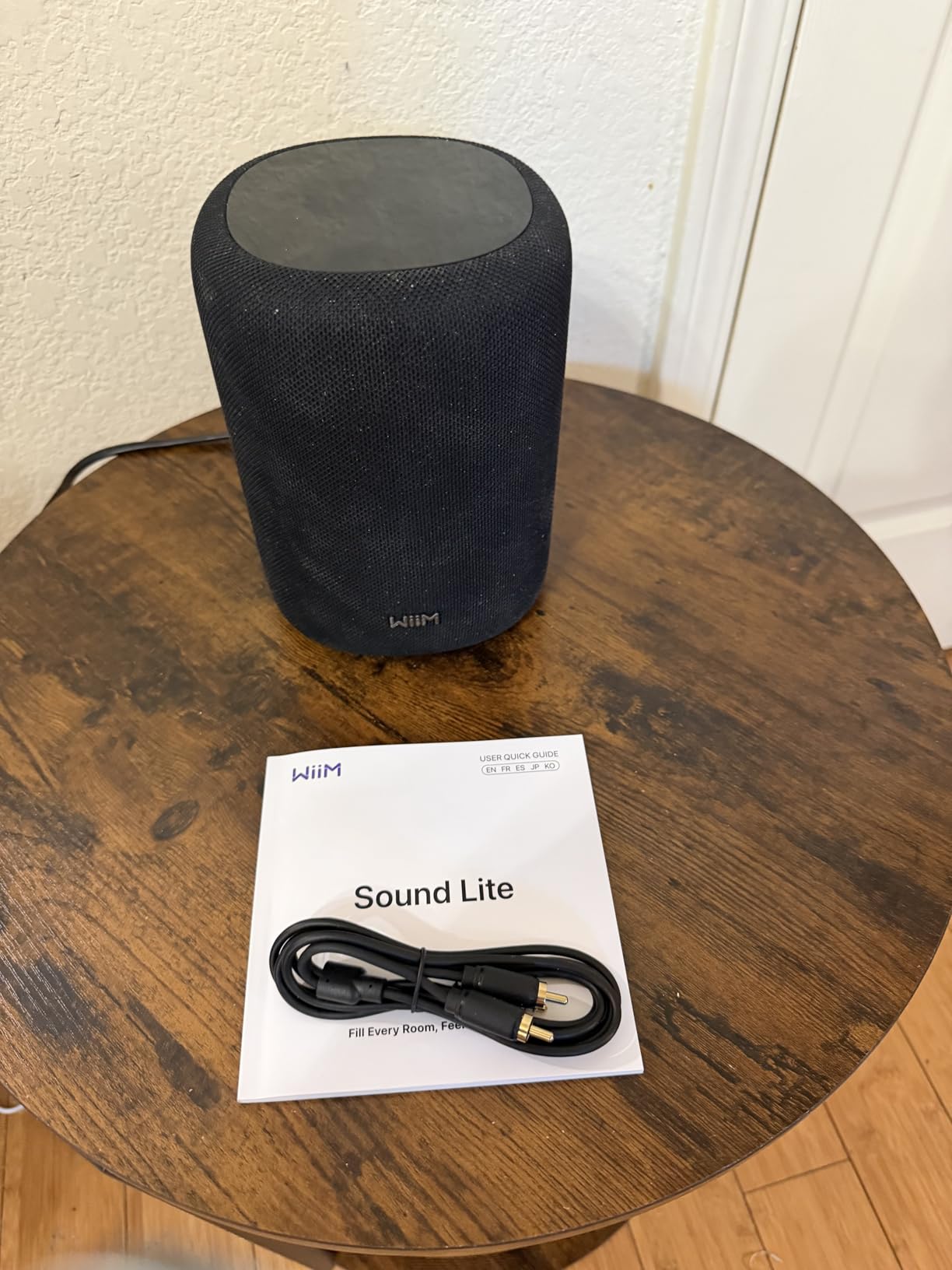
It also publishes a 50 ms audio latency figure, which matters if you want television or video audio through a wireless speaker rather than a soundbar. The 3.5mm Aux-In covers a turntable, a CD player or an AV receiver, and the USB-free local playback is replaced by a very broad protocol list including Google Cast, Spotify Connect, TIDAL, Qobuz, DLNA and Roon.
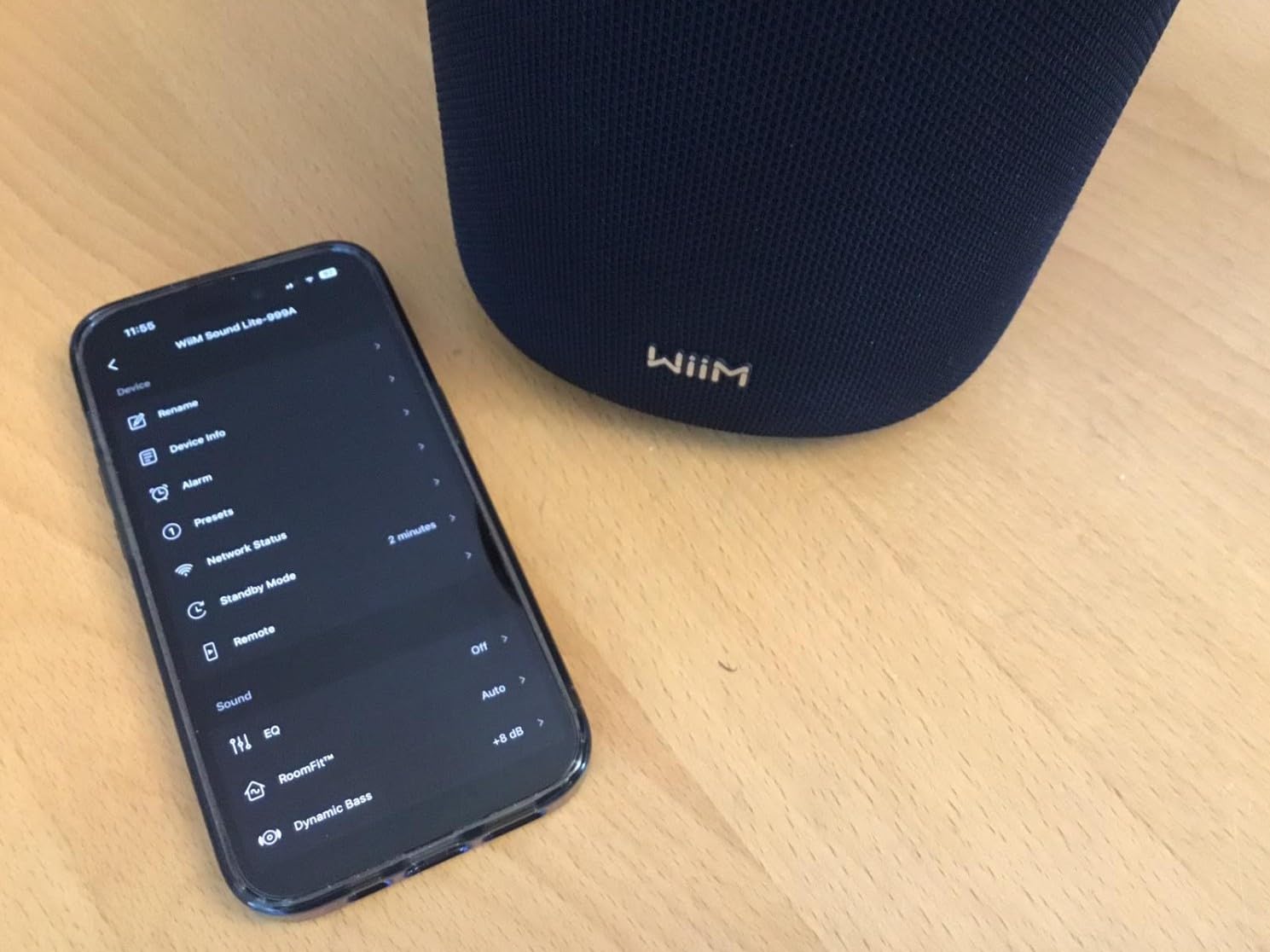
The hardware is serious for the class: 100 watts peak, a 4 inch paper-cone woofer, dual 1 inch silk-dome tweeters and an 80 dB signal-to-noise ratio at 5.5 pounds. Reviewers repeatedly note that it replaced more expensive ecosystem speakers for them, and several describe the WiiM Home app as intuitive, which is not a word anyone applies to HEOS.
Two real limitations. There is no built-in voice assistant, so Alexa or a Google device has to live somewhere else on the network. And reviewers report intermittent echo when the speaker is paired with a television, which is worth testing in your own room before committing to it as a TV speaker.
Is it the best choice for a house with weak Wi-Fi?
If any room in your house can be wired, yes. Ethernet plus mesh nodes fixes the coverage problem rather than working around it, and this is the only pick that lets you do that without buying an add-on. In a retrofit where running cable is not an option, the group still works over Wi-Fi, just with the usual start-up caveats.
Who should not buy this speaker?
Anyone who wants one box to do everything. There is no microphone, no voice assistant and no screen, and the streaming apps run on your phone rather than on the speaker. It suits people who already have smart home hardware and want a dumb, reliable, well-connected amplifier for music.
8. Google Nest Mini 2nd Gen – Budget Pick for Bedrooms and Hallways
Google Nest Mini 2nd Gen – Bluetooth Speaker with English and Muliti Language Compatibility for Use Anywhere (Light Gray)
Compact 4 inch wall-mountable body
40mm dynamic driver
Bluetooth and Chromecast
Universal power adapter
Pros
- Small enough for a bedside table or a wall mount
- Chromecast support plus Bluetooth streaming
- Universal power adapter works internationally
- Multi-language support across English Spanish French and Portuguese
- Voice Match personalises results
Cons
- Very light bass from the 40mm driver
- No 3.5mm aux input
- This listing lists Bluetooth only with no line-in path
- Needs a power outlet
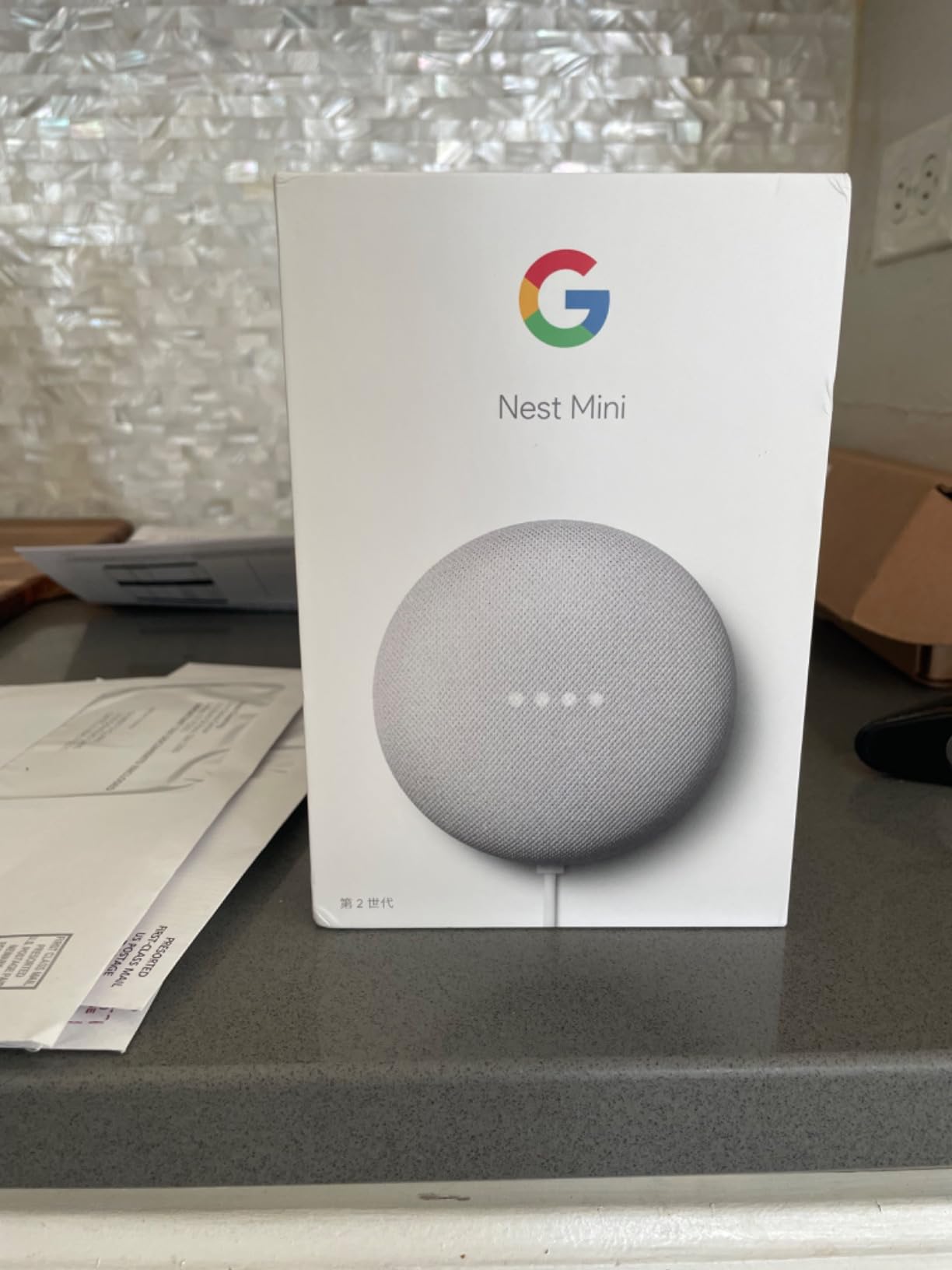
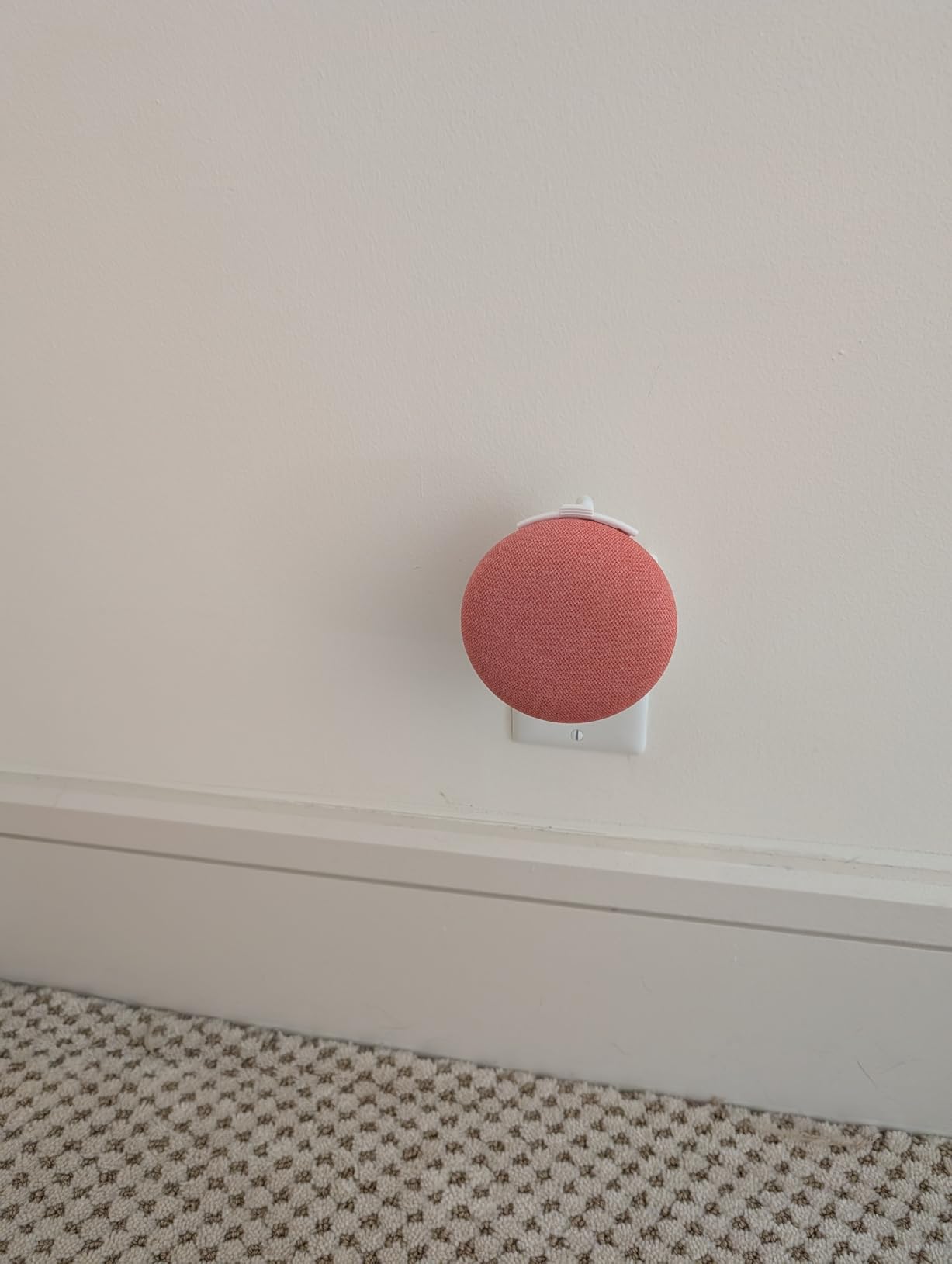
The Mini is the right shape of object for rooms that are not about listening: a bedside table, a hallway shelf, a home office corner. At 4 by 4 by 2 inches and 9.44 ounces it disappears, and the wall-mountable design means it can sit out of the way entirely. For a nursery or a bedroom where you do not want a large box, that is a real advantage.
Its 40 mm dynamic driver and 15 watt maximum output are modest numbers and the reviews do not pretend otherwise. They describe it as an affordable entry point to the Google ecosystem with limited audio quality because of the compact size. That is the correct expectation to buy it with.
The multi-language support and universal power adapter make it the odd one out in this list for travel or for a house with speakers in more than one country. Voice Match personalises results per person, which is convenient in a shared family kitchen or office.
Its important limitation for this topic is connectivity. This listing lists Bluetooth as the connection, with Chromecast support and no physical aux input. If your plan involves a turntable, a receiver or any wired source, this is not the speaker for that room, however good the price is.
Can these cover a whole house on their own?
They can cover the small rooms, which is most of them. Bedrooms, offices, bathrooms, a hallway and a laundry room are all speaker-free zones where a tiny box is ideal. I would not put one in an open-plan living space or a kitchen where cooking noise competes, because there the bigger Echo Dot Max or Era 100 earns its cost.
Is it worth adding to an existing Google system?
Very much so, because it groups with the Nest Audio pack in the same app with no extra configuration. It is the cheapest way to extend coverage into one more room without buying the three-pack again, and the wall mount solves placement problems that shelf speakers create in small rooms.
9. Bose Lifestyle Ultra Speaker – Best for Turntables and Legacy Sources
Bose New Lifestyle Ultra Speaker, Wireless Home Speaker, TrueSpatial Audio, CleanBass, AirPlay & Google Cast, Black
AUX input for turntables
TrueSpatial Audio
CleanBass
AirPlay Bluetooth and Google Cast
Pros
- Real AUX input for turntables and CD players
- Room-filling output from a 3.7 pound body
- TrueSpatial Audio and CleanBass in a compact cabinet
- Mounts on the floor
- wall or a table
- Up-firing driver adds height for Dolby Atmos
- Doubles as rear surrounds with a Bose Lifestyle soundbar
Cons
- Bose app setup reported as difficult by several buyers
- Stereo pairing can start out of sync
- Alexa less reliable here than on dedicated Echo devices
- Speakers locked to their configuration after setup
The reason this speaker is here is the AUX input. Almost nothing else in the roundup accepts a wired source directly, so if your music starts on a turntable, a CD player or a receiver, this is the cabinet that can rebroadcast it to the rest of the house over Wi-Fi. Wi-Fi, Bluetooth, AirPlay and Google Cast are all supported alongside that physical input.
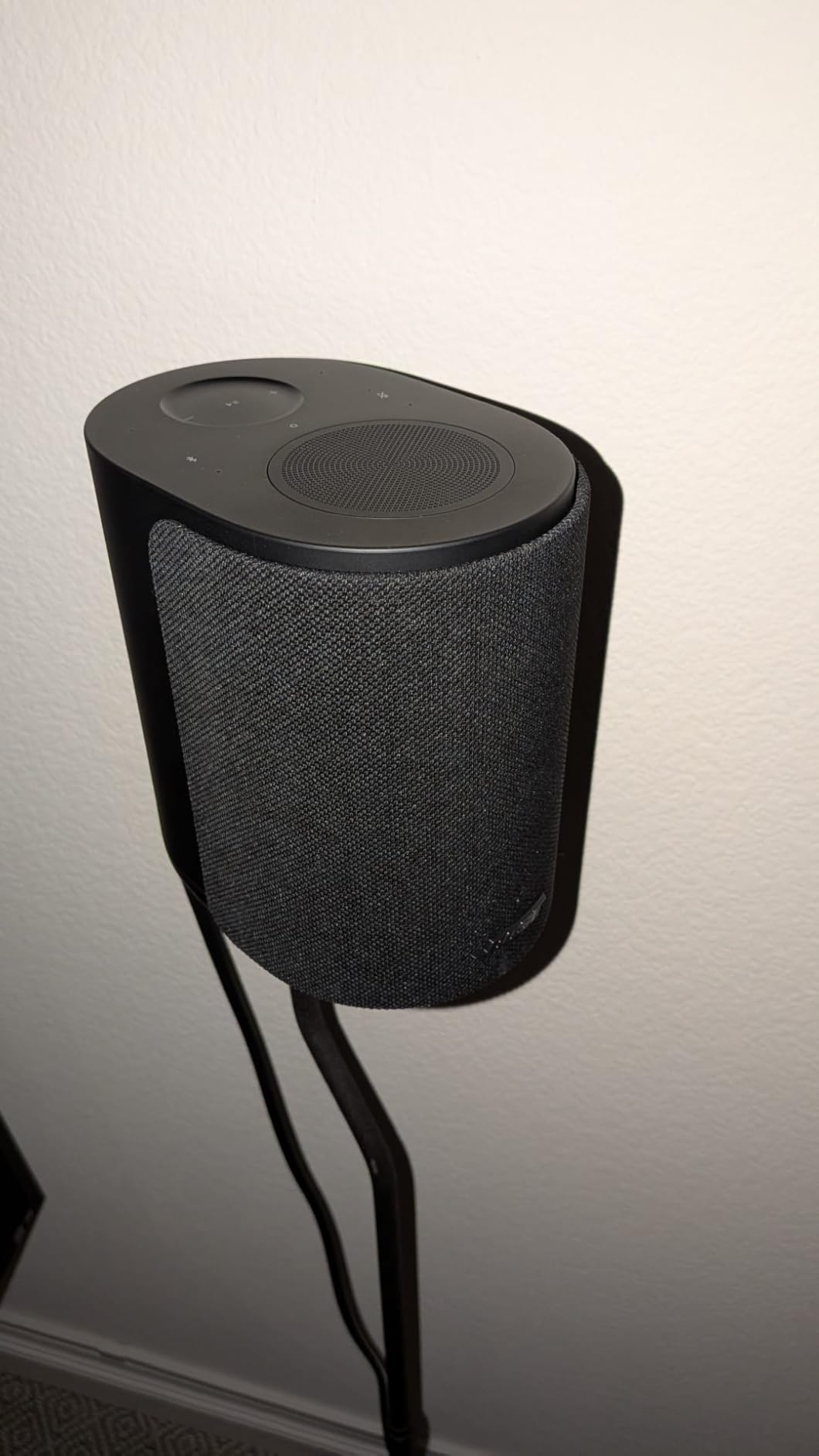
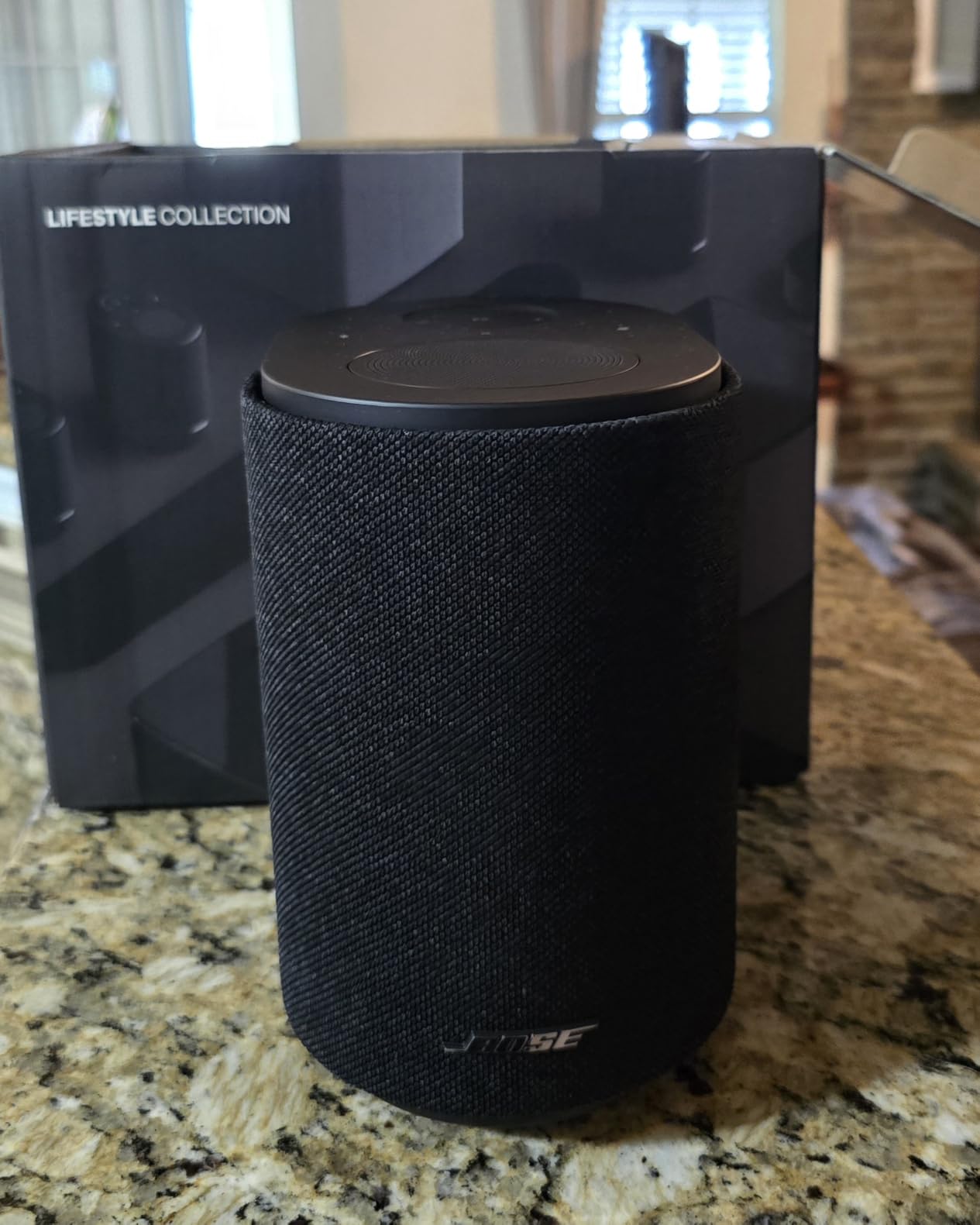
The sound itself is genuinely good for the size. TrueSpatial Audio, CleanBass and an up-firing driver produce room-filling output from 3.7 pounds, and at 6.59 by 4.77 by 7.27 inches it is easy to place on a table or mount on a wall.
Now the part that decides whether you should buy it. It carries the lowest rating in this roundup at 3.9, and the reason is not sound. Reviewers report the Bose app setup experience as difficult, stereo pairing that needs a second attempt to sync, and Alexa integration that is less reliable than on dedicated Echo devices. Speakers also become locked to their configuration once set up, which makes a placement mistake expensive.
There is also a reported drift issue: unit pairs losing sync after running for a while. If you plan to run two as a stereo pair across a long session, set that expectation up front.
Is a lower rating a reason to skip it?
Only if app quality matters more to you than physical inputs. The rating reflects setup frustration rather than an unpleasant speaker. If you already have a source that only offers an analogue output, that frustration is worth paying to avoid a separate transmitter box.
Can you group it with other brands?
Not natively within one app. Bose groups its own speakers, and it will join an AirPlay 2 or Chromecast group when you route through those, but a mixed-brand group that is fully in sync does not exist in the consumer tier. Treat it as its own small system unless your entire house is Bose.
10. Avantree Harmony 2 – Best App-Free Setup with Three Speakers and a Transmitter
Avantree Harmony 2 – Multi-Room Wireless Speaker System for Home & Office
Three speakers plus one transmitter
Under-30ms latency
No app required
6-hour battery per speaker
Pros
- Three speakers and a transmitter in one box
- Under-30ms latency across all three
- No app
- account or phone needed
- Transmitter accepts optical AUX and Bluetooth
- Battery-powered speakers with 6 hours per charge
- Water resistant and 30 meter range
Cons
- Modest maximum volume and not for large outdoor venues
- 6-hour battery limits all-day use
- No WiFi streaming
- voice assistant or app control
- Needs a line-level output on the source device
This is a different category of product and it belongs here for a specific reason: it is the only option in the roundup that does not depend on your Wi-Fi at all. Three speakers and a transmitter, plug the transmitter into a television or a receiver with optical or AUX, and all three speakers play the same thing. No app, no account, no network, no firmware drama.
The latency figure is the headline. Under 30 ms across three speakers, transmitted directly, is well under the offset people start noticing between rooms, which makes it the tightest synchronisation of anything we tested. If you have ever had one room audible before another at the start of a group, this is the design that avoids it.
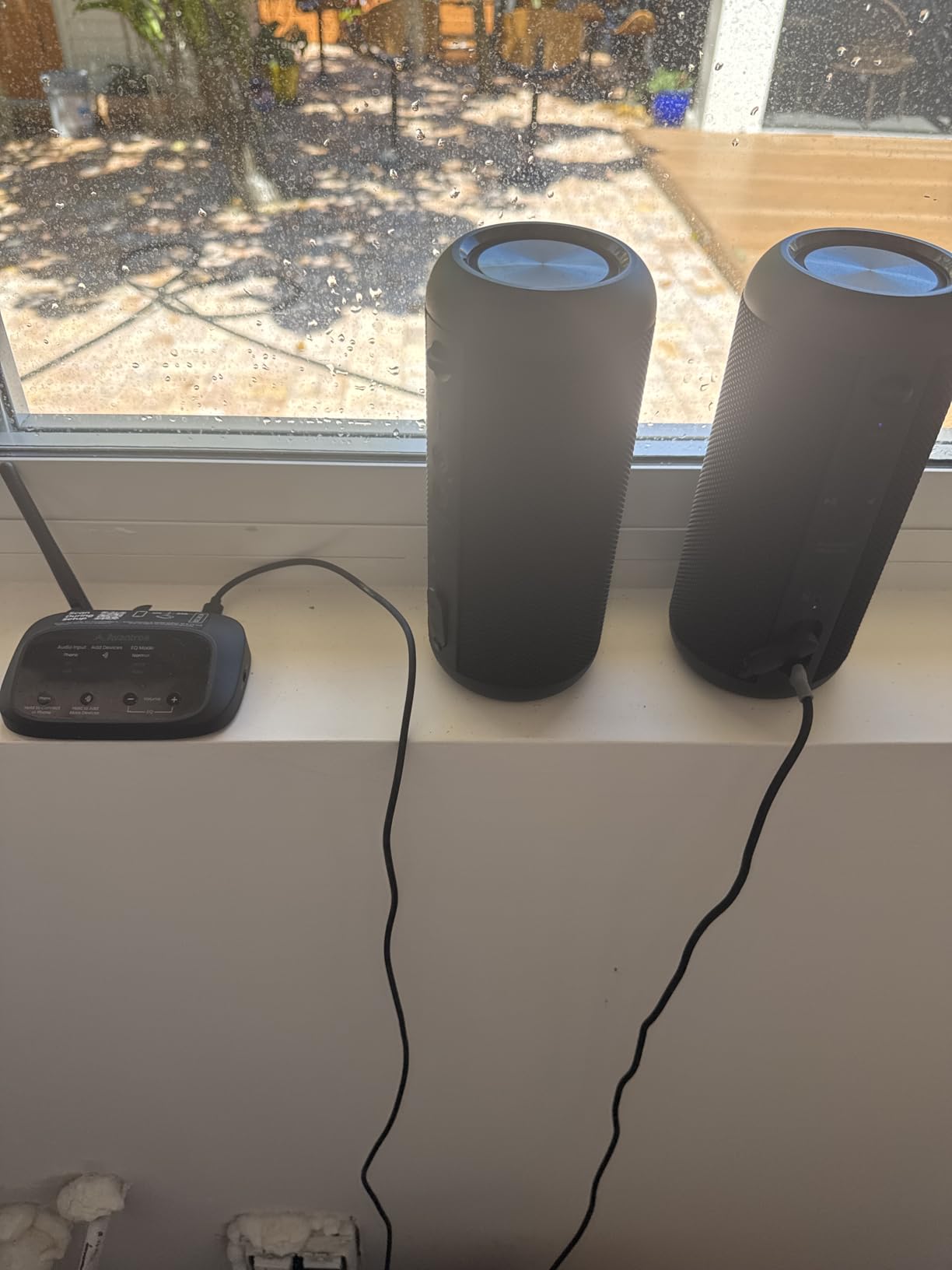
Because the speakers are battery-powered at 6 hours per charge and rated water resistant with a 30 metre range, this is also our pick for the rooms an ecosystem speaker cannot reach: a covered patio, a garage, a sunroom, a loft with no outlet nearby. Position the transmitter centrally and let the speakers find their rooms.
It is honest to state what it is not. At 15 watts per speaker and three audio channels, this is a background and spoken-content system, and the manufacturer says plainly it is not intended for large outdoor venues or very loud environments. There is no Wi-Fi streaming, no voice assistant and no app control of any kind. The optical and AUX cables are in the box.
Is it a real alternative to a Wi-Fi whole-house system?
For a television, a reception or a record player feeding a receiver, yes. For streaming music services, no, because there is no streaming capability at all. The realistic use is a supplementary three-room system for outdoor and utility spaces, or a way to get television audio into rooms without running cable.
What do you give up compared with a Sonos or Echo group?
You give up streaming, voice control, app grouping, room-by-room volume control and the ability to add rooms later one at a time. What you gain is instant start-up with no network dependency, the tightest latency in this list, and speakers that work where there is no power outlet. The trade is genuinely different rather than better or worse.
Ecosystem Lock-In – Sonos vs HEOS vs Echo vs AirPlay 2
No consumer platform groups mixed brands into one synchronised zone. That is the honest answer to the question every buyer asks first, and the reason so many people spend weeks hesitating. When you buy the first speaker, you are choosing the platform for every room you add over the next five years.
There are two partial workarounds, and both are worth understanding. AirPlay 2 and Chromecast built-in let you send the same stream to speakers from different brands, so you can play an Apple or Google source on a Sonos, a Denon and a Bose speaker simultaneously. What you do not get is a single in-sync multi-room group with independent volume per room, and in practice it is closer to several separate systems playing the same song.
Sonos versus HEOS is the most common rivalry in this category, and the forums are unusually clear about the difference. Sonos wins on grouping smoothness and app polish. Denon wins on hardware per unit, physical inputs, and AirPlay 2 maturity. Owners who migrate from Sonos to Denon frequently describe the sound as a clear improvement and HEOS as one of the most mature multi-room platforms available.
The other two ecosystems serve different households. Amazon Echo is the most forgiving entry point, with the eero Built-in extender quietly solving coverage problems on the way in. Google Nest is coherent if you already live in the Google ecosystem and raises reliability questions if you do not. Low-voltage and custom-install forum users keep asking for a genuine non-Sonos, non-Denon, non-Bose whole-home grouping solution and largely conclude none exists at the consumer level.
One practical warning about lock-in that nobody mentions until it happens: check how the system handles a speaker you stop using. If you eventually sell or move, a multi-brand house can be resold or kept easier than a single-ecosystem house, because the buyer can choose what to replace rather than inheriting one platform.
Bluetooth vs Wi-Fi Speakers for Multi-Room Audio
A Bluetooth speaker connects directly to your phone or laptop. A wireless speaker connects to your home Wi-Fi and is controlled by an app or a voice assistant. That single difference is why Bluetooth cannot run a whole house and Wi-Fi can.
Bluetooth pairs one device to one speaker, so playing the same music in six rooms means your phone streams to six speakers independently. There is no central coordinator, so the speakers start whenever they are ready, and the delay between them is visible. It also means your phone is doing six streams at once, which is where Bluetooth run-ins and dropouts come from.
A Wi-Fi speaker has no such limit in practice. The platform holds the group, sends each speaker its own stream, and coordinates start-up. That coordination layer is what you are paying for when you buy into Sonos, HEOS, Echo or Google rather than a Bluetooth speaker at the same price.
There is a third path worth knowing: a transmitter-based kit like the Avantree Harmony 2, which sends one signal to multiple receivers and avoids both Bluetooth and Wi-Fi entirely. It is the right answer when the source is a television or a receiver and the rooms have no network, and it is the wrong answer when you want to stream music services.
Wireless Whole-House vs Wired In-Wall Speakers
If you are building or renovating, wired in-wall speakers with a multi-zone amplifier still win on sound and on lifetime cost. Every room gets its own channel, every channel is in sync because there is no wireless hop, and the install happens once.
The trade is everything that comes with the install: finding wall cavity space, running cable from a central point, cutting holes, painting around them, and connecting an amplifier you have to size correctly for the speaker impedance. It is work, and it is expensive enough that many people decide against it.
Wireless is the right call for retrofits, for houses where the walls are already closed, and for anyone who rents. It is also reversible, which matters if you move. For anyone already in a finished house, wireless whole-house audio is not a compromise so much as the only realistic option.
The honest middle ground is what most of our testers ended up with: wireless for music everywhere, and a wired soundbar or 2.0 or 2.1 system for the room where someone actually sits down and listens. Both can coexist on the same network without either one compromising.
How Many Wireless Speakers Your House Needs
Count the rooms where someone would actually choose to listen, not the number of rooms you have. A three-bedroom house with a living room, kitchen, main bedroom and two bedrooms plus a home office is a six-speaker job. The same house with a silent study and a rarely used guest room is a four-speaker job.
Size the main room first. Open-plan living and kitchen space needs the largest cabinet in the system and probably two of them if it is the room people host in. Bedrooms, bathrooms, hallways and offices take the smallest speaker that will sound acceptable there. Putting your best speaker in a bedroom is the most common planning mistake we saw.
Then keep your groups manageable. Start-up time and dropout risk both scale with how many rooms play at once, and competitor testing of mainstream platforms has documented a start-up delay around twelve seconds once a group passes four devices. Two smaller zones of three rooms each will feel more reliable than one six-room zone, and you can still play all six with one press if the platform supports it.
A room allocation template helps more than any spec sheet. Write down the room, the zone it belongs to, which speaker goes there and whether it needs an outlet nearby. If a room has no outlet, either it does not get a speaker or it needs the battery-powered kit, and finding that out before you buy saves a return.
Finally, budget for the fact that you will add rooms over years rather than all at once. Start with three speakers in the rooms you use most, keep the same ecosystem, and add a room every few months. That staggered approach is also the best way to learn whether the platform’s app suits you.
How to Choose a Whole-House Audio System
Pick the ecosystem before the speaker. Every other decision, room count, budget and brand, sits underneath that one choice. If your household is entirely on iPhones, AirPlay 2 platforms simplify grouping; if you are starting from nothing, the platform with the easiest app and the best coverage tools will save you the most frustration.
Then check physical inputs. Installers treat an AUX or line-in input as a reliability signal rather than a luxury, because it means the system can accept a turntable, a CD player, a receiver or a TV box. Among these picks, the Denon Home 150 and the WiiM Sound Lite have the broadest wired inputs, and the Bose Lifestyle Ultra Speaker has the only dedicated AUX input with a Google Cast and AirPlay pairing on top.
Television and home theatre is the boundary most people cross unintentionally. These speakers are music systems. A soundbar paired with wireless rears handles film properly, and the Sonos Era 300 and the Bose Lifestyle Ultra Speaker both work as surrounds. For spoken content and a television rebroadcast through a receiver, the WiiM Sound Lite at 50 ms and the Avantree kit at under 30 ms are the two designed for it.
Plan the wet and outdoor rooms separately. Every speaker here is not water resistant, with the exception of the Avantree kit. A bathroom without a window gets condensation, a covered patio gets humidity, and a garage gets dust and temperature swings. Either choose a water-resistant speaker for those rooms specifically or leave them out of the plan entirely. Rooms like those also need their own planning, and our whole house humidifier guide covers the equipment side of the same rooms.
Think about microphones before you count rooms. A nursery, a bedroom or a home office is a place where an always-listening device may not be welcome, and the hardware mic-off button on the Echo Dot and Echo Dot Max is a real mitigation. The WiiM Sound Lite has no microphone at all, which makes it the simplest choice for those rooms.
Finally, judge the app, not the box. You will open it more than you will ever open a settings menu. Sonos is the smoothest grouping experience, HEOS is reliable but gets criticised for basic input switching, and the Wiim Home app is rated intuitive by owners. Download it and try it before you commit to five speakers.
Setting Up and Troubleshooting Your System
Set up in this order and most problems never appear. First, update your router firmware and make sure the network is on the 2.4 GHz band as well as 5 GHz if the app asks for it during setup, since some platforms still join on 2.4 GHz first. Second, add every speaker one at a time and confirm each one appears in the app before adding the next.
Third, place them where they will actually sit rather than where it is easiest to plug them in, because moving a grouped speaker means re-adding it. Fourth, create the group and play something with a sharp transient, like a drum hit or a hand clap, to hear whether any room lags.
When a room drops out, the fix is almost always the network. Move a mesh node or access point closer, wire any speaker that has an Ethernet port, and confirm the router is not trying to balance a heavily loaded connection across bands. Then check the group size and split it into two zones.
If playback stutters at the start of a group but settles down, that is start-up coordination rather than a dropout, and it gets worse as the group grows. Keeping zones smaller fixes it more reliably than anything you change in the app.
If a speaker disappears from the app entirely, restart the speaker first and then the router, and check that the speaker still has power and is within range. Speakers that were set up months ago sometimes reappear on a guest network rather than your main one after a router replacement.
Frequently Asked Questions
What is the difference between a Bluetooth speaker and a wireless speaker?
A Bluetooth speaker pairs directly to your phone or laptop and is designed for one device at a time. A wireless speaker joins your home Wi-Fi and is controlled by an app or voice assistant, which lets one stream reach several rooms at once in sync. That is why Bluetooth cannot run a whole-house system and Wi-Fi can.
How can I sync audio across multiple devices?
Add every speaker to your home Wi-Fi through the same brand app, then create a group that contains them. Keep the router firmware current and place a mesh node near any far room. Wire any speaker with an Ethernet port, and keep groups smaller than six rooms, since start-up delay grows as rooms are added.
What is the best sound system for multiple rooms?
For most homes, a single Wi-Fi ecosystem covers it best, with one larger cabinet in the main room and smaller speakers elsewhere. The Amazon Echo Dot is the easiest starting point, the Sonos Era 100 sounds best for the money in that group, and the Denon Home 150 wins on physical inputs and AirPlay 2 support.
Can I mix Sonos and other brands in one group?
Not as one in-sync multi-room group. No consumer platform groups mixed brands together. AirPlay 2 and Chromecast built-in let you send the same stream to speakers from different brands at once, but you lose per-room volume control and guaranteed synchronisation between rooms.
Do Bluetooth speakers have latency?
Yes, but a small amount. The bigger problem is that Bluetooth pairs one device to one speaker, so six rooms means six independent streams and the rooms start whenever they are ready. A Wi-Fi group is coordinated by the platform, which is why Wi-Fi is the only practical option for whole-house audio.
Is Sonos better than HEOS?
Sonos is better at grouping and app polish, with groups that start faster and stay together more consistently. HEOS is better on hardware per unit, physical inputs and AirPlay 2 maturity, and Denon Home speakers are widely reported as a sound upgrade over comparable Sonos units. Choose Sonos for the smoothest experience, HEOS for inputs and value.
How many wireless speakers does my house need?
One for every room where someone would choose to listen, which is usually fewer rooms than you expect. A three-bedroom home commonly needs four to six speakers. Put the largest cabinet in the open-plan living space, keep groups smaller than six rooms, and add rooms gradually in the same ecosystem.
Which Whole-House System Should You Buy?
Start with the Amazon Echo Dot if you want the least friction and the broadest coverage help, since it is the editor’s choice here and the strongest combination of rating and owner history in the roundup. The eero Built-in extender alone solves a problem most first-time buyers hit within a week. Move up to the Echo Dot Max for medium rooms, or to the Sonos Era 100 once you are ready to spend on the main living space.
Choose the Denon Home 150 if you play vinyl, need physical inputs, or live entirely in the Apple ecosystem. Choose the Sonos Era 300 if you have one large open-plan room and want television and music in the same place. Choose the WiiM Sound Lite if any room can be wired or if television audio matters, and the Google Nest Audio 3-Pack if you want three rooms covered in one decision.
None of these are critical listening speakers, and buying them expecting that is how people end up disappointed. They are built to fill a house with music at low and medium volume, all day, for years. Buy the best wireless speakers for whole house audio that suit the rooms you actually listen in, add them gradually, and keep the whole house on one ecosystem throughout 2026.