
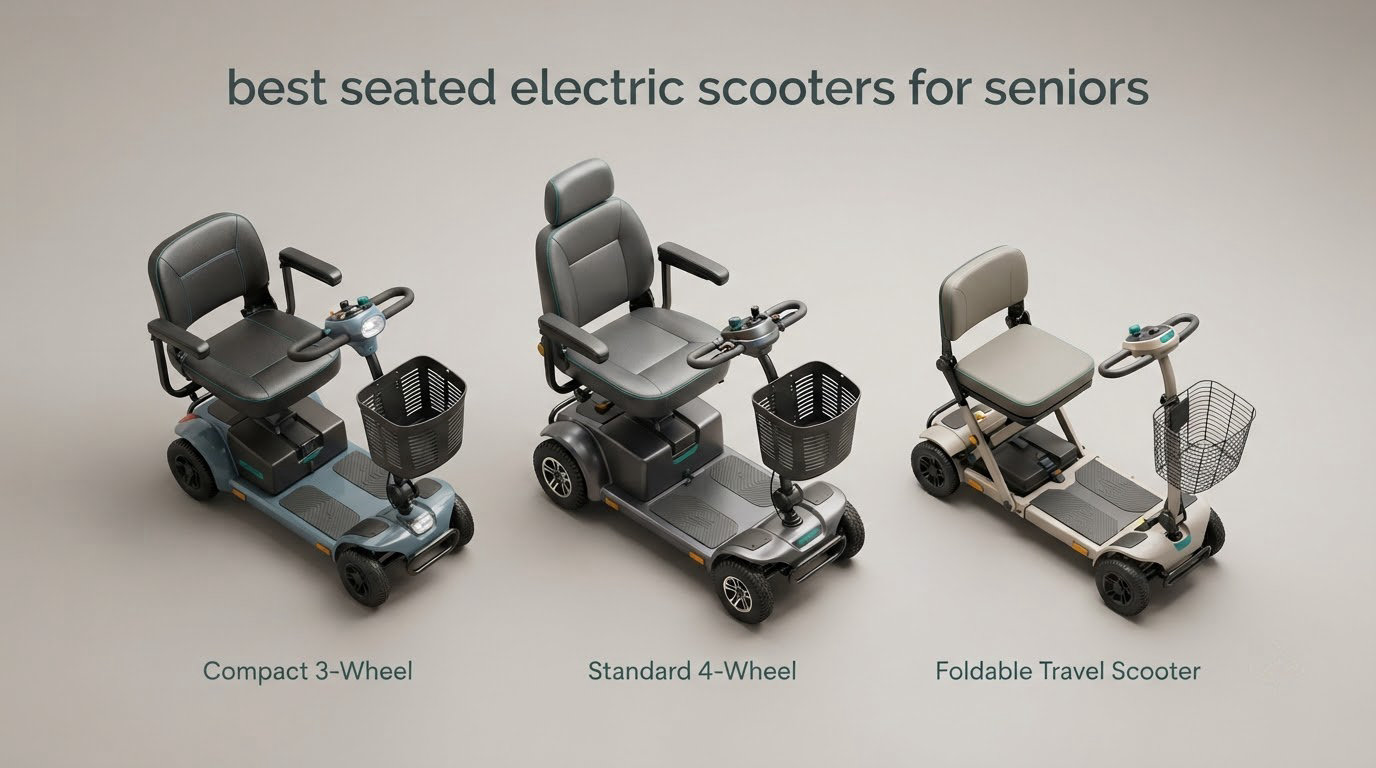
Choosing the best seated electric scooters for seniors is less about finding the fastest ride and more about finding the one you will actually use without thinking about it. A scooter that looks great in a listing can still be wrong for you if the seat is too high, the throttle fights an arthritic hand, or the heaviest piece weighs 50 pounds on a day when your back is bad. We went through twelve of them, separating the two families that matter most: the scooter-bike style with a padded seat post, and the four-wheel mobility scooter built around a swivel seat and a tiller.
Those two families feel nothing alike. The seated scooter-bike rides like a bicycle with a motor, travels 15 to 19 mph, and handles park paths and neighborhood streets. The four-wheel scooter is a small powered chair that travels under 5 mph, turns on a dime, and works in a grocery aisle or down a senior living hallway. Buyers who pick the wrong one usually end up with something that is either too slow for the errand they wanted or too twitchy for the balance they have.
Over the past few weeks our team has read through thousands of owner reviews on all twelve models, checked capacity numbers against real rider weights, and cross-checked claimed range against what riders report back. The pattern that surprised us most: on six of the twelve, the distance you get between charges is well under the number on the box. We tell you which ones, and by how much, in every section below.
Whether you are shopping for yourself, for a parent, or on behalf of a patient recovering from hip surgery, the deciding factors are the same. If you want a broader look at the category first, our general electric scooter roundup covers the standing models, and our adult scooter guide covers larger frame sizes. This one stays focused on seated machines for older riders.
Top 3 Picks: Best Seated Electric Scooters for Seniors in October 2026
Three models stand clearly above the rest this year. The Vive 4 Wheel Mobility Scooter wins on stability, documentation, and a five-year guarantee. The Gotrax A5 is the best value in the seated scooter-bike group, with a suspension-mounted seat that takes pressure off the knees. The Gyroor C1S is the highest-rated seated scooter in the set and the one with the most useful cargo arrangement.

Vive 4 Wheel Mobility Scooter
- Four-wheel stability
- 265 lb capacity
- Four-piece disassembly
- 5-year guarantee
Gotrax A5 Electric Scooter…
- Suspension seat
- 12 inch pneumatic tires
- 550W peak motor
- UL2272 certified

Gyroor C1S Electric Scooter…
- 550W motor
- Center basket and rear rack
- 12 inch vacuum tires
- UL2272 with disc brakes
Every Seated Electric Scooter We Compared for October 2026
All twelve models below are seated, all are rated for riders well above 200 pounds, and all run on removable or detachable lithium-ion style battery packs. The format column tells you which of the two families each one belongs to.
| Product | Specs | Action |
|---|---|---|
| Vive 4 Wheel Mobility Scooter |
|
Check Latest Price |
| Gotrax A5 Electric Scooter with Seat |
|
Check Latest Price |
| Gyroor C1S Electric Scooter with Seat |
|
Check Latest Price |
 SKRT Foldable 4-Wheel Mobility Scooter SKRT Foldable 4-Wheel Mobility Scooter |
|
Check Latest Price |
 Awwscooter Electric Scooter with Seat Awwscooter Electric Scooter with Seat |
|
Check Latest Price |
 WAYCARE Mobility Scooter 330 lb WAYCARE Mobility Scooter 330 lb |
|
Check Latest Price |
 Rylox Foldable 4-Wheel Mobility Scooter Rylox Foldable 4-Wheel Mobility Scooter |
|
Check Latest Price |
 Mbxcooter 45-Mile Mobility Scooter Mbxcooter 45-Mile Mobility Scooter |
|
Check Latest Price |
 URBANMAX C1S Seated Electric Scooter URBANMAX C1S Seated Electric Scooter |
|
Check Latest Price |
 LAGTOM Heavy Duty 4-Wheel Scooter LAGTOM Heavy Duty 4-Wheel Scooter |
|
Check Latest Price |
 VEVOR Heavy Duty 4-Wheel Scooter VEVOR Heavy Duty 4-Wheel Scooter |
|
Check Latest Price |
 Serianie Foldable Mobility Scooter Serianie Foldable Mobility Scooter |
|
Check Latest Price |
1. Vive 4 Wheel Mobility Scooter: The Four-Wheel Stability Anchor
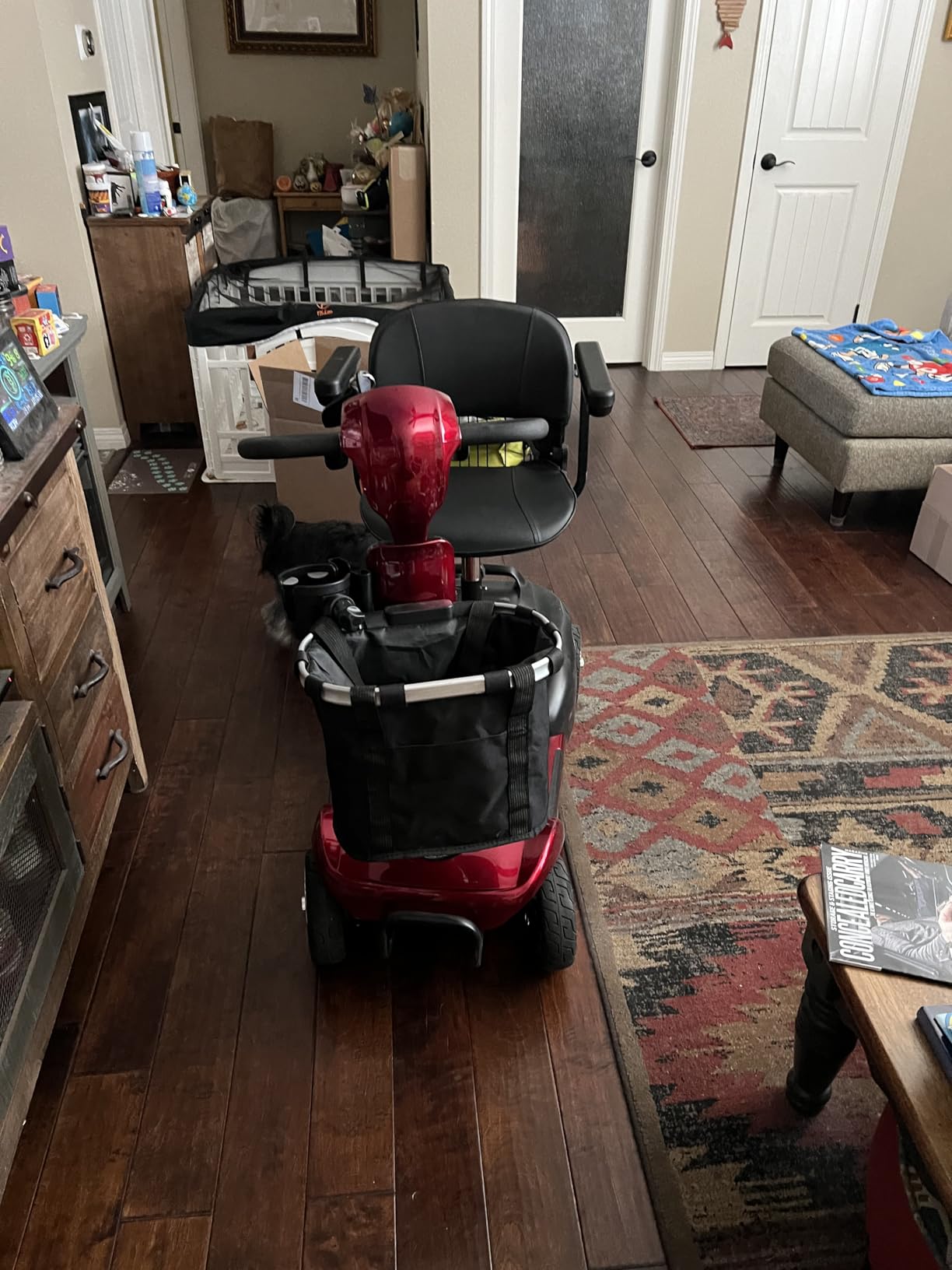
Vive 4 Wheel Mobility Scooter – Electric Powered Wheelchair Device
265 lb capacity
3.7 mph top speed
Up to 12.4 miles per charge
88 lb total weight, 29 lb rear section
Pros
- Four-wheel stability on level ground
- Swivel seat with height adjustment
- Four-piece disassembly fits a car trunk
- Variable speed dial controls top speed
- Five-year guarantee
Cons
- Loud warning beep cannot be muted
- Thin seat cushion out of the box
- Molded battery compartment blocks a lithium upgrade
With more than 3,000 owner reviews behind it, the Vive is the model we keep coming back to for riders who want a chair, not a ride. It is a four-wheel scooter with a 3.7 mph top speed, which is a fast walking pace, and a 15.75-inch seat on a post that swivels out of the way and adjusts in height. That combination is why it is our top pick for seniors who want independence on sidewalks, in parking lots, and around a senior living campus.
The four-piece disassembly is the detail that decides this for us. Owners routinely report taking it apart without tools, loading the four sections into a trunk, and reassembling it at the far end of a visit. The rear section is the piece most people complain about, because it comes in at 29 pounds. But it is still within the range an average adult can manage, and it is the lightest part of the heaviest part.

Three things come up repeatedly in the reviews. First, the tight turning radius: owners driving it inside grocery stores and down apartment hallways report that it maneuvers well on level surfaces, which is what a four-wheel scooter is built for. Second, the variable speed dial on the tiller, which lets a cautious rider cap the top speed rather than riding at the full 3.7 mph. Third, the battery life indicator on the console, which is color coded and easy to read at a glance.
It is worth being straight about the complaints, because they are consistent enough to plan around. The warning beep at low speed is loud and, according to many owners, cannot be silenced without also disabling the safety alert that goes with it. The seat cushion is thin when it arrives, and a lot of buyers add a pad. Range also degrades noticeably after a few months of daily use for owners who report it openly, so treat the 12.4-mile figure as a new-battery number.
Who the Vive fits well
This suits anyone whose main goal is predictable, low-speed travel: a caregiver taking a parent to appointments, someone living in a building with elevators and long corridors, or a rider who wants to cross a parking lot without balancing on a narrow deck. The swivel seat with flip-up armrests and lever height adjustment makes it one of the easier four-wheel boards in this group to get on and off, which matters after hip or knee surgery.
The five-year guarantee is also the longest we found in this roundup, and that is meaningful for a machine with a sealed battery compartment you cannot upgrade yourself. If your plan is to keep one scooter for a decade, that warranty is the deciding factor for us.
Who should skip the Vive
Skip it if you need real range. Twelve miles per charge on a fresh battery, less after months of daily use, is not enough for a large property or a long rural route without a mid-day charge. It also tips on steep inclines and loose gravel, so it belongs on pavement, not on a gravel farm road or a campground track.
If you have shoulder or back problems, test the lift on the 29-pound rear section before you commit. Owners with back issues consistently flag that piece as the hardest part of the whole ownership experience, and no amount of disassembly convenience fixes a lift that hurts.
2. Gotrax A5 Electric Scooter with Seat: Best Value With a Suspension Seat
Gotrax A5 12″ Electric Scooter with Seat for Adults & Teens, 15.5-Mi Range
220 lb capacity
15.5 mph top speed, 20 mph in gear 2
50.7 lb weight
16 miles claimed, 25 mile variant
Pros
- Suspension-mounted seat eases knee and back strain
- 12 inch air-filled tires over rough pavement
- UL2272 certified
- 90 percent pre-assembled
- Large rear basket
Cons
- Power drops sharply on inclines
- Real range closer to 10-15 miles
- Front end has no suspension
- Hardware loosens over time
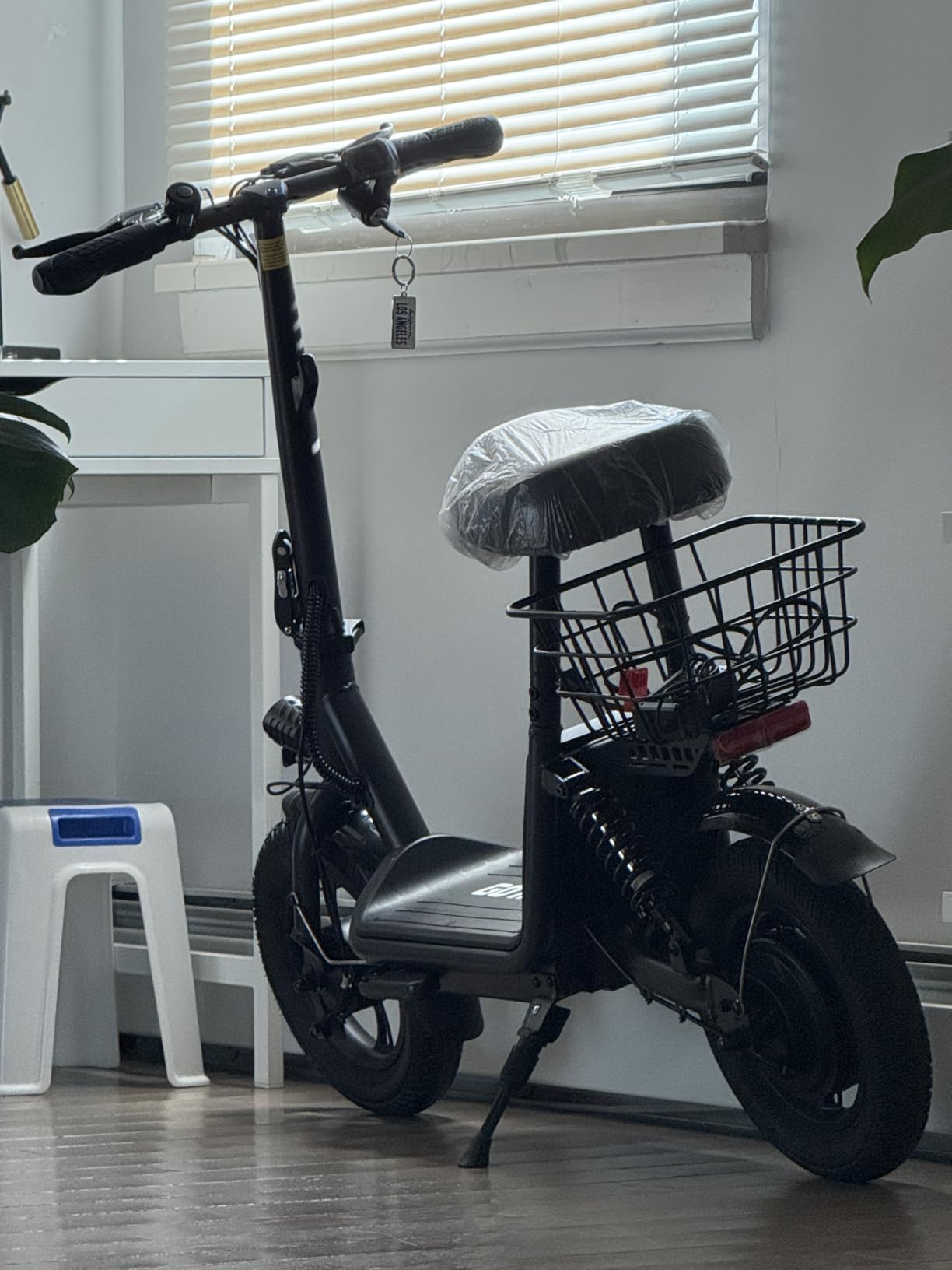
The Gotrax A5 is the seated scooter-bike we recommend most often, and the reason is the seat post. Instead of a rigid post, the seat sits on a sprung post with dual rear shock absorbers, so bumps in the pavement are absorbed by the frame before they reach your spine. Owners describe it as the first thing they notice, and it is the single most important feature for a rider whose knees hurt from standing.
The motor is a 550W peak, 400W rated unit that carries a 220-pound rated capacity, though owners report it handles riders in the 250 to 280 pound range on flat roads without complaint. Top speed is listed at 15.5 mph with 20 mph available in gear two on flat ground. That is much faster than a four-wheel scooter, which is the entire appeal for riders who want to cover real neighborhood distance rather than a single block.
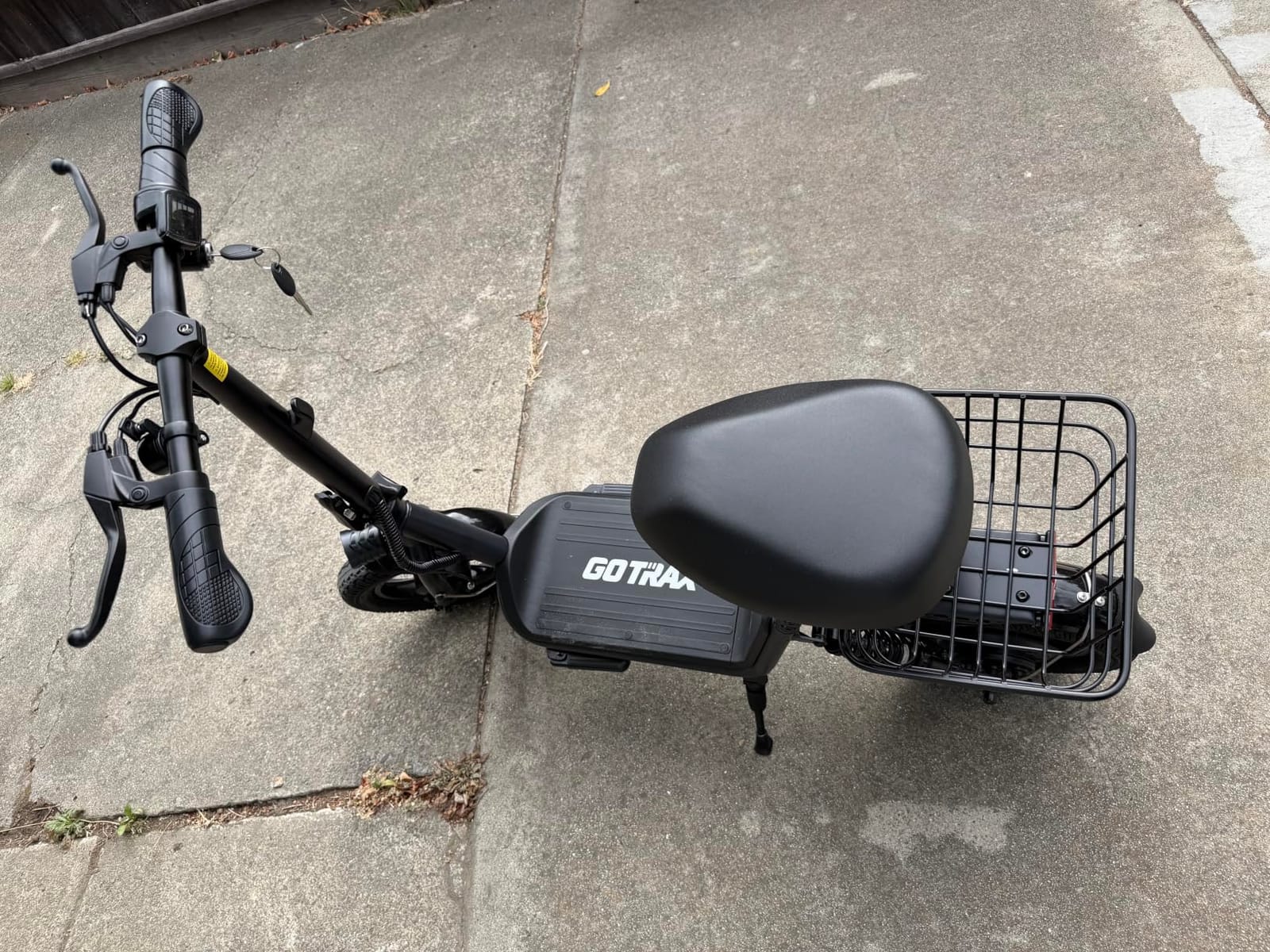
Range is where honesty matters. The listing carries both a 16-mile figure and a 25-mile maximum variant depending on which configuration you get. Owners report real-world distances closer to 10 to 15 miles with a typical adult on flat ground, and significantly less on hills. We would plan your charging around the lower number, and treat the higher one as a lab figure under light load in mild weather.
Brakes are dual drums, front and rear. Reviewers generally find them progressive and easy to modulate, which is the right character for a heavier seated machine. A negative that comes up after a month or two of daily use is loosening hardware: the handlebar and seat post can develop wobble, and a quick check every few hundred miles with the included tools keeps it from becoming a problem.
Who the Gotrax fits well
It fits riders who want to travel several miles on a paved route without pedaling, and who have knee or hip pain that rules out standing. The 9-inch wide pedals with a foldable footrest give you a real place to put your feet, and the rear basket is rated for 40 pounds or more, which is enough for a week of groceries or a small dog.
It is also the easiest of the seated scooter-bikes to get running. It ships 90 percent pre-assembled with tools and instructions in the box, and the 5-hour charge means overnight charging is realistic even for a first-time owner.
Who should skip the Gotrax
Skip it if your route has real hills. The single most consistent complaint is that power and battery state both drop on inclines, and the range collapse on a grade can be severe. It is also front-suspension free, so the front wheel tracks hard over broken asphalt, which is uncomfortable over a long ride.
If you exceed 280 pounds, look elsewhere. The 220-pound rated capacity is the most conservative of the scooter-bikes here, and the four-wheel models in this roundup carry considerably heavier riders.
3. Gyroor C1S Electric Scooter with Seat: The Most Versatile Cargo Setup
Gyroor C1S Electric Scooter with Seat for Adults – 550W Motor, Pet Basket, 19 MPH Top Speed, 20 Miles Range, 12″ Pneumatic Tires, Foldable Commuting Scooter, Black
265 lb capacity
Up to 19 mph top speed
20 miles claimed, roughly half in practice
48.5 lb weight
Pros
- Rated 4.4 across 653 reviews
- the highest here
- Soft adjustable seat
- 12 inch shock-absorbing vacuum tires
- Center basket plus rear cargo rack
- UL2272 certified with dual disc brakes
Cons
- Real range closer to 10 miles than 20
- No turn signals
- Throttle operation poorly explained
- Loose basket weave
The Gyroor C1S carries the highest average rating in this group at 4.4, and the reason shows up in the details rather than the spec sheet. The seat is a soft, breathable adjustable cushion, the 12-inch vacuum tires absorb bumps well, and a 550W motor handles minor inclines without straining. Owners also report a year of reliable use, which is longer than most of the seated scooter-bikes in this roundup.
What makes it distinctive is the storage. You get a large detachable middle basket mounted between the handlebar and the deck, plus a rear cargo rack behind the seat. Keeping the load centered and forward rather than over your back wheel changes how the scooter handles, and a pet in the center basket does not shift the balance the way a rear load would.
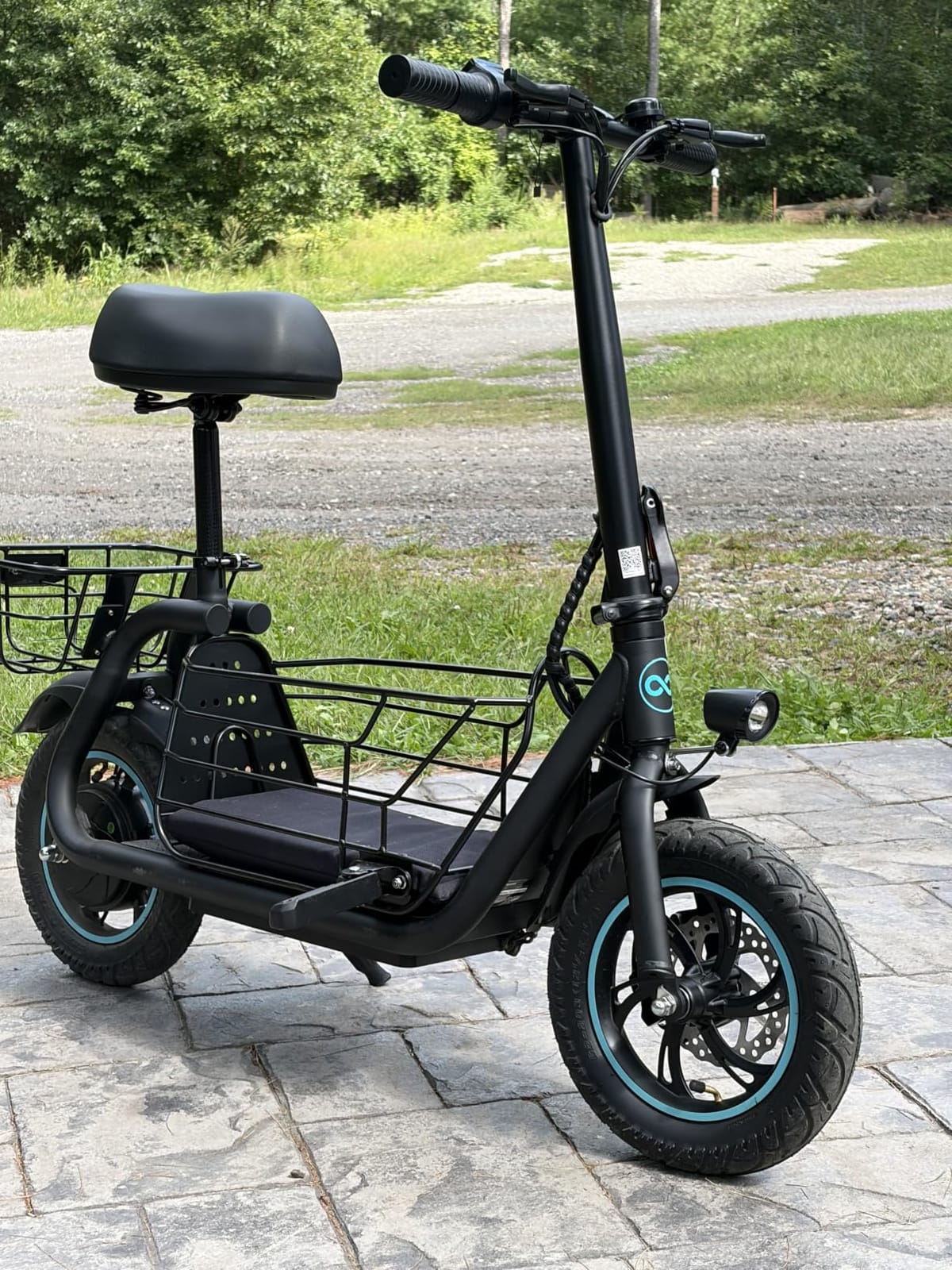
The 20-mile range claim is the big gap. Owners consistently report getting closer to 10 miles in real use, and the gap widens with hills, heavier riders, and cold weather. That is roughly half the advertised figure, so if your route is longer than 5 miles each way, plan on charging mid-day. The battery does take 5 hours to recharge, which makes a mid-day top-up a real commitment.
Disc brakes front and rear, plus UL2272 certification, put this ahead of most competitors on stopping confidence. The 9.5-inch wide deck leaves room for a small pet or both feet comfortably. Two smaller notes: there are no turn signals, and the throttle operation is not clearly explained in the manual, so plan ten minutes of practice in a flat parking area before riding anywhere real.

Who the Gyroor fits well
It fits riders who want a faster, longer-legged seated scooter than a four-wheel chair but who will stay on paved routes. The 9.5-inch deck width and the 44-inch handle height suit riders roughly 5 foot 1 inch to 6 foot 1 inch, and the aluminum frame folds flat for a car trunk or public transit.
The center basket and rear rack together make it the pick for anyone combining errands: groceries in the middle basket, a bag on the rack, and both hands on the grips. Just put a pouch around your phone, because the basket weave is loose enough to let small items through.
Who should skip the Gyroor
Skip it if you need reliable long-range freedom. Halving the claimed figure to plan a route is a big adjustment, and the 5-hour recharge makes opportunistic charging harder than it sounds. Riders on hills will also feel the motor bog down and see the battery indicator drop bars during the climb.
If you ride at dusk regularly, note the absence of turn signals. The LED headlight and rear brake light are bright and owners like them, but on a road with traffic you are relying on lighting alone to be seen.
4. SKRT Foldable 4-Wheel Mobility Scooter: Folds Smallest for Apartments and Cars
Mobility Scooter for Adults & Senior, Foldable 4 Wheels Electric Scooter
300 lb capacity
4.5 mph top speed
Up to 15 miles on 24V 12Ah
Folds to 16.5 inches tall
101 lb total weight
Pros
- Folds to 16.5 inches and splits into five pieces
- Detachable battery charges indoors off-board
- 360-degree swivel seat with flip-up armrests
- Anti-tip rear wheels and electromagnetic braking
- Ground lights
- USB port
- cup holder and phone mount
Cons
- 4.5 mph top speed is modest
- Heaviest single piece is 40 lbs
- 180W motor struggles past 8 degree grades
- Solid tires ride harder than pneumatic
This is the scooter to look at if your storage problem is the real problem. It folds down to 16.5 inches tall and breaks into five pieces, which is the smallest packed size of any four-wheel model we reviewed. Owners use it for everything from apartment closets to loading into a back seat, and the 300-pound capacity is higher than most of its size class.
The detachable battery is the detail we would not compromise on. Because the pack comes out, you charge it on a kitchen counter rather than dragging a 101-pound scooter across a room to an outlet. In a one-bedroom apartment that difference decides whether the scooter stays in use or ends up in a closet.
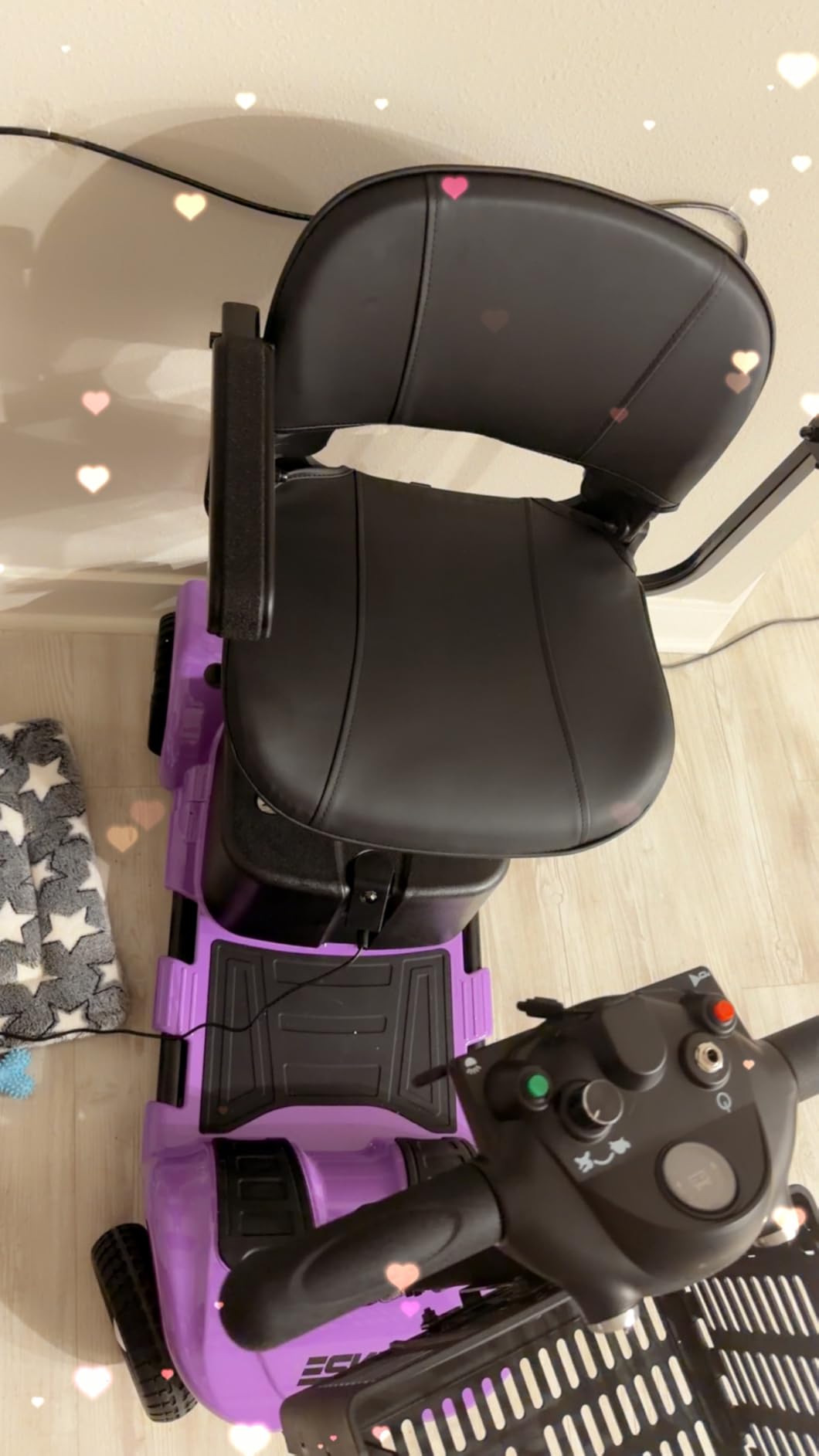
Comfort comes from a 360-degree swivel seat measuring 16.5 by 13.4 inches with height adjustment, plus two flip-up armrests. The swivel matters more than the size: you sit down facing forward, then rotate, rather than twisting your body sideways over the deck as you would on a scooter-bike. For anyone recovering from hip surgery, that is the feature that makes boarding possible without help.
Controls are a single interface with a forward and reverse switch and a speed knob, plus a headlight and two LED ground lights on either side of the deck that owners say genuinely help in a dim garage. The 180W motor and 8-degree grade limit are the honest constraints: this is a sidewalk and indoor machine, not something for a sloped driveway or a gravel lane.
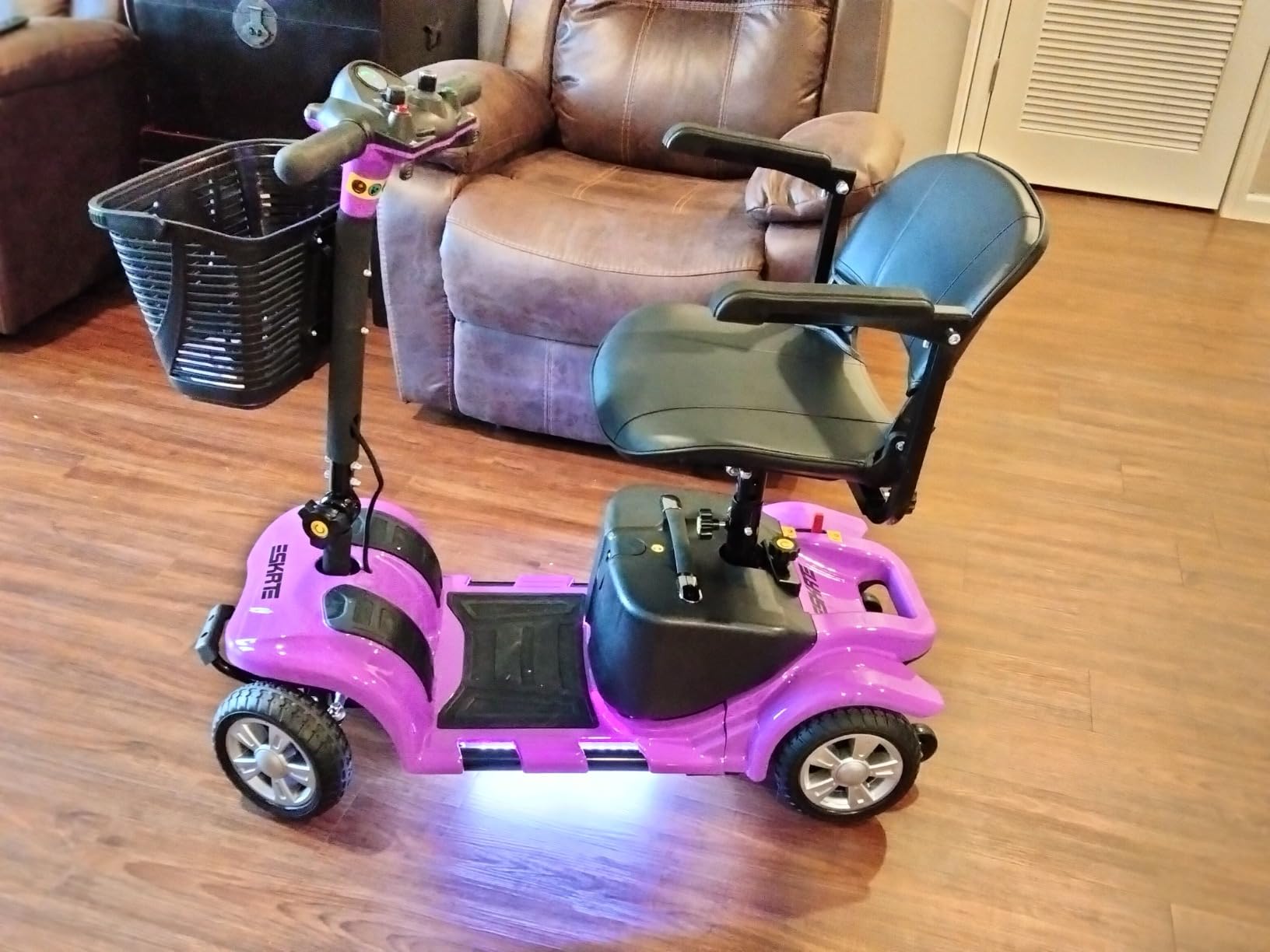
Who the SKRT fits well
It fits riders in small apartments, or anyone who needs the scooter to live in a car rather than beside it. The folding frame plus five-piece breakdown is the most forgiving packing arrangement we found, and the off-board charging is a genuine quality-of-life gain indoors.
The extras are unusually complete for the class: USB charging port, cup holder, phone mount, and lighting on all sides. If you plan to run errands that end after dark, that visibility is worth more than it sounds on paper.
Who should skip the SKRT
Skip it if you need to cover distance. A 4.5 mph top speed sounds slow on paper, and owners confirm it feels slow on any trip longer than a few blocks. The 40-pound heaviest component is also a real lifting challenge for riders with shoulder or back limits, so plan for a second person on loading days.
Solid tires mean no air to maintain, which is a genuine benefit, but they transmit more vibration over uneven asphalt than pneumatic tires do. On a rough street, expect a harsher ride than the Gotrax or Gyroor.
5. Awwscooter Electric Scooter with Seat: Gentlest Starting Speeds for New Riders
AWWSCOOTER C1 Electric Scooter with Seat & Basket for Adults, Classic Black
265 lb capacity
9, 12 and 16 mph across three settings
Up to 20 miles claimed
450W motor, 15 degree grade
Pros
- Three selectable speed settings including a 9 mph mode
- Riders in their 70s and 80s report picking it up fast
- Integrated rear basket with phone holder
- Dual disc brakes and UL 2272 certification
- Extra inner tube included
Cons
- Actual top speed closer to 10 mph and drops under load
- Range varies widely with speed and terrain
- Seat padding uncomfortable on long rides
- Front wheel connection can loosen
The Awwscooter earns its place for one reason: three speed settings. The 9 mph setting is low enough that a first-time rider in their 70s or 80s can learn the controls in a parking lot without the fear that usually stops people from starting. Owners describe exactly that experience, and for a nervous beginner the third gear is a goal to move toward rather than a risk on day one.
Underneath that is a solid 450W motor rated for 15-degree grades, dual disc brakes front and rear, and UL 2272 certification on the battery and electrical system. The 12-inch pneumatic tires with air suspension take the edge off pavement that would be punishing on solid wheels, and the 9.5-inch deck with a wide adjustable seat gives you a real seated posture rather than a perch.
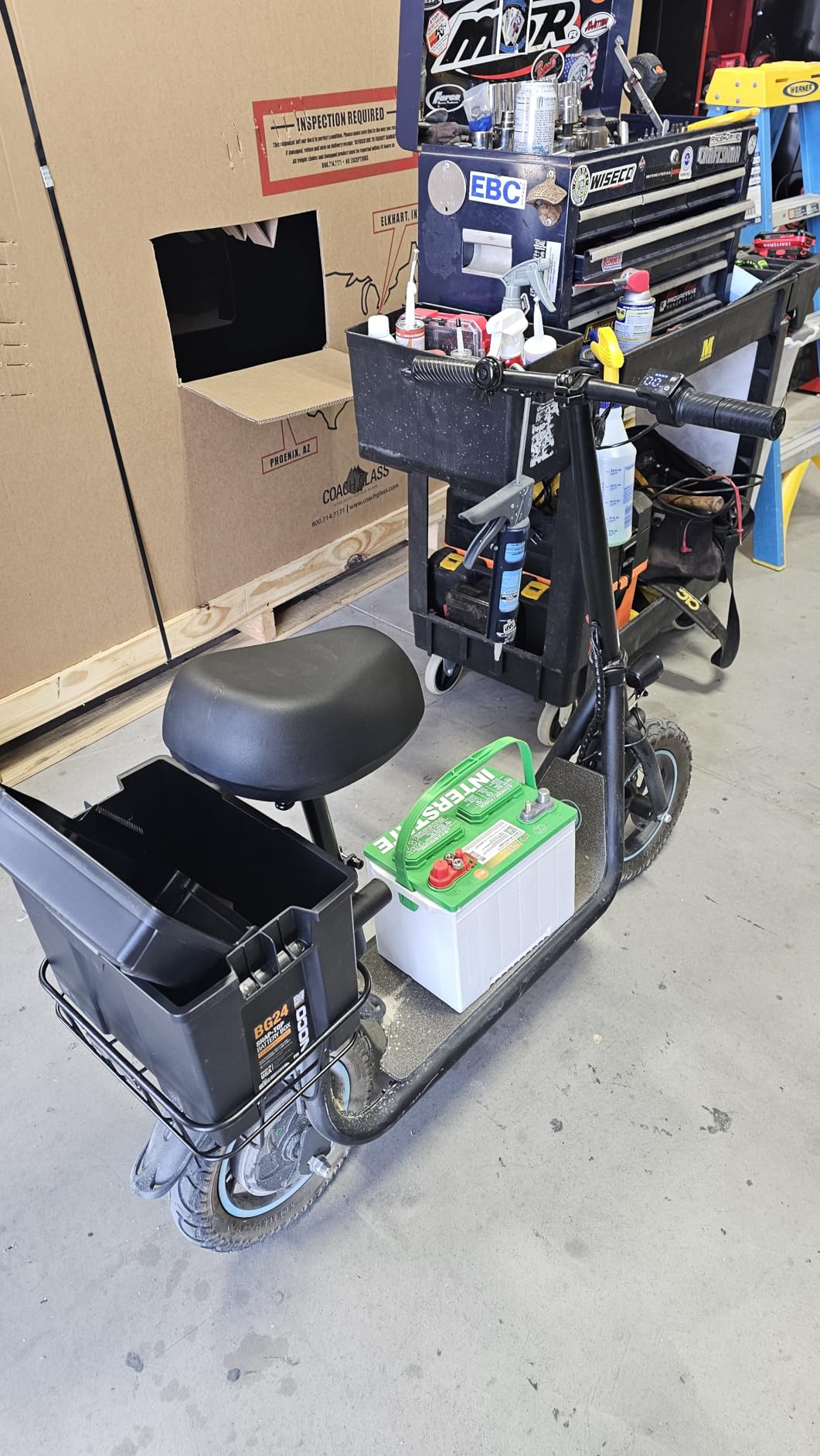
The honest problem is that the 16 mph claim is aspirational. Owners report an actual top speed nearer 10 mph that drops further under load, and range that varies widely with speed and terrain, so you will charge more often than the up-to-20-miles figure suggests. A spare inner tube is included, which tells you the company expects punctures on the pneumatic tires, and it saves you a roadside stop.
Assembly is quick and charging is straightforward, but the instructions are difficult to follow according to multiple reviews, so budget an extra half hour. Seat padding gets uncomfortable past an hour or two; if long rides are your plan, an aftermarket cushion is the first accessory to buy.
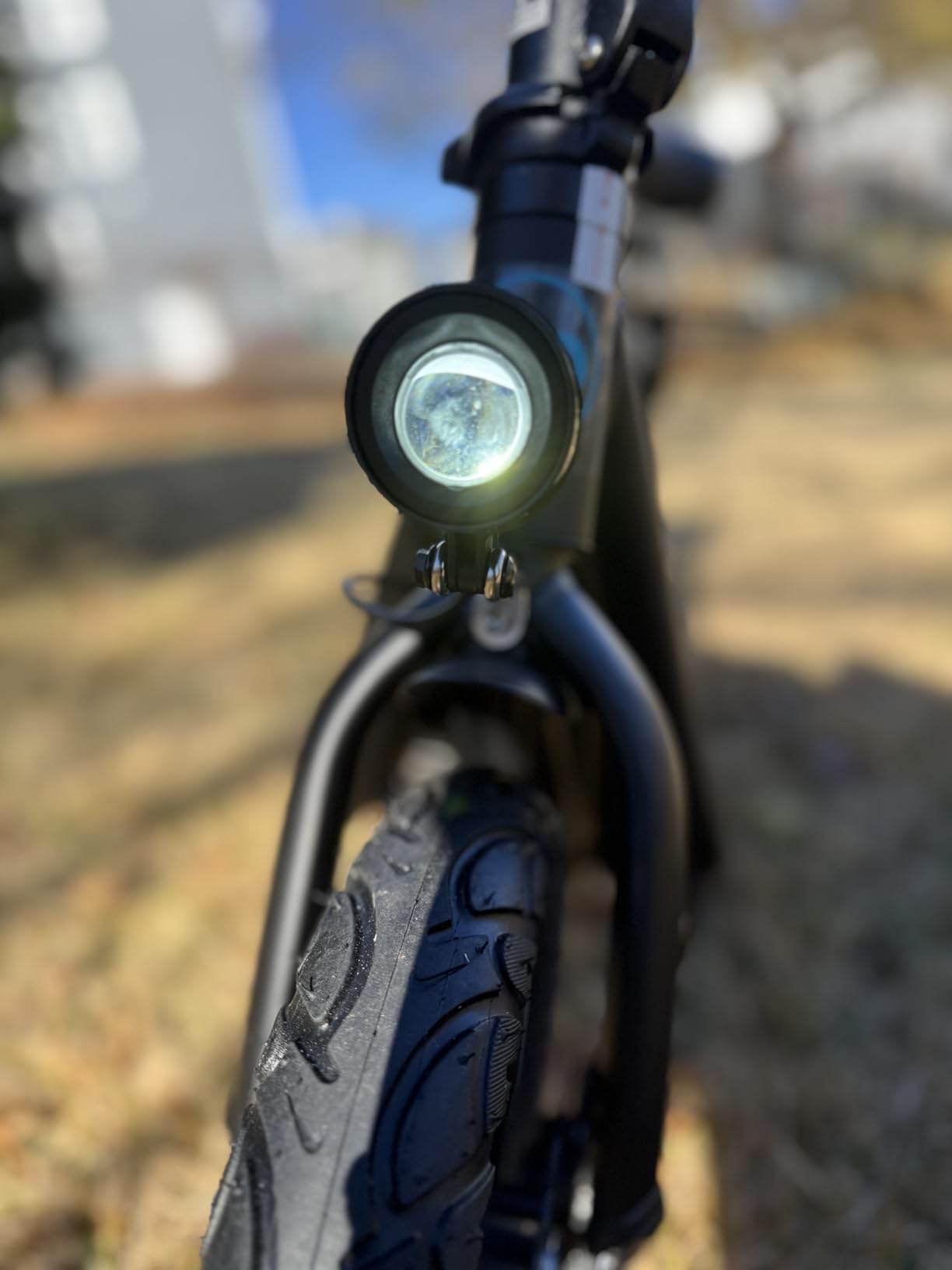
Who the Awwscooter fits well
It fits first-time riders, and riders recovering from a period of reduced mobility who want to build confidence slowly. The three-speed layout lets you set the ceiling rather than accept whatever the scooter decides to do, which is the whole point for someone who has been avoiding scooters after a fall.
The rear basket and included phone holder make short shopping and appointment trips practical, and the 265-pound capacity is generous relative to the class. Riders who want disc brakes without moving up a size will also appreciate the stopping power.
Who should skip the Awwscooter
Skip it if you plan long rides on a schedule. Range falling short of claim and seat padding that fades after an hour or two is a poor combination for a 15-mile commute. Owners are also clear that it is not suited to rainy or cold-weather riding, which limits it to fair-weather neighborhoods.
If you want genuine off-pavement capability, this is not it. It handles neighborhood streets and sidewalks well and nothing rougher.
6. WAYCARE Mobility Scooter: The Simplest Controls We Found
WAYCARE Mobility Scooter for Adults & Seniors, 330 lb 15-20 Mile Range Blue
330 lb capacity
4.97 mph top speed
15-20 miles on 24V 12Ah
24V 250W motor
83 lb total weight
Pros
- Single speed dial with no menu or app
- Higher 330 lb capacity for the class
- Oversized cushioned seat for longer outings
- Folds and disassembles in about five minutes
- Solid puncture-proof tires need no upkeep
- Hill-hold mechanism stops rollback on slopes
Cons
- 4.97 mph top speed is slow
- About 80 lb total weight is hard to self-load
- Solid tires transmit more vibration than pneumatic
The thing that separates this model is that it does not ask you to learn anything. The control panel has a gear dial for speed, a direction control, lights, and a horn, and that is the whole interface. There is no app, no menu, no pairing step. For a rider who is intimidated by technology, that simplicity is worth more than any feature on the spec sheet, and owners consistently single it out.
Capacity is the other headline number: 330 pounds, which is the joint-highest in this roundup and unusually high for a machine of this size. The seat is oversized at 19.6 by 18 by 16 inches with cushioned synthetic leather, and the adjustable handles and control lever make entry and exit less of a negotiation than on smaller models.
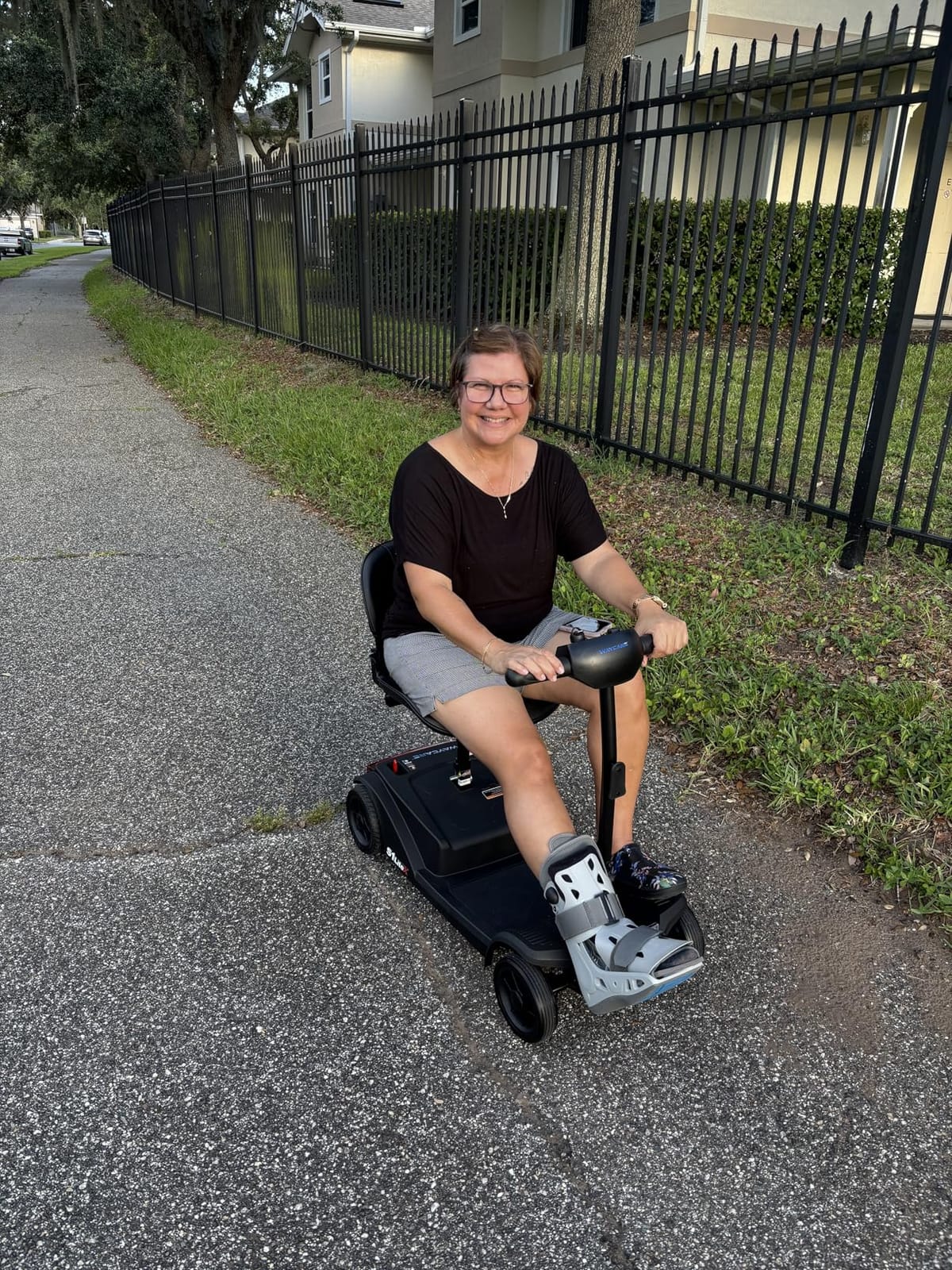
The hill-hold mechanism deserves a mention because it solves a specific, real problem. On a sloped driveway or a parking lot with a grade, a four-wheel scooter will roll backward when you take your hands off. This one locks in place. It is a small feature that prevents the kind of small incident that makes people give up on a mobility device entirely.
What you give up is pace and comfort. A 4.97 mph top speed is slower than lighter four-wheel models, and the 8-inch solid puncture-proof tires need no maintenance but transmit noticeably more vibration over uneven ground. Owners like that the total weight of about 80 pounds still folds and disassembles in roughly five minutes for car transport, though a second person helps with the heaviest section.
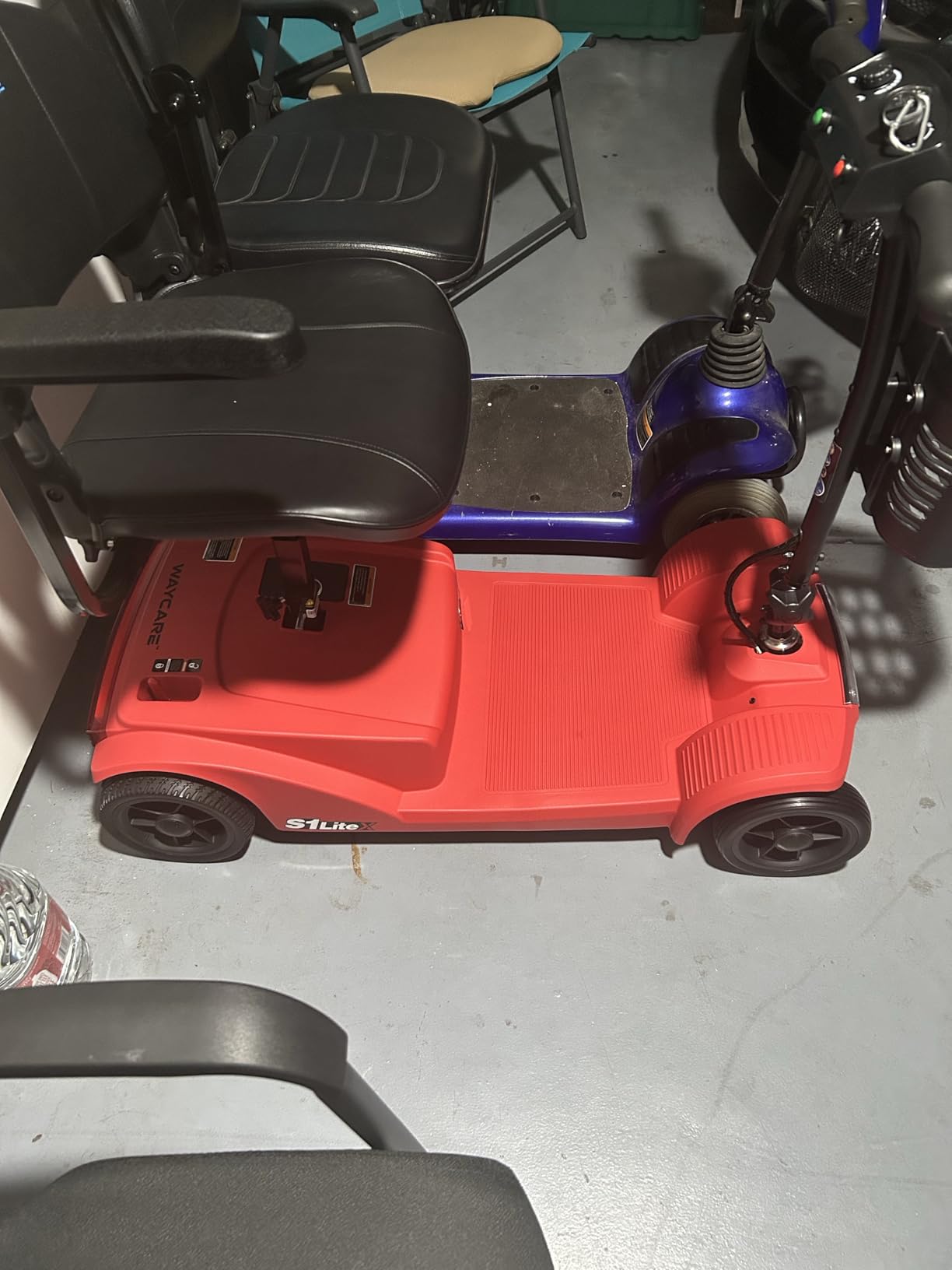
Who the WAYCARE fits well
It fits riders who want zero learning curve, and riders over 300 pounds who have been priced out of the four-wheel category. The oversized seat also suits anyone whose previous scooter felt cramped after an hour, which is a common complaint with 16-inch-wide bases.
Practical owners will also appreciate puncture-proof solid tires, which remove tire pressure from the maintenance list entirely. For a machine that lives outdoors in a garage or on a patio, that is a real reduction in ongoing attention.
Who should skip the WAYCARE
Skip it if your errands cover more than a couple of blocks. Just under 5 mph is comfortable and safe but genuinely slow, and there is no faster mode to unlock later. Anyone who plans to keep pace with a walking companion will find this limiting.
Also weigh the 80-pound total against your own loading capacity. Five-minute disassembly is meaningless if the piece you need to lift is beyond what your back allows on its own.
7. Rylox Foldable 4-Wheel Mobility Scooter: Best for Multi-Stop Errands
Foldable 4-Wheel Mobility Scooter for Adults – Portable Motorized Scooter with 330 lbs Capacity, Detachable Battery, Dual Baskets, Cup & Phone Holder, Blue
330 lb capacity
0-4.3 mph variable
Up to 15 miles on a 6-hour charge
89 lb weight, folds to 40 x 19 x 14 inches
Pros
- Assembles in roughly ten minutes with no tools
- Two removable baskets plus combined phone and cup holder
- Stable on grass and rock walkways
- Detachable battery for off-board charging
- Extra legroom versus comparable models
Cons
- Turning radius is wide
- so tight aisles need a backing move
- Seat and steering column can feel wobbly
- Heaviest component is 50 lbs
- Soft aluminum front basket rim bent easily
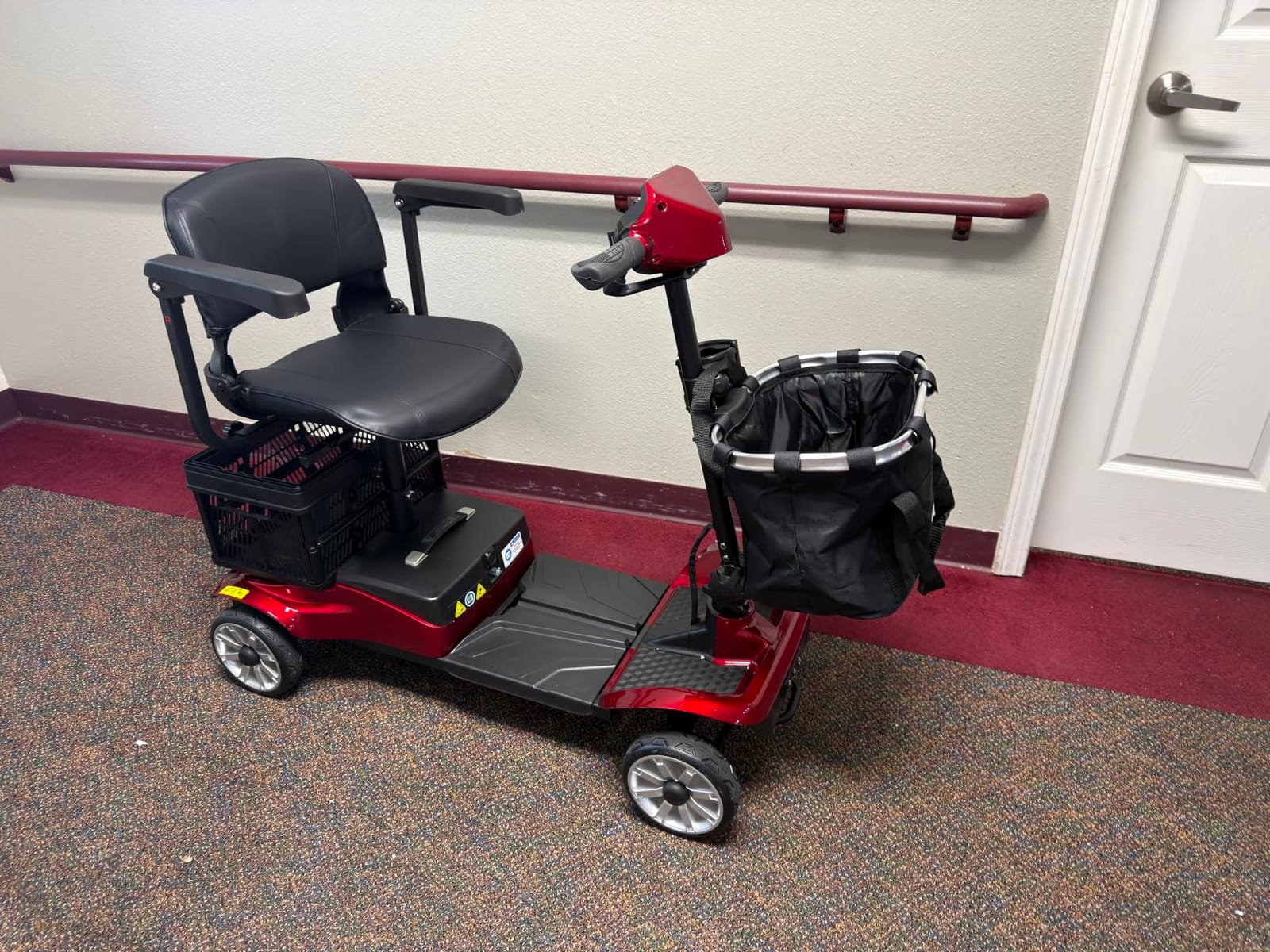
This is the one to buy if your week is a list. Two removable baskets, one in front and one behind, plus a combined phone and cup holder, means you can leave the basket in the car and take only what you need into the store. Owners report using it for multi-store trips on a single charge, which is the practical promise that matters for grocery errands.
Assembly is genuinely fast. Owners describe roughly ten minutes with no tools required, and the folded size of 40 by 19 by 14 inches fits most car trunks. The 250W motor gives smooth, quiet low-speed control, and the four-wheel design holds stable on grass, asphalt, and rock walkways, which is broader than the flat-pavement-only claim of most competitors.
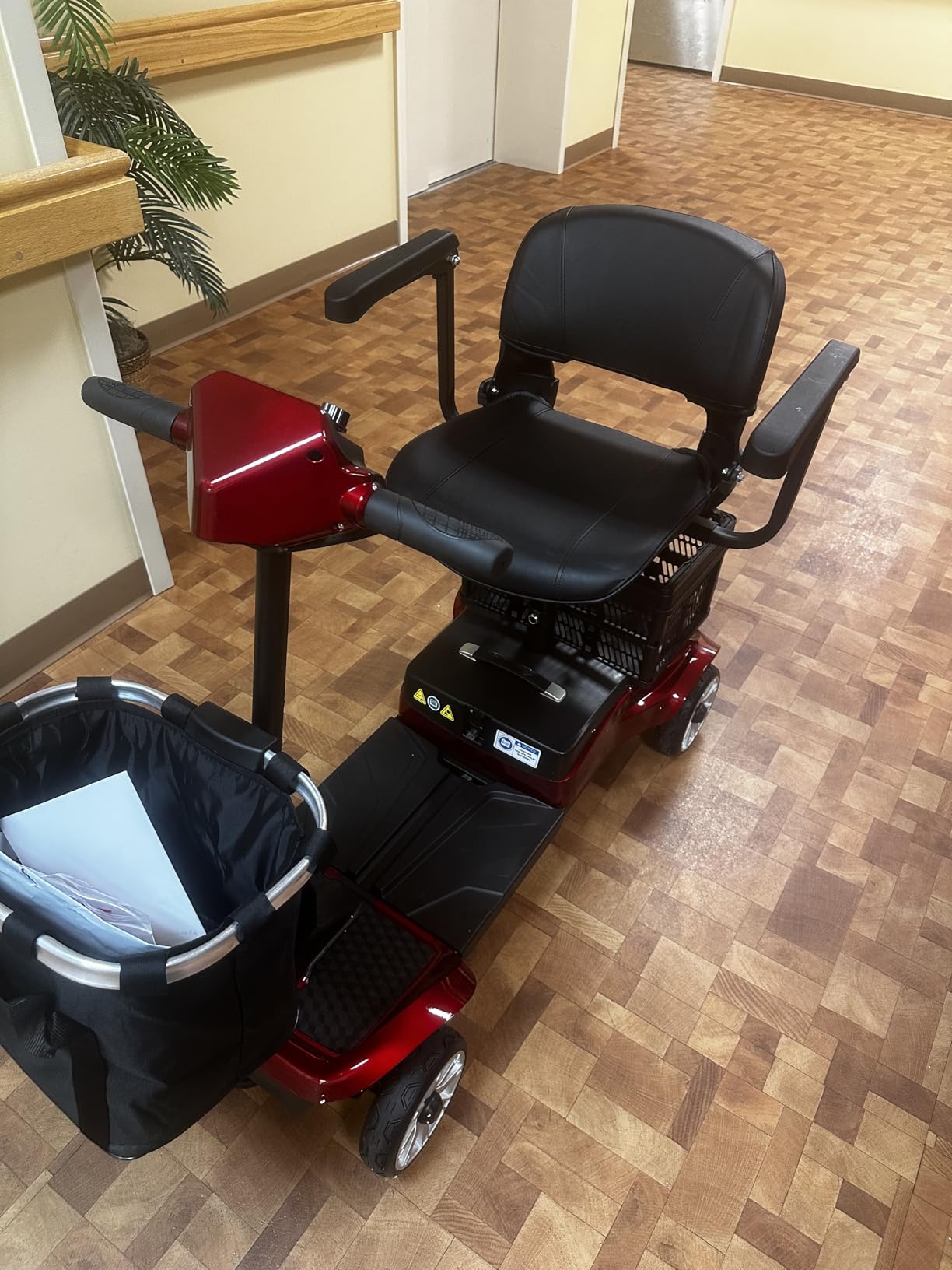
The 330-pound capacity and 15-degree incline handling put it near the top of the mobility class on paper, and the detachable battery means you charge it wherever a socket is convenient. Electromagnetic braking, an anti-tip structure, non-slip rear wheels, a reinforced bumper, and a bright LED headlight cover the safety basics properly.
Two real limitations. The turning radius is wide, and owners in narrow store aisles report needing to back up and re-approach tight corners, which is the single most common complaint. The seat and steering column also get described as slightly wobbly by some. The front basket rim is soft aluminum and one reviewer bent it, so treat the front basket as light-duty.
Who the Rylox fits well
It fits riders whose routine is repeated shopping trips rather than long recreational rides, and anyone who wants help carrying more than one bag at a time. The 8 inches of extra legroom compared with similar models sounds minor until you spend an hour in the seat with a heavy basket in front of you.
Assembly speed is a real advantage for caregivers. If you are building a scooter for a parent who will need it set up by someone else, a ten-minute no-tools build removes an entire category of friction.
Who should skip the Rylox
Skip it if you navigate narrow spaces regularly. Store aisles, tight restaurant corners, and small clinic waiting rooms are where a wide turning radius is most annoying, and no amount of four-wheel stability compensates for the maneuver you cannot make.
The 50-pound heaviest component also needs planning. If you are loading solo, this is one of the harder units in this roundup to get into a vehicle, and that cost is paid every single trip rather than once.
8. Mbxcooter 45-Mile Mobility Scooter: Longest Range With a Lithium Battery
45Miles Mobility Scooter for Seniors/Adults,All Terrain Mobility Scooter
300 lb capacity
7 mph top speed
20, 35 or 45 mile battery options
350W motor, 15 degree grade
85.5 lb weight
Pros
- Lithium battery with 20
- 35 and 45 mile options
- Highest average rating among four-wheel models at 4.6
- Included GPS tracker and USB charging port
- Four-piece disassembly with foldable tiller
- Proactive customer service that calls to check on the unit
Cons
- Assembly instructions are terse and partly in Chinglish
- Rudimentary suspension makes cobblestones uncomfortable
- Removable battery needs tools to release
- About 85 lb is heavy to load unaided
The Mbxcooter MS20 is the only model here where you choose your battery at purchase, and that choice is the whole proposition. Depending on the pack you select, the range is 20, 35, or 45 miles, which is the difference between one errand and a full day of independence. The lithium chemistry is noticeably lighter and more consistent than the lead-acid packs used on most of the mobility scooters here.
It is also the highest-rated four-wheel model in the set at 4.6, and owners report running 100-plus miles without issues. At 7 mph, it is the fastest mobility scooter in this roundup, which still counts as a comfortable walking pace but noticeably quicker than the 4 to 4.5 mph cluster.
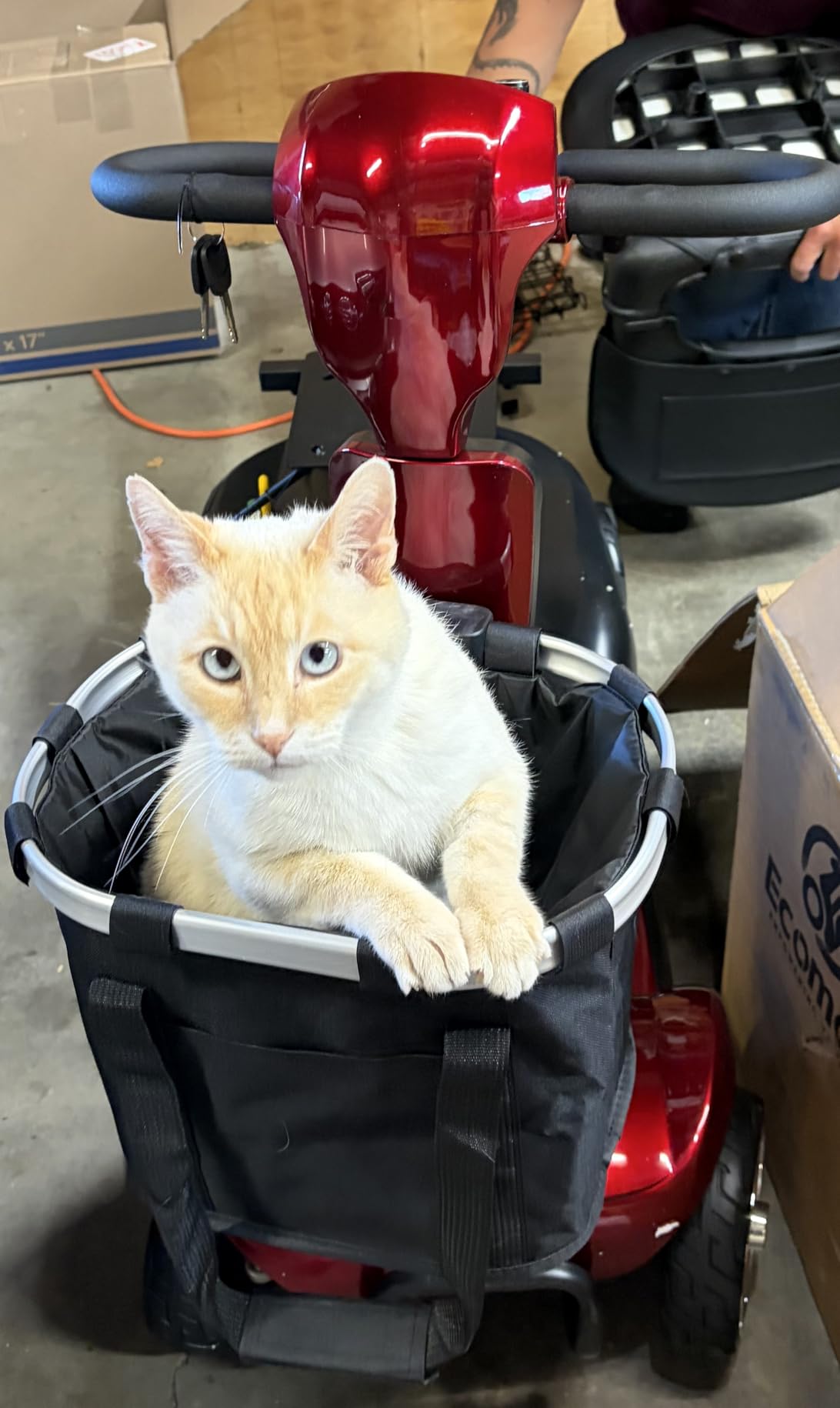
The extras are more thoughtful than the category norm. A GPS tracker is included, which matters if the scooter is ever moved without you, and there is a USB charging port for a phone. You get two baskets, one fabric and one metal, a front anti-collision bar, anti-tip rear wheels, and a bright headlight with a rear safety tail light. The side-swiveling seat with adjustable armrests makes boarding easier than a fixed post.
Two things hold it back. The suspension is rudimentary, so cobblestones and uneven ground transmit a lot of impact, and the assembly instructions are terse and partly in Chinglish, so give yourself extra time. The detachable battery is a genuine plus for indoor charging but is not easy to release without tools.
Who the Mbxcooter fits well
It fits riders on large properties, campground and RV travel, or anyone whose nearest store is more than a few miles away. The 45-mile option removes the mid-day charge from the equation entirely, and the 300-pound capacity covers most riders with headroom.
The GPS tracker and the four-piece disassembly with a foldable tiller make it sensible for anyone who travels between locations rather than living with the scooter in one place.
Who should skip the Mbxcooter
Skip it if your route is rough. With the 45-mile pack this is a heavier machine, and the minimal suspension means long stretches of uneven pavement become tiring. The direct trade-off is range for ride comfort, and that trade is only worth it on smooth routes.
Plan on help for loading. At roughly 85 pounds, this is a two-person lift for most riders, and the battery release needing tools is a small friction that adds up on loading days.
9. URBANMAX C1S Seated Electric Scooter: Best Braking and Dashboard Detail
URBANMAX C1S Foldable Adult Electric Scooter with Seat Black
265 lb capacity
18.6 mph top speed
Up to 20 miles, varies with load and grade
550W motor, 50 lb weight
Pros
- UL2272 certified with dual mechanical disc brakes front and rear
- 12 inch pneumatic tires with a shock absorber
- LCD dashboard shows real-time battery level
- Two removable baskets
- LED headlight and rear brake light
Cons
- Manufacturer recommends an added seat cushion for long rides
- Range varies widely with rider weight and temperature
- Brake pads need periodic inspection and adjustment
- Inner-tube tires need pressure maintenance
The URBANMAX C1S is the most honest listing of the seated scooter-bikes. It states outright that the 20-mile range varies by rider weight, load, road grade, and temperature, and that long rides need an added cushion. Manufacturers rarely write that down, and it tells you the company has owner feedback and publishes it rather than hiding it.
On hardware, it is well equipped. Dual mechanical disc brakes front and rear give you the shortest stopping distances in the seated group, 12-inch pneumatic inner-tube tires with a single shock absorber take the sting out of potholes, and the LCD dashboard shows a live battery level rather than a four-bar guess. The 550W motor and 18.6 mph top speed make it the second-fastest seated scooter here.
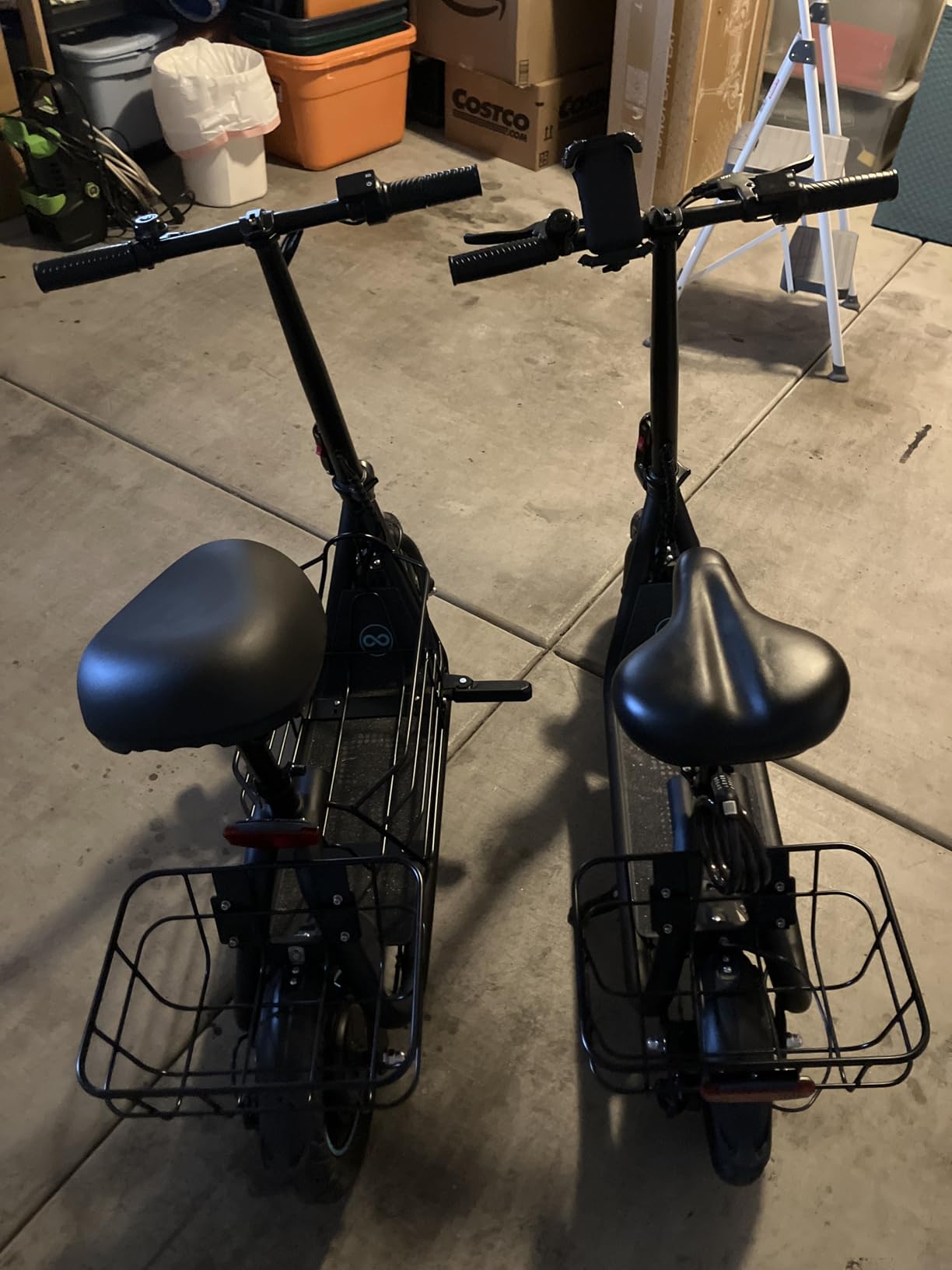
Two removable baskets plus a foldable frame give it genuine grocery-run utility, and the padded seat on an aluminum frame holds up well for typical trip lengths. At 50 pounds with a 46 by 9.5 by 38 inch folded profile, it packs into a car more easily than the Gotrax.
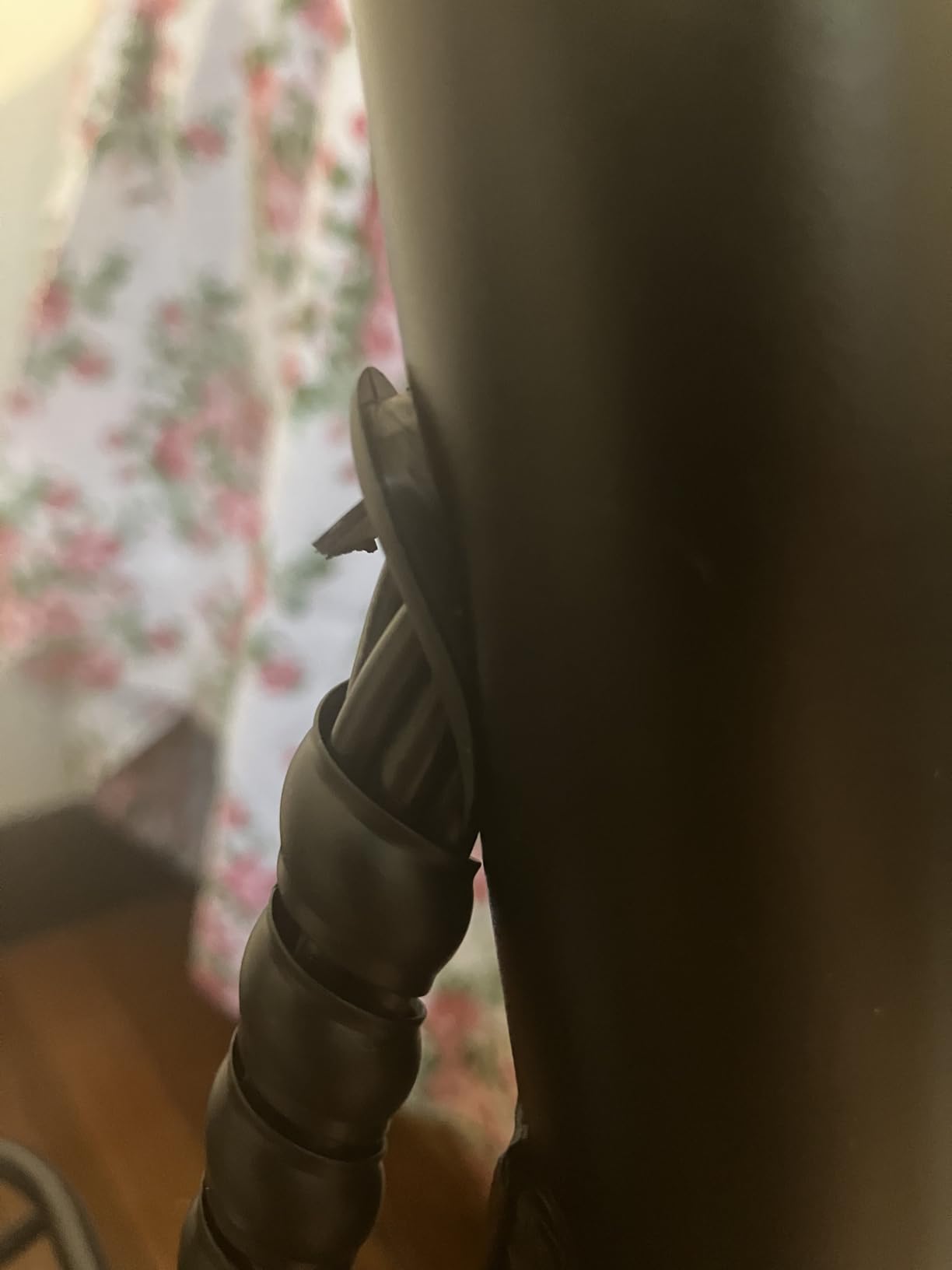
The maintenance notes are worth repeating because they are honest rather than alarming. Brake pads wear with regular use and need periodic inspection and adjustment, fasteners should be checked occasionally to keep the frame and basket assembly stable, and inner-tube tires need pressure maintenance and can pick up punctures from sharp debris. None of that is a defect; it is what owning a scooter with discs and pneumatics involves.
Who the URBANMAX fits well
It fits confident riders on paved neighborhood routes who want real stopping power and a battery gauge they can trust. Disc brakes matter more as speeds rise, and this is the scooter where they are most justified.
It also suits anyone who values documentation over marketing. When a manufacturer publishes its own weaknesses, you can plan around them instead of discovering them in month three.
Who should skip the URBANMAX
Skip it if you plan to ride far without stopping. The manufacturer’s own recommendation to add a seat cushion for long rides, combined with a range figure that swings with temperature and load, means long day trips will need planning and money for an accessory.
Pneumatic inner-tube tires also need occasional pressure checks and carry a puncture risk on roads with debris. Riders with no access to a pump should weigh that before choosing discs over drums.
10. LAGTOM Heavy Duty 4-Wheel Scooter: Built for Riders Over 500 Pounds
Heavy Duty 4 Wheel Mobility Scooters for Seniors & Adults 500lbs Capacity – Electric Powered Chair – 1000W All Terrain Fast Mobility Scooter for Travel w/Long Range Battery Remote Key
500 lb capacity
1 to 15 mph via variable dial
1000W motor, 60V 20Ah battery
16 inch fat tires
275 lb total weight
Pros
- 500 lb capacity on a 1000W motor
- 16 inch fat tires with rear shocks handle sand and grass
- Deluxe reclining captain's seat with safety belt
- Full lighting with headlights
- taillights and turn signals
- Locking glove compartment
- rear basket and under-seat storage
- 98 percent pre-assembled
Cons
- 275 lb makes vehicle loading impractical
- Large footprint is difficult indoors
- 15 mph far exceeds walking pace
- Premium pricing well above the rest
For riders above 350 pounds, nearly every scooter on the list is disqualified by its capacity number, which is why we included the heavy-duty class at all. This one is rated to 500 pounds, driven by a 1000W motor on a 60V 20Ah long-range battery, and it carries a 4.6 average rating, the joint-highest in this roundup.
It is built like equipment rather than a personal mobility device. Sixteen-inch fat tires, two rear shock absorbers, and a rear wheel anti-tip system handle sand, grass, and mud that would stop a smaller scooter dead. The deluxe reclining captain’s seat has folding armrests and a safety belt, which matters for anyone who spends hours in it.
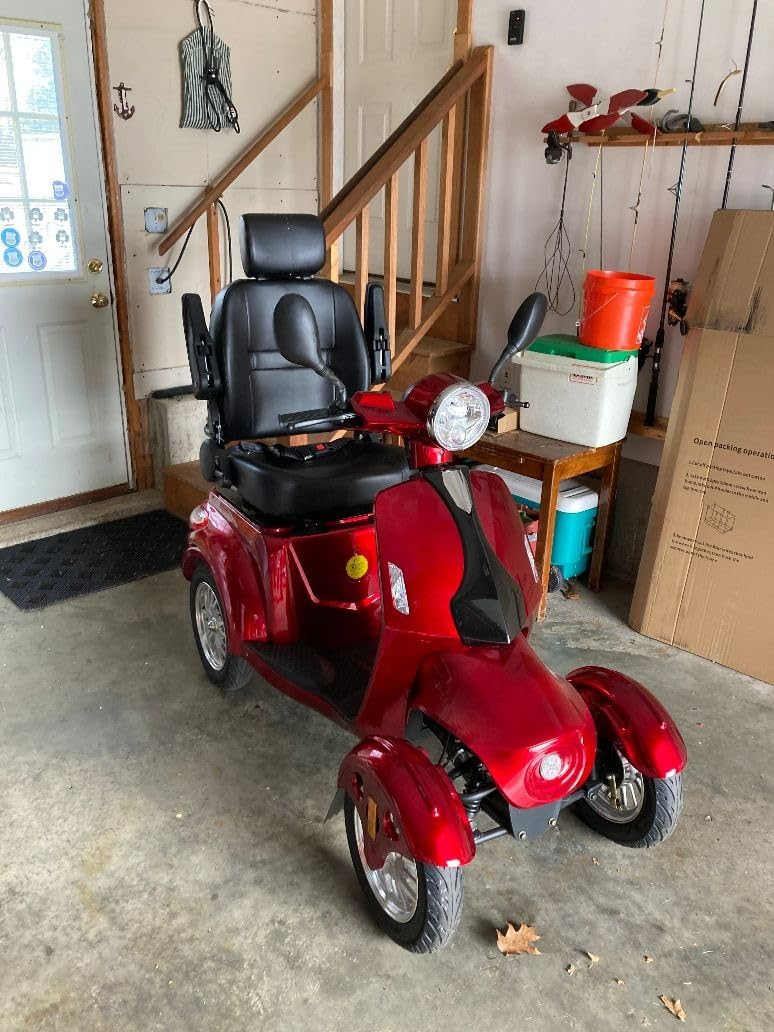
Feature-wise it is the most complete machine here. Three-speed control with a variable dial runs from a gentle 1 mph to 15 mph, so you can crawl in a parking lot or move quickly on an open path. You get a twist throttle with keychain remote, headlights, taillights, and actual turn signals, plus a digital anti-theft alarm system and a built-in USB charger with cup holder.
It arrives 98 percent assembled, so setup on delivery is limited to fitting the rear trunk and the mirrors. That is a genuine practical advantage, since the alternative is assembling a 275-pound machine in a living room. Storage is likewise extensive: a locking glove compartment, a rear basket, and under-the-seat space.
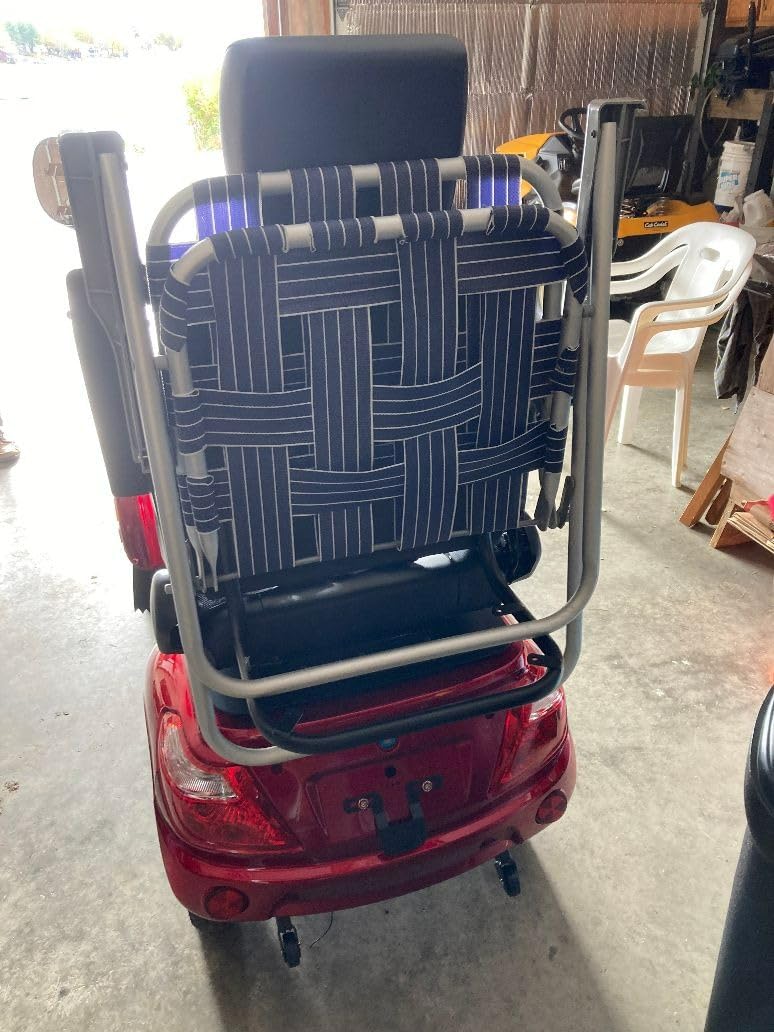
Who the LAGTOM fits well
It fits riders over 350 pounds who have been told by every lighter model that they are too heavy. It also fits anyone on a property with sand, grass, or uneven ground, and anyone who wants a seat that reclines during a long afternoon outdoors.
The lighting package with turn signals is the one we would highlight for road-adjacent use, and the keychain remote for locking and the alarm is useful when the scooter lives outside.
Who should skip the LAGTOM
Skip it if you need to load it into a vehicle. At 275 pounds it is effectively stationary once parked, and no amount of four-piece disassembly changes that. If your plan depends on taking the scooter with you on trips, this is the wrong class entirely.
The 62.6-inch footprint is also difficult in indoor spaces, and a 15 mph top speed requires real caution for a rider who may not have the reaction time of a younger driver. Set the dial low and leave it there.
11. VEVOR Heavy Duty 4-Wheel Scooter: Most Capable on Steep Grades
VEVOR Heavy Duty 4-Wheel Mobility Scooter, Powerful 1000W Brushless Motor, 500 lbs Capacity, 21.5 Miles Long Range, All Terrain Mobility Scooter with Lockable Trunk for Seniors & Adults
500 lb capacity
6, 10 and 15 mph settings
Up to 21.5 miles on 60V 20Ah
20 degree max grade
257.94 lb weight
Pros
- 1000W brushless motor handles 20 degree slopes
- 500 lb capacity on a reinforced frame
- 21.5 mile range on a 60V 20Ah battery
- 16 inch tubeless tires with spring suspension
- Lockable rear trunk plus under-seat storage
- 360 degree lighting
- disc brakes
- mirrors and alarm
Cons
- 4.0 average is the lowest rating here with 17 percent one-star reviews
- About 258 lb makes it effectively stationary once parked
- 66 inch footprint limits indoor maneuverability
- Premium price point above the rest
On paper this is the most capable machine we reviewed. A 1000W brushless motor rated for 20-degree grades is the steepest incline figure in the entire roundup, the 500-pound capacity matches the LAGTOM for highest, and the 21.5-mile range on a 60V 20Ah battery is the longest advertised figure of any four-wheel model here. If you have a genuinely steep driveway or a hillside property, nothing else in this list climbs it as confidently.
The safety hardware is extensive: front and rear disc brakes, an anti-tip wheel, protective bumpers, clear rearview mirrors, a 360-degree lighting system, and a built-in anti-theft alarm. Storage includes a lockable rear trunk, under-seat space, and a large front basket, and the seat has a plush backrest with flip-up armrests.
Here is the part that gave us pause. Despite that specification sheet, this model carries a 4.0 average, the lowest rating in this roundup, with 17 percent of reviews at one star. We could not get detailed review text explaining the pattern, so we are reporting the number rather than guessing at causes. A long feature list and a mediocre owner rating is a combination we would want a warranty behind.
Like the LAGTOM, it weighs 258 pounds, which means once it is parked in a garage it stays there. The 66.1 by 26.4 by 46.1-inch footprint is the largest here, so indoor maneuvering is limited to open spaces.
Who the VEVOR fits well
It fits riders who need serious climbing ability and a large load, combined with the security of a lockable rear trunk for valuables. The 21.5-mile range and the lockable storage make it sensible for large properties, ranches, or campuses where theft is a concern.
Sixteen-inch tubeless tires with spring suspension are also a meaningful upgrade over pneumatic inner tubes for anyone who has dealt with punctures.
Who should skip the VEVOR
Skip it if the 4.0 average concerns you, and it should, because we cannot explain it from the data available. When a specification list and an owner rating disagree, trust the owners. The disc brakes, mirrors, and trunk are genuinely good; the satisfaction record is not.
It is also the wrong choice for anyone who needs to move it, store it in a small space, or ride indoors. It is a stationary machine with excellent specifications.
12. Serianie Foldable Mobility Scooter: The One You Can Buy With Pre-Tax Health Funds
Foldable Mobility Scooters for Seniors, FSA&HSA Eligible, 330LBS Capacity 4 Wheel Lightweight Mobility Scooters for Adults, Powered Electric Mobility Scooters, Folding Travel Motorized Scooters-Pink
330 lb capacity
6.2 mph top speed, 15.5 mile range
300W motors, 15 degree grade
84.22 lb weight
FSA and HSA eligible
Pros
- Listed as FSA and HSA eligible
- 330 lb capacity on a reinforced frame
- 15 degree incline capability
- Folds down for trunk storage
- 360-degree swivel seat with contoured backrest
- Security key prevents unauthorized startup
Cons
- 84 lb total weight makes solo vehicle loading difficult
- Reflective rear lighting is passive and does not illuminate the road
- Newer listing with a shorter review history
This is the one to check first if you pay for healthcare with pre-tax dollars. The listing is marked FSA and HSA eligible, which means the purchase can run through a Flexible Spending Account or Health Savings Account rather than coming straight out of a checking account. On a machine in this price range, that changes the effective cost more than any feature on the list, and no other model we reviewed carries that designation.
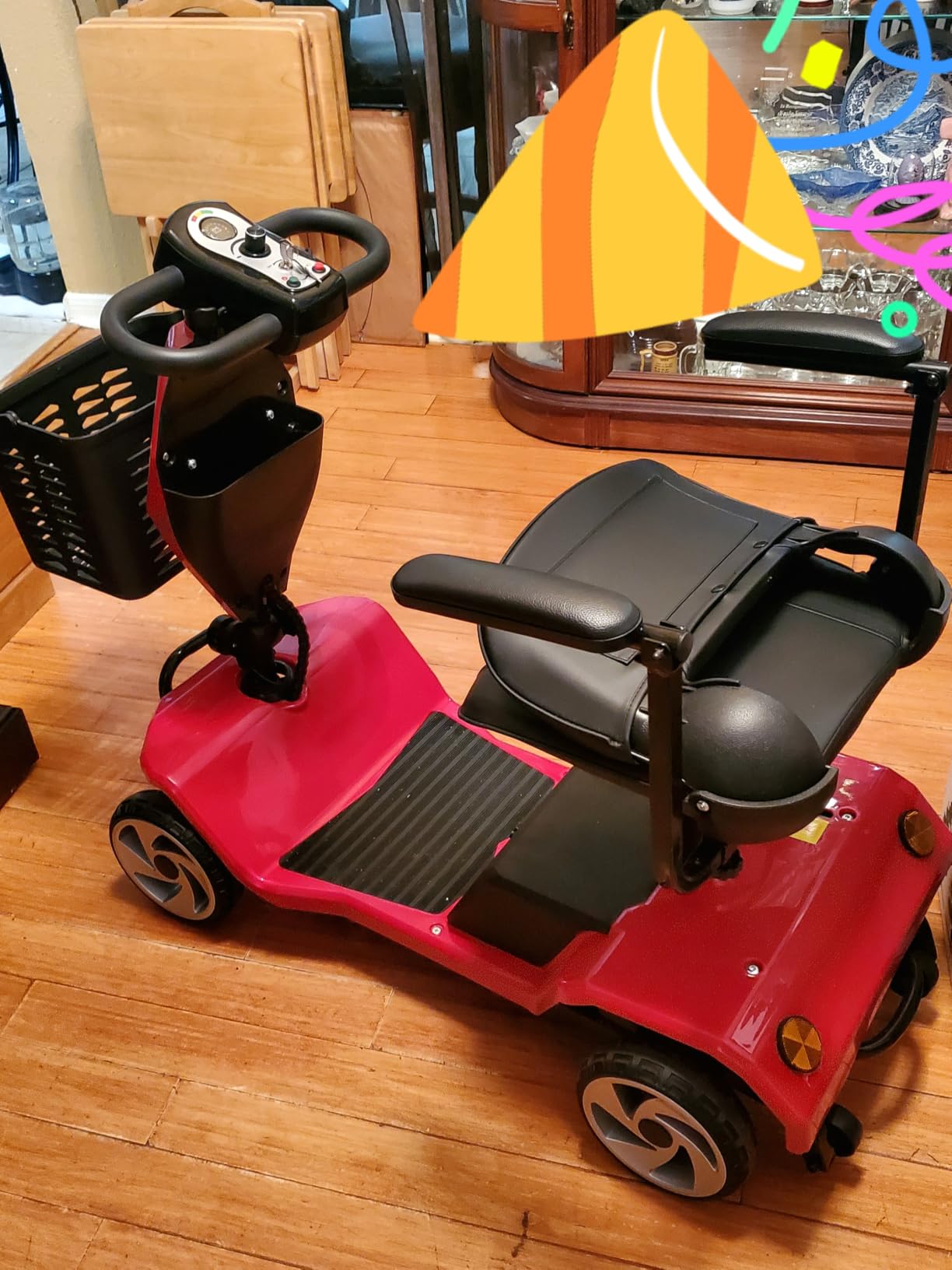
Mechanically it is a competent four-wheel machine. The 300W motors handle urban sidewalks, uneven trails, and 15-degree inclines, the reinforced frame supports 330 pounds, and the foldable frame stores in a car trunk. The 360-degree swivel seat has a contoured backrest and the armrests adjust, which is the pairing we look for on anyone recovering from hip surgery.
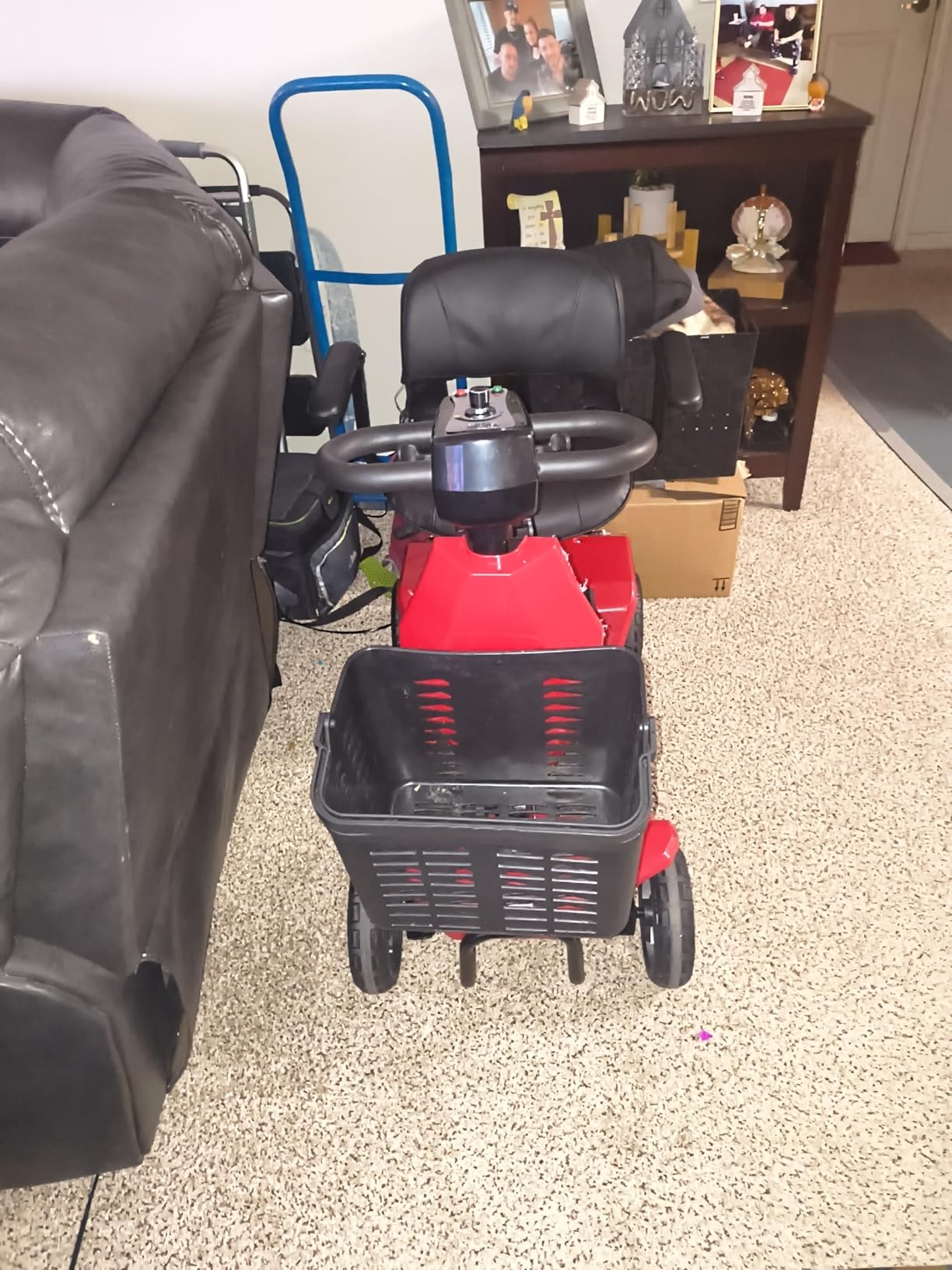
Safety details are sensible: electromagnetic braking, anti-tip rear wheels, anti-slip treads, and a dedicated security key that prevents unauthorized startup. The control panel has a forward and reverse switch, a speed dial, a battery level display, plus horn and LED lighting buttons. That is more than most competitors at this level provide.
Two honest caveats. The rear lighting is reflective rather than active, so it makes you more visible but does not light the path ahead, and you will need a separate light source for evening travel. And at 188 reviews this is the newest listing in the roundup, so the long-term record simply does not exist yet.
Who the Serianie fits well
It fits riders who use an HSA or FSA and want mobility equipment covered by those funds, which is a surprisingly large group of people who do not realize they can. It also fits anyone in the 300-plus-pound range who needs a foldable frame for car travel.
The security key is a small but real advantage for a machine that may live in a shared hallway, a garage, or a vehicle, where a keyed start is worth more than it sounds.
Who should skip the Serianie
Skip it if evening travel is part of your routine and you want the scooter to light your way. Reflective panels only work when light hits them, and a separate headlight becomes a required accessory rather than an option.
It is also worth weighing the 84-pound total against your loading capacity, and recognizing that a shorter review history means less long-term evidence. The mechanics look right, but the track record is short.
Two-Wheel or Four-Wheel: Which Seated Scooter Fits Your Life
The single most useful question is not about price or speed. It is where you are actually going. A seated scooter-bike and a four-wheel mobility scooter serve different environments, and the wrong one produces frustration within a week.
Choose a seated scooter-bike if you ride on pavement
Gotrax, Gyroor, Awwscooter, and URBANMAX all fall here. They run 9 to 19 mph, have 12-inch wheels, and cover real neighborhood distance. The Gotrax and Gyroor have suspension and pneumatic tires, the Awwscooter has the gentlest starting speed, and the URBANMAX has the best brakes. If your route includes a park path, a long street, or a bike lane, this is your category.
Choose a four-wheel scooter if your world is small and paved
Vive, SKRT, WAYCARE, Rylox, and Serianie run 4 to 7 mph with swivel seats and tiller controls. They turn in tight spaces, work in stores and corridors, and are far less demanding on balance. If your world is a building, a campus, a shopping center, or a neighborhood of short flat trips, this is the safer and calmer choice.
Choose a heavy-duty four-wheeler only if weight or terrain demands it
The LAGTOM and VEVOR carry 500 pounds and handle sand, slopes, and mud. Both weigh 258 pounds or more, which means neither can be loaded into a car. Treat this class as permanent furniture in a garage or barn rather than portable mobility.
A note on balance
Riders with genuine balance concerns should default to four wheels and never talk themselves into a two-wheeler to save money or gain speed. Riders with good balance and knee or hip pain often find the seated scooter-bike more comfortable than any chair, because the seat lets them take weight off their legs on longer routes.
How to Choose a Seated Electric Scooter for Seniors?
Match the scooter to your condition, not just your age
Age is a poor guide. The relevant questions are specific. If you have arthritis in your hands, throttle design matters more than anything else on the spec sheet. If you are recovering from hip or knee replacement, seat height and a swivel seat decide whether you can board without help. If you have balance limitations or a history of falls, four wheels are not optional.
For arthritic hands, a twist throttle requires a rotating grip that many riders cannot comfortably perform. A thumb throttle, or a variable speed dial like the one on the WAYCARE, removes that demand entirely. Every scooter-bike here uses a throttle, so check the control shape before anything else. For post-surgical riders, prioritize a swivel seat with flip-up armrests, and measure the seat height against the height of your own chair at home.
Step-through height and mounting effort
How you get on matters as much as how you ride. A step-through frame with no crossbar means you swing a leg over from the side rather than lifting it over a tube, which is easier on hips and knees. Four-wheel scooters with low deck height and a swivel seat are the easiest to board, and the largest difference between models here is the seat adjustment range.
Spend ten minutes seated before you commit. Sit down, stand up, sit again, and check that your feet reach the deck or footrest flat while your back is supported. Riders who skip this test are the ones who discover the seat is wrong after delivery.
Throttle choice for arthritic hands
There are three patterns. A thumb throttle needs only a press, which is the least demanding. A twist throttle needs wrist rotation and grip strength. A variable speed dial is set once and then requires no hand effort at all while riding, which is why the WAYCARE’s single dial is worth highlighting for anyone with hand arthritis.
The four-wheel mobility scooters in this roundup all use a tiller with a speed knob and direction switch, which is in the same low-effort category. Whatever you choose, set the maximum speed to its lowest setting for your first week, then increase it as your confidence builds.
Claimed range versus the range you will actually get
Plan on roughly half the advertised figure for anything with hills, cold weather, or a rider near the weight limit. That is not a defect in the product; it is physics plus marketing. Real-world numbers from owners on these specific models land well below the claims more often than not.
Our practical guidance: take the lowest range figure anyone reports for your route type, halve it again, and see whether the result still covers your round trip. If it does not, the answer is a larger battery, a mid-day charge, or a shorter route. Do not buy on the box number alone, because that is the mistake that produces a scooter nobody uses in month two.
Charging time is the other half of the equation. Most of these charge in 5 to 6 hours, which means overnight charging on a standard outlet. A detachable battery, as on the SKRT, Rylox, and Mbxcooter, is a real convenience because you can charge the pack indoors without moving the whole machine.
Brakes, suspension and tires over rough pavement
Pneumatic tires and suspension are the single biggest comfort upgrade. Owners consistently describe the jump from solid to air-filled tires as dramatic, because air absorbs what rubber alone cannot. The Gotrax, Gyroor, Awwscooter, and URBANMAX all use 12-inch pneumatic tires; the four-wheel mobility scooters here use solid or flat-free tires because their wheels are smaller and their speeds are lower.
Brakes come in three flavors. Drum brakes are progressive and easy to modulate, which is why riders like them on the Gotrax. Mechanical disc brakes, on the Gyroor, Awwscooter, and URBANMAX, give the shortest stopping distances, which matters at higher speeds, and they need periodic pad inspection and adjustment. The mobility scooters use electromagnetic brakes, which engage automatically and require no adjustment.
Suspension is where expectations need adjusting. The Gotrax has dual rear shock absorbers and the best seat post in the group; the Gyroor and Awwscooter have partial suspension; the URBANMAX has a single shock absorber. The heavy-duty four-wheelers rely on tire size, with fat tires and springs doing the work. None of the mobility scooters here has true suspension, so uneven pavement will feel firm on all of them.
Weight capacity, piece weight and car transport
Two numbers matter and they are not the same. Weight capacity is how much rider the scooter supports: 220 pounds for the Gotrax, 265 for most scooter-bikes, 300 to 330 for the mobility scooters, and 500 for the heavy-duty pair. Check your weight against the rating with real margin, because the rating assumes pavement and a properly inflated tire.
Piece weight is what decides whether the scooter can live in your car. Disassembly into pieces is standard, and the piece that matters is the heaviest one: 29 pounds on the Vive rear section, 40 on the SKRT, 50 on the Rylox, and 258 or more on the heavy-duty models. If you plan to load alone, anything above 30 pounds per piece is a real problem for riders with back or shoulder limits, and it is a problem that repeats on every single trip.
Owners on our forum discussions raised a related point that we agree with: total weight is far less useful than heaviest-piece weight when you are deciding whether a scooter fits your life. A 275-pound scooter that splits into four equal pieces is harder to manage than an 89-pound one with a 50-pound chunk, but only for the minute it takes to lift.
Battery safety, certification and charging habits
Look for UL2272 certification, which is the electrical system safety standard that serious brands carry. Five of the models in this roundup are UL2272 certified: the Gotrax, Gyroor, Awwscooter, and URBANMAX, plus the certification is worth confirming on any model where the listing does not mention it. Forum reviewers consistently treat that mark as the signal that separates serious manufacturers from the rest.
Charging habits matter more than most buyers expect. Charge on a hard surface away from combustibles, do not leave a scooter charging overnight every night, and if a battery is swollen, stop using it. A detachable battery is easier to charge safely indoors than a permanently installed one because you control where it sits.
On cold weather, expect less range. This is not a specific claim about these models but a general property of lithium-ion chemistry, and it is the reason riders in northern climates plan shorter winter routes. If you live where temperatures drop below freezing, ask the manufacturer about the rated operating temperature before assuming year-round range figures apply.
Assembly, warranty and long-term upkeep
Assembly ranges from genuinely trivial to worth planning for. The Gyroor arrives nearly assembled, the Rylox takes about ten minutes with no tools, and the Gotrax ships 90 percent pre-assembled with tools included. At the other end, the Mbxcooter’s instructions are terse and partly in Chinglish, and the Awwscooter’s are difficult to follow. Budget an extra hour for the difficult ones rather than expecting a one-box afternoon.
Warranty lengths vary enormously and are worth checking before purchase. The Vive carries a five-year guarantee, which is the longest in this roundup and matters most on the Vive because its molded battery compartment cannot accept a standard lithium upgrade later. The Gyroor gives one year on the scooter and six months on the battery, the Gotrax offers one year plus a 365-day parts warranty, and the Awwscooter and URBANMAX both cover the battery for six months and parts for one year. A six-month battery warranty is a real limitation on a machine you hope to keep for years.
For upkeep, a simple schedule covers almost everything. Check tire pressure monthly if you run pneumatic tires, inspect brake pads every few hundred miles on disc-brake models, and tighten the handlebar, stem, and seat post bolts every couple of months since loosening hardware is the most common mechanical complaint across this entire group. Check brake pads and fasteners on the Gotrax and URBANMAX particularly, and expect to replace tires and pads eventually on any scooter used daily. A caregiver adding five minutes to a monthly check prevents most of the complaints we read about.
Frequently Asked Questions
What is the best electric scooter for older people?
The best seated electric scooter for older adults is the Vive 4 Wheel Mobility Scooter if your priority is stability, a swivel seat, tool-free four-piece disassembly into a car trunk, and a five-year guarantee. If you want to cover several miles on paved neighborhood routes and your knees rule out standing, the Gotrax A5 with its suspension-mounted seat and 12-inch pneumatic tires is the better match. The right answer depends on your route and your balance, not on your age.
What scooter will Medicare pay for?
Original Medicare generally does not cover scooters bought for convenience. Medicare Part B covers durable medical equipment, including some powered mobility devices, but only when a doctor documents a medical need such as the inability to use a cane or walker, and the device must meet Medicare mobility coverage criteria and be supplied by an approved vendor. Most of the consumer scooters in this roundup are paid for out of pocket. Some purchase with an HSA or FSA, which is how the Serianie model is listed.
What is the best scooter for older people to ride comfortably?
Comfort comes down to seat design, tires, and throttle effort. A swivel seat with flip-up armrests and height adjustment makes boarding and exiting easier, which is the biggest single comfort factor after hip or knee surgery. Pneumatic tires with suspension absorb road vibration that solid tires pass straight through. A thumb throttle or variable speed dial reduces hand strain for arthritic riders, since a twist throttle requires grip and wrist rotation. Set the maximum speed to its lowest setting for the first week.
Which adult electric scooter with a seat is the best?
For adults who want speed and distance on paved routes, the Gyroor C1S is the highest-rated seated scooter in our testing at 4.4, with a 550W motor, 12-inch shock-absorbing vacuum tires, and both a detachable center basket and a rear cargo rack. For adults who need to stay close and stable, the Rylox foldable four-wheel model offers dual removable baskets, a 330-pound capacity, and a ten-minute no-tool assembly. Plan on roughly half the claimed range on any of them.
How far can an electric scooter go on one charge?
The advertised figure is a best case, usually measured with a light rider on flat ground in mild weather. In real owner use, the seated scooter-bikes in this roundup typically deliver 10 to 15 miles where the claims say 16 to 25, and the Gyroor falls closer to 10 against a 20-mile claim. The four-wheel mobility scooters generally hold closer to their claims, running 15 to 20 miles on a fresh charge and less after months of daily use. Hills, cold temperatures, a heavy rider, and steep grades all reduce the number further.
Conclusion: The Best Seated Electric Scooter for Your Routine in 2026
After reviewing all twelve, our pick for most seniors is the Vive 4 Wheel Mobility Scooter, because four-wheel stability, a swivel seat, four-piece disassembly, and a five-year guarantee are the four things that keep a mobility scooter in daily use for years rather than months. If your world is larger and paved, the Gotrax A5 with its suspension-mounted seat is the best value in the seated scooter-bike group, and the Gyroor C1S is the highest-rated with the most useful cargo setup of any of them.
Whatever you choose, test three things before you pay: sit down and stand up without help, ride the lowest speed setting in a flat area, and confirm the heaviest disassembly piece is something you can lift. Those three checks rule out more bad purchases than any spec sheet, and they take twenty minutes.
Start with your route, then your hands, then your knees. The best seated electric scooters for seniors in 2026 are the ones that match how you actually live, and that is a question only you can answer. For more comparisons across the category, see our roundup of electric scooters overall and our off-road scooter guide if your terrain is rougher than pavement.