
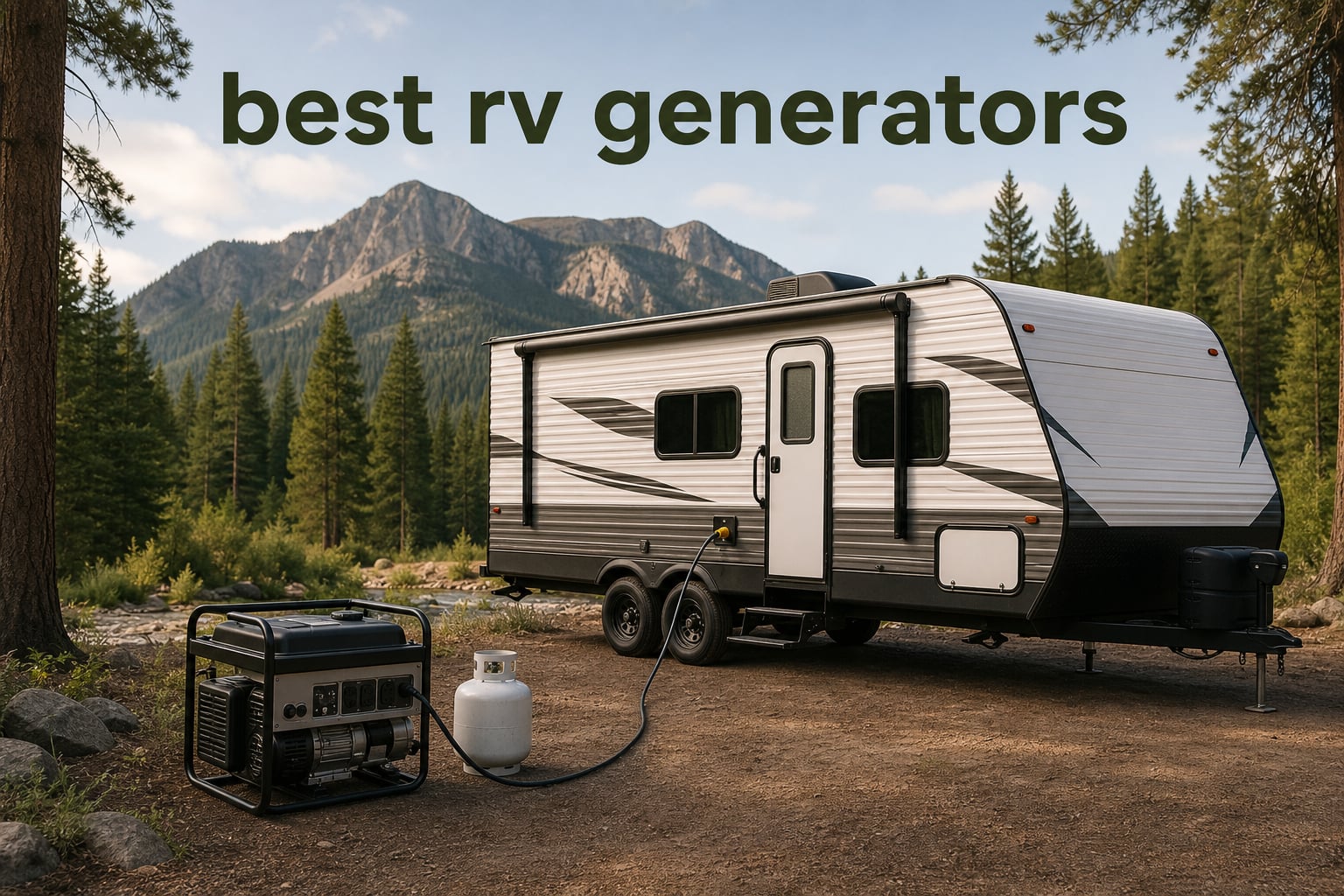
The best RV generators match the appliance with the biggest startup draw, not just a large wattage label. A compact camper that only needs lights, charging, and a fan can use a very different machine than a travel trailer expected to start a rooftop air conditioner.
I start with the RV electrical service, the air-conditioner data plate, and the loads that must stay on together. A 30-amp RV has a practical 3,600-watt ceiling at 120 volts, while a 50-amp coach can have far greater demand; neither fact makes a generator connection automatic.
This 2026 guide compares every analyzed model by its stated watts, fuel choices, weight, runtime, safety hardware, outlets, and noise figure where one is published. It also addresses the worries RV owners repeat in forums: AC startup, heavy lifting, campground sound, propane output, altitude, and maintenance.
My buying rule is to select an inverter generator when clean power and lower noise matter, leave capacity above the continuous load, and retain surge headroom for the largest motor. Read the RV, appliance, and generator manuals before connecting a cord.
The top three RV generator picks cover the most common camper needs 2026
The Champion 4500W is the broad 30-amp choice, the Champion 4000W is the lighter managed-load choice, and the A-iPower 2300W suits compact low-demand trips. Larger models below can be better when a 50-amp outlet, remote start, or substantial output is the deciding feature.
These 12 RV generators provide a quick 2026 overview
This comparison keeps the stated specification points together. Product listings can contain conflicting fields, so the manufacturer manual and your appliance labels remain the final check for an RV connection.
1. The Champion 4375W dual-fuel generator is a direct RV-outlet choice

Champion Power Equipment 4375-Watt Dual Fuel RV Ready Portable Generator with Free 3-Year Warranty
4375W start
3500W run
Dual fuel
TT-30 RV outlet
106 lb
Pros
- Dual fuel flexibility
- TT-30 RV outlet
- CO Shield
- Volt Guard
- 3-year warranty
Cons
- 106 lb
- No listed noise figure
This Champion lists 4,375 starting watts, 3,500 running watts, a 120V 30A TT-30R RV outlet, and a 4.7-gallon tank. The feature list also states gasoline or propane operation, CO Shield carbon-monoxide shutoff, and Volt Guard voltage-spike protection.
I see it as a conventional portable generator for an owner who wants a stated RV receptacle without building the plan around an adapter. Its listed 14-hour runtime is useful trip-planning information, but actual runtime changes with the connected load.
This generator fits a 30-amp trailer with planned loads
The 3,500 running-watt rating gives useful room for essentials and an intentional appliance sequence. Add the loads that remain on, then add the largest startup demand before deciding whether it fits an AC plan.
A TT-30 outlet is helpful for a compatible travel trailer, but the cord and RV input still need to be rated for the setup. I would confirm each connection in the manuals before the first trip.
This generator requires a lifting and noise decision
At 106 pounds, it is above the weight that many RV owners call easy to lift into a truck bed. A roll-out storage location or a second person makes more sense than a solo lift.
No decibel rating appears in the analyzed listing. Campers who stay in close sites should obtain an official sound specification and ask the campground about generator hours.
2. The Champion 4500W dual-fuel inverter is the strongest all-round 30-amp pick

Champion Power Equipment 4500-Watt Electric Start Dual Fuel RV Ready Portable Inverter Generator with Quiet Technology and Free 3-Year Warranty
4500W start
3500W run
Dual fuel
61 dBA
99.2 lb
Pros
- 61 dBA quiet technology
- Up to 21 hours on propane
- CO Shield
- Parallel ready
- EZ Start Dial
Cons
- 99.2 lb
- No customer-image match
This inverter is a compelling broad match because Champion states 4,500 starting watts, 3,500 running watts, dual-fuel operation, and 61 dBA quiet technology. The product also lists Cold Start Technology, CO Shield, an EZ Start Dial, Intelligauge with a power meter, and parallel readiness.
Champion states up to 14 hours on gasoline and 21 hours on propane. Those fuel choices, the RV-focused output, and the noise number answer several common travel-trailer concerns without claiming that every AC and microwave can run together.
This generator suits AC-focused 30-amp camping
A rooftop AC produces a startup surge that owners often underestimate. The 4,500-watt stated starting capacity is a more forgiving starting point than a compact 2,000-watt class unit, while the AC label and a soft start still settle the answer.
Its 99.2-pound listed weight is significant but lower than the largest 50-amp candidates. It is a practical midpoint for a camper who can handle that weight and wants an inverter with a stated quiet-operation figure.
This generator needs fuel-specific and parallel checks
Propane performance may not equal a gasoline rating on a dual-fuel model. Check the manual’s propane output before treating this as an automatic high-load propane solution.
Parallel readiness can expand choices with a compatible second unit and the correct connection equipment. It does not mean any two portable generators can be paired safely.
3. The Gidrox 8000W dual-fuel inverter offers 30-amp and 50-amp outlets

8000W Dual Fuel Inverter Generator – Super Quiet with Remote/Electric Start, CO Sensor, Low THD, 30A & 50A Outlets, Gas & Propane Powered, Perfect for Home Backup, Camping & RV (Black)
8000W listing
Dual fuel
30A and 50A
Remote start
122 lb
Pros
- 30A and 50A outlets
- Remote and electric start
- Under 3% THD
- CO protection
- 3-year warranty
Cons
- 122 lb
- Output fields need manual confirmation
The Gidrox listing has a broad feature set: dual fuel, 30A and 50A outlets, remote and electric start, CO detection, and pure sine-wave output under 3% THD. That combination targets a larger RV setup where receptacle choice and low-distortion power for electronics matter.
The wattage fields need extra care. Its title says 8,000W, details list 8,000 watts output and 6,500 stated starting watts, and the feature summary says 8,000 starting watts, so I would get the manual before matching it to a high-demand load.
This generator fits a larger RV needing stated outlet flexibility
A listed 50-amp outlet can simplify a compatible connection, but it does not identify voltage, wiring, transfer-switch compatibility, or usable output by itself. The RV system and the generator manual need to agree on all of those points.
The 317cc engine, 3.6-gallon tank, and listed 9.5-hour runtime at 25% load identify a substantial machine rather than a small carry-by-one-hand inverter. It makes more sense for capacity-minded owners than for minimalists.
This generator needs a sound and transport plan
At 122 pounds and a stated 74 dB, it is neither the easiest unit to lift nor the quietest listed option. A wheeled route and a campsite that permits generator use are sensible requirements.
Low THD is useful for chargers and electronics, but it does not replace a running-watt calculation. Add continuous loads and allow capacity for the largest motor startup.
4. The Champion 4000W dual-fuel inverter is the lighter AC-capable contender

Champion 4000-Watt Dual Fuel RV Ready Portable Inverter Generator
4000W start
3000W run
Dual fuel
64 dBA
51.8 lb
Pros
- 51.8 lb weight
- Less than 3% THD
- Up to 25 hours on propane
- TT-30 outlet
- Parallel outlets
Cons
- 3000W running limit
- Recoil start
This Champion has 4,000 stated starting watts and 3,000 running watts in a 51.8-pound package. It adds dual fuel, a 64 dBA rating, clean electricity listed at less than 3% THD, CO Shield, a 120V 25A TT-30R outlet, and parallel outlets.
The weight is the standout. It is dramatically easier to handle than the 99- to 122-pound alternatives while offering enough stated surge to investigate a compatible, soft-start-equipped AC system.
This generator fits lighter trailers with managed demand
I would put this model near the top for a couple or small family that moves the generator often. Its stated 10-hour gasoline and 25-hour propane runtimes can work well when the active load stays moderate.
The 3,000 running-watt limit leaves limited room after a major appliance is operating. Treat the coffee maker, microwave, water heater, and AC as scheduled loads, not a simultaneous default.
This generator benefits from a soft-start decision
A soft start is an add-on that reduces the compressor’s startup surge on a compatible air conditioner. It may make a smaller generator practical for that AC, but it does not supply extra continuous capacity.
Confirm the AC plate, the soft-start instructions, and the generator manual before relying on the pairing. A 4,000-watt product name is not a universal AC guarantee.
5. The Champion 11000W dual-fuel inverter is for large RV and backup demands

Champion Power Equipment 11,000-Watt Electric Start Dual Fuel Home Backup Portable Inverter Generator with Quiet Technology and Free 3-Year Warranty
11000W start
9000W run
Dual fuel
64 dBA
205.1 lb
Pros
- 9000W running power
- Electric start
- 64 dBA listed
- CO Shield
- 15-hour runtime
Cons
- 205.1 lb
- Too heavy for routine lifting
This Champion sits in a different output class with 11,000 stated starting watts and 9,000 running watts. The listing names dual fuel, battery-included electric start, CO Shield, a 10.8-gallon tank, 64 dBA quiet technology, and up to 15 hours runtime.
It can suit a large coach load or home-backup role where a compact inverter cannot carry the demand. Its 205.1-pound listed weight is equally important data, since it determines the storage and moving plan.
This generator fits high-output use with organized handling
For a 50-amp RV, this output creates more room for multiple appliances than a 3,000-watt model. The plug arrangement, voltage, RV input, and safe connection equipment still have to match before that capacity is available.
Electric start is welcome on a unit this large. I would plan a level storage area, a rolling path, and help for any move rather than expecting routine manual lifting.
This generator is not the compact campground answer
Owners in RV discussions often call anything over 100 pounds difficult to lift, and this one is roughly double that mark. It fits a fixed storage strategy much better than a quick truck-bed transfer.
A 64 dBA listing is useful, but every campground’s rules still apply. Keep it outdoors, away from openings and neighboring sites, and respect quiet-hour restrictions.
6. The Genkins 4500W dual-fuel generator is a basic power-first choice
Genkins 4500 Watt Dual Fuel Generator Propane & Gas
4500W start
3600W run
Dual fuel
4 gallon tank
98 lb
Pros
- 3600W rated output
- Gas or propane
- 4 gallon tank
- Low-oil shutdown
- RV-ready outlets
Cons
- 98 lb
- Manual choke and recoil start
The Genkins is a straightforward 223cc OHV four-stroke generator with dual-fuel capability, recoil start, a fuel gauge, low-oil shutdown, and a steel frame. It lists 4,500 starting watts, 3,600 running watts, a 4-gallon tank, and six hours of runtime.
It is worth considering for RV and jobsite-ready outlets when the goal is basic dual-fuel power rather than a detailed inverter feature set. The analyzed data does not provide a decibel figure or a THD rating, which makes those qualities unknown rather than poor.
This generator suits simple dual-fuel RV routines
Gasoline and propane capability gives a traveler flexibility if the RV already uses propane cylinders. Verify fuel-specific output in the manual before a high-load propane plan because propane ratings can be lower.
The stated 3,600 running watts offer room for many essential loads, but a 98-pound unit needs a sensible lift plan. It is close to the point where one-person truck-bed loading is a poor fit.
This generator requires added quiet-operation research
Without a published dBA measurement in the listing, its campground sound fit cannot be fairly compared with models listing 60, 61, or 64 dBA. Get a manufacturer figure and check the site rules first.
Recoil start and manual choke favor a more hands-on routine than electric start. Follow the manual closely in cold weather and maintain the engine according to its published service schedule.
7. The A-iPower 2300W dual-fuel inverter is for compact low-demand camping

A-iPower 2300W Dual Fuel Inverter Generator, RV Ready, Parallel Ready
2300W start
1800W run
Dual fuel
61 dB
40.3 lb
Pros
- 40.3 lb weight
- Telescopic handle
- 61 dB stated
- 3% THD
- CO sensor
Cons
- 1800W running limit
- 0.9 gallon tank
The A-iPower SUA2301iD is the lightest listed choice at 40.3 pounds. It provides 2,300 starting watts, 1,800 running watts on gasoline, dual fuel, a telescopic handle, CO sensor, low-idle technology, two USB ports, a stated 61 dB sound level, and 3% THD.
I would describe it as a campervan, pop-up, or low-demand trailer generator rather than a default rooftop-AC solution. Its compact dimensions and easier carry weight are meaningful advantages where raw output is not the first concern.
This generator fits charging and light appliance use
At 1,800 running watts, the use case is charging, lights, small electronics, and carefully selected low-draw appliances. It works for a camper that has a modest electrical routine and does not expect every load to run at once.
The 0.9-gallon tank and listed nine-hour runtime reinforce the same idea. Lower demand and low-idle operation can extend a stop between refueling, while heavier demand reduces duration.
This generator is not a blanket rooftop-AC solution
A compatible AC with a soft start may work in limited circumstances, but that depends on exact equipment and a very light remaining load. The air-conditioner plate, soft-start documentation, and generator manual decide the answer.
If the goal is AC plus microwave use, begin with the assumption that a larger generator is needed until a load calculation proves otherwise. The 3,000- to 3,500-watt running models leave far more operating margin.
8. The Aceup 4000W dual-fuel inverter combines clean power and a compact weight

Aceup Energy 4000 Watt Dual Fuel Inverter Generator 149cc,Quiet Portable Gas and Propane Powered Quiet for Home, RV-Ready, EPA Compliant
4000W start
3200W run
Dual fuel
about 60 dB
51.8 lb
Pros
- About 60 dB in Eco mode
- THD below 1.5%
- 51.8 lb
- Parallel ready
- RV outlets
Cons
- 5-hour listed runtime
- Recoil start
The Aceup AI4000Ds lists 4,000 peak watts and 3,200 running watts on gasoline in a 51.8-pound inverter. Its stated features include about 60 dB in Eco mode, THD below 1.5%, an RV outlet, parallel readiness, recoil start, and dual-fuel capability.
It supplies an important fuel-planning detail that many listings omit: 3,500 peak and 3,000 running watts on propane. I value that distinction because it prevents a gasoline AC calculation from being copied directly to propane use.
This generator suits quiet-minded campers with measured demand
A stated 60 dB Eco-mode figure places it among the quieter reported figures in this group, though sound changes with load and distance. The 3,200-watt gasoline running rating gives more room than a small 1,800-watt inverter.
THD below 1.5% is a strong stated point for sensitive electronics such as chargers. It does not change outdoor-only operation, cord care, or the need to avoid overloading the generator.
This generator requires runtime and propane planning
The 1.32-gallon tank and five-hour listed runtime mean a long dry-camping day needs a fuel plan. Eco mode may help on light loads, but plan around the manufacturer’s stated condition.
For propane operation, use the stated 3,000 running-watt figure in the calculation. I would not use the higher gasoline number as a propane AC allowance.
9. The PowerSmart 4400W dual-fuel inverter favors stated light-load runtime

PowerSmart 4400-Watt Dual Fuel Portable Inverter Generator, PowerSmart Gas Powered, CO-Sensor, Lightweight & Quiet for Home Use and Emergency Backup, Camping, EPA Compliant
4400W start
3600W listed rated
Dual fuel
68 lb
CO sensor
Pros
- Dual fuel
- CO sensor
- 11-hour stated runtime
- Low-oil shutdown
- 68 lb weight
Cons
- 76 dB stated
- Only two outlets
PowerSmart lists this dual-fuel model with 4,400 starting watts, a CO sensor, low-oil shutdown, overload protection, a 1.6-gallon tank, and 11 hours of runtime at 25% load. Its feature summary describes 3,600 rated watts.
The product-details fields also say 4,400 watts for output and running wattage. I would resolve that conflict with the manual before choosing a cord, connecting AC, or treating the generator as a 3,600- or 4,400-watt continuous source.
This generator suits light-load runtime priorities
Eleven hours at 25% load can be attractive for battery charging, lighting, and other modest needs. It is not an 11-hour claim with a heavily loaded air conditioner, which is why the stated load percentage matters.
At 68 pounds, it is easier to move than a 98-pound conventional unit but is not a one-hand carry. Plan the actual path from RV storage to the permitted operating spot.
This generator is less suited to close campground neighbors
The analyzed data lists 76 dB, above the 60 to 64 dBA figures reported for several other models here. I would make sound a priority if campsites are close or quiet hours are strict.
The listing also says there are only two power outlets. Check them against the RV cord and intended loads, since an adapter never adds capacity.
10. The AIVOLT 11250W dual-fuel inverter is a high-output 50-amp candidate
AIVOLT 11250W Dual Fuel Inverter Generator 50A for Home Backup
11250W listing
9000W run
Dual fuel
50A RV outlet
Remote start
Pros
- 50A RV outlet
- Remote electric and recoil start
- 19-hour Eco runtime
- CO shutdown
- Parallel capable
Cons
- Heavy
- Output listing should be confirmed
The AIVOLT is built around high-load features: dual fuel, a 50 AMP RV outlet, remote, electric, and recoil start, automatic CO shutdown, Eco Mode, parallel capability, and a stated 19-hour runtime. The feature list calls out 11,250 peak watts and 9,000 running watts on gasoline.
Its data needs confirmation before a 50-amp connection. The title says 11,250W while product-details fields list 9,000 watts for running and starting, so a manual check should come before any expectation about full-coach operation.
This generator suits large RV output needs with verified wiring
A 50-amp outlet and 9,000 listed running watts make it worth considering for a coach with bigger demands than a travel trailer. That capacity does not override the RV’s input arrangement or make an improvised panel connection safe.
Remote start is convenient when a generator is safely placed outdoors at a distance. It is not a reason to move a fuel-burning machine closer to doors, windows, or vents.
This generator needs transport and altitude planning
The listing calls the unit heavy for portable use but does not provide a weight in the analyzed data. Its dimensions warrant a storage measurement and a wheeled transport route before purchase.
Mountain campers should not assume stated output stays unchanged at elevation. Forum discussions identify high-altitude performance as a common problem, so follow manufacturer altitude guidance rather than guessing.
11. The Champion 4500W remote-start inverter is the gasoline convenience choice

Champion 4500-Watt Wireless Remote Start Portable Inverter Generator
4500W start
3500W run
Gasoline
61 dBA
80 foot remote
Pros
- 80 foot wireless remote
- 61 dBA
- Eco Mode
- CO Shield
- 14-hour runtime
Cons
- Gasoline only
- 101 lb
This Champion lists 4,500 starting watts, 3,500 running watts, 61 dBA, Economy Mode, CO Shield, and a wireless key fob with an 80-foot range. It is gasoline only, exchanging propane flexibility for a remote-start arrangement.
That trade can make sense for a camper who already carries gasoline and wants simple remote start and stop. Its listed 101-pound weight means the remote feature does not change the transport task.
This generator fits owners who value remote starting
The 80-foot remote can be useful when the generator is placed at the required outdoor distance. Still inspect fuel, cords, exhaust direction, and the surrounding area before every start.
Champion states up to 14 hours runtime with a 2.3-gallon tank. Actual results depend on load and Economy Mode use, so treat the number as a tested reference instead of an all-load promise.
This generator does not fit propane-first camping
Choose a dual-fuel option if the RV routine centers on propane cylinders and avoiding separate gasoline storage. A gasoline-only generator has less fuel flexibility even when its starting system is more convenient.
The stated 61 dBA makes it one of the quieter listed models. Campground rules still control because product sound figures are measured in defined conditions rather than every site layout.
12. The Champion 4250W dual-fuel inverter is a long-runtime 30-amp choice

Champion Power Equipment, 4250/3500w Dual Fuel Inverter Generator, Surge Watts 4250 Rated Watts 3500 Voltage 120 Model# 200977
4250W start
3500W run
Dual fuel
64 dBA
79 lb
Pros
- 30A RV outlet
- Up to 22-hour runtime
- 64 dBA
- Economy Mode
- USB ports
Cons
- 79 lb
- Lower propane output
The Champion 200977 lists 4,250 starting watts, 3,500 running watts, dual fuel, 64 dBA, a 120V 30A RV outlet, Economy Mode, Intelligauge, and two USB ports. At 79 pounds, it sits between suitcase inverters and the 100-pound-plus machines.
Its runtime claim is notable: the analyzed data cites up to 22 hours on gasoline, while product details list 21 hours. Review data also notes lower running wattage on propane, which should shape the load calculation.
This generator fits overnight 30-amp dry camping priorities
The 3,500 running-watt rating and stated TT-30 outlet suit a 30-amp travel trailer with disciplined load management. Long listed runtime can reduce refueling interruptions while the generator is supporting modest loads.
The 64 dBA sound figure and Economy Mode are useful for dry camping near others. They do not remove the need for outdoor operation or compliance with the host’s quiet-hour policy.
This generator needs fuel-specific AC planning
Use gasoline and propane ratings separately when assessing a particular air conditioner. Propane convenience does not make gasoline wattage available on propane.
At 79 pounds, the generator is portable but can still be too heavy for a solo lift. Measure the storage lift and consider a ramp or rolling solution before deciding.
The right RV generator begins with a real load calculation and safe placement
Buying gets easier when three questions are kept separate: what must run continuously, what motor has the largest startup draw, and how the RV receives power. A large number on a listing cannot fix an outlet mismatch, too little continuous output, or unsafe generator placement.
Running watts carry the ongoing appliance load
Running watts are the power available while appliances stay on. Add every appliance intended to run together, then leave a margin instead of selecting a generator that will operate at its stated limit for long periods.
Starting watts cover the short extra demand when a motor begins moving. Rooftop AC compressors, refrigerator compressors, and pumps create the mismatch between a generator that looks adequate on paper and one that overloads at the moment of startup.
Small campers can sometimes operate on the A-iPower’s 1,800 running watts for charging and light appliances. RV research in the current results repeatedly identifies about 4,000 watts of startup capacity as a useful threshold to investigate for rooftop AC, but the AC label is decisive.
A 30-amp RV needs a compatible 120-volt plan
The familiar 30A times 120V calculation equals 3,600 watts. That is a useful service ceiling, not an instruction to run at the ceiling or a claim that every generator delivers a matching RV connection.
Several Champions list a TT-30 RV receptacle, including the 4375W, 4250W, and 4000W models. Check the precise outlet, cord rating, and RV manual before powering up, particularly because the 4000W lists a 25A TT-30R outlet and 3,000 running watts.
The Champion 4500W dual-fuel model offers 3,500 stated running watts and 4,500 stated starting watts, making it a strong paper match for a managed 30-amp trailer. It still cannot make every high-draw appliance run with the AC.
A 50-amp RV needs verified voltage and connection hardware
A 50-amp RV can support a far larger demand than a 30-amp trailer, especially if it has two air conditioners. A generator’s 50-amp receptacle only helps where its voltage, wiring, transfer equipment, and available output fit the RV system.
The Gidrox and AIVOLT listings name 50-amp RV outlets, and the Champion 11000W brings high stated output. Product-page fields can conflict, so use the manual to verify ratings and connection details before assigning any of these to a motorhome.
I would seek qualified electrical help for a transfer switch, an RV panel, or an unfamiliar 50-amp connection. Improvised wiring is not an acceptable campsite shortcut.
A soft start reduces an AC surge but does not create power
A soft start changes how a compatible AC compressor comes up to speed, reducing the startup surge. This is why it is discussed so often by owners who want to use a smaller inverter generator with a rooftop air conditioner.
It does not reduce every running load or add watts to the generator. Check the AC label, soft-start instructions, and generator surge and running figures, then turn off other high-draw appliances before a test.
A 2,000-watt-class inverter may run some compatible soft-start AC systems under limited conditions, but that is not a general promise. The A-iPower’s 1,800 running watts leave much less room than the 3,000- to 3,500-watt running models here.
Dual fuel adds flexibility but needs two separate calculations
Gasoline often carries the headline specification, while propane can be convenient for an RV already carrying cylinders. Dual fuel supplies a fallback fuel choice, a benefit many RV owners value for travel and boondocking.
Do not assume propane output matches the gasoline number. The Aceup listing expressly states 4,000 peak and 3,200 running watts on gasoline, versus 3,500 peak and 3,000 running watts on propane.
Select fuel according to storage, refueling access, temperature, and the real power demand. Never refuel a hot running generator, and follow the product instructions for every propane connection and leak check.
Quiet camping depends on dBA, distance, and local rules
Noise is a major camping concern because a generator that is acceptable in a remote area can be unwelcome in a close campground. The Aceup lists about 60 dB in Eco mode, while the Champion 4500W dual-fuel inverter, Champion remote-start inverter, and A-iPower list 61 dB or 61 dBA.
The Champion 4000W and 4250W list 64 dBA, while Gidrox lists 74 dB and PowerSmart lists 76 dB. Load, distance, surface, and campsite layout change what a neighbor hears, so a figure alone does not settle campground compatibility.
Place every generator where the host permits it, keep exhaust away from people and RV openings, and respect quiet hours. A lower dBA number is helpful but not a pass to ignore a park rule.
Portability depends on the lift rather than the marketing label
The A-iPower lists 40.3 pounds, the Champion 4000W and Aceup each list 51.8 pounds, and the Champion 11000W lists 205.1 pounds. These figures tell more about daily ownership than the word portable.
Forum users commonly say generators over 100 pounds are difficult to lift. Measure the route from storage compartment to truck bed and decide whether a ramp, wheels, or another person will be available.
Remote start changes the start-and-stop routine, not moving, securing, or safely placing the machine. Choose the weight you can manage on an ordinary travel day.
Altitude, cold starts, and maintenance require manual-led care
High-altitude performance is a recurring forum pain point, but the analyzed listings do not provide comparable corrected-output figures. Follow the manufacturer’s altitude instructions rather than guessing at remaining capacity on a mountain trip.
Cold weather affects starting procedure, fuel condition, and electric-start battery condition. Champion lists Cold Start Technology on the 4500W dual-fuel and 4000W dual-fuel inverters, yet every owner still needs the manual for the temperature and fuel used.
Use the published maintenance schedule for oil, air filter, spark plug, storage fuel preparation, and battery care. Routine service prevents many common RV generator problems and should always be performed with the generator outdoors and off as directed.
Carbon-monoxide protection is a backup layer, not a placement rule
CO sensors or automatic CO shutoff appear on several picks, including Champion CO Shield units, A-iPower, PowerSmart, Gidrox, and AIVOLT. No sensor makes a fuel-burning generator safe inside an RV, garage, enclosed tent, or beside a window or vent.
Run it outdoors with exhaust directed away from the RV, doors, windows, vents, and nearby campers. Keep working CO alarms inside the RV and stop operation if an alarm activates or anyone feels unwell.
The search phrase “20 20 20 rule” does not replace the equipment manual or local regulations with one universal clearance claim. Follow the product placement directions and any stricter rules set by the campground or code authority.
These RV generator FAQs answer common sizing and sound questions
What size generator is needed to run an RV?
Size a generator from the loads that run together, using running watts plus the largest motor startup demand. Small campers may work with 1,800 running watts for charging and light appliances, while a trailer with rooftop AC often needs about 4,000 watts of startup capacity and careful load management. Check appliance labels and the generator manual before connecting.
Can I run my RV AC with a 2000 watt generator?
Sometimes, but not as a universal rule. A compatible AC with a soft start and few other active loads may work with a 2,000-watt-class inverter, yet many rooftop units need more startup capacity. Verify the AC label, soft-start documentation, and generator running and surge ratings rather than relying on the generator label alone.
What brand of generator is the most reliable?
RV owner discussions commonly place Honda and Yamaha at the reliability-focused end, with Champion often praised for dual-fuel value. This roundup compares analyzed listings where Champion has several RV-ready models with stated CO protection and three-year limited warranties. Choose by documented power, fuel, service support, and RV fit.
What is the best generator for a 30 amp RV?
A strong 30-amp choice has an appropriate RV receptacle, enough running watts for planned loads, and enough surge for the largest motor. The Champion 4500W dual-fuel inverter lists 3,500 running watts, 4,500 starting watts, 61 dBA, and dual fuel. The Champion 4250W and Champion 4375W are additional RV-ready choices with stated 30A outlets.
What is the quietest RV generator on the market?
Quiet depends on load and measurement conditions, so these listings do not establish one universal answer. The Aceup 4000W lists about 60 dB in Eco mode, while the Champion 4500W dual-fuel inverter, Champion remote-start inverter, and A-iPower 2300W list 61 dB or 61 dBA. Follow campground quiet-hour rules and outdoor-placement directions.
The best RV generator is the model that fits your RV service, AC, and campsite
For an all-round 30-amp choice, the Champion 4500W dual-fuel inverter combines stated 3,500 running watts, 4,500 starting watts, 61 dBA operation, and fuel flexibility. The Champion 4000W is the lighter option when 51.8-pound portability and 3,000 running watts fit the plan, while the A-iPower suits compact low-demand trips.
For a 50-amp RV or larger demand, study the AIVOLT, Gidrox, and Champion 11000W using the relevant manuals, not outlet labels alone. The best RV generators in 2026 follow a real load calculation, fuel-specific output check, and safe outdoor placement plan.