
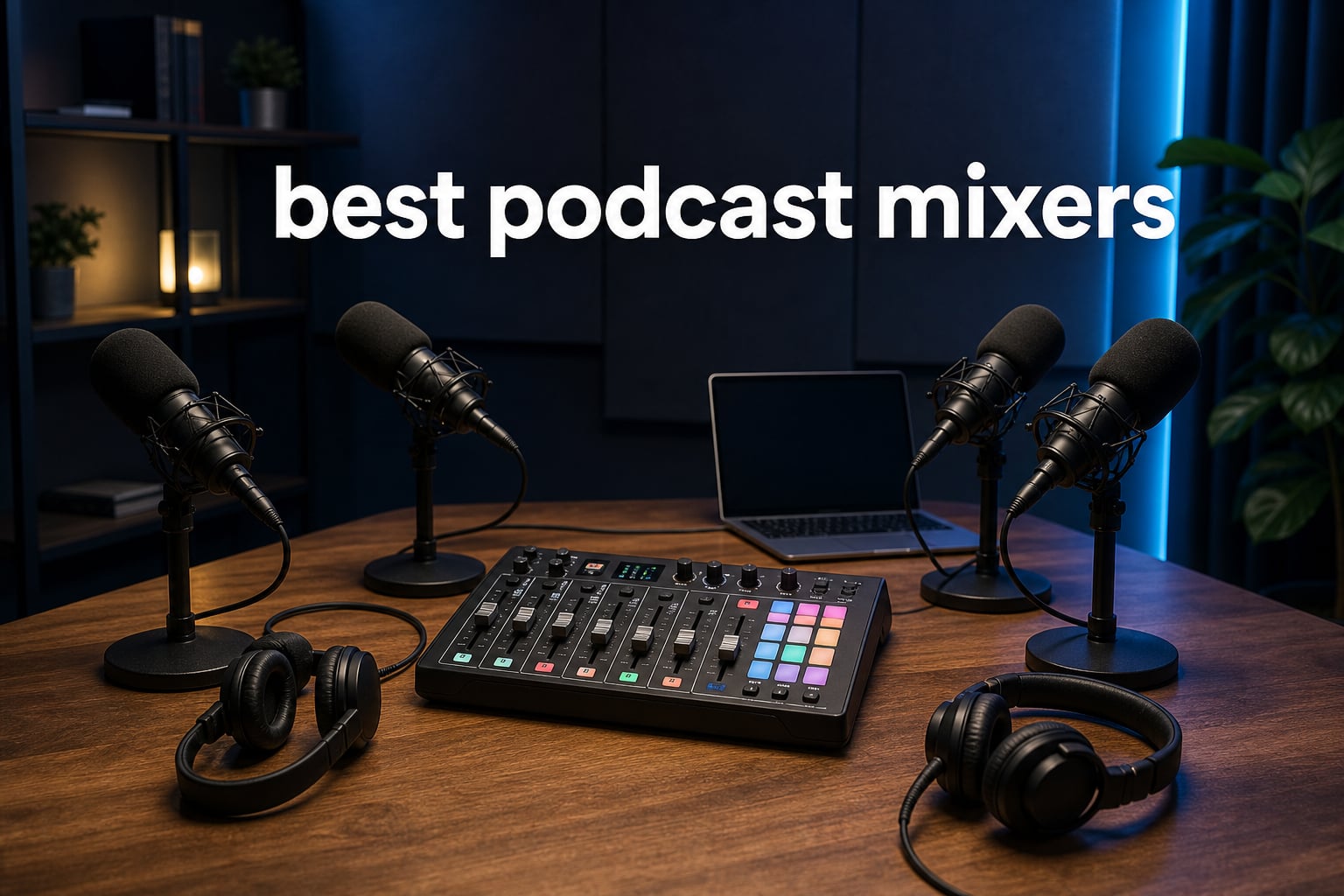
The best podcast mixers let you control voices, music, remote callers, and recording without turning every episode into a rescue job in post-production. I compared eight current mixer and interface options around the choices that matter most: microphone count, clean gain, independent headphone monitoring, local recording, phone connections, sound pads, and how much menu work a first-time host must learn.
A podcast mixer is a purpose-built control center that boosts microphones through preamps, sets a level for each source, and sends audio to a computer or recorder. Some units here are true multi-input podcast consoles with faders and local recording, while others are compact USB audio interfaces that make more sense for one host or a creator who records straight into a DAW.
The difference matters. A regular analog mixer can blend signals, but it may not record separate tracks or connect to a phone; a USB audio interface handles microphone-to-computer capture but may not offer pads, guest inputs, or hands-on mixing; a dedicated recorder can capture a show without a computer. Forum discussions repeatedly show that beginners are less bothered by missing novelty effects than by confusing routing, weak microphone gain, and a lack of a simple guest path.
My short answer is this: choose the number of XLR microphones you need on a normal recording day, then choose the recording path you can actually live with. Four hosts need a different podcast console from a solo show, and a travel show benefits from battery power far more than a large touchscreen.
Top 3 picks for the best podcast mixers are clear by setup 2026
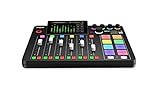
For a full desk-based studio, I would start with the RØDE RØDECaster Pro II. The Zoom PodTrak P4next is the stronger fit when four people need a portable recorder, while the FIFINE AmpliGame SC3 keeps a single-microphone streaming desk simple.
The best podcast mixers in 2026 compared at a glance
This overview sorts the eight picks by the job they do rather than pretending every creator needs the same feature stack. The RØDE, Zoom, and TASCAM are strongest for multiple voices, while the compact MAONO and FIFINE options suit a single-host desk or stream.
| Product | Specs | Action |
|---|---|---|
| RØDE RØDECaster Pro II |
|
Check Latest Price |
 Zoom PodTrak P4next Zoom PodTrak P4next |
|
Check Latest Price |
 FIFINE AmpliGame SC3 FIFINE AmpliGame SC3 |
|
Check Latest Price |
 TASCAM Mixcast 4 TASCAM Mixcast 4 |
|
Check Latest Price |
 MAONO P2 Hybrid MAONO P2 Hybrid |
|
Check Latest Price |
 MAONO MaonoCaster AME2 MAONO MaonoCaster AME2 |
|
Check Latest Price |
 MAONO PS22 Lite MAONO PS22 Lite |
|
Check Latest Price |
 Mackie DLZ Creator XS Mackie DLZ Creator XS |
|
Check Latest Price |
1. The RØDE RØDECaster Pro II is the best all-in-one desk console
RØDE RØDECaster Pro II All-in-One Audio Production Studio
4 combo inputs
Dual USB and Bluetooth
8 SMART pads
Pros
- Four flexible combo inputs
- Dual USB plus Bluetooth
- APHEX processing
- Records to microSD or USB
Cons
- Learning curve for beginners
- Larger desk footprint
The RØDE RØDECaster Pro II is my first choice for a fixed podcast studio that records several people and also handles a computer, phone, and clips. Four Neutrik combo inputs give it room for microphones, line sources, or instruments, while dual USB and Bluetooth make it easier to bring in a remote caller or a second computer.
It is more than a USB audio interface with extra buttons. RØDE lists a quad-core engine, customizable workflow controls, and APHEX processing that includes Aural Exciter, Big Bottom, and Compellor, so the board is designed to shape a finished broadcast-style sound before the file reaches editing software.
The eight SMART pads have eight banks for 64 total actions. I like that breadth for shows with an intro, stingers, censor clips, recurring segments, and preloaded guest material, but it also explains why this is not the fastest board to learn by trial and error.
Four-host productions get the broadest routing options here
Four combo sockets are the practical starting point for a roundtable, and the unit can record to microSD, external storage, or a computer through USB. That choice gives a producer a backup approach and reduces the risk of building a show around just one recording destination.
Each participant still needs a microphone, cable, and headphones, but the console itself does not force the four-person show into an add-on preamp. Its 250 mW headphone-output specification also signals that monitoring was treated as a major part of the design.
Hands-on producers benefit most from the customizable controls
Someone who wants to set up a show once and repeat the process each week will get more from the pads and routing than a host who only records one voice into a laptop. The Wi-Fi and Ethernet connections are useful for a desk that stays put and may receive updates or work within a networked production space.
The supplied data lists a two-year warranty, which is longer than the one-year coverage listed for several compact alternatives in this group. I would set aside time for a deliberate first setup: name inputs, establish a monitoring routine, and decide whether you want to record to microSD, storage, or the computer.
2. The Zoom PodTrak P4next is the best portable mixer for four people
Zoom PodTrak P4next Podcast Recorder with 4 Inputs + AI Noise Reduction
4 XLR inputs
4 headphone outputs
Battery power and SD recording
Pros
- Four XLR microphone inputs
- Up to 70dB gain
- Four individual headphone outputs
- Battery-powered operation
Cons
- Needs an SDHC card
- Battery runtime is finite
The Zoom PodTrak P4next is the best podcast mixer choice here for creators who need four microphones away from a permanent desk. It combines four XLR inputs, four separately controlled headphone outputs, phone connection support, and battery operation in a recorder that is much lighter than a large console.
Its headline technical advantage is up to 70 dB of gain. That is a meaningful specification for dynamic microphones that need more level, and it can spare a beginner the extra complication of adding an inline booster before they know whether they need one.
Zoom also lists AI noise reduction, Tone Enhancement, and COMP features. These can make a rough location or untreated room more manageable, but I would still prioritize microphone placement and quiet monitoring over asking processing to fix every problem.
Mobile roundtables work because every person gets a headphone feed
Four dedicated headphone outputs are a better match for an in-person group than a splitter hanging from one socket. Separate volume controls let each speaker hear comfortably without changing the level for the entire table.
The battery rating is 8.5 hours, which is generous for a recording session but not infinite for an event weekend. Pack spare power planning and an SDHC card before leaving home, because local recording is central to why this unit makes sense.
New hosts can keep the recording process computer-free
Recording WAV files to removable media gives a beginner a clear end point: stop the recorder, save the file, and back it up. The USB audio interface function remains available when the show later moves to software-based recording or live streaming.
Community discussions often point mobile beginners toward the PodTrak family because it keeps core podcast jobs in one portable box. I agree with that direction for a four-person field kit, provided you are comfortable handling media cards and maintaining a battery routine.
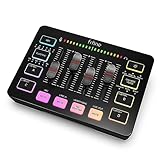
3. The FIFINE AmpliGame SC3 is the easiest single-mic streaming mixer
FIFINE Ampligame SC3 Gaming Audio Mixer with Indi-Fader and Volume Control
XLR with 48V
Four channel controls
Fader and sound pads
Pros
- XLR input with phantom power
- Individual channel controls
- Smooth volume fader
- Plug and play on Mac and Windows
Cons
- One XLR microphone input
- XLR cable is not included
The FIFINE AmpliGame SC3 is a sensible pick for a solo host who also streams and wants physical controls without managing a full recording console. It has one XLR microphone input with 48V phantom power, a USB-C power connection, a fader, and separate controls for mic, line input, headphones, and line out.
That layout is intentionally simpler than the multi-mic boards above. I would not buy it for a co-host show that records both people locally through XLR, but I would consider it for a creator using one microphone, computer audio, and a live platform such as OBS, Twitch, or YouTube.
It includes four customizable sound-effect pads, six voice-changing modes, 12 auto-tune options, and controllable RGB lighting. Those are creative tools rather than audio necessities, so the better reason to choose it is the immediate mute, monitor, and fader access.
A one-person live desk gets fast physical level control
A smooth fader is easier to grab during a live introduction than a buried software slider. The dedicated mute and monitor buttons also make it practical to pause a cough, check your voice, or prevent a private comment from reaching a stream.
The four advertised channels refer to control paths, not four XLR microphones. That distinction is important when comparing an audio mixer for podcasting with a multi-host recorder: channel labels do not always equal the number of people who can plug in professional microphones.
Condenser-mic owners can use phantom power without extra hardware
The SC3 can provide 48V phantom power for a compatible condenser microphone. It can also accept an XLR dynamic microphone, though its results may vary with the microphone and cable choice, and FIFINE does not include the XLR cable.
The compact shape and plug-and-play Mac and Windows support help a newcomer get to a first recording quickly. I would keep the RGB and voice effects off until the voice level is stable, then add them only if they fit the show’s tone.
4. The TASCAM Mixcast 4 is the best touchscreen recorder for a roundtable
TASCAM Mixcast 4 Podcast Streaming Mixer, Recorder, and USB Audio Interface — Four XLR/TRS Mic Inputs, Touch Screen and Editing Software Included
4 XLR/TRS inputs
5 inch touchscreen
14-track SD recording
Pros
- Four mic inputs and headphone outs
- 14-track SD recording
- Bluetooth and phone audio
- Podcast Editor included
Cons
- Desk-based corded design
- Availability can vary
The TASCAM Mixcast 4 targets the host who wants a large, self-contained recording mixer without treating a computer as the center of every session. Its hardware details list four XLR/TRS microphone inputs, four headphone outputs, a 5-inch touchscreen, Bluetooth, USB, TRRS, and SD multitrack recording.
For a multi-host podcast, the 14-track direct-to-SD capability is the standout detail. Separate recording tracks give an editor more freedom to balance a loud laugh, lower a noisy guest, or remove a pause without damaging every other voice.
The included TASCAM Podcast Editor software rounds out the system for creators who want a branded companion app for control and post-editing. I see that as a useful path for a host who wants one ecosystem, though it is still smart to confirm that its workflow matches the editing software you already know.
Roundtable shows get recording depth and monitoring from one unit
Four XLR/TRS inputs allow typical podcast microphones and compatible line-level sources, while four individual headphone outputs keep a full group involved in the conversation. That pairing addresses a common home-studio problem: a show may have enough microphone sockets but no comfortable way for every speaker to monitor.
The Mixcast 4 is corded rather than battery-powered, so I would place it in a studio, office, or regular recording location. It is a recording mixer built for repeat sessions, not the first choice for a backpack interview kit.
Touchscreen-first users can manage pads and sources more directly
The touchscreen gives the system a different feel from a small interface with two knobs. TASCAM also specifies eight banks of illuminated, customizable sound pads, which suits shows that use recurring intros, audience messages, transitions, or pre-recorded clips.
Bluetooth and aux phone audio provide several ways to bring in external sound, although a remote guest still depends on the call service and the setup at both ends. Before recording a remote interview, I would always make a short test call and record it to confirm the return path.
5. The MAONO P2 is the best hybrid interface for computer and phone creators
MAONO P2 Hybrid USB Audio Interface Dual XLR for PC Phone iPad Guitar
Two XLR channels
56dB gain
Dual USB hybrid connectivity
Pros
- Computer and phone or iPad connection
- 56dB gain
- 192kHz recording
- Low-latency ASIO monitoring
Cons
- Limited to two channels
- Needs the appropriate USB cable
The MAONO P2 is a compact two-channel hybrid USB audio interface for a creator whose podcast work crosses a computer and a phone or iPad. MAONO specifies dual USB ports with MFi-certified connectivity, 56 dB of gain, a 24-bit/192 kHz maximum sample rate, and loopback for desktop audio capture.
That makes it a useful bridge between a traditional recording setup and mobile content creation. Rather than loading it with large pads or a touchscreen, the P2 centers on routing, independent mute controls, low-latency monitoring, and compatible software that includes common DAWs plus OBS, Twitch, Discord, and short-form video platforms.
The 15-degree tilt angle is a small but thoughtful desk detail. I prefer controls that can be read at a glance during a recording, especially on a small interface where one mistaken switch can change the signal path.
Two-source creators get useful routing without a large console
Two channels are enough for a solo host plus a guest, a microphone plus an instrument, or a compact two-person recording. They are not enough for a four-host roundtable, so count people before being tempted by its broad device compatibility.
The built-in loopback lets a creator capture a voice, instrument, and computer audio through the interface rather than relying on a loose collection of system settings. That can reduce friction when recording a demonstration, streamed guest, or screen-based tutorial.
Computer and tablet recording benefit from the dual-USB design
MAONO lists compatibility with Android, ChromeOS, Windows, iOS, and macOS, along with support for software such as Logic Pro, Cubase, GarageBand, FL Studio, and Studio One. I would still check the specific port and cable arrangement for the device you own, since the supplied product data notes that the appropriate USB-C-to-USB-A or USB-C cable is required.
The one-year manufacturer warranty is standard within this list. Its compact aluminum-alloy housing and 0.45-kilogram weight point toward a portable desk interface, but its feature set remains more recording-focused than a traditional live mixer.
6. The MAONO MaonoCaster AME2 is the best sound-pad mixer for solo creators
MAONO AME2 Audio Interface Mixer, Podcast Studio Console with XLR Input
60dB preamp
Bluetooth
11 customizable sound pads
Pros
- 60dB low-noise gain
- 48V phantom power
- Eleven sound pads
- Bluetooth and loopback
Cons
- Does not support USB microphones
- One host-focused microphone setup
The MAONO MaonoCaster AME2 is for a host who wants a compact podcast console with a lot of on-board personality. It combines a 60 dB low-noise preamp, 48V phantom power, Bluetooth, loopback controls, instrument input, six reverb modes, auto-tune, tone adjustment, and 11 customizable sound pads.
The pads are unusually flexible for a compact device: three support 60-second recordings with looping and eight support 20-second recordings. I would use that capacity for a theme, short clips, callouts, a safety message, and repeatable segment transitions rather than filling every pad just because it is there.
The product details specify 10 channels and several connection types, including XLR, TRRS, 6.35 mm, and USB-C. That variety supports a creator who moves between voice, guitar, phone-style audio, and desktop recording, but it does not change the fact that USB microphones are not supported.
Segment-heavy shows gain more live production tools
Sound pads make a repeatable live format easier when used with restraint. A host can launch an intro or transition at the right moment instead of adding it later, and loopback can bring computer audio into the recording path.
The sidechain, music-only, and loopback switches point to a more involved creator workflow than a bare-bones interface. I would label each pad in a written setup note at first, particularly if you record infrequently and do not want to relearn the controls before every episode.
Dynamic and condenser microphones have usable gain options
The AME2 offers three levels of microphone gain and up to 60 dB, plus phantom power for compatible condensers. MAONO says it works with microphones such as the Shure SM7B, SM58, and Rode PodMic, but I would set a proper speaking-level test for any microphone rather than assuming one gain setting suits all of them.
Bluetooth offers a convenient mobile audio path for a solo desk. The one-year warranty is listed in the product details, and the 0.95-kilogram build is manageable for a portable content kit when a full console would be overkill.
7. The MAONO PS22 Lite is the best compact interface for a solo recording desk
MAONO PS22 Lite USB Audio Interface for PC for Guitar & Vocals Streaming
XLR input
56dB gain
192kHz audio and ASIO routing
Pros
- 24-bit 192kHz recording
- 56dB gain with 48V
- Instrument input
- Compact plug-and-play design
Cons
- Limited to two channels
- Driver selection may need attention
The MAONO PS22 Lite is not a multi-host podcast console; it is a compact USB audio interface for a single voice, a guest, or a creator adding guitar and DAW work to a podcast setup. It offers two channels, a 56 dB microphone preamp with 48V phantom power, a dedicated instrument input, 24-bit/192 kHz audio, ASIO support, and routing software.
I would choose it when clean computer capture matters more than physical pads and four headphone ports. Its 106 dB dynamic-range specification and low-latency driver support speak to a recording-oriented workflow where you monitor and edit in software.
MAONO includes intuitive modes for recording, live broadcasting, and instruments, plus a dynamic light-ring indicator. Those design choices can make a small interface less intimidating, though the product data also notes that a user may need to select the proper driver inside their DAW.
Solo recording and voice-plus-guitar sessions fit the PS22 Lite
A dedicated instrument input gives a host an easy way to record a music cue, a guitar-led teaching segment, or basic song ideas without a second interface. For spoken-word work, the XLR microphone path and headphone monitoring cover the core job with less hardware on the desk.
The two-channel ceiling should be taken literally. It can support a compact two-source workflow, but a show with three or four in-room hosts should move to a recorder or console with the matching number of XLR inputs.
Software-based creators gain virtual routing and DAW compatibility
The ProStudio routing software offers virtual channels and loopbacks, which can be useful for bringing a computer source into a live broadcast or recording. Listed compatibility includes Windows, macOS, and iPad, along with software such as Pro Tools, Ableton Live, Cubase, Studio One, Logic Pro, Reaper, Audacity, and Adobe Audition.
At 0.43 kilograms, this is one of the lightest options in the group. I would regard it as a compact recording interface that can support podcasting well, not as a substitute for a self-contained four-person mixer.
8. The Mackie DLZ Creator XS is the best guided touchscreen mixer for two mics
Mackie DLZ Creator XS Adaptive Digital Mixer for Podcasting
Two XLR/TRS inputs
7 inch touchscreen
AutoMix and SD recording
Pros
- Three user modes
- AutoMix for two mics
- USB-C and Bluetooth
- Multitrack computer or SD recording
Cons
- Limited to two channels
- Phantom power is menu controlled
The Mackie DLZ Creator XS is a compact digital audio mixer built around guided control instead of a wall of conventional knobs. Its 7-inch touchscreen offers Easy, Enhanced, and Pro modes, while AutoMix can manage up to two microphones and the unit supports USB-C, Bluetooth, SD card recording, NDI, and six customizable trigger pads.
I like the three-mode idea for a host who is still learning signal flow but expects their show to grow in complexity. Easy mode can keep a first recording focused on essentials, then Enhanced or Pro mode can open up more control when the host understands what they want to change.
The limitation is equally clear: there are two XLR/TRS inputs and AutoMix is for up to two microphones. It is a strong guided console for a solo host and co-host, not the right mixer for four people around a table.
Two-person shows get automatic level management and separate monitoring
AutoMix can help keep two voices controlled when hosts speak at different volumes or move off the microphone. The product information also lists separate headphone mixes, which is valuable when one host needs a different listening level from the other.
Automatic mixing does not eliminate good microphone technique. I would still place microphones close enough for a healthy signal, speak across rather than directly into the capsule when appropriate, and test both voices before inviting a guest to join.
Growing creators can move from guided controls to deeper settings
USB-C provides a direct computer path, Bluetooth serves mobile devices, and NDI offers another connection possibility for compatible networked video production. Multitrack recording to a computer or SD card also gives a creator a choice between a software-first workflow and a stand-alone backup.
One operational detail deserves attention: phantom power must be enabled in the menu when using a compatible condenser microphone. The supplied warranty is one year, and I would check the full touchscreen workflow during the return window so the system feels comfortable before it becomes the center of a regular show.
The right podcast mixer starts with your actual recording format
Choosing among the best podcast mixers gets easier when you ignore feature counts for a moment and map a normal episode from start to finish. Ask how many people speak in the same room, whether a remote guest joins by phone or computer, whether you need a computer on every session, and whether you want separate tracks for editing.
For a solo podcast, a compact USB audio interface such as the MAONO PS22 Lite can be enough when you record into a computer. A host who streams, plays clips, and wants a fader may prefer the FIFINE SC3 or MAONO AME2, while an all-in-one desk console makes more sense when show production itself is part of the appeal.
The number of XLR inputs should match your normal guest count
Each in-room person using an XLR microphone needs an available microphone input. One host needs one input, a co-host recording in the same room generally needs two, and a roundtable needs four; buying fewer inputs than the usual show requires creates workarounds before the first episode is finished.
Do not confuse a product’s total channel count with its XLR input count. The MAONO AME2 is described as a 10-channel mixer, for example, but its appeal is its multi-source creator controls, while the Zoom PodTrak P4next and TASCAM Mixcast 4 explicitly provide four microphone inputs for an in-person group.
Preamp gain and phantom power determine microphone compatibility
A preamp raises a low-level microphone signal to a recordable level. Dynamic microphones may need substantial clean gain, which is why the Zoom’s up-to-70 dB specification and the 56 dB to 60 dB figures on several MAONO models are worth checking before you buy.
Phantom power is the 48V supply used by many condenser microphones. It is not automatically better for every microphone, and it should only be switched on for compatible gear; the FIFINE SC3, MAONO P2, MAONO AME2, and MAONO PS22 Lite each list 48V support.
Local multitrack recording gives editors more repair options
Multitrack recording saves people or sources separately rather than combining every sound into one file. That makes it easier to lower a loud guest, clean a cough, or balance a host who sat farther from the microphone, but it also means you must organize more files after the session.
The RØDE RØDECaster Pro II can record to microSD, external storage, or a computer. The Zoom PodTrak P4next, TASCAM Mixcast 4, and Mackie DLZ Creator XS also offer local SD-based recording paths, making them better candidates when you do not want a laptop to be the sole recorder.
Headphone outputs prevent the most common guest-monitoring problem
A speaker who cannot hear a remote caller or their own voice clearly will often talk too loudly or hesitate. Four-person sessions are much easier with four dedicated headphone outputs, a point in favor of the Zoom PodTrak P4next and TASCAM Mixcast 4 for group recording.
A simple splitter can work for a casual two-person recording, but it gives less personal control and can be awkward around a table. For a recurring show, independent headphone level controls are a quality-of-life feature that hosts notice every week.
Remote guests need a reliable return path, not only a phone input
Phone and Bluetooth inputs can bring a caller or music source into the mixer, yet a usable interview also requires the guest to hear you. The RØDE’s dual USB and Bluetooth, the Zoom’s phone connection, the TASCAM’s Bluetooth and TRRS options, and the Mackie’s Bluetooth offer different ways to build that path.
Always make a brief recording test with the actual calling app, cables, and headphones before a guest arrives. Remote audio quality depends on the service, network, device settings, and whether the guest is wearing headphones, so a mixer cannot control every part of the call.
Sound pads and effects should support the format instead of distracting from it
Sound pads are buttons that trigger a stored clip such as an intro, musical sting, censor tone, or recurring segment. They are useful when the show benefits from repeatable live production; they are unnecessary for a conversational show that edits every episode afterward.
The RØDE offers eight pads with eight banks, the TASCAM has eight banks of illuminated pads, the MAONO AME2 has 11 pads, and the Mackie has six trigger pads. Choose pad count based on the clips you truly plan to use, not on the largest number on a product page.
Software and future connections should fit the way you already work
For a DAW-centered creator, driver support, loopback, and software compatibility matter. The MAONO P2 and PS22 Lite list ASIO support and broad DAW compatibility, while the TASCAM includes Podcast Editor software and the RØDE’s network connections suit a more established desktop production space.
Think about the next six to twelve months rather than an imaginary studio. A two-mic host who expects regular three-person sessions should buy for that known expansion, while a solo narrator may be better served by a smaller interface and a clean, repeatable computer workflow.
Podcast mixer questions have straightforward answers
Do I need a mixer for podcasting?
No. A solo host can record well with a USB microphone or an audio interface. A mixer becomes helpful when you need several XLR microphones, hands-on levels, local recording, headphone feeds, phone or computer audio, sound pads, or simpler live-stream routing.
What equipment do most podcasters use?
Most podcast setups include a microphone, headphones, a stand or boom arm, a recording device or computer, and recording software. Multi-host shows often add an XLR mixer or recorder so each microphone has its own gain control and the editor can work from separate tracks.
What audio mixer do most streamers use?
Streamers choose mixers based on their audio sources and control needs. A solo creator may favor a compact unit with a fader, mute button, loopback, and pads, while a talk show with several speakers needs multiple XLR inputs, headphone outputs, and a recording path.
What mic does Joe Rogan use for his podcast?
Joe Rogan has publicly been associated with the Shure SM7B at different points. The microphone alone does not create a podcast sound; microphone placement, room noise, preamp gain, monitoring, and editing have a large effect, so choose a mixer that suits your own microphone and show format.
The RØDE RØDECaster Pro II is our top choice for a full podcast studio
For a four-person desk production with multiple devices and a serious live workflow, the RØDE RØDECaster Pro II has the widest toolset in this roundup. The Zoom PodTrak P4next is the practical portable alternative for a group, while the FIFINE SC3, MAONO P2, and PS22 Lite make better sense when a compact single-host recording desk is the real goal.
The best podcast mixers are not the units with the most buttons; they are the ones that match your microphone count, monitoring needs, recording destination, and comfort with controls. Pick the format you will use every episode, set aside time for one full test recording, and your first published conversation will start from a much calmer place in 2026.