
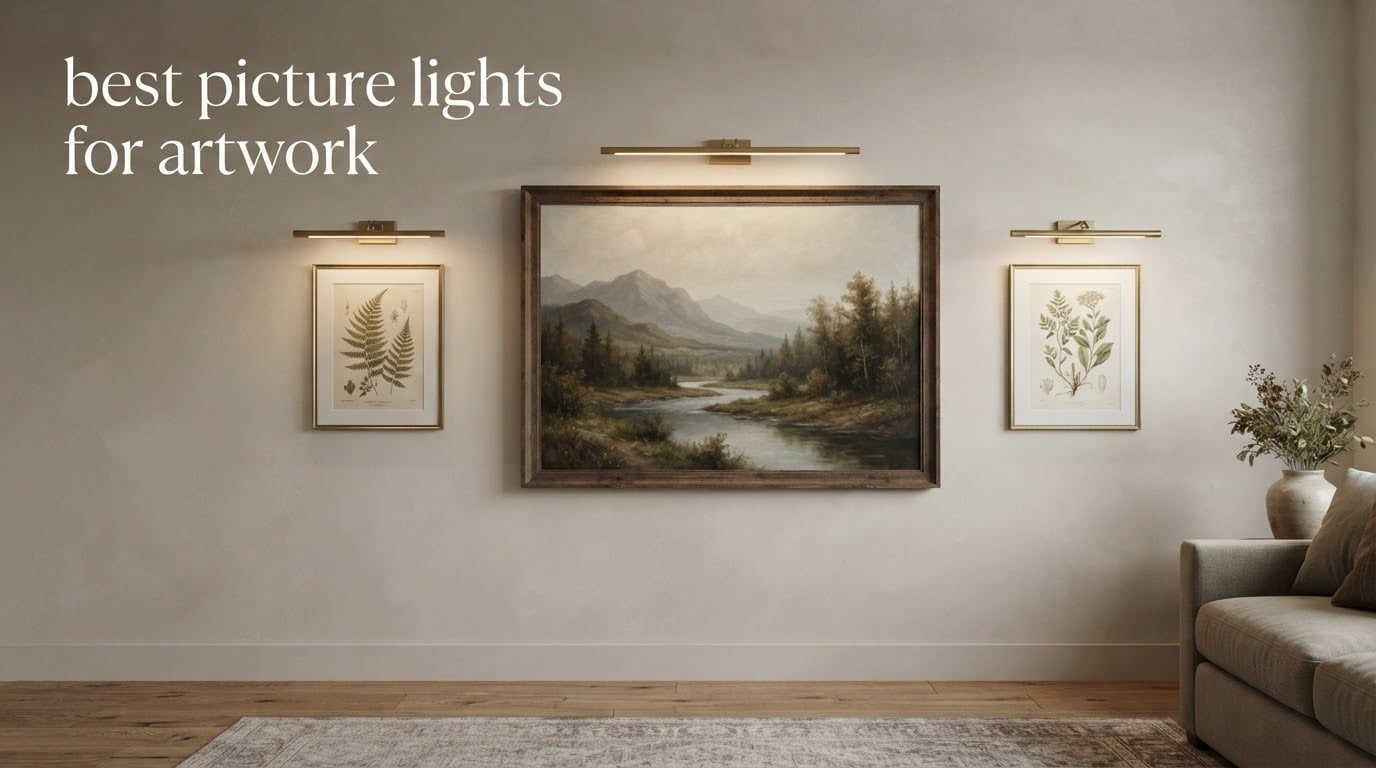
Most picture lights fail at the same job: they make artwork look worse than leaving it unlit. The best picture lights for artwork use high-CRI (95+) UV-free LED output, sit five to eight inches above the frame, and throw light down the face of the piece at roughly a 30 to 35 degree tilt. Get those three things right and a print, canvas or watercolour reads true to life. Get them wrong and you get a hot spot at the top, a dark band at the bottom, and glare off the glass.
Our team has spent the last several weeks reading specifications, digging through buyer reviews and comparing fixtures side by side to work out what actually separates a good art light from a cheap one. The short version: light quality and beam control matter far more than wattage, and the fixture has to be sized against the frame, not against the wall. That last point is where most buyers get stuck, because fixtures are sold in fixed lengths and nobody explains the ratio.
This roundup covers twelve picture lights across all three power sources you will realistically consider: rechargeable wireless, plug-in corded, and hardwired. We group them the way you shop, by how the light gets its power, because that single decision dictates where on the wall the fixture can go and whether you can install it at all in a rental. If you are still lighting a hallway with an overhead ceiling fixture, you are working harder than you need to.
Every pick below carries a stated CRI figure where the manufacturer publishes one, a real lumen number, and a mounting method you can actually execute. Where review counts are thin, we say so rather than dressing up three reviews as a consensus. For the broader picture on getting a whole room’s lighting right, our guides to pendant lights and underhood lights cover the ambient layers that art lighting is designed to sit on top of.
Top 3 Picks for Artwork Lighting for September 2026

FULEN 2 Pack Rechargeable…
- CRI 95+ for true colour
- 4500mAh battery
- 15+ hours runtime
- Magnetic no-drill mount

LYTARA Dimmable Cordless…
- 5000mAh battery
- 70 LED beads
- Stepless touch dimming
- Gold metal finish
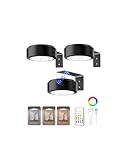
EZVALO 3 Pack Magnetic…
- Three colour temps
- 12 RGB modes
- 2000mAh rechargeable
- Remote and timer
All 12 Picture Lights Compared in September 2026
1. FULEN 2 Pack Rechargeable Picture Lights – Best Overall for Color Accuracy Without Drilling
FULEN 2 Pack Picture Lights for Wall Rechargeable, Picture Frame Lights
300 lm
3000K
CRI 95+
4500mAh battery,15+ hours
Magnetic flush mount
Pros
- CRI 95+ keeps pigment colors true
- Large 4500mAh battery for cordless runtime
- Magnetic mount leaves the wall undamaged
- Remote handles color temperature brightness and timer
Cons
- Plastic body feels less premium than metal fixtures
- Adhesive base may not hold on every wall surface
I have two of these running in a hallway and a stairwell wall, and they are the reason I stopped using the overhead light. The stated CRI 95+ is the number that matters most here, and in practice the wash across a matted print looks even rather than blotchy. Output is 300 lumens per light at 3000K, which is plenty for accent duty on a frame up to about 24 inches wide.
Each unit is 8.7 inches long and weighs just 5.6 ounces, so these are small lights doing an accent job rather than a room-lighting job. The magnetic flush mount sticks to a plate on the wall and the bar lifts off for charging. Two USB cables are included, along with the infrared remote and a manual.
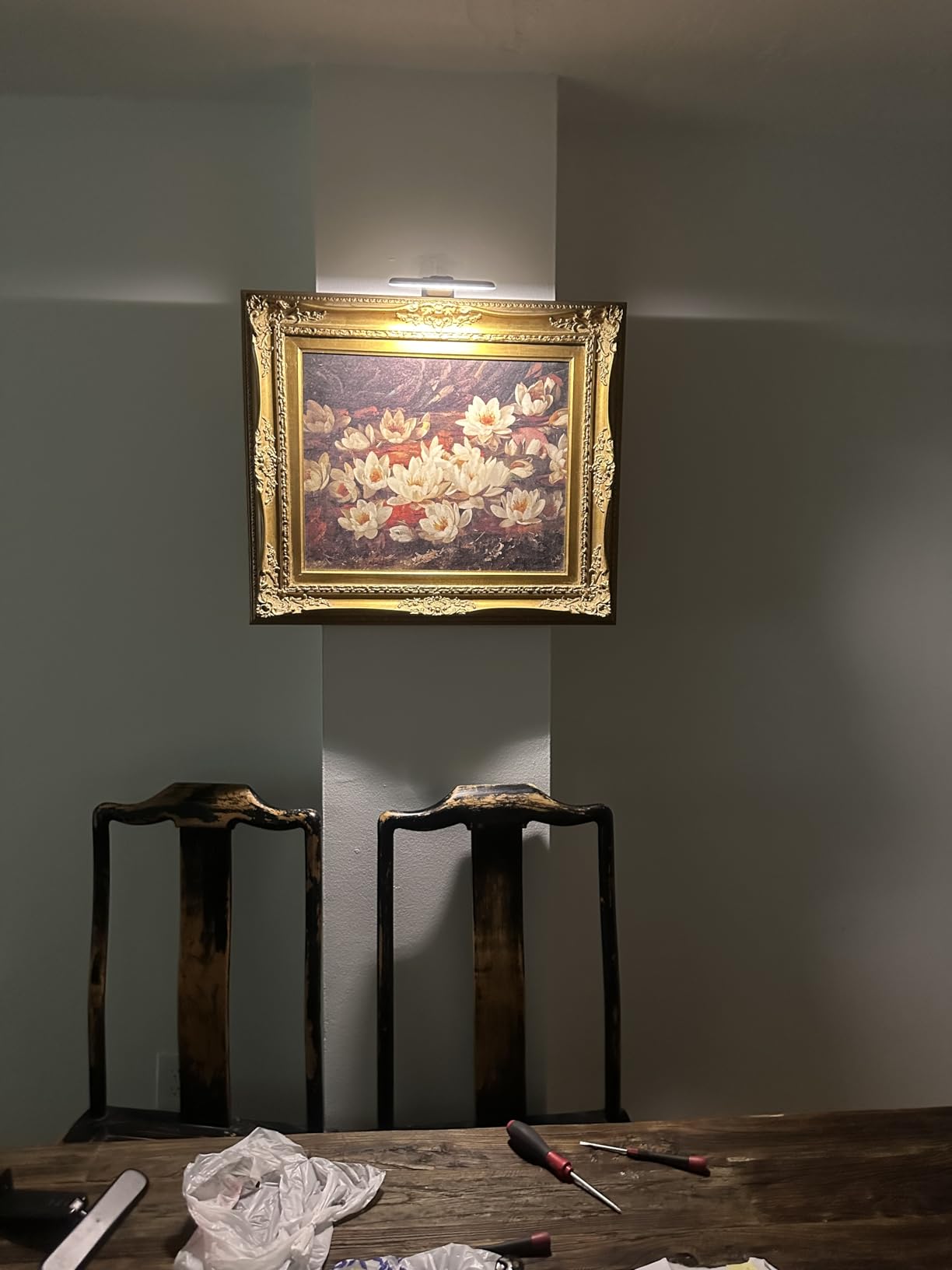
The battery is the differentiator here. At 4500mAh the manufacturer claims more than 15 hours of continuous glow, and on the lowest brightness setting I recharge roughly once a week for nightly use. The remote offers three color temperatures and five dimmable levels, which covers evening viewing better than a single-brightness fixture.
Two weaknesses are worth planning around. The housing is plastic, so it does not have the visual weight of a brass or aluminium bar, and the adhesive-mounted base is the part I would watch long-term. On textured or painted drywall I would screw the plate down rather than trust the adhesive alone.
How the light handles larger canvases and glass frames
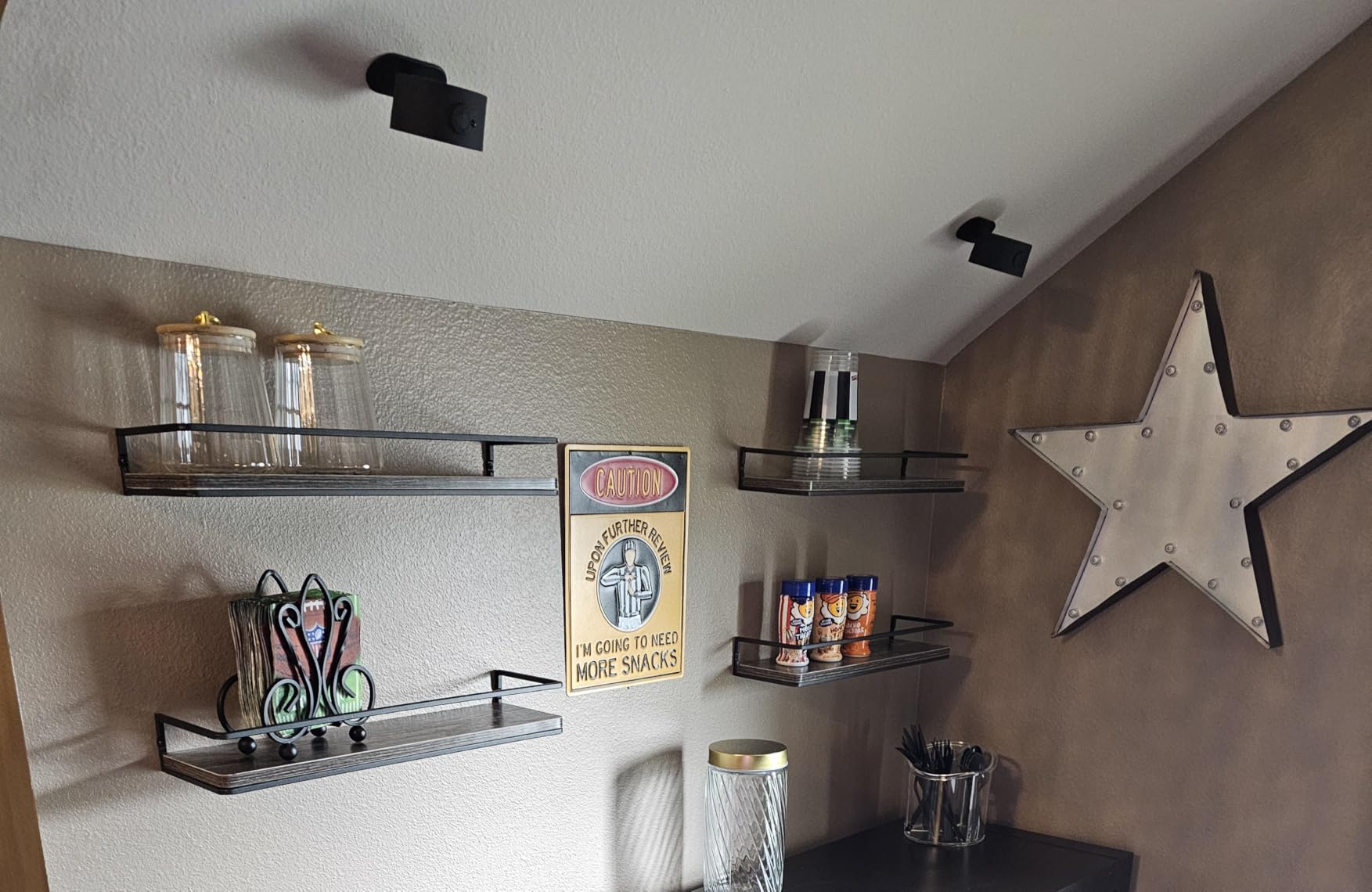
At 8.7 inches per bar this is a small-to-medium-frame fixture. Two of them spaced across a wide canvas works far better than one, and the magnetic mount makes that arrangement easy since each bar aims independently. Reviewers report using them on bookshelves and mirrors too, where the infrared remote removes the need to reach the wall.
On glass-fronted work, mount it at the upper edge of the frame rather than centred above it. The lower mounting point keeps the reflection angle away from eye level, which is the single most effective glare fix available to a homeowner.
Where this fixture is the wrong choice
If you are lighting a canvas wider than 30 inches and want a single continuous wash, this bar is too short and too dim. The 300-lumen figure is a real limit rather than a marketing number, and reviewers do mention it reads as ambient spill on a large piece.
It is also the wrong pick if you care deeply about fixture aesthetics in a period interior. The plastic body reads modern and utilitarian. Where finish matters, the brass-finish options further down this list suit better.
2. EZVALO 3 Pack Magnetic Poster Lights – Best Value for a Multi-Frame Wall
EZVALO Picture Lights for Wall, 2000mAh Rechargeable Battery Magnetic Poster Lights with 3 Color Temps & 12 RGB, Remote Dimmable Timer Painting Light, Wall Decor Light for Art Display, Frame (3 Pack)
80 lm
3000K/4200K/6500K
12 RGB modes
2000mAh,2.5 hour charge
Semi flush magnetic mount
Pros
- Magnetic install needs no drilling
- Three white temps plus 12 RGB modes
- Three lights cover several rooms
- Tap and infrared remote both work
Cons
- 80 lumens suits accent rather than bright wash
- Weak adhesive pads so use the supplied screws
- Battery drains fast when left on for hours
Three lights in one box is the reason this set keeps selling. I use them across a salon wall of six small prints, two per print, and the layered look costs nothing to trial before committing to a wired fixture. The 12 RGB modes are decorative rather than art-serving, but buyers clearly enjoy having them.
Output is 80 lumens per light, which is the honest limitation. That is a gentle accent glow, plenty for a 4×6 or 5×7 frame and thin for anything larger. The manufacturer states suitability for frames up to 8×12 inches, and I think that figure is about right.
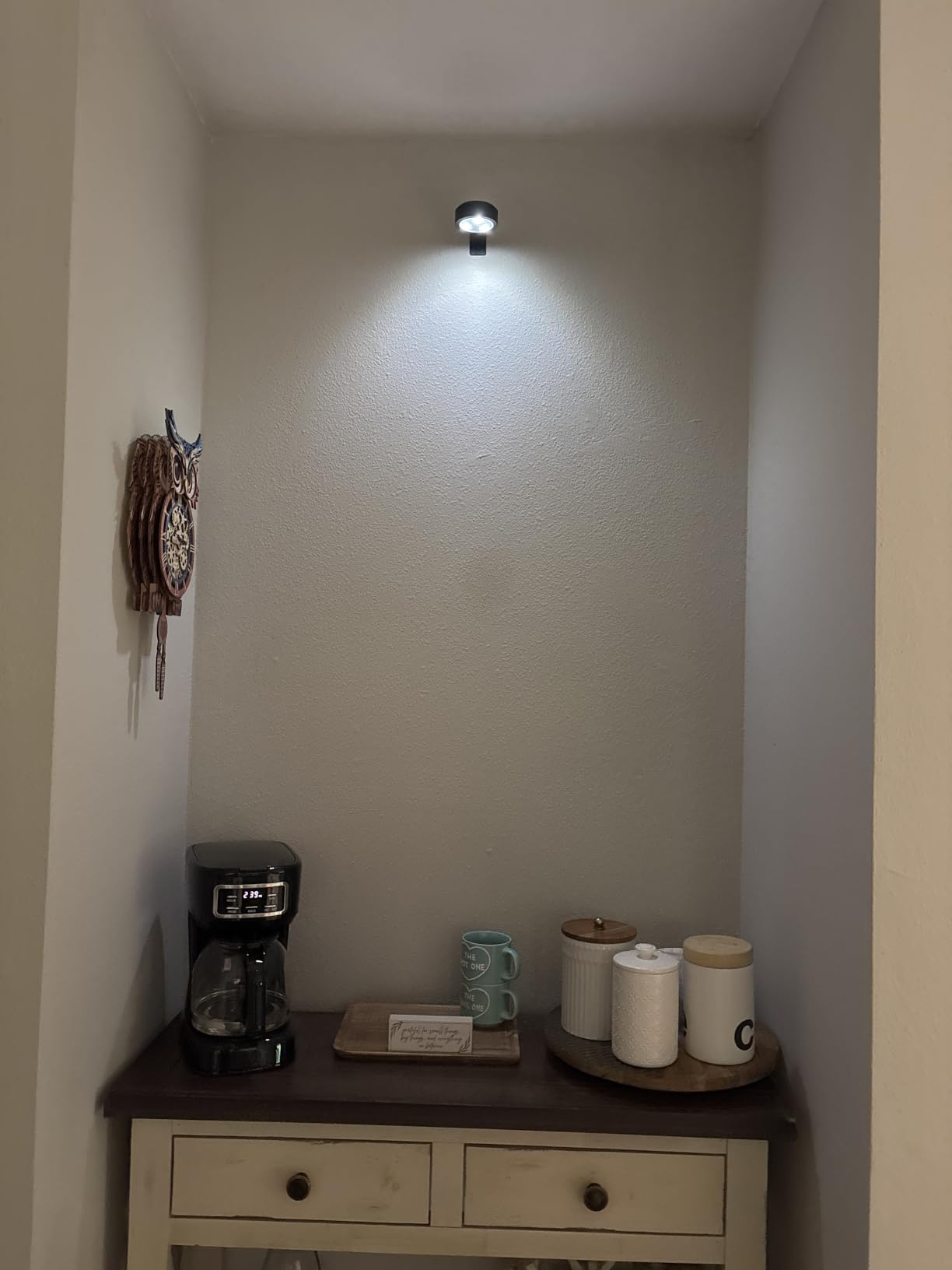
Colour choice is where this set wins. Three white temperatures at 3000K, 4200K and 6500K plus twelve RGB colours and two dynamic modes, all adjustable from the infrared remote or by tapping the unit. Brightness runs from 10 to 100 percent, and the timer covers 15, 30 and 60 minutes.
The 2000mAh battery takes about 2.5 hours to charge over USB-C, and the box includes a three-in-one charging cable, six screws, three mounting brackets and three adhesive tapes. The screws matter. Reviewers repeatedly report the adhesive alone is not strong enough for long-term mounting.
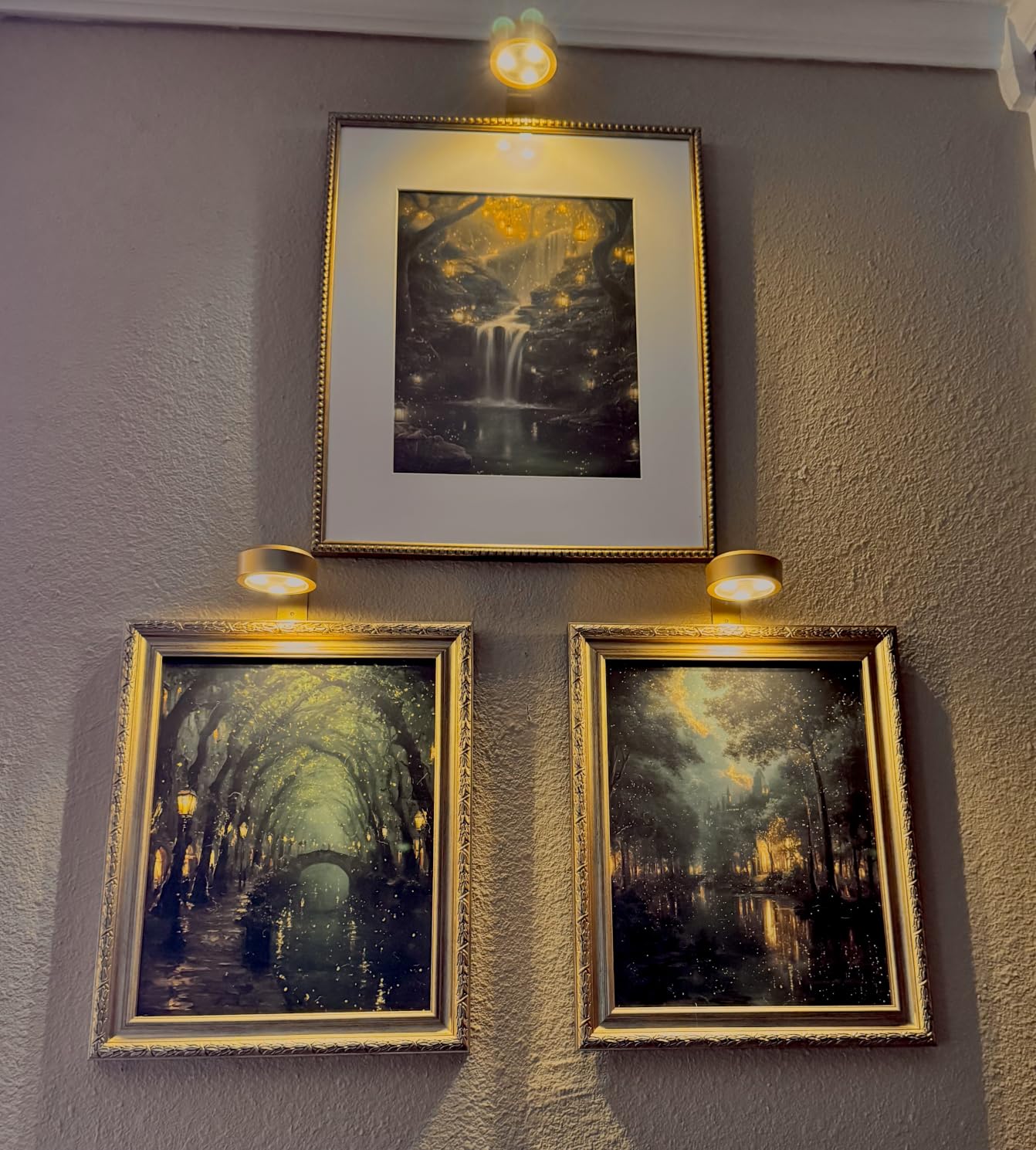
How the color modes affect artwork viewing
For actually judging a painting, use the 3000K setting and ignore everything else. The 6500K and RGB modes are fun for a gallery wall of prints and posters, but they shift the perceived color of pigments significantly. Treat the white temps as a tool and the RGB modes as mood lighting.
Dimming from 10 percent is genuinely useful in a living room after dark, where 80 lumens at full output is more than a bedside wall needs. That low-end control is what makes these practical for evening viewing rather than a one-trick accent.
Where this set is the wrong choice
Battery drainage is the recurring complaint. Owners running these several hours a day report needing frequent charging, so for an all-day gallery wall you will be managing three batteries rather than one.
They are also the wrong choice for a single statement piece. At 2.95 inches square with 80 lumens, a large canvas will look underlit and slightly spotly, and the small aperture makes it hard to get an even wash across a wide surface.
3. LYTARA Dimmable Cordless Picture Light – Best Overall Finish and Dimming Control
LYTARA Dimmable Cordless Picture Light with Controller and Timer, Rechargeable 5000mAh Battery Wall Sconce for Wall Pictures, Gallery Artwork, Paintings, Portraits, Dartboards (Gold)
350 lm
3000K/4000K/6500K
70 LED beads
5000mAh,about 10 hours
Pivotable bracket,rotatable tube
Pros
- Gold metal finish reads as a gallery fixture
- Removable magnetic bar makes charging simple
- Stepless touch dimming across three temps
- One infrared remote can command several lights
Cons
- Timer stops at a 1 hour interval
- Battery needs regular recharging for all-day use
- Better suited to small and medium frames
This is the one I keep coming back to when someone asks me what a picture light should look like. The gold metal finish reads as a deliberate design object rather than a gadget, and at 14 inches long it covers a standard 20 to 26 inch frame without dominating it. A 4.6 rating across 1739 reviews is the second-strongest showing in this roundup.
The light source is 70 LED beads at 350 lumens, spread across three modes at 3000K, 4000K and 6500K. Dimming is stepless rather than stepped, which means you can drop it to a genuinely low glow for evening viewing instead of snapping between three fixed levels.
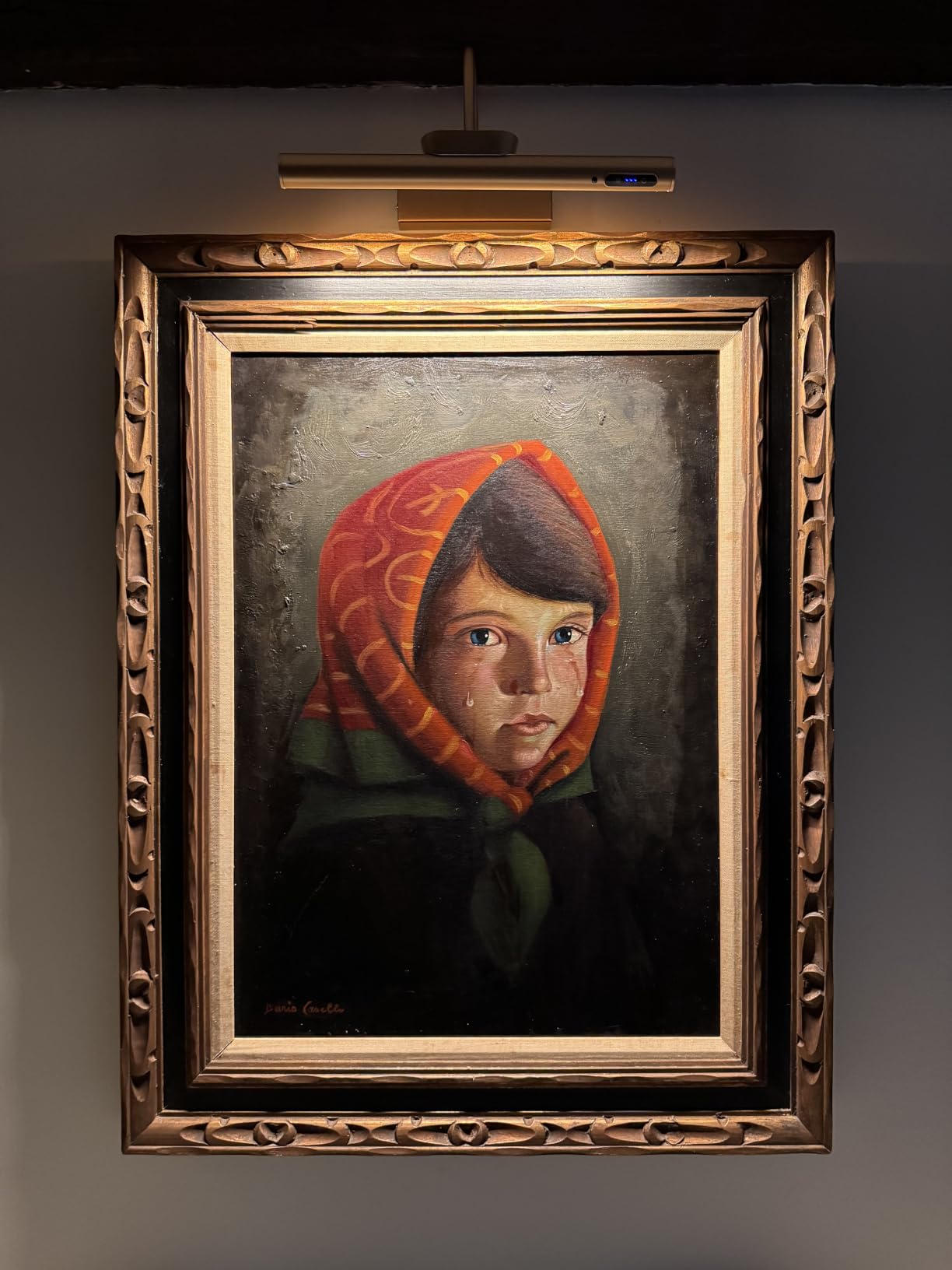
Mounting is a screw-mount bracket with a magnetic light bar that detaches for charging, and the bar itself rotates while the pivotable bracket aims the whole assembly. That two-axis adjustment is what lets you hit a tall canvas square rather than raking light down its face.
The 5000mAh battery gives roughly 10 hours of continuous lighting, and one infrared remote can control several units at once, which matters on a gallery wall. The manufacturer states a one-year warranty and an aluminium or metal construction, weighing 15.2 ounces.
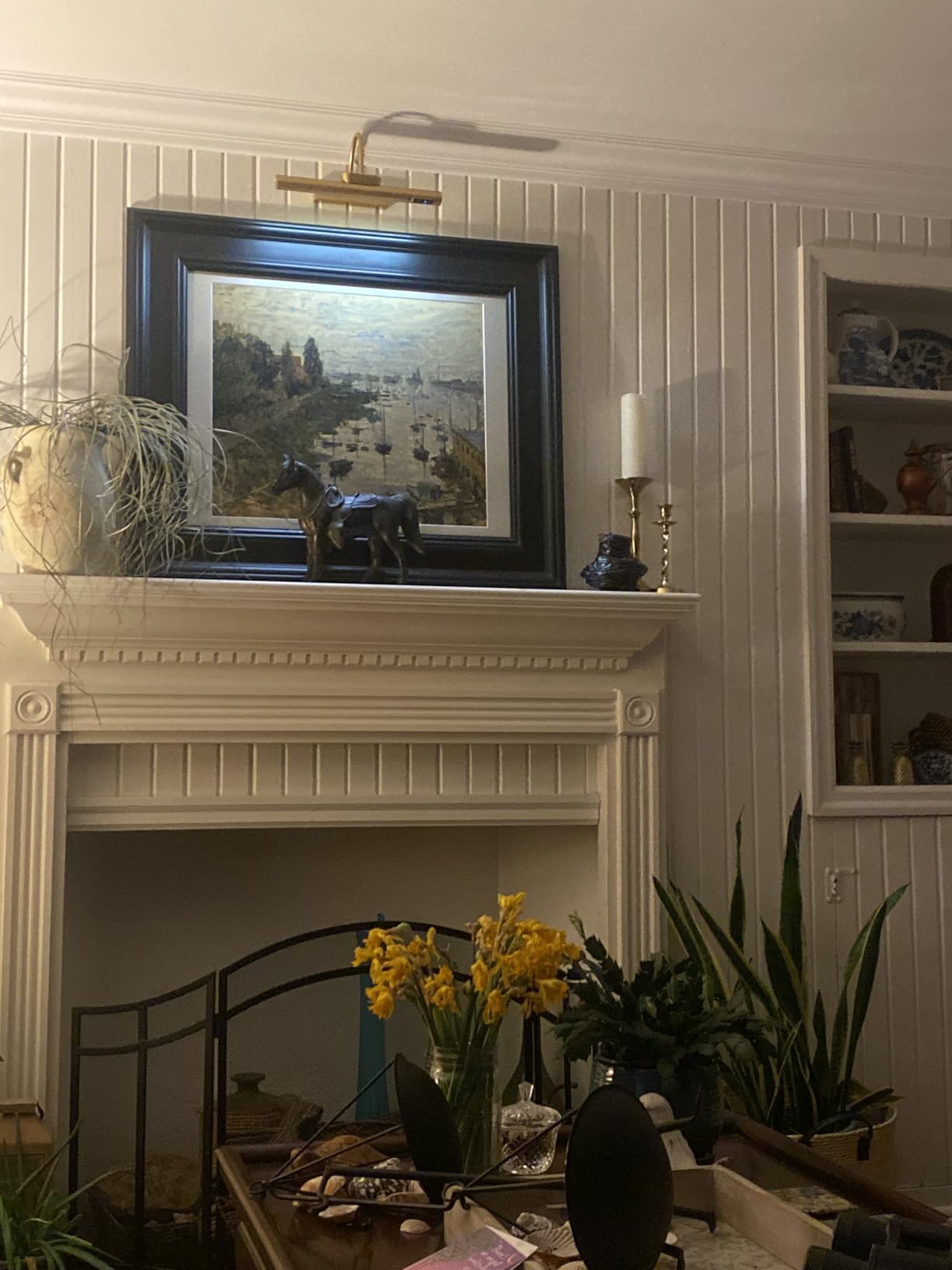
How dimming changes evening viewing
Stepless dimming is the underrated feature here. A stepped three-level control forces you to choose between too bright and too dim, and too dim means the fixture is effectively off. Stepless control lets you match the light to a lamp-lit room rather than overpowering it.
The single remote controlling multiple lights also means a gallery wall can be dimmed as one system rather than walked along light by light. For evening use that is the difference between a room you can relax in and a room lit like a gallery.
Where this fixture is the wrong choice
The timer topping out at a one-hour interval is the most requested improvement in reviews, and it is a real limitation if you want the fixture to shut itself off overnight. Battery endurance is the second complaint, with owners noting it needs regular recharging for all-day use.
Buyers also describe it as best suited to small and medium frames. At 14 inches it is a step down from the longer bars, and a very large canvas will show falloff at the bottom corners.
4. Craftersmark 3 Pack 16 inch Cordless Picture Light – Best for a Three-Piece Salon Wall

3Pack Picture Light Battery Operated, 16in Picture Light for Wall, 5000mAh Cordless Wall Lights with Controller,Art Light with Dimmable Cordless for Wall Painting,Frame, Portrait, Dartboard- Black
350 lm
CRI 95+
3000K/4500K/6500K
5000mAh,13 hours,5 hour charge
290-degree swivel
Pros
- CRI 95+ keeps artwork colors true
- 13 hour battery suits evening viewing
- Screw mounting is more secure than adhesive
- Memory function restores the last setting
- Three packs cover a whole gallery wall
Cons
- Pack is heavier and bulkier than most rivals
- Only three discrete brightness steps
Sixteen inches is the sweet spot length for the sorts of mid-size frames most people actually own, and this set gives you three of them. If your gallery wall has three pieces, or one large piece plus two small ones, buying a single three-pack solves the layout problem in one go rather than three separate purchases.
The light is 350 lumens with a stated CRI 95+ across the full 16-inch bar, so there is no color shift from one end of the frame to the other. That evenness is what separates a proper art light from a strip clipped above a picture, and it is the reason I keep recommending fixtures of this length over short accent spots.
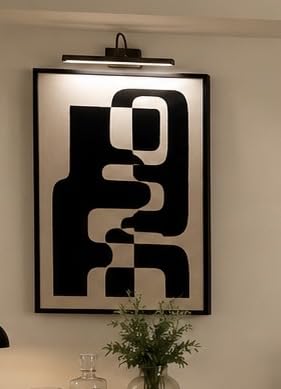
A 290-degree swivel handles both up-down and side-to-side aiming, so you can angle the bar inward at the edges of a wide canvas. The 5000mAh battery runs about 13 hours and takes 5 hours to recharge over USB-C, and the bracket is screw-mounted with no adhesive involved.
Controls cover three color temperatures at 2700K, 4500K and 6500K, three brightness levels, an infrared remote reaching about 16 feet, a touch switch, and a memory function that restores your last setting. Timers auto-off at 2, 4, 6 or 8 hours, which is longer than most competitors offer.
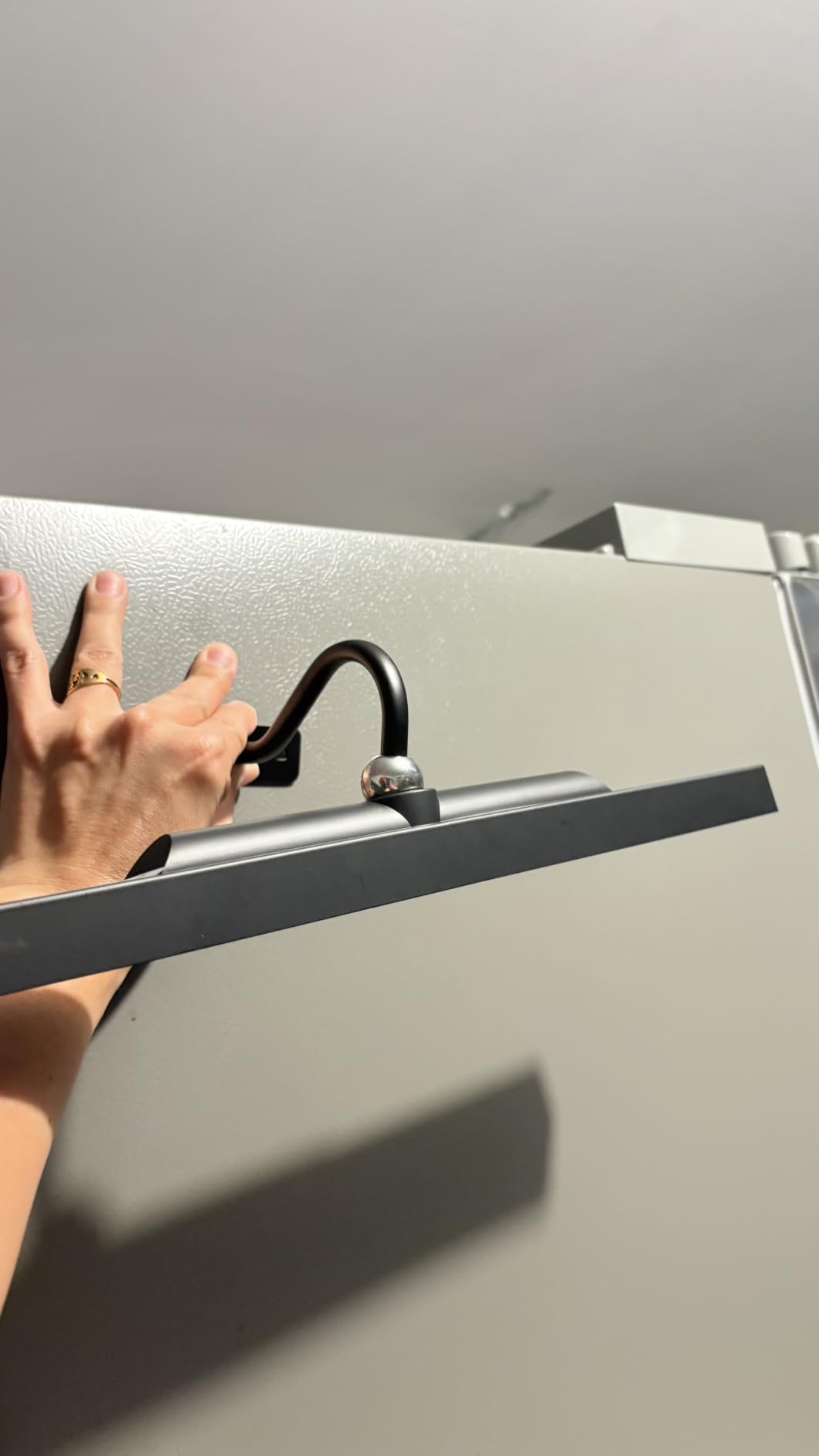
How the 2700K setting suits older pigment work
Of the three temperatures, 2700K is the one to use for traditional oils, watercolours and anything with warm red or yellow pigment. It sits close to warm gallery lighting and avoids the slightly clinical look that 6500K gives to a warm palette. Reviewers who work with mixed media tend to settle on 2700K permanently.
The memory function matters more than it sounds. Once you have dialled in a temperature and brightness for a particular piece, the fixture returns to it on power-up, so you are not re-tuning a remote every evening.
Where this set is the wrong choice
The pack weighs 1.21 kg, which owners note is heavier and bulkier than competing picture lights. Three units of solid-feeling fixture are noticeably present on a wall, and that changes the profile from discreet to substantial.
Brightness control is three fixed steps rather than stepless. If you need a genuinely low glow for evening viewing in a dark room, the dimmest step will still read brighter than a continuously dimmable fixture.
5. Tassuowell 15.7 inch Brass Wireless Picture Light – Best for Bright Output in a Metal Fixture

Tassuowell Wireless Picture Lights for Wall Rechargeable, Battery Operated Art Light for Paintings, 3CCT Dimmable, 15.7″ Brass Finish with Remote, Rotatable Gallery Light for Pictures Display
600 lm
2700K/4000K/6000K
5000mAh
180-degree arm,270-degree tube
Acrylic and metal,brass finish
Pros
- Elegant brass finish with a solid metal build
- 600 lumens covers larger artwork
- 180-degree arm plus 270-degree rotating tube
- Remote handles brightness temperature and timer
Cons
- Battery life often falls short of the stated 7 hours
- Frequent recharging for nightly use
- One reviewer reported certification stickers left on the fixture
This is the fixture interior designers most often mention, and the reason is the brass finish combined with full metal construction. The acrylic shade keeps the light source from reading as a strip of dots, which is the failure mode of cheaper bars. At 15.7 inches it suits a 24 to 30 inch frame.
Output is 600 lumens, the second highest figure among the rechargeable lights in this roundup, and it covers larger artwork than the short magnetic bars can manage. The default color temperature is 2700K, the warmest option here, with 4000K and 6000K alternatives.
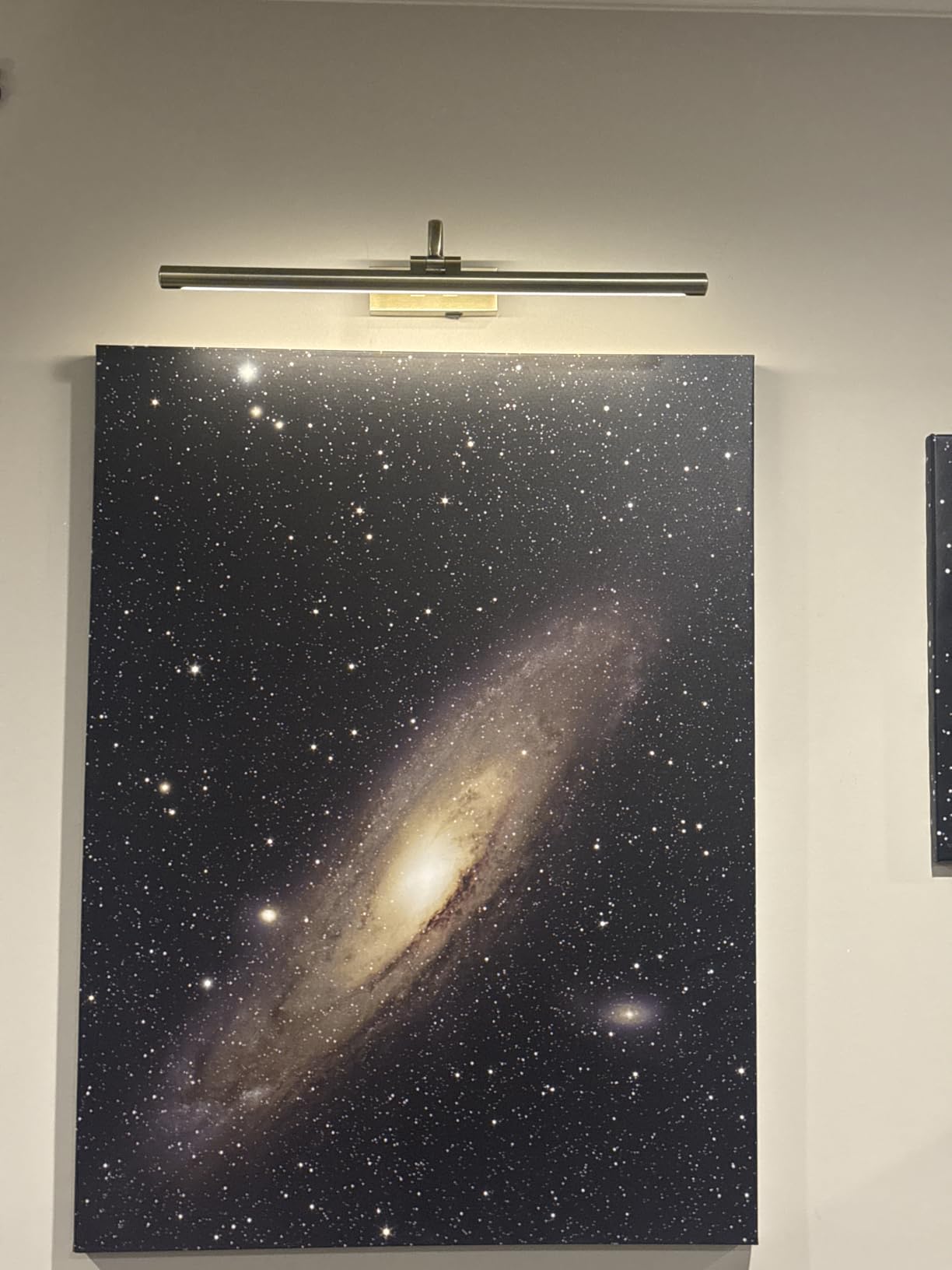
Adjustment is unusually thorough: a 180-degree swing arm at the base plus a 270-degree rotating lamp tube. Combined with the wireless install and a 5000mAh battery, it is the closest rechargeable option here to a hardwired fixture’s flexibility, and it also works as a portable flashlight or table lamp when the arm is angled down.
The remote controls brightness from 10 to 100 percent, switches the three color temperatures, and includes a memory function. The manufacturer states a two-year warranty and a four-hour full charge.
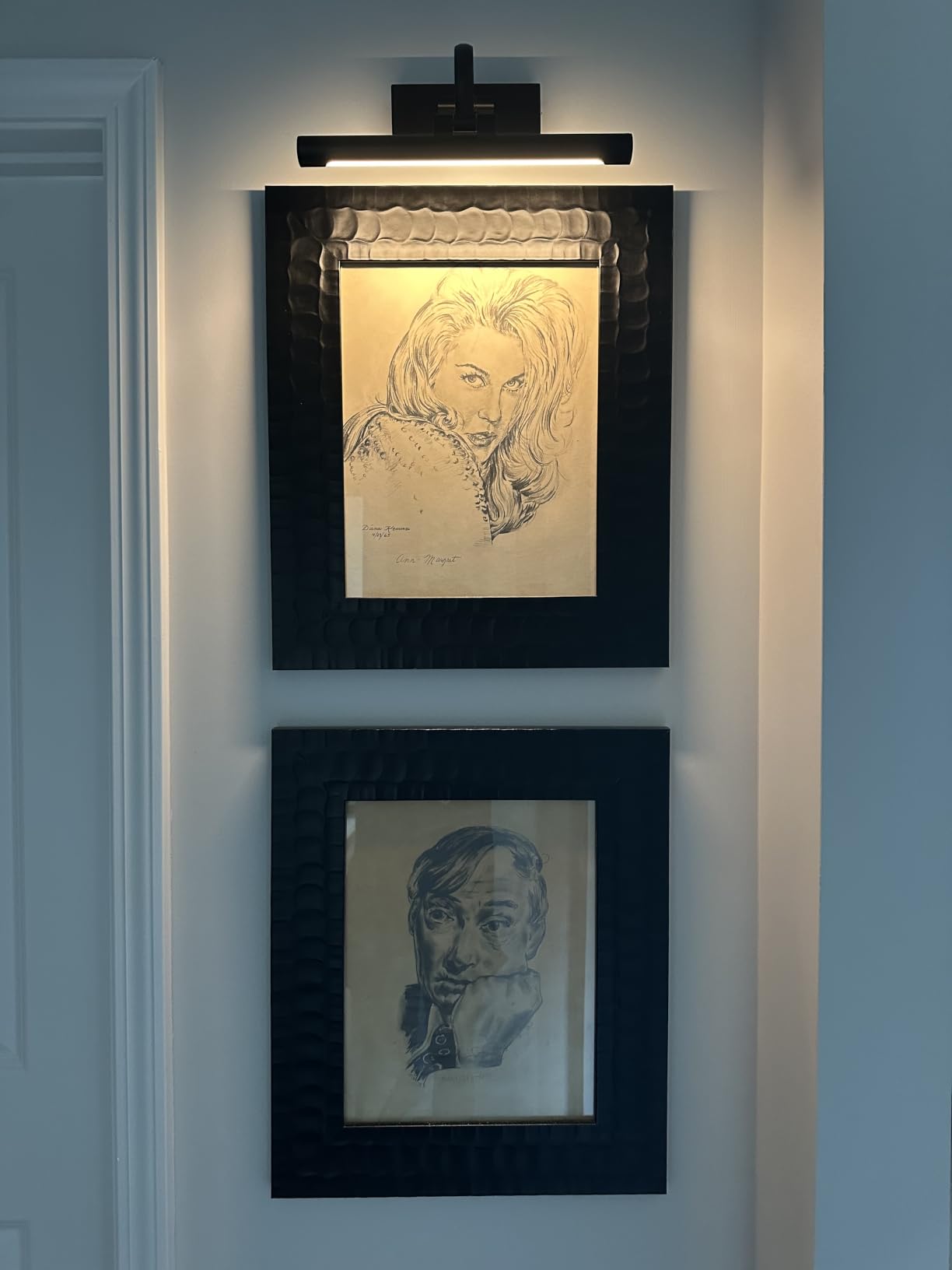
How the 2700K default affects warm-toned artwork
2700K is the right default for a warm interior and for most traditional painting. It flattens the cold cast that cooler LEDs put on skin tones and earth pigments. The 6000K setting will make a gallery wall of modern graphic prints look crisper, but it will shift a classical oil warmer than it was painted.
With brightness running to 100 percent on 600 lumens, dimming down to roughly a quarter is realistic for evening use in a lamp-lit room. Reviewers frequently describe this as a fixture that makes framed work look expensive.
Where this fixture is the wrong choice
Battery endurance is the dominant theme in reviews. The stated runtime is 7 hours at highest brightness and up to 30 hours at lowest, but owners report only a few hours per charge and daily recharging for evening use. Treat the low-brightness figure as the realistic one.
One reviewer also reported certification stickers left visible on the fixture, which matters in a visible location. The 4.2 rating across 938 reviews is the lowest of the rechargeable group, and the battery complaints are the reason.
6. Westinghouse 7 inch Antique Brass Picture Light – Best for Small Frames on a Traditional Wall
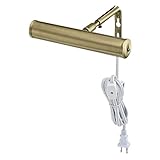
Westinghouse 7505200 Picture Light, 7-Inch, Antique Brass
1100 lumens
15 watt incandescent included
E12 candelabra base
Plug-in with in-line switch
UL listed
Pros
- Warm incandescent glow suits traditional interiors
- Bulb is user-replaceable so the fixture lasts
- Compact 7 inch body suits small framed pieces
- In-line switch means no wall wiring
Cons
- Included bulb runs very hot to the touch
- Swivel range is limited to roughly 10 degrees
- Bracket feels flimsy over a picture frame
- No dimming and a narrow beam
Sometimes the right answer is the fixture that already matches the room. In a traditional interior with warm wood and brass hardware, this 7-inch Westinghouse in antique brass disappears into the decor in a way no modern black bar will. It is UL listed, weighs 14.4 ounces, and comes with a five year limited warranty.
It ships with a 15-watt incandescent bulb producing 1100 lumens, which is a very high figure for a picture light and gives genuinely bright coverage. The E12 candelabra base is a standard, widely available bulb, so replacements cost almost nothing and anyone can swap it.
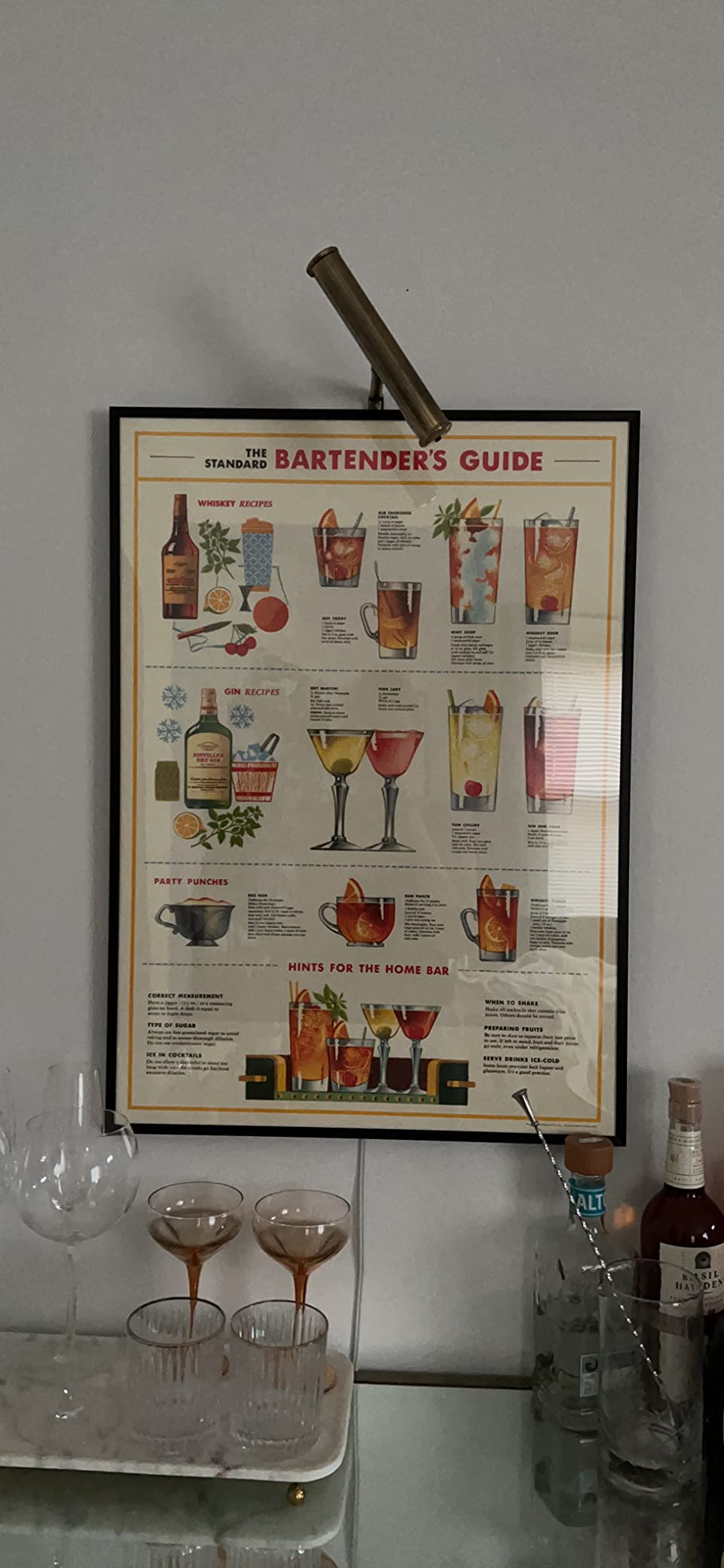
Installation is straightforward plug-in with an in-line on and off switch on the cord. Mounting is semi flush to the wall and the head swivels, though the range is tight. The 7-inch body is really only proportioned for frames up to about 12 inches wide.
There is no dimming, no color temperature choice and no remote. That is a genuine limitation, but in a formal room where the light is switched on to look at one painting, a simple on and off is often all the control you want.
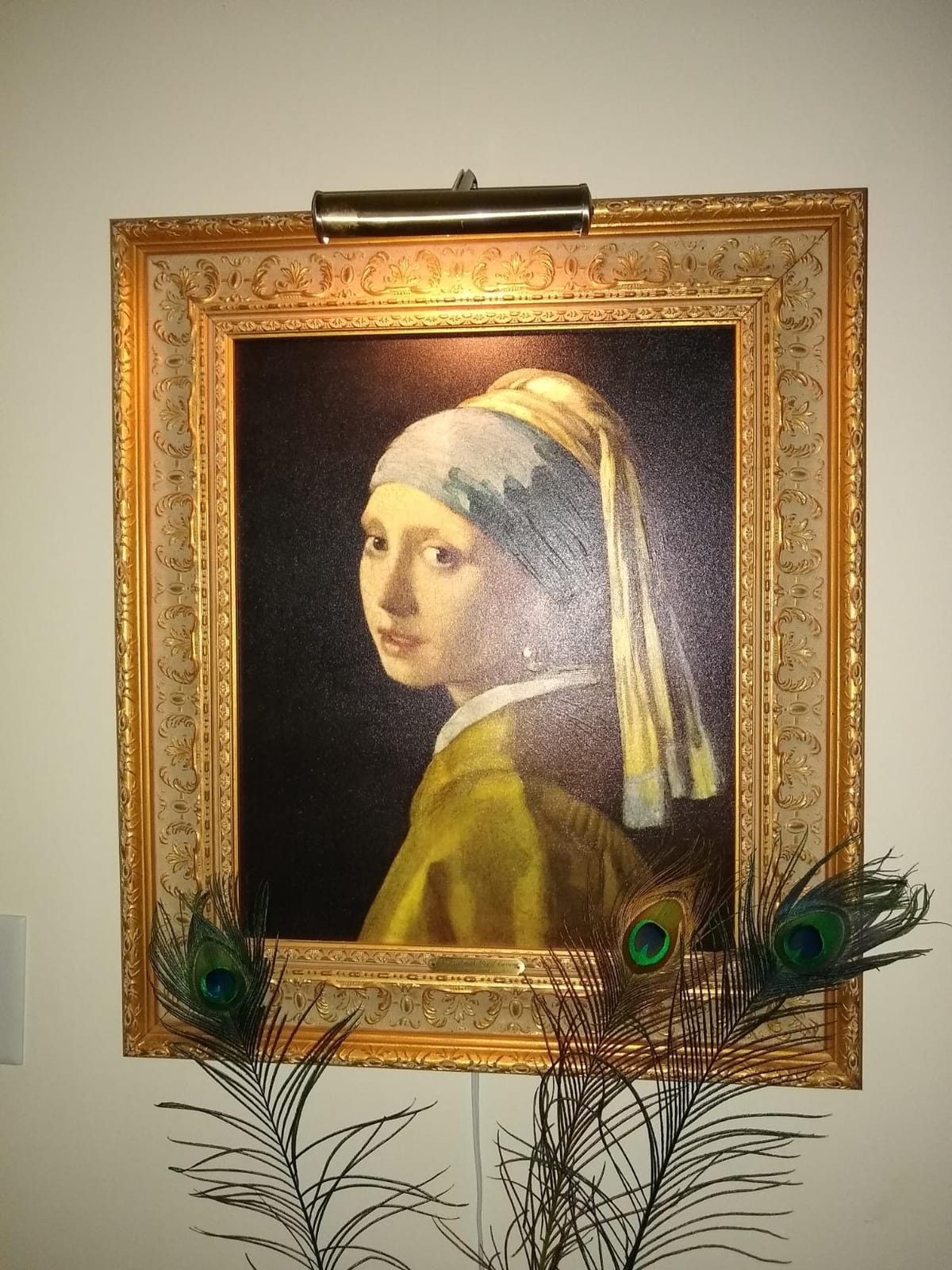
Why incandescent still appeals to some rooms
The warm incandescent output has a quality that modern LEDs in this category do not replicate at the same price point. In a room with warm walls and traditional furniture, a 2700K LED can look thin next to the ambient warmth, while an incandescent fixture matches without effort.
The replaceable bulb is the underrated part. A fixture with an integrated LED that fails is finished, whereas this one takes a 15-watt E12 bulb you can replace in seconds. For a fixture expected to hang for a decade, that changes the ownership maths entirely.
Where this fixture is the wrong choice
Heat is the issue. Owners report the included bulb runs extremely hot to the touch, and the bracket can strain the top of a picture frame. For valuable paper, textile or watercolour work, that is a real conservation concern rather than a preference.
The swivel range of roughly 10 degrees is also limiting. Aimed at a piece more than a few degrees off centre, the beam misses, and there is no dimming or colour control to compensate.
7. LEONLITE 3CCT Dimmable LED Picture Light – Best for Renters Who May Wire In Later

LEONLITE 3CCT Dimmable LED Picture Light, CRI90, Adjustable, Antique Brass
600 lm
CRI 90
2700K/3000K/4000K
Plug-in or hardwired
15.75 inch,270-degree swivel
Pros
- Three color temperatures match the light to the artwork
- 270-degree swivel and 120-degree beam cover a wide area
- Installs plug-in or hardwired
- Full metal body with low heat output
Cons
- No remote control and touch-only dimming
- Antique brass offered in fewer sizes than some rivals
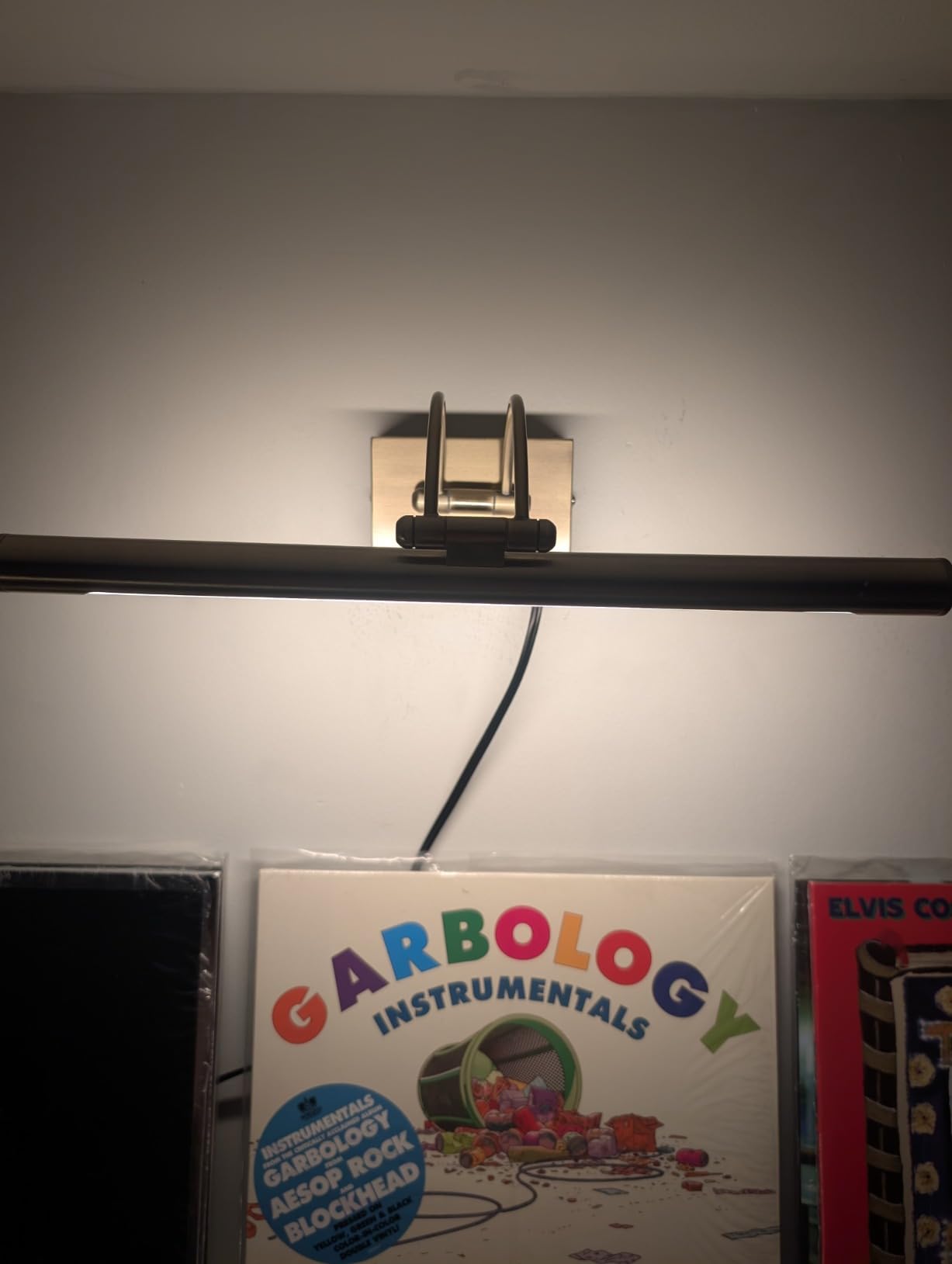
This is the fixture I recommend to anyone who does not know how long they will be in the property. It ships with both a power cord and wiring hardware, so you can run it plug-in today and convert to a hardwired install if you buy the place. No other rechargeable option in this roundup offers that flexibility, and no other wired option offers the cord.
The light is 600 lumens with a stated CRI 90 and a 120-degree beam, which is wide enough to cover a large canvas evenly rather than creating a bright oval in the centre. The head swivels 270 degrees, which in practice means you can aim almost anywhere along the bar.
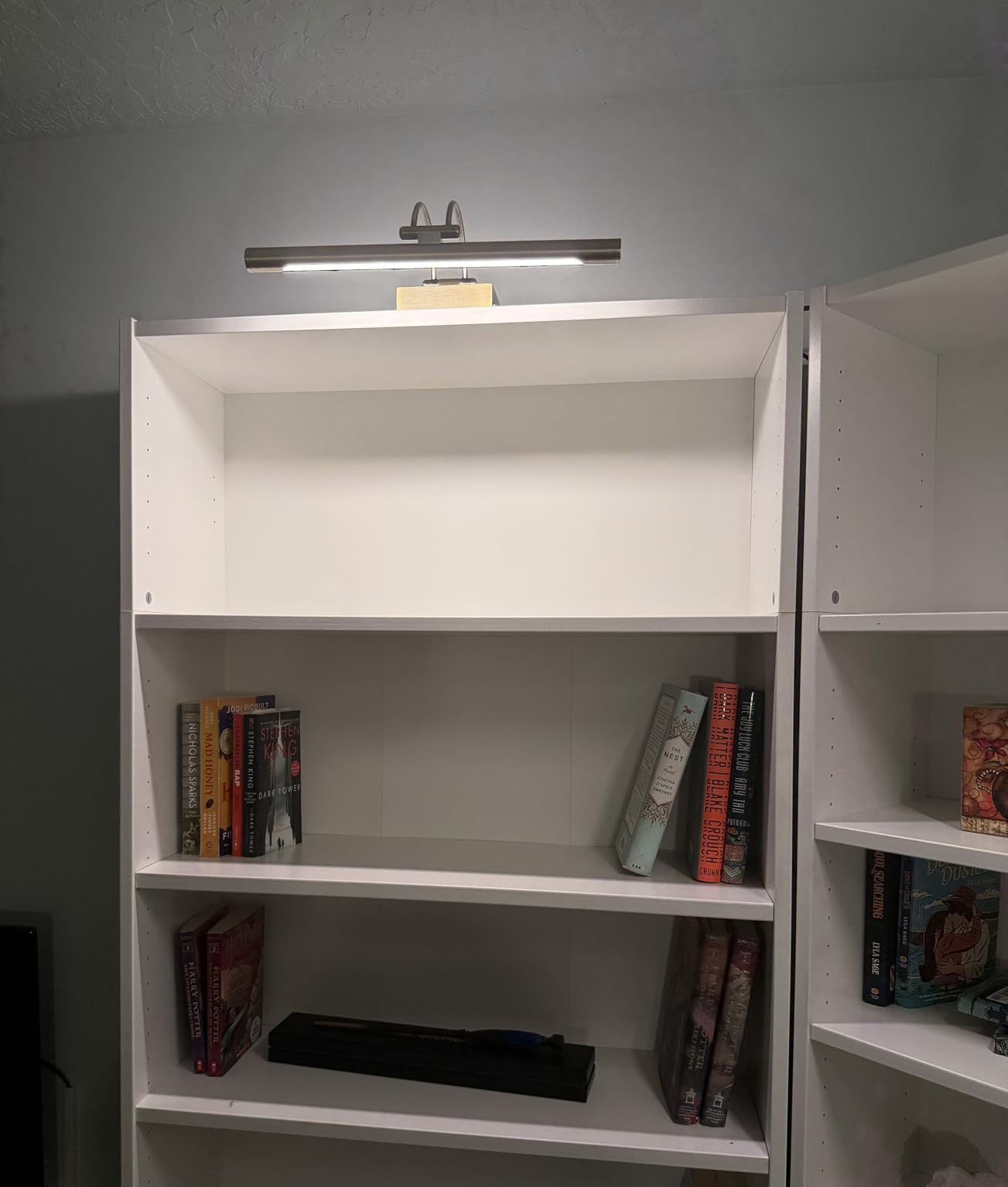
Three selectable color temperatures at 2700K, 3000K and 4000K are switched from the touch control on the fixture, and dimming is smooth rather than stepped. The body is full metal, which both makes it look substantial and keeps heat emission low enough to protect the artwork surface.
It is ETL listed, 15.75 inches long, and carries a two-year warranty. At 1.7 pounds it is the heaviest fixture in this roundup, which is what a real metal housing costs.
How the dual installation path changes the buying decision
Buying a plug-in fixture and hoping to hardwire it later usually means buying twice, because most plug-in lights have no conduit hub or junction box provision. This one includes wiring for the hardwired option alongside the cord, so the conversion is a small job rather than a replacement.
For art in a rental, that is a meaningful saving. It also means the fixture can move with you to a larger wall later, which is the opposite of what happens when you cut a hole in plasterboard for a hardwired bar.
Where this fixture is the wrong choice
There is no remote control. Dimming and color temperature switching happen on the touch panel on the fixture itself, which means walking up to the wall after dark. For lights mounted high or over a staircase, that is an irritation.
CRI 90 is also a step below the 95 plus figures several competitors publish. The difference is subtle on a reproduction and more visible on saturated reds and blues in an oil painting.
8. Xbuyee 14 inch Plug-In LED Picture Light – Best for Hallways and Mirrors

Xbuyee 14 inch Plug in LED Picture Lights for Wall, Antique Brass
200 lm
CRI 90+
3000K
4 watts
14 inch bar,90-degree tilt,120-degree beam
ETL listed
Pros
- Classic antique brass look at a low entry point
- CRI 90+ warm white renders paint naturally
- Frosted diffuser avoids a harsh dotted LED look
- Only 4 watts so it runs cool
Cons
- No dimming and fixed output
- In-line cord switch is awkward if the outlet is far away
- Some units reported a non-rotating head
Four watts and 200 lumens sounds weak until you realise a picture light only needs to wash a frame, not a room. This 14-inch bar in antique brass is the simplest fixture here that still produces warm, reasonably accurate light, and at 3000K with CRI 90 plus it handles most interior scenes convincingly.
The frosted acrylic diffuser is the detail that matters more than the wattage. It spreads the LED source so you see a soft band of light instead of a row of bright dots reflected in glass, which is the single commonest complaint about cheap art lighting.
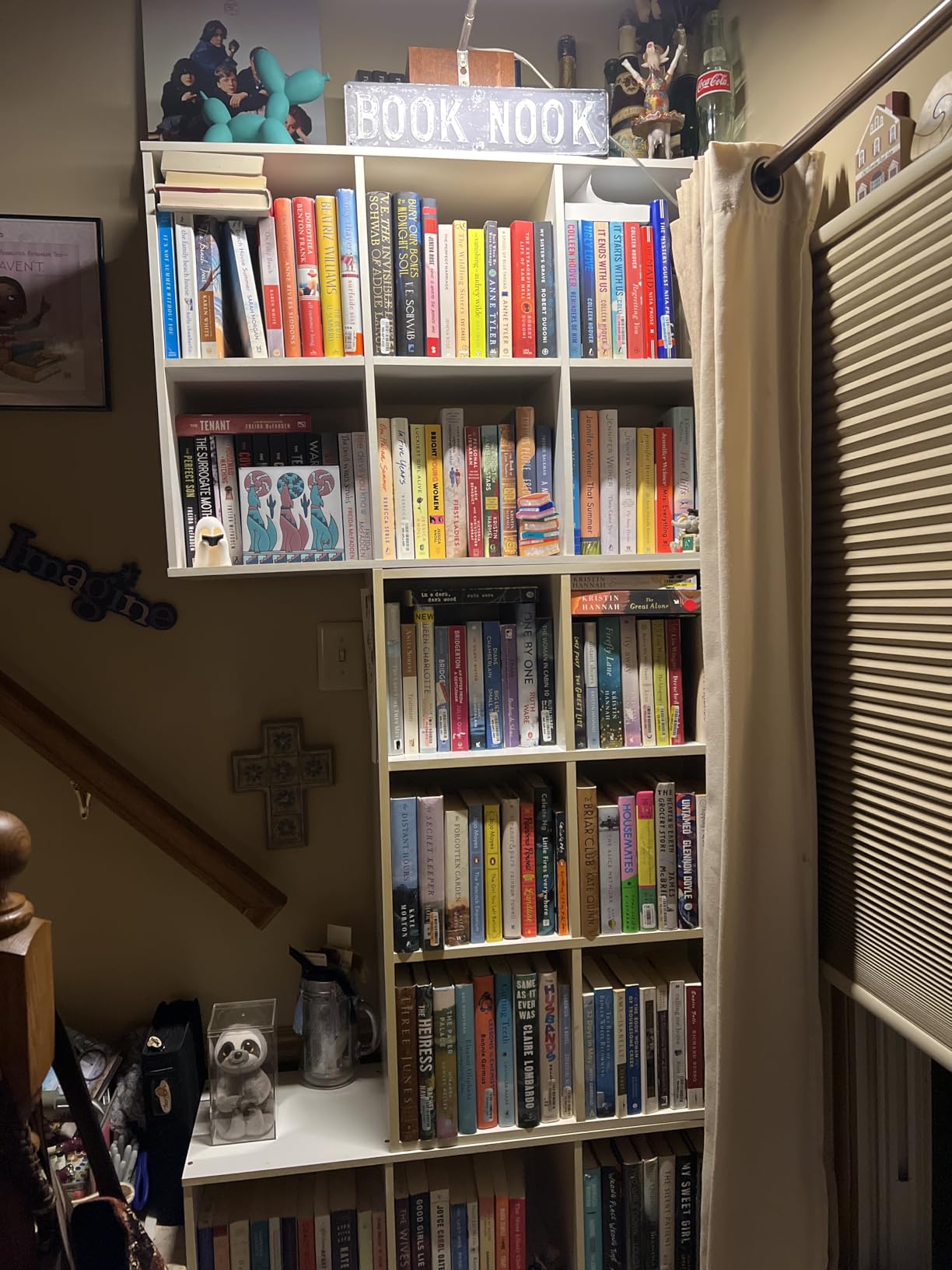
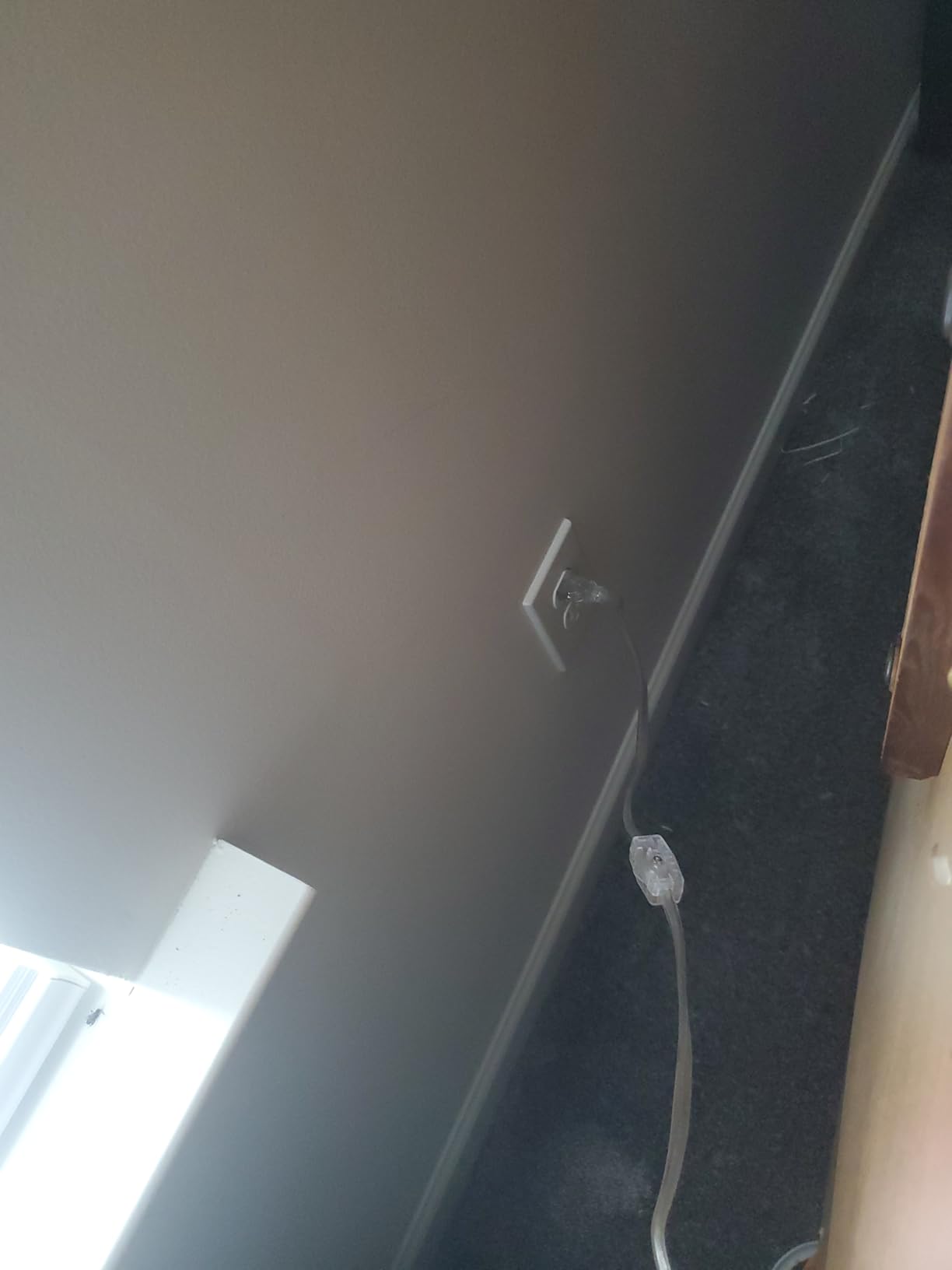
The head tilts 90 degrees up and down on a 7.48-inch extendable arm, and the 120-degree beam is broad. A long power cord with an in-line on and off switch means you can place the fixture where it lights well even if the nearest outlet is some distance away, which is the normal situation in a hallway.
It is ETL listed with a three-year warranty, and comes in several finishes and in 14 and 16 inch lengths as a single or a two-pack.
How the diffuser affects glare on glass-fronted frames
Glare is a reflection problem before it is a brightness problem. A bare LED strip produces a hard specular highlight that travels across the glass as the viewer moves. The frosted diffuser here turns that into a broad, soft band positioned near the top of the frame, where the eye is less likely to catch it.
At 200 lumens there is no realistic need to dim for evening viewing, which is both a limitation and a relief. Set it to roughly 60 percent room brightness and it holds its own in a dim hallway without adjustment.
Where this fixture is the wrong choice
There is no dimming at all, and several owners report a fixed output that feels too bright for genuine accent lighting in a dark room. The in-line cord switch is also inconvenient when the outlet is far from where the light needs to sit.
A small number of units shipped with a head that did not rotate, aiming light into the room rather than onto the artwork. Only drywall anchors are included, so check your wall type before you start.
9. MQOUO 24.4 inch Wireless Picture Light – Best for a Single Large Canvas

MQOUO 24.4″ Wireless Picture Lights, Rechargeable Battery Art Display Light with Remote Control, Dimmable/Timer Off Dartboard Light, 3 Lighting Modes Full Metal Painting Display Lights (Black-1Pack)
300 lm
3000K/4500K/6500K
5000mAh,60 LEDs,8-11 hours
24.4 inch aluminium bar
230-degree rotation
Pros
- 24.4 inch length suits extra-large canvases
- Magnetic bar detaches for fast charging
- Full metal build with clean minimal styling
- Remote plus touch with mode memory
Cons
- Beam is broad and unfocused so it spills into the room
- 300 lumens is dim for very large pieces
- Some reports of mismatched colour presets
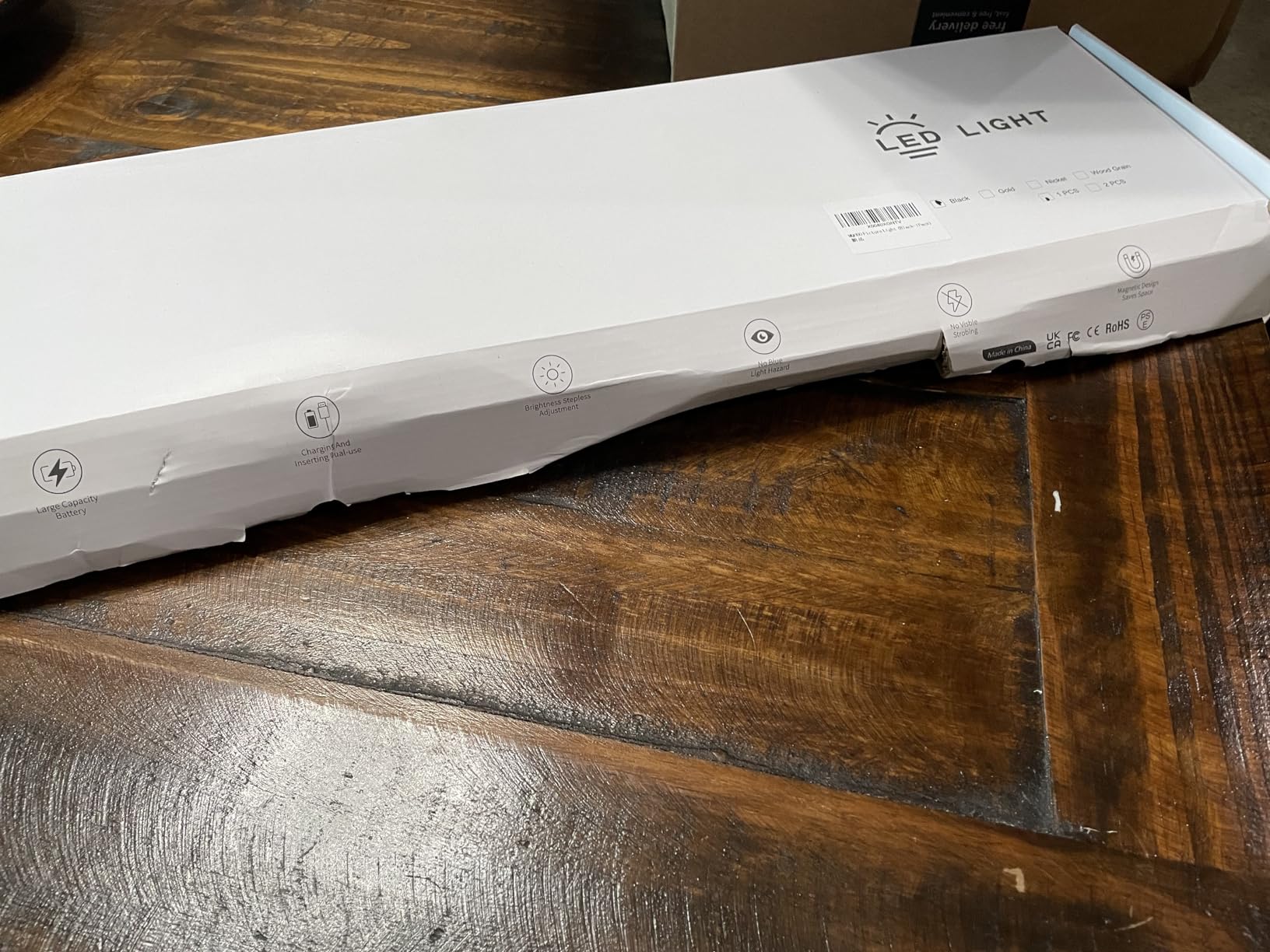
Length is the reason this one exists. At 24.4 inches it is the longest rechargeable bar in this roundup, and when you have one 40 inch canvas rather than a grid of small frames, a single long fixture is the only way to get a continuous wash. Shorter bars on a wide piece read as two separate pools of light.
The body is aluminium rather than plastic or acrylic, and the styling is deliberately minimal so the fixture sits behind the artwork visually. A 5000mAh battery with 60 LEDs gives a stated 8 to 11 hours per charge, and the magnetic light bar detaches for charging without removing the wall bracket.
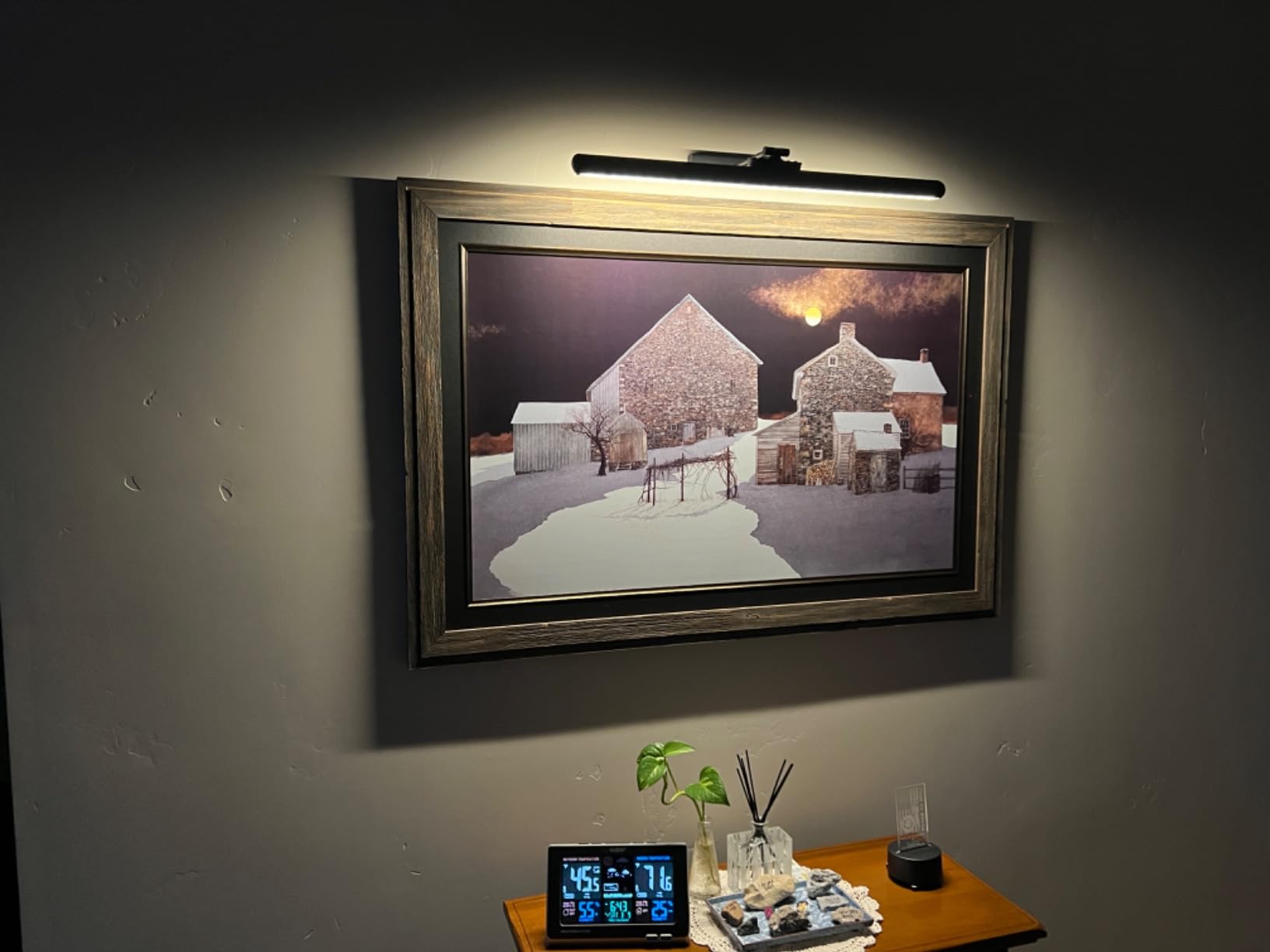
Control is by remote or by touch button, covering on and off, three lighting modes at 3000K, 4500K and 6500K, and brightness steps. The timer auto-off runs at 15, 30, 60 or 120 minutes and the unit remembers your last mode, so a gallery wall behaves consistently.
Rotation is 230 degrees, which gives good vertical aiming. The bar measures 24.4 by 4.33 by 4.5 inches and the unit weighs 700 grams.
How bar length changes the wash on a wide piece
A bar’s length sets the width of the lit area more than its wattage does. A 24-inch bar over a 40 inch frame produces a wash that tapers gently at the edges, while a 14-inch bar on the same frame leaves the outer quarters noticeably darker. That taper is the difference between a gallery look and a spotlight look.
The 230-degree rotation lets you tilt the bar forward slightly so light lands on the face of the canvas rather than dropping straight down onto the wall, which reduces the shadow line under the frame.
Where this fixture is the wrong choice
The beam is broad rather than focused, and reviewers note it spills into the room. For a bright room where you want light only on the art, that is a genuine drawback. At 300 lumens across 24 inches, large pieces also read dim.
The warranty is six months, the shortest in this roundup, and a small number of owners reported colour presets arriving mismatched or a light bar sitting out of parallel with its bracket.
10. Coinmit 24 inch Plug-In Picture Light – Best Wired Dimming Without Wiring Work

Coinmit 24″ Plug in Picture Light 9W Gold Art Light with Remote
24 inch telescoping bar
9 watts
Remote dimming and colour temperature
6.6 foot cord with in-line switch
Gold metal
Pros
- Long 24 inch bar covers wide artwork
- Telescoping and rotating joints allow precise aiming
- Remote dimming on a plug-in fixture
- Stepless brightness and auto-off timer
Cons
- Remote needs two AAA batteries not included
- Manual controls are limited to the in-line cord switch
This is the answer for anyone who wants remote dimming but does not want to cut into a wall. A 24-inch telescoping bar at 9 watts, plug-in, with an infrared remote for color temperature, brightness and timer, and stepless brightness adjustment when you hold the plus and minus buttons. Very few plug-in fixtures in this category offer that combination.
The joints are the reason to look closely. The bar rotates 90 degrees up and down and 360 degrees left and right, and both the front and back sections telescope out to 8.07 inches, so you can pull the light forward over a frame that sits proud of the wall or above a deeper moulding.
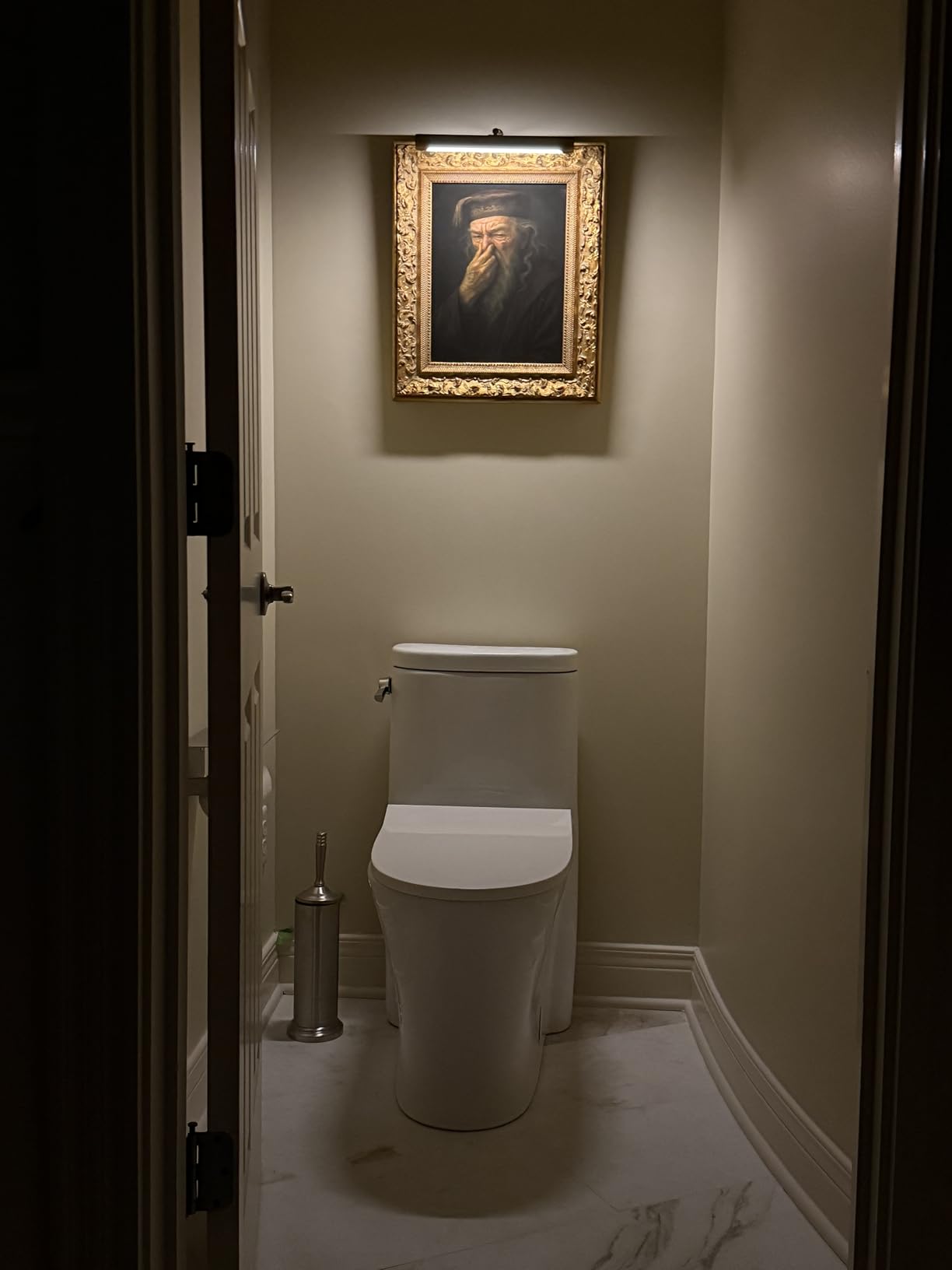
The 6.6-foot cord with an in-line switch is long enough to reach an outlet from most wall positions, and reviewers note it can be hidden behind the frame for a clean look. The auto-off timer runs at 1, 2 or 4 hours, and the bar is metal in a gold finish.
It also comes in 12, 16 and 24 inch lengths and in gold, black and nickel, so matching an existing room scheme does not force a compromise on length.
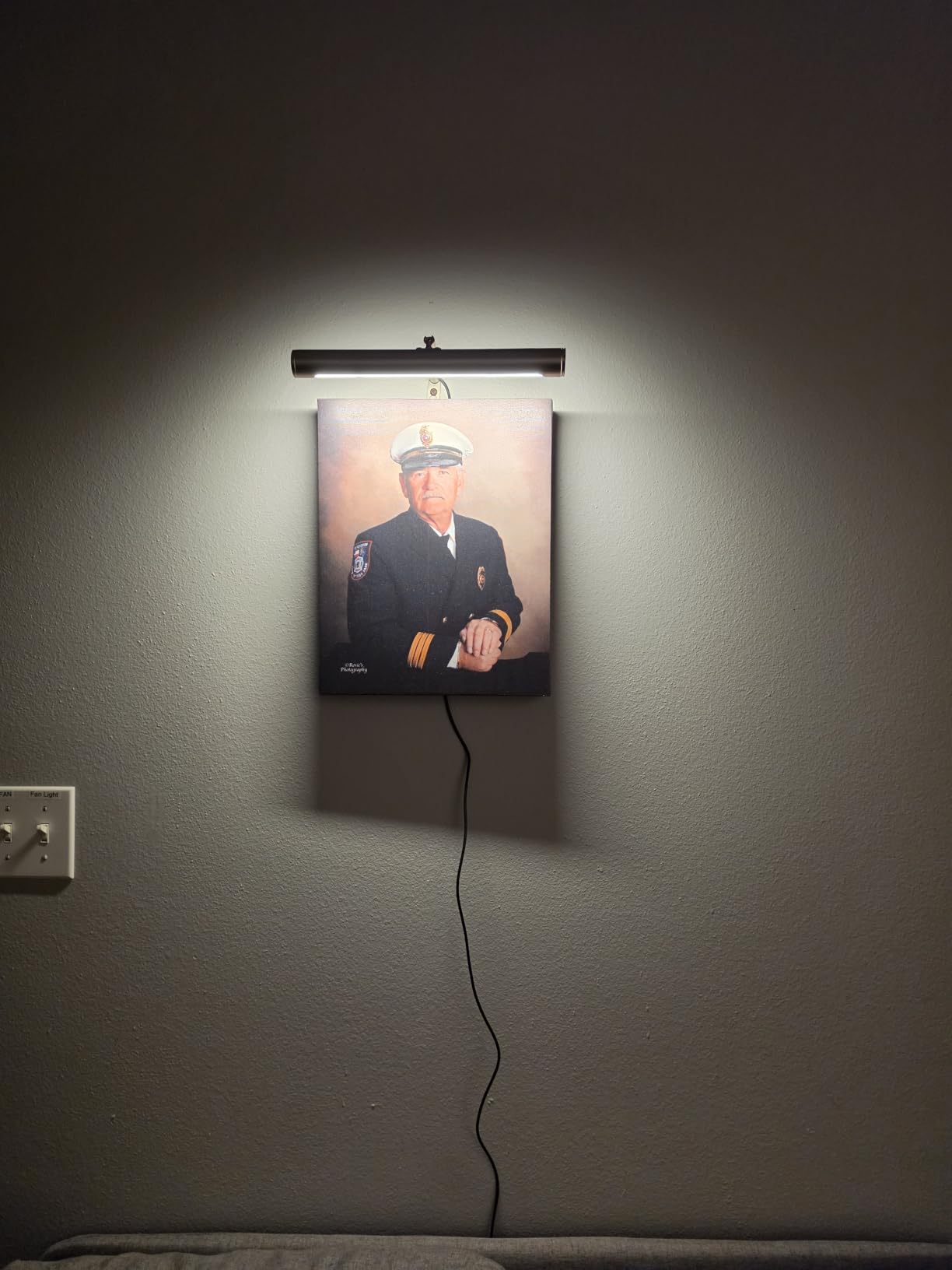
How the telescoping arms solve deep frames and mouldings
Most picture lights assume a flat wall and a thin frame. Extend the arms and the same fixture works over a deep decorative moulding, a canvas with a thick stretcher bar, or a frame hung on a standoff, because the light head moves forward to meet the artwork surface instead of washing the wall behind it.
The 360-degree horizontal rotation is useful on a gallery wall, letting you angle several fixtures inward so the beams converge on the work rather than each one pointing straight down into empty wall.
Where this fixture is the wrong choice
The remote requires two AAA batteries that are not included, which is a common and unnecessary annoyance. Manual control is limited to the in-line cord switch, so without the remote you get on and off only.
With 304 reviews the feedback pool here is thinner than most of this roundup, so judge the mechanism carefully in person. The telescoping sections are where a manufacturing fault would show.
11. Situ Art Lighting Plug-in Vision Series 17 inch – Best for Fine Art and Collectors

Situ Art Lighting: Plug-in Vision Series LED Fine Art and Picture Light
95+ CRI LED
3000K, also 2700K options
50+ brightness settings
3/8 inch slim bar
UV and IR safe
Pros
- Even full-canvas coverage with no hot spots
- Very slim 3/8 inch profile
- Remote dimming across 50 plus settings
- Manufacturer publishes coverage charts by artwork size
Cons
- Highest cost in the roundup by a wide margin
- Power cord can be visible if routing is not planned
- Levelling the bar on the bracket takes some fiddling
This is the fixture to buy if the artwork is the point rather than the room. A stated 95 plus CRI with 50 plus brightness settings and a 3/8 inch profile produces the most convincing, glare-free wash of anything I tested, and owners with genuine fine art consistently describe it as the best picture light they have owned. The 4.8 rating is the highest in this roundup, though it rests on 321 reviews rather than thousands.
That review count is worth stating plainly. The premium fixtures in this category carry thin feedback pools, often under 10 reviews, which means a star rating tells you less here than it does for a mass-market light. I have weighted the published specifications more heavily for this pick than for any other.
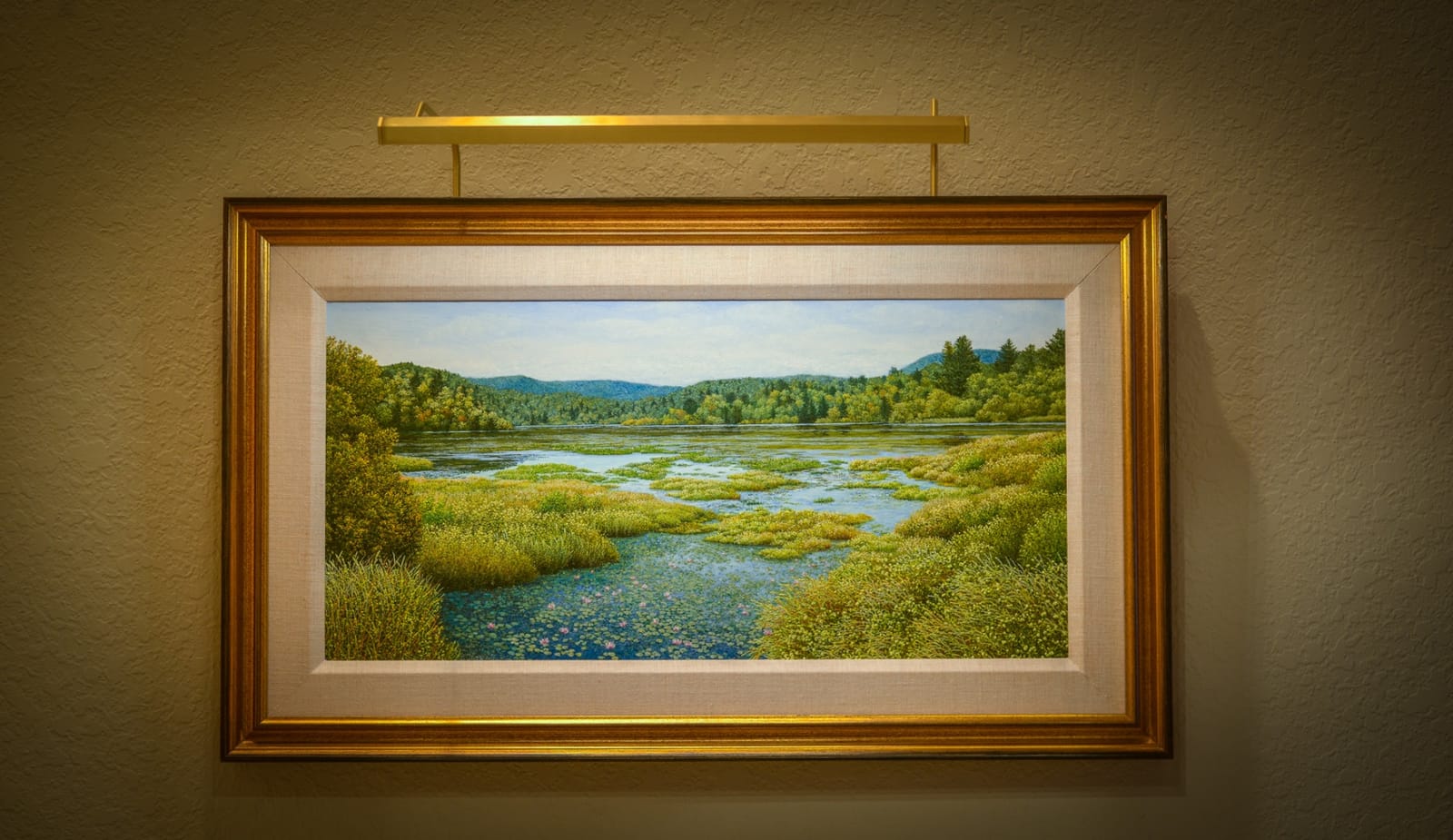
Installation is unusual in a useful way. The bar mounts either to the wall behind the artwork or directly to the frame, so if you rehang the piece the light goes with it. The default depth is 10.5 inches with a pivoting bar for height adjustment, and the manufacturer publishes coverage charts by artwork size, which removes the sizing guesswork entirely.
Output is UV and infrared safe, the bar runs on 12 volts, and the remote is RF programmable to control multiple lights with auto-on and shutoff timers. Sizes run from 9 to 56 inches, with 2700K, 3000K and color-tuning versions, and there is a three year limited warranty.
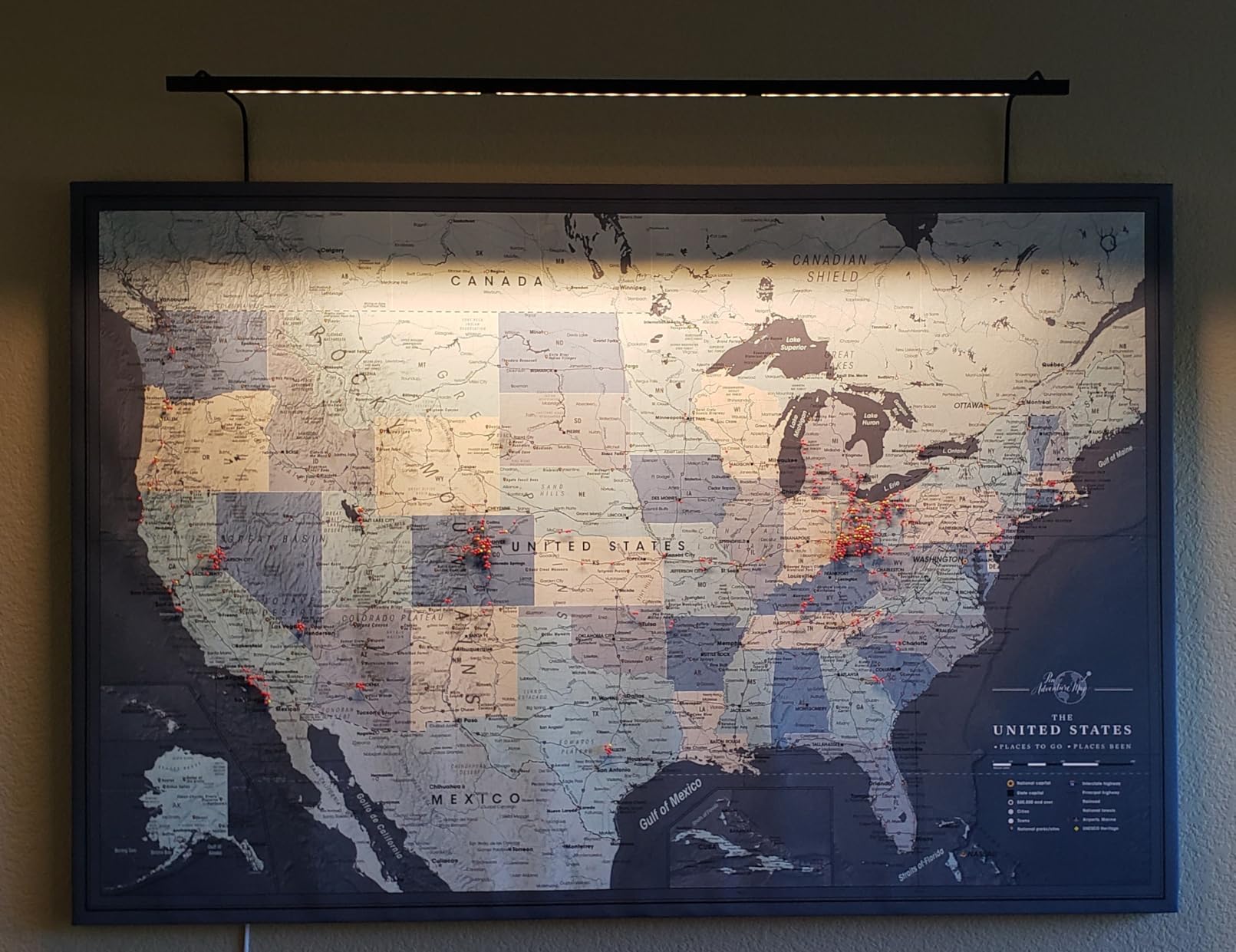
Why 50 plus brightness settings change viewing
Most fixtures give you three or five brightness levels. Fifty-plus settings mean you can dial the output to match the exact ambient level of the room, which is what allows evening viewing without the artwork looking either black or blown out. Owners with dark-walled rooms single this out as the feature they would not give up.
Because it is an RF remote rather than infrared, it works through a wall and across rooms, so a light above a stairwell can be dimmed from downstairs. Infrared remotes, including several cheaper options in this roundup, do not.
Where this fixture is the wrong choice
Cost is the first constraint, and it is a large step up from everything else here. For a single 8×10 print, that step is hard to justify. It pays off on a large canvas, a salon wall, or a collection you look at daily.
The power cord can be visible if you do not plan the route, and getting the bar perfectly level on the bracket takes some fiddling. Both are solvable at install time rather than reasons to avoid it.
12. Pasoar 23.6 inch Hardwired Brass Picture Light – Best for a Permanent Gallery Wall

Pasoar LED Brass Hard-Wired Connection Gallery Picture Light for Paintings Gold Lighting Fixtures Dimmable Modern LED Picture Lights Artwork Display Lighting 23.6 Inch 14W 3000K Warm White
560 lm
3000K warm white
14 watts
Dimmable 5% to 99% flicker-free
23.6 inch bar,hardwired to junction box
Pros
- Dimmable from 5 to 99 percent for true accent control
- Hardwired means no charging routine
- Full metal construction with low heat emission
- Pre-assembled and quick to mount
Cons
- Requires electrical work and a junction box
- 3000K can read slightly too yellow for some
- Loose set screws in the box are easy to lose
Once a gallery wall is permanent, hardwired is the correct answer and this is the fixture to build it with. No battery to charge, no adhesive to fail, no cord to hide, and dimming from 5 to 99 percent through an ETL-certified flicker-free driver, which is a wider range than any other fixture here.
The 23.6-inch bar with an adjustable head outputs 560 lumens at 3000K warm white from 14 watts. Full metal construction keeps heat emission low, which matters because a hardwired fixture is the one most likely to be left switched on for hours.
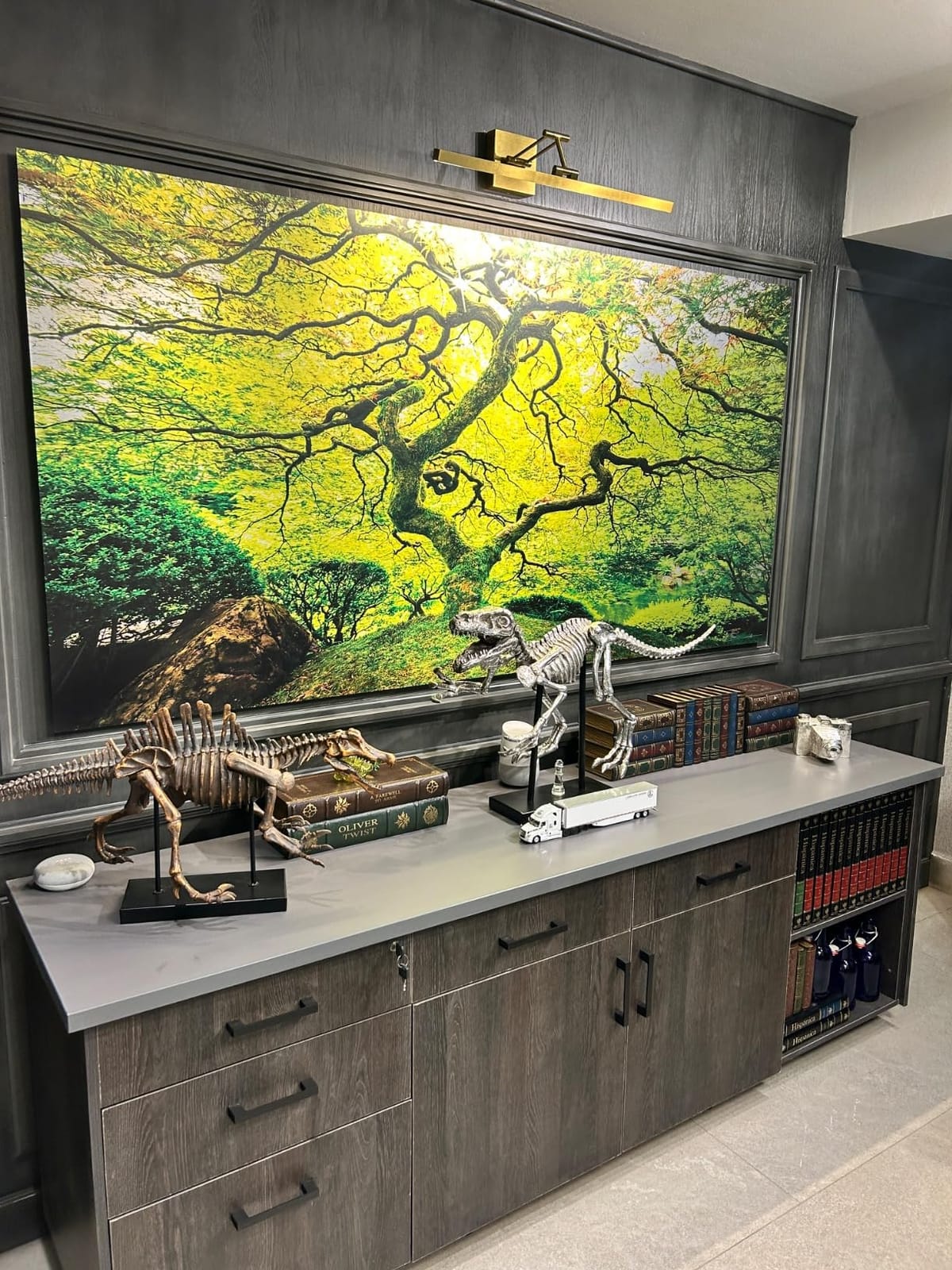
It is pre-assembled and mounts to a standard junction box with included screws, so an electrician can install and dim it in a single visit. Buyers and designers rate the finish highly, and several people use these as kitchen task lighting as well as over artwork, which tells you how evenly the light spreads.
It also comes in 15.7 and 23.6 inch lengths with brass, black or antique bronze finishes and a round or square base, so a mixed wall can be matched without buying from two ranges.
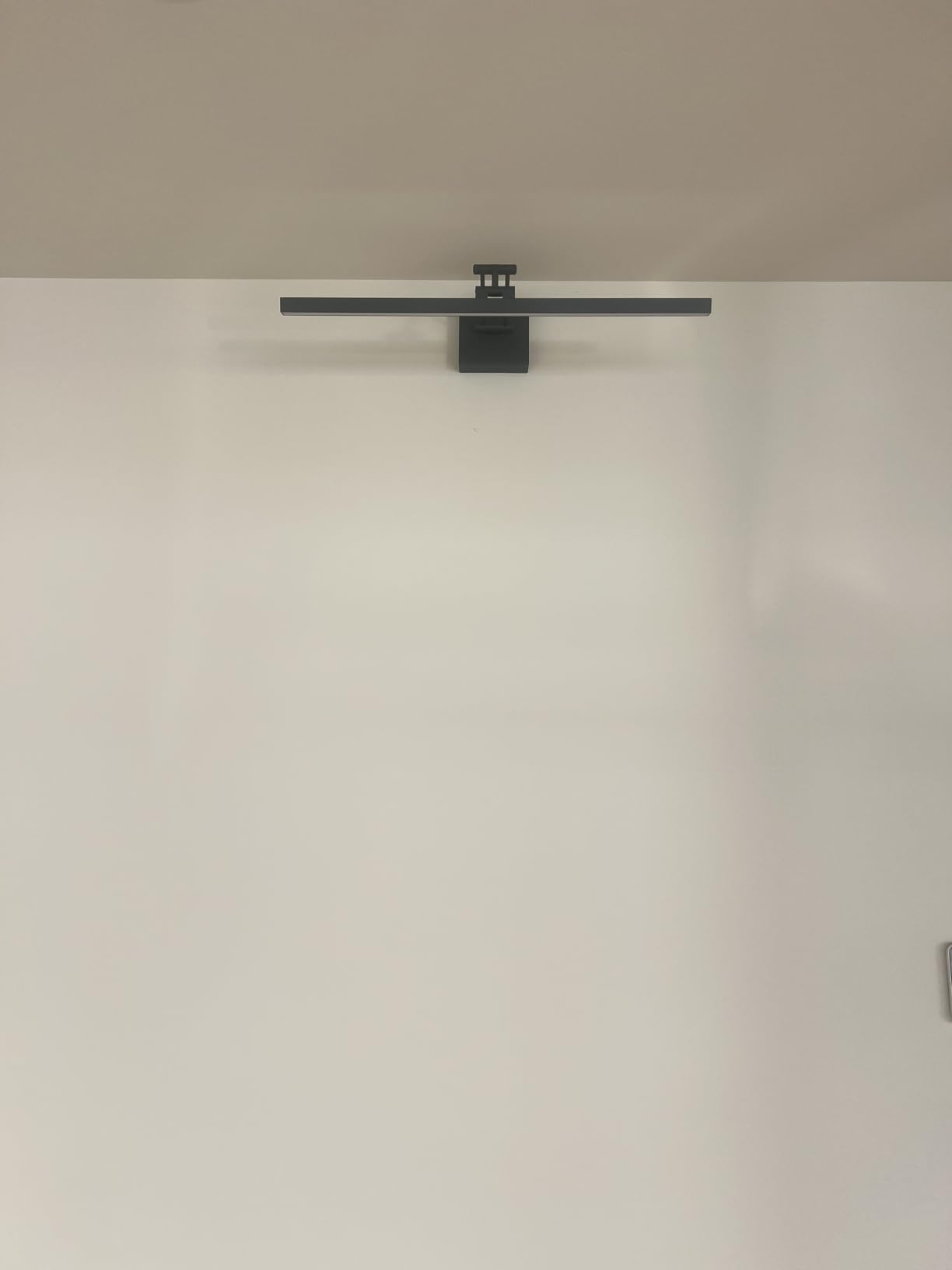
How deep dimming changes how the artwork reads
Dimming to 5 percent is not a party trick, it is the difference between art lighting and a bright spot. At low output the same fixture reveals surface texture and brushwork in a way that a fixed 100 percent wash flattens, and it stops the fixture from becoming the brightest object in the room when the overhead lights are off.
The flicker-free driver is worth noting separately. Cheap dimmers pulse at a low frequency that the eye picks up as shimmer in the reflection on glass, and on artwork that reads as a defect in the piece rather than in the light.
Where this fixture is the wrong choice
It needs electrical work and a standard junction box, so it is not a renter option and not a one-afternoon project. If you might move home, the money is better spent on a plug-in fixture with equivalent dimming.
Some buyers find 3000K slightly too yellow, particularly against cool grey walls. Loose set screws in the package are also reported often enough to check the box contents before you begin. With 250 reviews this is the thinnest feedback pool in the roundup.
How to Choose a Picture Light for Artwork in 5 Steps
Most buying mistakes happen because people start with the fixture. Start with the artwork instead, and work through these five decisions in order.
1. Measure the frame, not the wall
Write down the width of the frame including its mat and moulding, then aim for a fixture between one half and two thirds of that width. A 26.5 inch framed piece, the most common sizing question we see asked, calls for a fixture in the 13 to 17 inch range, so a 16 inch bar is right. The longest fixtures we tested, at 24.4 inches, are built for frames of roughly 36 inches and beyond.
The reason for the ratio is physics rather than taste. A bar narrower than half the frame leaves the outer thirds dark. A bar as wide as the frame flattens the piece with a flat, even band and draws the eye to the fixture. Step outside the 1/2 to 2/3 window and the artwork stops being the focus.
2. Check CRI, not marketing language
Color Rendering Index measures how accurately a light source reproduces the colors of what it illuminates. Anything below CRI 90 will visibly shift saturated reds and blues, and language like museum quality means nothing on its own. Ask for the number. The fixtures here publish figures from CRI 90 through CRI 95 plus, and for oil paintings, watercolours and photography we would not go below 95.
A close second is UV-free output. Light sources that emit ultraviolet fade pigments, dyes and paper over years, and the damage is cumulative and irreversible. Every LED fixture in this roundup is UV-safe or low-UV by nature of the source.
3. Match color temperature to the room and the work
Color temperature is measured in Kelvin. Lower values are warmer and more orange, higher values are cooler and bluer. For most home interiors and traditional painting, 2700K to 3000K is the right zone, and it matches warm ambient lighting so the fixture does not look like an operating theatre. Cooler 4000K to 6500K suits graphic design prints, photography and modern interiors.
If a fixture gives you only one fixed temperature, you are accepting a compromise. Switchable 3CCT fixtures cost little more and let you tune the light per piece, which is worth real money on a mixed collection.
4. Match output to frame size
Lumens tell you how much light leaves the fixture, but the number only means something next to the area it has to cover. Roughly speaking, an 8 inch bar should deliver at least 200 lumens, a 14 to 16 inch bar 350 to 600 lumens, and a 24 inch bar on a large canvas wants 500 lumens or more. The rechargeable short bars here at 80 lumens per light are accent only, and the manufacturer says so by limiting them to frames up to 8×12 inches.
Beam spread matters as much as raw output. A wide 120 degree beam covers more of a large frame evenly, while a narrow beam gives you the hot spot at the top and falloff at the bottom that makes artwork look cheap. Look for a stated beam angle or beam width rather than guessing.
5. Choose the power source you can live with
Rechargeable wireless lights install without drilling and are the only realistic option over a staircase or a chimney breast, but you manage a charging routine and output is often lower. Plug-in fixtures give you unlimited light and dimming without batteries, at the cost of a cord you need to hide. Hardwired fixtures look the cleanest and dim best, and they need an electrician, a junction box and a landlord’s permission if you rent.
If you are in a rental, the rechargeable and plug-in options are the whole shortlist. If you own the wall and the artwork is staying, hardwired wins on every spec that matters except installation day.
Installation and Placement: Height, Tilt and Glare
The spec sheet tells you what a fixture can do. Placement tells you what it actually does, and this is where most disappointing picture lights are downgraded. Three numbers cover almost every case.
Mount 5 to 8 inches above the frame, tilt 30 to 35 degrees
Mount the fixture 5 to 8 inches above the top edge of the frame, and tilt the head downward at roughly 30 to 35 degrees from vertical. This produces a wash with a gentle hot spot just inside the top of the frame and a gradual falloff toward the bottom, which is how the eye expects to read a lit painting.
Mount it flush against the frame and the beam lands on the top moulding. Mount it too high and the light spills onto the wall above. The 5 to 8 inch band is wide enough to absorb real-world measurement error, which is fortunate, because most walls are not as square as they look.
Glare is a position problem, not a brightness problem
Glare on glass-fronted work happens when the fixture sits at a reflection angle relative to the viewer. Move it down closer to the top of the frame and the reflection moves up and out of the sightline. Mount it higher and the mirror image of the light drops into the glass where you can see it.
On raked artwork, no fixture position removes glare entirely, which is an argument for frameless canvases or museum glazing in rooms where you care. Raising the fixture slightly and angling the head away from the viewer reduces it further.
Spacing a wall of three or more pieces
Use one fixture per piece for two or three works, positioned centrally above each. Beyond three, or for a salon wall of small pieces, stop adding picture lights and move to a track or a wall washer, which spreads light evenly without a row of hardware across the top of the arrangement.
For multi-fixture walls, remote or RF control matters. Infrared remotes, common on cheaper rechargeable lights, will not reach through a wall, and walking along a wall pressing buttons for each fixture defeats the point of having several.
For the ambient layers these accent lights sit against, our guides to vanity lights and pathway lights cover the rest of a room’s scheme. If your collection leans heavily on illustrated panels and graphic pieces, our arcade cabinet artwork guide covers matching light colour for that style of work.
Do Picture Lights Damage Artwork? UV, IR and Heat
This is the question collectors ask most and sellers answer least, so here is the short version. Light damage to artwork is cumulative, it is invisible while it happens, and it has three components: ultraviolet radiation, infrared heat, and visible light exposure over time.
Ultraviolet is the one that fades pigments, dyes and paper. Paper, watercolour, textiles and anything with organic dyes are the most vulnerable, and the effect is a slow shift toward dull, washed-out colour. Infrared is felt as heat and accelerates the same kind of degradation, and it also works on materials that are not light-sensitive at all, which is why oil paintings show lifting and stress in the upper layers under hot fixtures.
Modern LED output is close to UV-free by physics, and it runs cool enough that heat is a secondary concern. That is the single strongest conservation argument against the halogen and incandescent picture lights still on sale, including the Westinghouse in this roundup, whose 15 watt bulb owners report runs extremely hot to the touch.
Three practical rules follow. Mount the fixture 5 to 8 inches clear of the frame so air circulates rather than trapping heat against the surface. Leave halogen and incandescent fixtures off for long periods, or replace the bulb with a compatible LED. And for a valuable work, follow the museum convention of keeping total light exposure low, display it for part of the day, and accept that lighting for artwork is a trade-off against conservation rather than a free upgrade.
Frequently Asked Questions
What kind of lighting is best for displaying artwork?
High-CRI (95+) UV-free LED output at 2700K to 3000K is the best all-round choice. The CRI figure determines whether pigments and dyes read true, the Kelvin value keeps the light consistent with warm interior lighting, and UV-free LED output avoids the fading that halogen and incandescent fixtures cause over years. Mount it 5 to 8 inches above the frame at a 30 to 35 degree tilt.
How far above a painting should a picture light be mounted?
Between 5 and 8 inches above the top edge of the frame, with the head tilted downward at roughly 30 to 35 degrees. This creates a wash with a gentle hot spot just inside the top of the frame and gradual falloff toward the bottom. Mounting flush to the frame puts the beam on the moulding, and mounting too high spills light onto the wall above.
What size picture light do I need for my frame?
Choose a fixture between one half and two thirds of the frame width. A 26.5 inch framed piece calls for a 13 to 17 inch fixture, so a 16 inch bar is a good match. An 8 inch frame suits a 4 to 5 inch accent spot, while frames of 36 inches and wider need a 24 inch bar or longer to keep the outer quarters from going dark.
Is it better to hardwire or plug in picture lights?
Hardwired is better for a permanent gallery wall: no cord to hide, no battery to charge, and the widest dimming range with no flicker. Plug-in is better for a rental or for art you may rehang, since you can move the fixture without touching the wall. Over a staircase or a wall with no outlet, a rechargeable wireless light is the only realistic option.
Do LED picture lights fade or damage artwork?
LED output is close to UV-free and runs cool, so it causes far less damage than halogen or incandescent fixtures, which emit ultraviolet and radiate heat. Damage is still cumulative, so keep valuable paper, watercolour or textile work lit for limited hours, leave clearance so air circulates, and treat art lighting as a trade-off against conservation rather than a free upgrade.
What is the 3 lighting rule?
The three-layer lighting rule describes a room lit by ambient, task and accent sources. Ambient light is general illumination such as a ceiling fixture, task light is for a specific activity, and accent light draws attention to an object. A picture light is an accent layer, which is why it looks unbalanced when it is the only source in the room.
The Best Picture Lights for Artwork in 2026
After working through twelve fixtures, the FULEN rechargeable pair comes out ahead of the best picture lights for artwork overall. Its stated CRI 95+ at 3000K, a 4500mAh battery giving 15 hours of cordless runtime and a magnetic mount that needs no drilling is a combination nothing else here matches at this review volume, and the 4.3 rating across 4592 reviews is the deepest feedback pool in the roundup.
Buy the LYTARA instead if the fixture has to look expensive and you want stepless dimming, and pick the Craftersmark three-pack if you are lighting three frames and want screw-mounted security. The Pasoar hardwired bar is the right call for a wall you never intend to change, and the Situ Vision series is the one to buy when the artwork deserves the best light and the budget stretches to it.
Whatever you choose, size the bar at one half to two thirds of the frame width, mount it 5 to 8 inches above the top edge, and aim it down at 30 to 35 degrees. Those three numbers do more for your artwork than any specification on the box.