
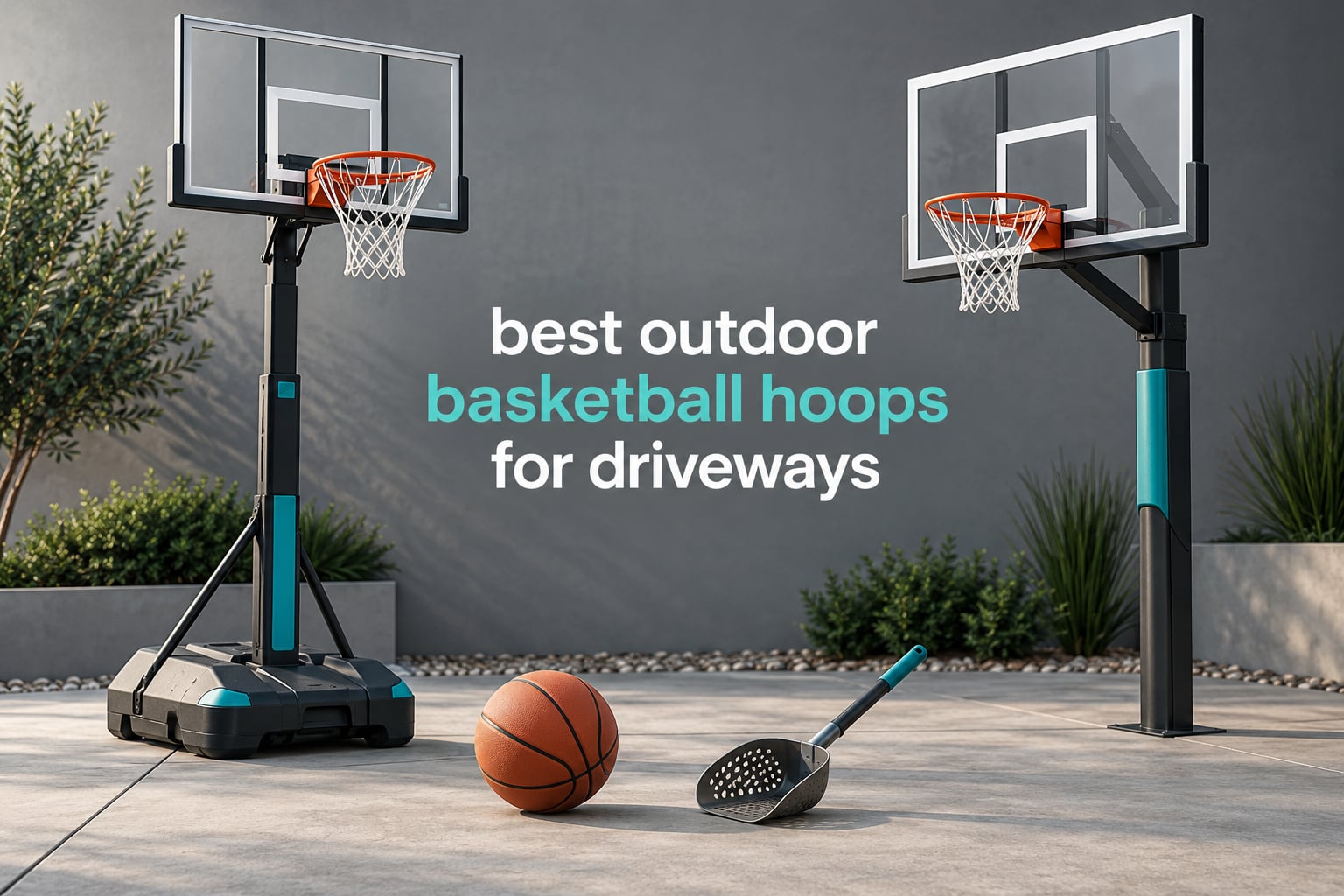
Most driveway hoop guides hand you a list of portable systems and leave you to work out whether you should be pouring concrete instead. That decision comes first, because it rules out half the field. An outdoor basketball hoop for a driveway is one of two things: an in-ground basketball hoop whose pole is set into a poured cement footing, or a portable basketball hoop that stands on a wide base you fill with sand or water and roll on transport wheels. Everything else – backboard size, rim style, height range – is a detail inside that larger choice.
We spent weeks comparing 12 of the best outdoor basketball hoops for driveways, weighing customer reviews, spec sheets, and the complaints owners actually post about. The result spans everything from a low-cost starter system to a 60 inch tempered glass in-ground goal, and it includes the honest gaps: which backboards feel dead, which bases tip in wind, and which “10 foot” poles only reach 10 feet with three inches of overlap left in the joint.
Short version: the Lifetime Portable takes the top slot for most households because it adjusts from 7.5 to 10 feet without tools, most reviews of anything we looked at, and rolls into a garage when winter arrives. If you own the house and plan to stay, the Silverback 60 inch in-ground model is the one that will still feel rock solid in five years. If you want the short version by category, start here:
Best overall: Lifetime Portable – 7.5 to 10 ft tool-free pole, 44 inch shatterproof Fusion backboard, fillable base with wheels.
Best in-ground: Silverback 60 inch – tempered glass backboard, pro-style breakaway rim, all-steel actuator, 7.5 to 10 ft.
Best for young kids: Yohood 4.4-10 ft – lowers to 4.43 ft, 44 x 28 inch molded base, works indoors too.
Best for hard play: IGL – 13.2 gallon base, tool-free five-level adjustment, top seller in the category.
Best for a narrow driveway: Sweetcrispy – 6.1 to 10 ft, 44 inch board, stability-focused frame that limits wobble.
Best on a budget: DUMOS – 6.1 to 10 ft, 44 inch shatterproof board, shock absorbent rim, wheels included.
Best without a sand mess: Best Choice Products – gel powder base mix, spring breakaway rim, 7.5 to 10 ft.
Best 54 inch in-ground: Silverback NXT54 – concrete-set pole, Infinity Edge backboard, pro-style breakaway rim.
If you are still working out how much space you have, read the in-ground guide first. If the household includes children under eight, our kids hoop picks break the height ranges down further.
Top 3 Picks: Outdoor Basketball Hoops for Driveways in 2026
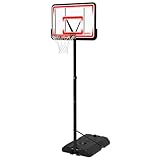
Lifetime Portable 44 Inch Hoop
- Tool-free 7.5-10 ft telescoping pole
- 44 inch shatterproof Fusion backboard
- fillable base with built in wheels
- 5 year limited warranty

Silverback 60 Inch In-Groun…
- 60 inch tempered glass backboard
- pro-style breakaway rim
- all-steel actuator from 7.5 to 10 ft
- backboard and pole pads included

Yohood Adjustable 4.4-10…
- Lowers to 4.43 ft across 11 levels
- oversized 44 x 28 inch molded base
- indoor and outdoor use
- labeled parts and video guide
All three reach regulation 10 feet, so the split is about who uses them. The Lifetime is the one you can move, store, and hand to a six year old without calling a contractor. The Silverback is the one you set once and never think about again. The Yohood exists because most portable hoops bottom out around 7.5 feet, which is still far too high for a small child.
Best Outdoor Basketball Hoops for Driveways (October 2026)
| Product | Specs | Action |
|---|---|---|
| Lifetime Portable 44 Inch Hoop |
|
Check Latest Price |
| Silverback 60 Inch In-Ground Hoop |
|
Check Latest Price |
| Yohood 4.4-10 Ft Hoop |
|
Check Latest Price |
 IGL 40/44 Inch Portable Hoop IGL 40/44 Inch Portable Hoop |
|
Check Latest Price |
 Best Choice Products 10 Ft Hoop Best Choice Products 10 Ft Hoop |
|
Check Latest Price |
 DUMOS 10 Ft Adjustable Hoop DUMOS 10 Ft Adjustable Hoop |
|
Check Latest Price |
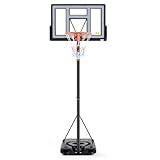 Sweetcrispy 44 Inch Hoop Sweetcrispy 44 Inch Hoop |
|
Check Latest Price |
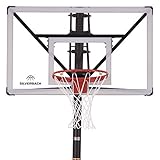 Silverback NXT54 54 Inch In-Ground Silverback NXT54 54 Inch In-Ground |
|
Check Latest Price |
 Lifetime 71281 In-Ground 52 Inch Lifetime 71281 In-Ground 52 Inch |
|
Check Latest Price |
 Yohood Crank 44/48 Inch Hoop Yohood Crank 44/48 Inch Hoop |
|
Check Latest Price |
 awii sport 40/44/48 Inch Hoop awii sport 40/44/48 Inch Hoop |
|
Check Latest Price |
 Lifetime 1084 In-Ground 50 Inch Lifetime 1084 In-Ground 50 Inch |
|
Check Latest Price |
1. Lifetime Portable 44 Inch Hoop – Best Overall and the Tool-Free Height Range
Lifetime Portable Basketball Hoop, Adjustable Height 7.5-10 Ft, 44 Inch Shatterproof Fusion Backboard, Base with Wheels
7.5-10 ft pole
44 in polycarbonate Fusion board
48 lb
Fillable base with wheels
Pros
- Tool-free telescoping pole in 6 inch increments
- Shatterproof 44 inch polycarbonate board with UV protected graphics
- Built in wheels move it without cement
- Drops to 7.5 ft so younger kids can reach
- 5 year limited manufacturer warranty
Cons
- Small board feels bouncy and layups hit the pole
- Tiny base filler holes make sand fill tedious
- Two adults are needed for height changes
This is the hoop we recommend to almost everyone who asks. The 44 inch x 30 inch Fusion backboard pairs a polycarbonate playing surface with a polyethylene frame, which is a stiffer and better-supported build than a thin plastic sheet. That matters more than the spec sheet suggests: the frame is what kills the trampoline effect you get on cheap boards.
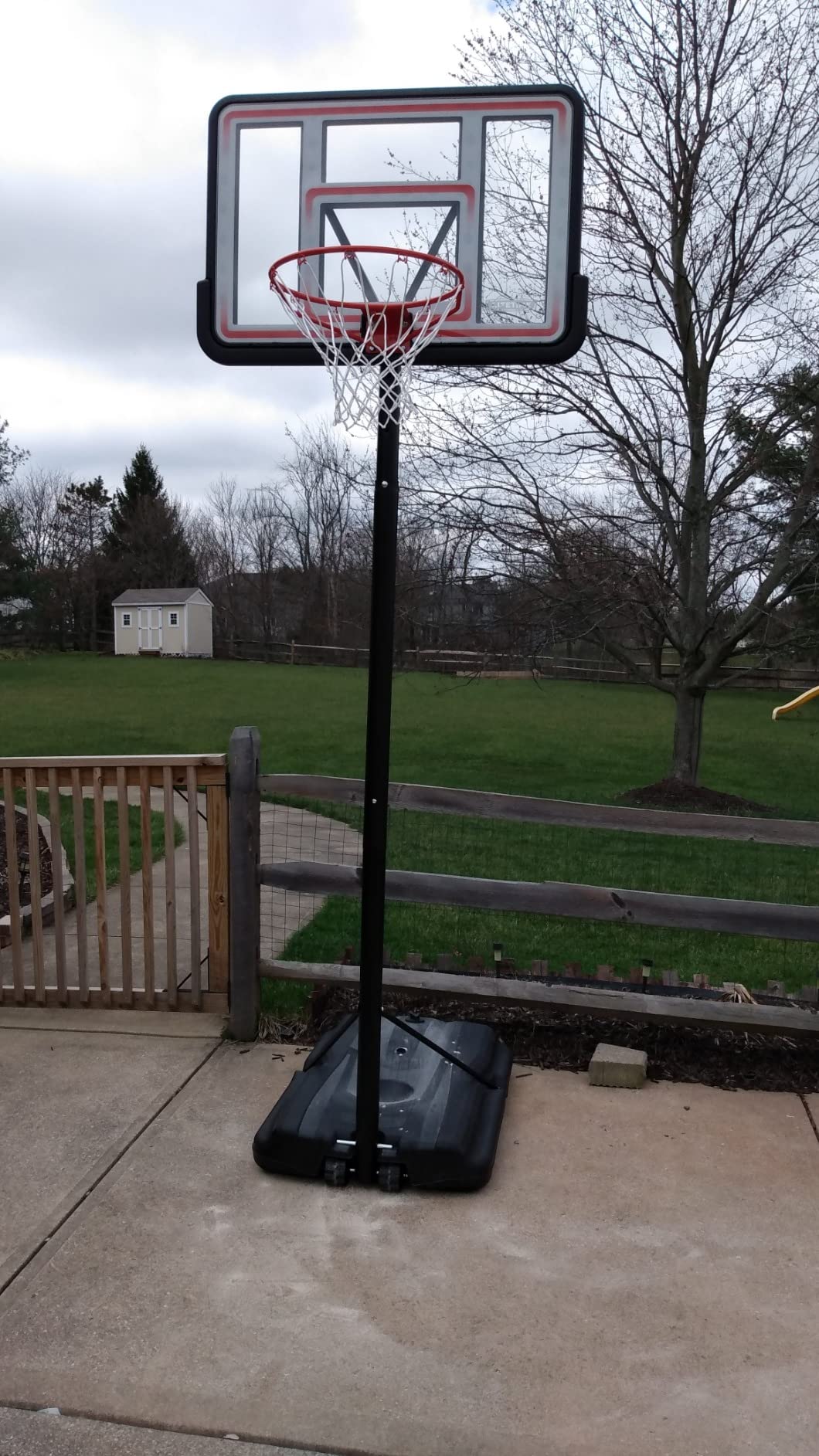
The three piece round steel pole has a powder coated, weather resistant finish and telescopes through 6 inch increments from 7.5 to 10 feet with no tools. In practice that means a six year old can shoot at 7.5 feet in the morning without you crouching over bolts, and an adult can raise it to 10 feet before a game. The telescoping design means the overlap between pole sections shrinks as it goes up, which is the trade every multi-section portable hoop makes.
What owners consistently praise is the whole-package convenience. The base takes sand or water, and the built in wheels let two people roll it across a driveway without lifting. Winter storage in a garage is a realistic plan rather than an aspiration, which matters for anyone in a climate with snow.
What to check before you fill the base
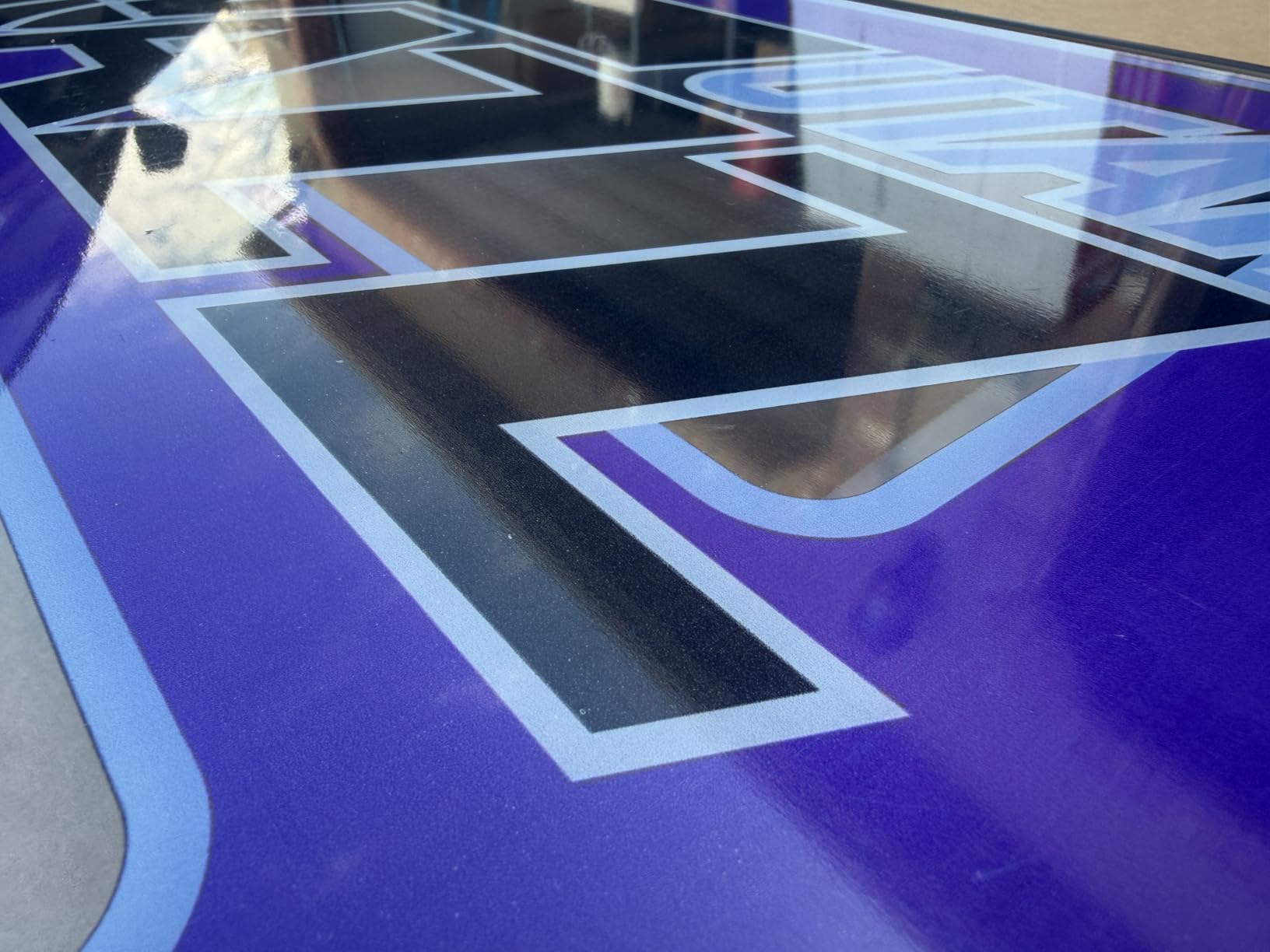
Reviewers flag the filler holes as the most frustrating part of ownership, and it is fair. Plan to fill the base gradually and check the level as you go, because a base that is heavier on one side will lean no matter how much weight is in it.
Two other things worth knowing. The backboard is genuinely small, so a fast layup at adult height will sometimes catch the pole – that is a board size limit, not a defect. And the printed instructions confuse a lot of buyers, who report that the online assembly video is dramatically clearer than the paper guide.
Who should skip it
If you are a serious player working on shooting form, a polycarbonate board gives back noticeably less than tempered glass and you will feel it. This model is built for driveway games, form work with kids, and households that will not be filling out a cement footing this weekend.
It is also not the model for a shared street where adults dunk hard all summer. Breakaway rim protection matters more at that level, and this hoop uses a fixed 5/8 inch steel ring with 1/2 inch braces rather than a sprung rim.
2. Silverback 60 Inch In-Ground Hoop – Best In-Ground with Real Glass Rebound
Silverback Height Adjustable In-Ground Basketball Hoop with Tempered Glass Backboard, Pro-Style Breakaway Rim & Backboard Pad, Black
60 in tempered glass
198 lb
7.5-10 ft actuator
Backboard and pole pads
Pros
- Tempered glass gives true indoor-style rebound
- Pro-style breakaway rim flexes on dunks
- All-steel actuator adjusts smoothly across 7.5 to 10 ft
- Backboard and pole pads included as standard
- Ranks first in Basketball In-Ground Hoops and Goals
Cons
- Concrete installation is permanent
- Around 200 lb means this is not a one person job
- Priced out of reach for casual driveway use
Everything else in this list uses a polycarbonate or polyethylene board. This is the only one with a 60 inch tempered glass backboard, and that single fact changes how the rim sounds and how the ball comes off the glass. Owners describe the shot feel as close to an indoor gym, and the dead-quiet ring-out is the opposite of the ringing resonance that drives some people off driveway hoops entirely.
The pole is stainless steel with a powder coat, driven by an all-steel actuator that walks the rim from 7.5 to 10 feet. The pro-style breakaway rim flexes under pressure on a dunk and returns, which protects both the glass and anyone standing underneath. Backboard and pole pads are included, and on a system this heavy that is not a trivial inclusion.
It arrives in a quick-play preassembled design, so the on-site work is mostly about the footing and the anchor kit rather than about wrestling with hardware. That said, at 198 pounds this is a two-person minimum, and the concrete pour is a commitment you cannot undo.
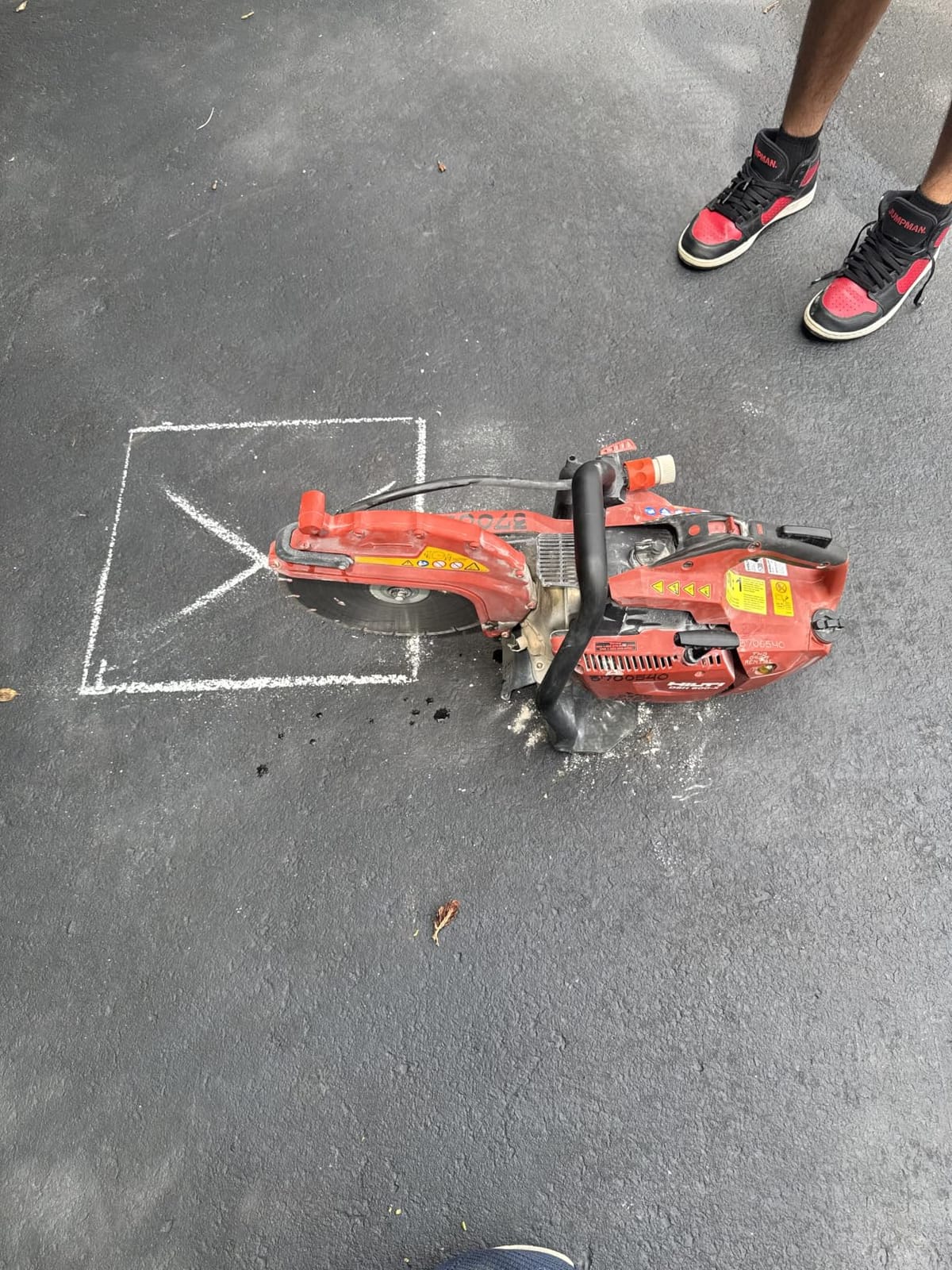
When glass is the right call
Tempered glass is the right call if the hoop will live in the same place for a decade, if adults are the primary players, or if you have ever noticed how much noise a cheap board makes. It is the wrong call if you rent, if you might move within five years, or if kids are the main users and you want a forgiving surface.
Measure carefully before this one. A 60 inch board is a wide footprint, and the overhang plus the shooter’s approach needs to clear your garage door and your street curb. If the numbers are tight, the 54 inch Silverback later in this list does the same job with less reach.
The real cost of permanence
Removing an in-ground system means breaking the footing out, which is a project, not an afternoon. Factor that into the decision if you are in a rental, on a short lease, or unsure about how long you will be there.
The other honest drawback is the entry point. For a family that mostly wants casual shooting, this is a significant jump in money and installation effort compared with a portable unit, and reviewers who regret the purchase tend to be the ones who did not already have a concrete-ready spot.
3. Yohood 4.4-10 Ft Hoop – Best for Young Kids and Low Adjustment Floors
Yohood Basketball Hoop Outdoor 10ft Adjustable, Portable Goal System for Kids Youth and Adults, 44 Inch Shatterproof Polycarbonate Backboard, Black
4.43-10 ft range
44 x 28 in base
44 lb
11 height levels
Pros
- Widest adjustment range here
- reaching down to 4.43 ft
- Oversized 44 x 28 inch molded base resists wind
- 11 distinct height levels from pole combinations
- Works in a garage as well as outdoors
- Sits near the top of the portable hoop sales chart
Cons
- Backboard is smaller than the 44 inch models and rebounds softly
- Base still needs fill before it will stand up in wind
- Going below 6.4 ft means removing a pole section
Almost every portable hoop on the market starts at 7.5 feet. That sits two and a half feet below regulation and is unreachable for a four or five year old. This one drops to 4.43 feet by running with two pole sections instead of three, and reviewers with several children at different ages call that range the whole reason they bought it.
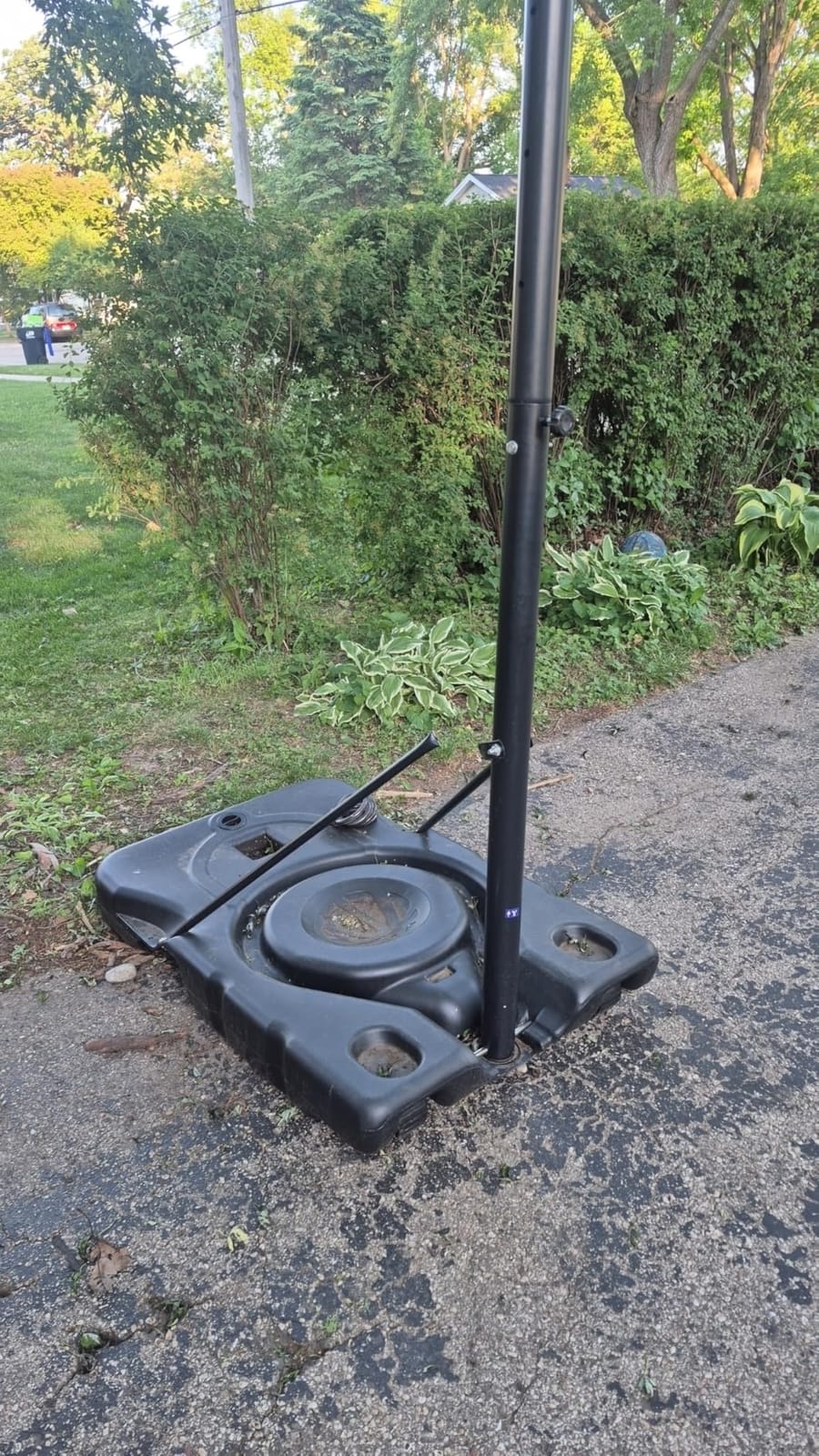
The base is the other differentiator. At 44 by 28 inches it is noticeably larger than the 36 by 24 inch bases common in this price bracket, and a bigger footprint is what resists a gust tipping the whole unit. Molding it as a single solid piece also removes the seam that is where cheaper portable bases split.
Included are a shatterproof backboard, a shock-absorption rim, a thickened solid PE net, and anti-rust steel poles. Buyers mention the assembly video and labeled parts approvingly, and this is one of the few budget hoops where the setup genuinely goes smoothly.
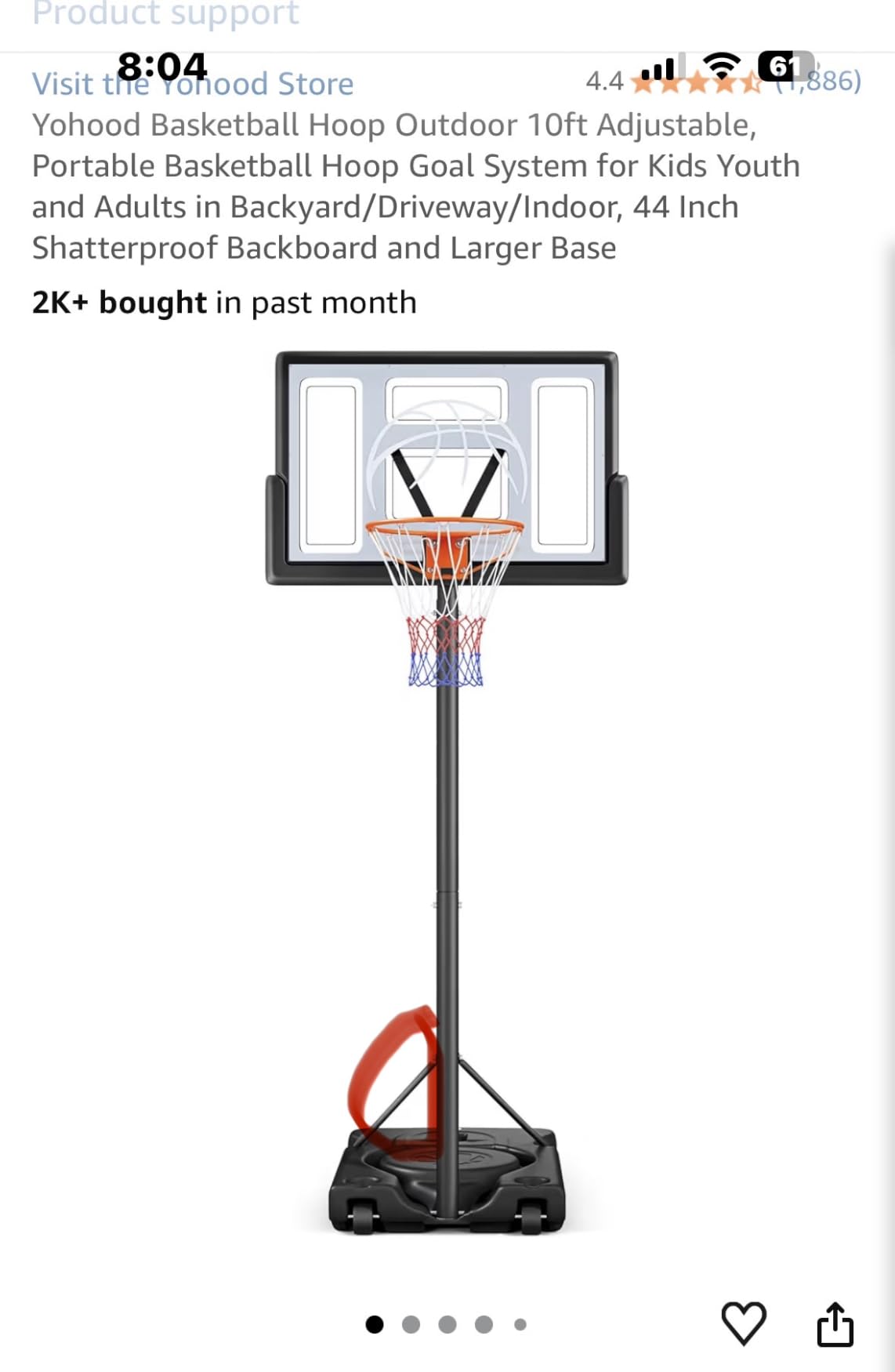
How low can it really go
With all three pole sections installed the range is 7.55 to 10 feet. Drop to two sections and you get 4.43 to 6.4 feet. That switching is the one fiddly step in an otherwise simple system, so know which heights you actually need before you assemble it.
For a household with a toddler and a teenager, that single feature is worth more than a better backboard. Nobody else in this lineup reaches below about 5 feet without a similar compromise.
Where the budget shows
The board is smaller than the 44 inch models and rebounds softly, which owners accept as the price of the low entry point. The one year manufacturer warranty is also short, and the poles are thinner than the three piece steel on the Lifetime.
Treat this as a family-height-range tool rather than a system you will shoot form on. If a hard backstop matters, look at the awii sport later on, which resists warping in a way this board does not.
4. IGL 40/44 Inch Portable Hoop – Best for Hard Play and Wind
IGL Portable Basketball Hoop, 5.6-10FT Adjustable Basketball Goal System, 44 Inch Outdoor Basketball Hoop & Goals for Kids, Youth, and Adults in The Backyard, Driveway with PC Backboard (Black)
5.6-10 ft in five levels
13.2 gallon base
46 lb
Front wheels
Pros
- 13.2 gallon base takes water or roughly 200 lb of sand
- Tool-free adjustment plus two screws at the pole joint
- Front wheels make repositioning straightforward
- Back panel designed not to yellow or curl in sun
- Sits near the top of the Sports and Outdoors sales chart
Cons
- Fully extended pole has less overlap and can feel unsteady
- Moving it means tipping the whole system
- Can tilt off level after an off-center shot
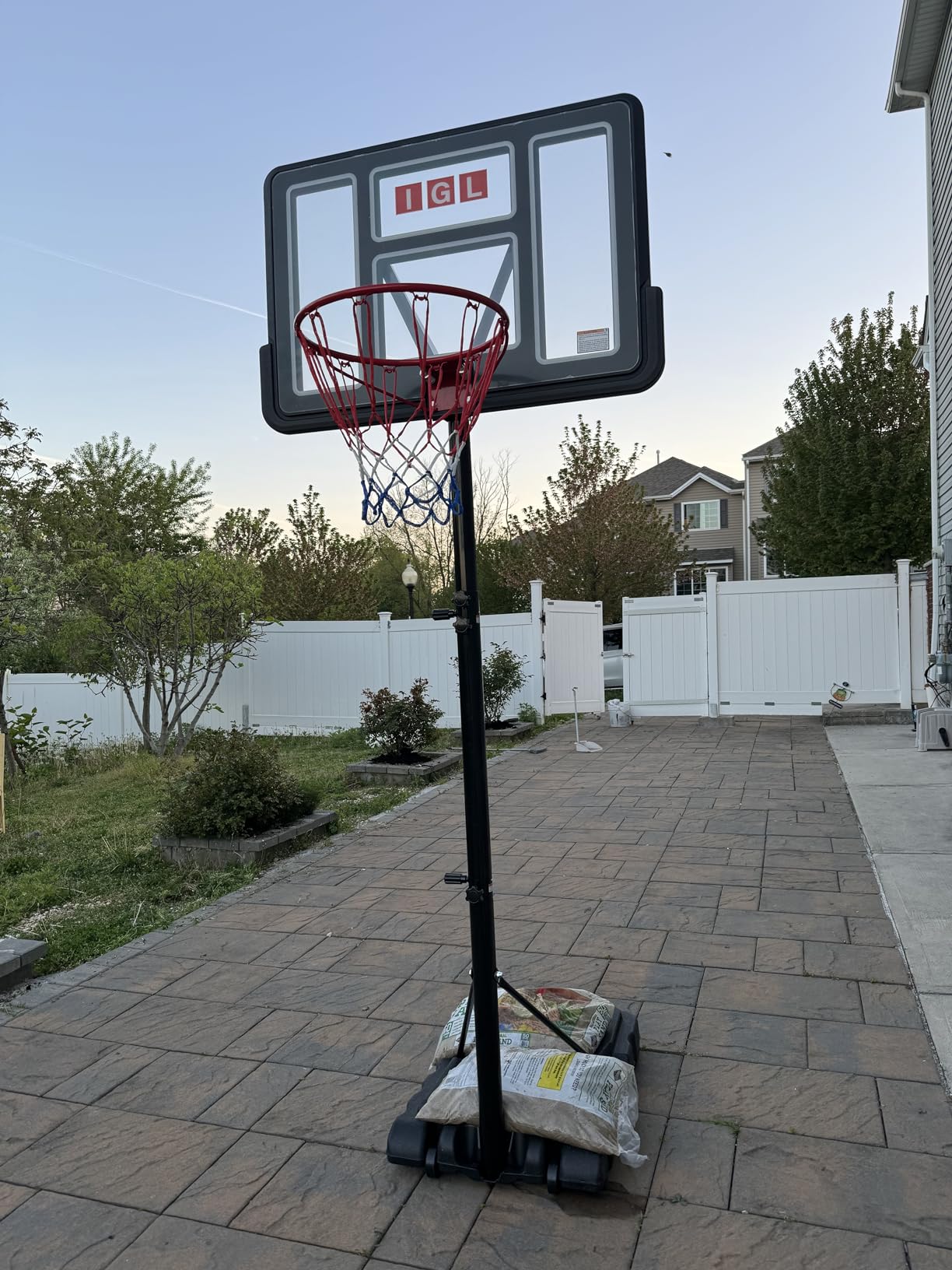
This is the most commonly described as the sturdiest portable system in its bracket, and the reason owners give is boring and convincing: a 13.2 gallon base. That is a lot of ballast for a goal that rolls on two wheels, and it is what keeps the pole from developing a lean during aggressive neighborhood play.
Height adjustment runs through five levels using rod combinations – four rods for 8.0 to 10 feet, three for 5.6 to 7.6. The design is tool-free, with two additional screws at the pole connection that reviewers appreciate as extra insurance against the wobble that creeps into multi-section poles.
The back panel is a shatterproof PE material chosen specifically because it resists yellowing and curling under sun exposure, which is the failure mode that ruins cheap portable boards after a couple of summers. Owners with a few seasons on it report the appearance holds up. The base is large enough to keep the pole planted, which is the property that most affects how a portable goal feels over years of use.
Living with a fully loaded base
A 13.2 gallon base is heavy. Repositioning works by tilting the goal forward onto the front wheels to about 40 degrees, which is fine for adults but is genuinely awkward on a sloped driveway or with a full ball or two. Plan your layout before you fill it.
That trade is worth it if the alternative is a base that tips. Forum threads about portable hoops describe wind incidents repeatedly, including one owner whose goal tipped toward a child during a street game. Ballast is the cheapest safety feature available.
What to watch
At full 10 foot extension the pole has less overlap, so it can feel slightly unsteady, and a few reviewers note the rim can tilt off level after a hard off-center shot. Neither is serious for shooting practice; both matter if you are running organized pickup games.
This is also the one on the list whose sales rank leads the category, which reviewers treat as a signal of proven demand rather than marketing. If you want a portable hoop that stays put, this is the one.
5. Best Choice Products 10 Ft Hoop – Best for a Mess-Free Base Fill
Best Choice Products Outdoor Basketball Hoop Portable & Adjustable 7.5-10FT, 44 Inch Shatterproof Backboard with Breakaway Dunk Rim & Stable Base Gel for Kids, Teens & Adults – Clear
7.5-10 ft pole
44 in polycarbonate
52 lb
Gel powder base mix
Pros
- Gel powder mixed with water is more stable than sand or water alone
- Adjusts 7.5 to 10 ft so one hoop serves kids and adults
- Spring-mounted breakaway rim absorbs layup and dunk impact
- Lightweight hollow base with two wheels when unloaded
- 44 inch polycarbonate backboard with solid rebound
Cons
- Only about 3 inches of pole overlap remain at full extension
- Rim does not stay perfectly level after an off-center shot
- Undersized backboard screws can loosen and crack the board
- 60 day return window and limited part support
Sand works, but it ends up everywhere. The gel powder mix in this base combines with water to produce a fill that is heavier and more stable than either ingredient alone, and you pour it in rather than shoveling it. For a driveway you also park on, or a concrete pad you care about, that difference is real.
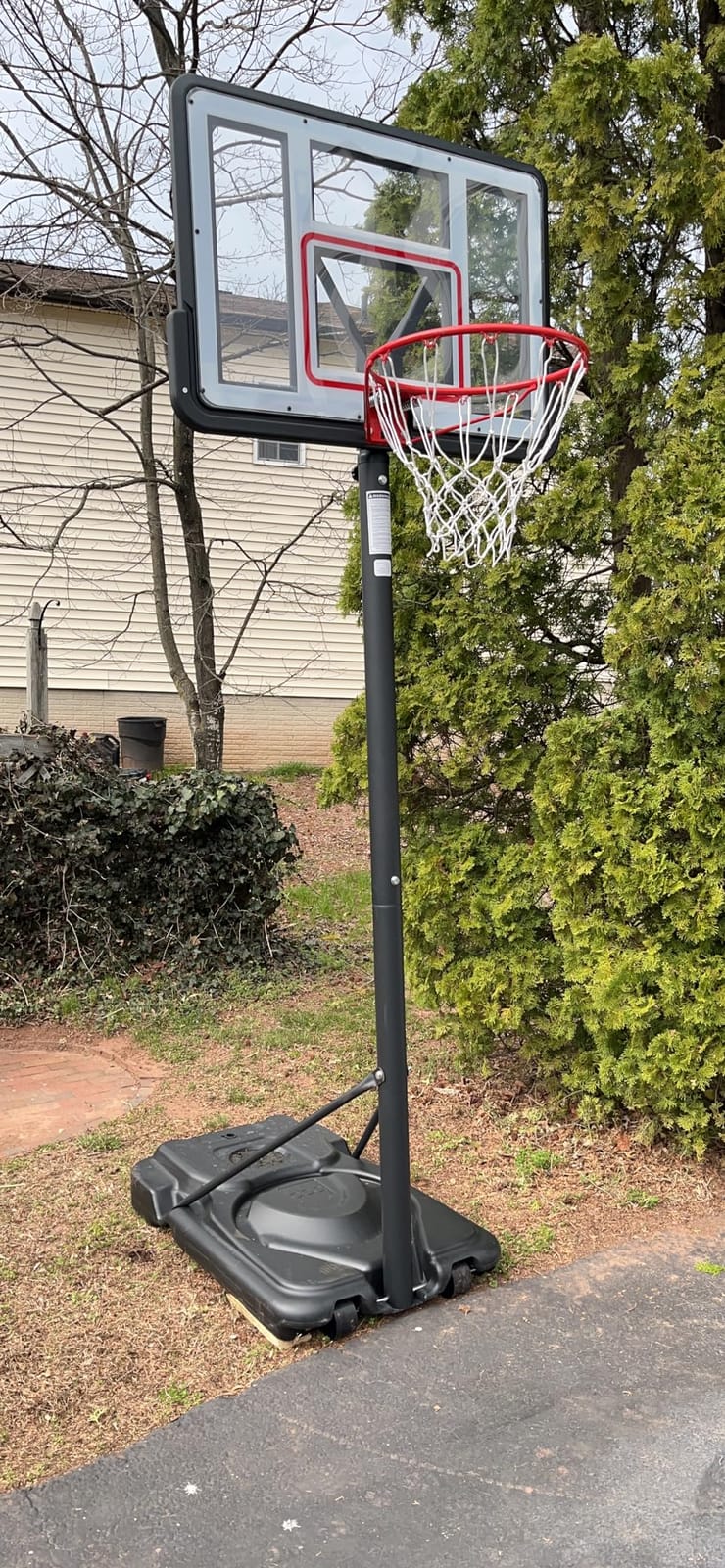
The rest of the package is sensible for the money. A 44 inch shatterproof polycarbonate backboard, a spring-mounted breakaway rim that absorbs layup and dunk impact, and a 7.5 to 10 foot adjustment so the same system works for a small child and an adult game.
It is also light, at 52 pounds, with a hollow base and two wheels, so repositioning an unloaded system is genuinely easy. That combination – clean fill, easy to move, full 10 feet – is not common at this entry point.
Check the pole overlap before you trust it at 10 feet
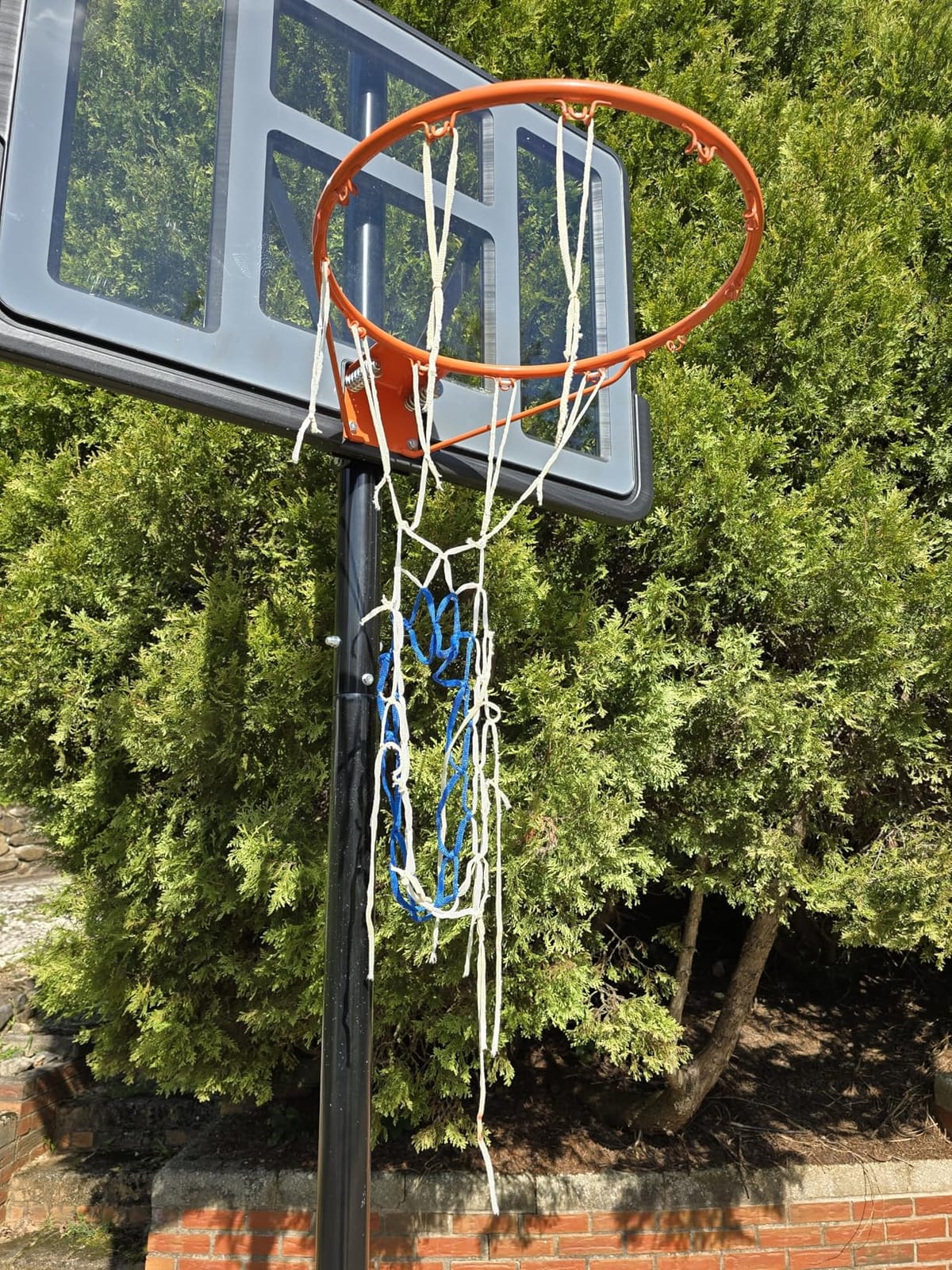
This is the one hardware detail that most affects how this hoop feels at full extension. Reviewers report roughly 3 inches of pole overlap remaining, which produces a slight lean under hard play. If your household shoots at 10 feet every day, dial it to 9 and the complaint largely disappears.
Also worth knowing: the rim does not self-level after an off-center shot the way a pro breakaway rim does, and the backboard screws are on the small side. A few reviewers have seen the board crack after months of use.
What support you actually get
Customer service here is limited to a 60 day return window, with a 10 percent discount offered on replacement parts. That is the weakest support structure here, and it matters more if you are hard on rims.
For light to moderate use with a preference for a clean base and easy moving, the value is real. For daily dunking and dunk-heavy play, the IGL or the awii sport holds up better.
6. DUMOS 10 Ft Adjustable Hoop – Best on a Budget
DUMOS 6.1-10FT Adjustable Height Portable Basketball Hoop Outdoor for Adult, 44 Inch Shatterproof Backboard w/Shock Absorbent Rim, Fillable Base, 2 Wheels for Swimming Pool/Indoor, Red
6.1-10 ft range
44 in shatterproof board
Fillable base
2 wheels
Pros
- One of the lowest entry costs in this group
- Upgraded base accepts more water or sand for real stability
- 44 inch shatterproof backboard with a shock absorbent rim
- Two transport wheels for moving between locations
- Tools and clear instructions included in the box
Cons
- Adjustment floor of 6.1 ft is higher than most rivals
- Backboard rebound is a clear step down from glass
- Only a one year warranty
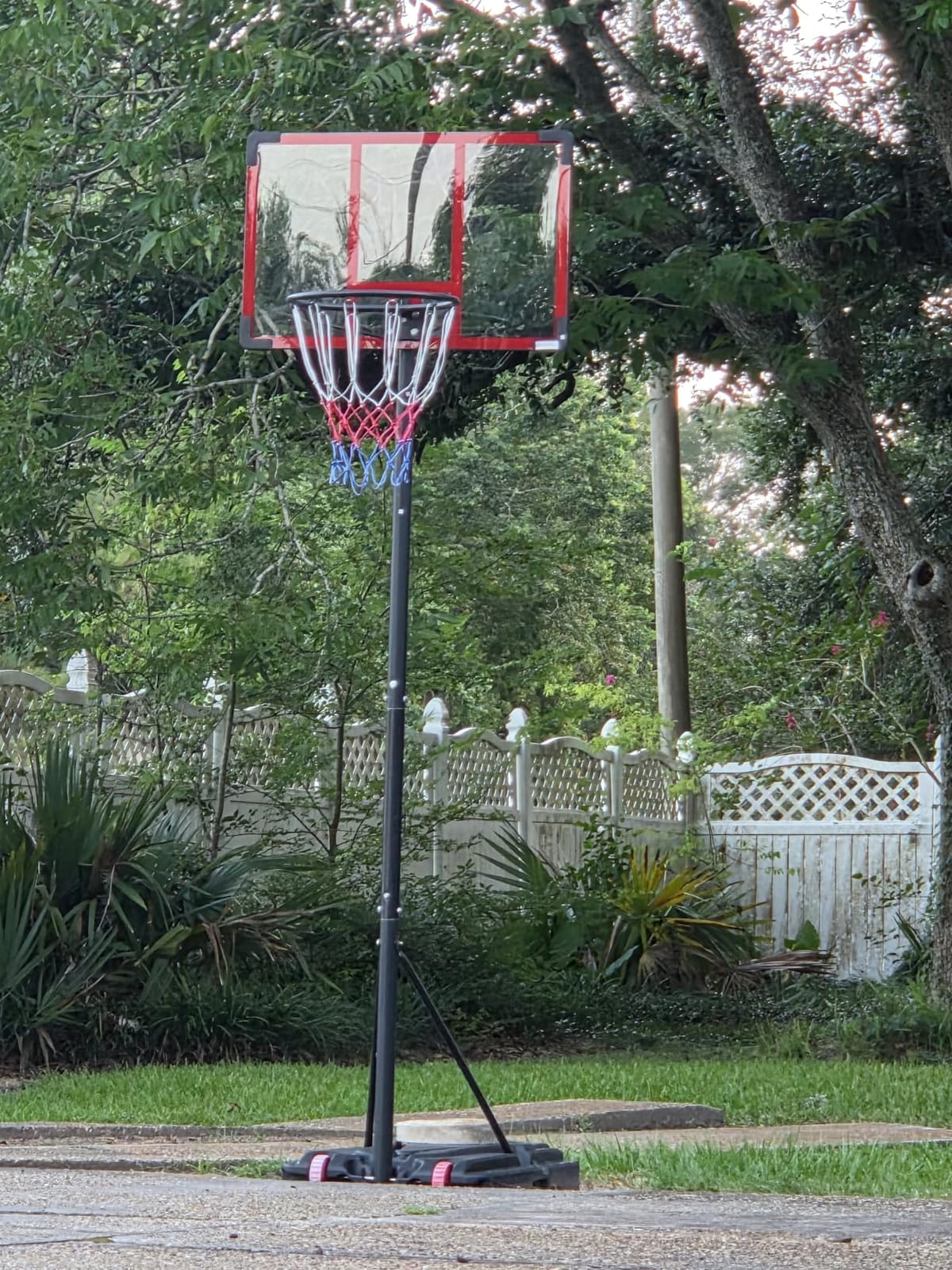
Sometimes the useful question is not which hoop is best but which one is not a mistake. This is among the least expensive full-size goals in the group, and the reason reviewers rate it above what the price suggests is that the two things that most often make cheap hoops unusable are present: a fillable base that holds enough weight, and transport wheels.
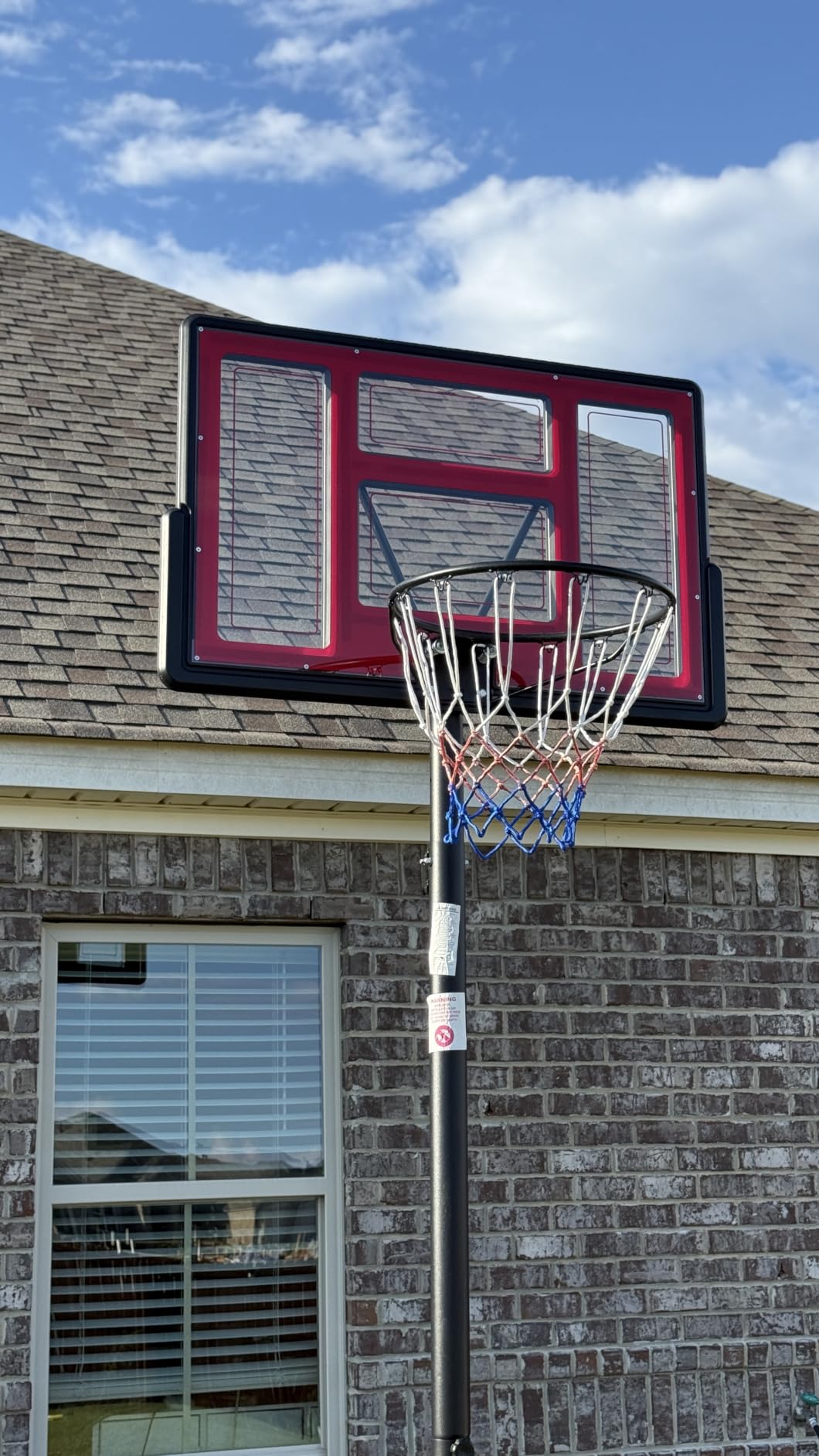
The frame is alloy steel and the backboard is a 44 inch shatterproof unit with a shock absorbent rim. Adjustment runs from 6.1 to 10 feet, which covers older kids and adults comfortably. Assembly is straightforward and the tools are in the box, so first-time buyers are not immediately fighting the hardware.
Reviewers consistently frame it as the budget pick and accept the softer polycarbonate rebound as the trade. For driveway games, casual shooting, and a hoop that lives in a garage half the year, that trade costs almost nothing.
Who it suits and who it does not
It suits households that want a full 10 foot goal for backyard shooting without a large outlay, and anyone who will store the hoop indoors. Wheels plus an alloy frame means one person can move it when it is empty.
It does not suit a family with a child under five or six. A 6.1 foot floor is above their reach, and no amount of adjustment fixes that – you need a system with a lower minimum like the Yohood.
Nor is it a dunking hoop. The shock absorbent rim takes the edge off a layup, but the board and pole are not built for someone hanging on the rim every weekend.
Fill it properly and it behaves
The most common advice from owners is simple: treat the base as a real ballast rather than a token fill. Once it is properly loaded, complaints about wobble drop away almost entirely.
The one year warranty is the other thing to weigh. At this price, that is normal, and it makes the hoops with longer coverage a better value if you keep a hoop for years.
7. Sweetcrispy 44 Inch Hoop – Best for a Narrow Driveway
Sweetcrispy 6.1-10FT Portable Basketball Hoop Outdoor, Adjustable Height, 44 Inch Shatterproof Backboard/Shock Absorbent Rim, Fillable Base, 2 Wheels for Backyard
6.1-10 ft range
44 in shatterproof board
44 in base footprint
2 wheels
Pros
- Stability-focused design that limits wobble during shooting practice
- Water or sand fillable base prevents tipping
- 6.1 to 10 ft range covers older kids through adults
- 44 inch shatterproof backboard with shock absorbent rim
- Two wheels make backyard to driveway moves simple
Cons
- Metal construction and one year warranty are thin
- Polycarbonate backboard rebounds less than glass
- Adjustment floor is higher than the Yohood 4.43 ft model
Stability is the word that comes up more than any other in the reviews for this hoop, and it is the reason it is here. Wobble ruins shooting practice in a specific way: a backboard that moves when the ball hits it changes the release point, and a form habit formed on a wobbly board is a habit you have to unlearn.
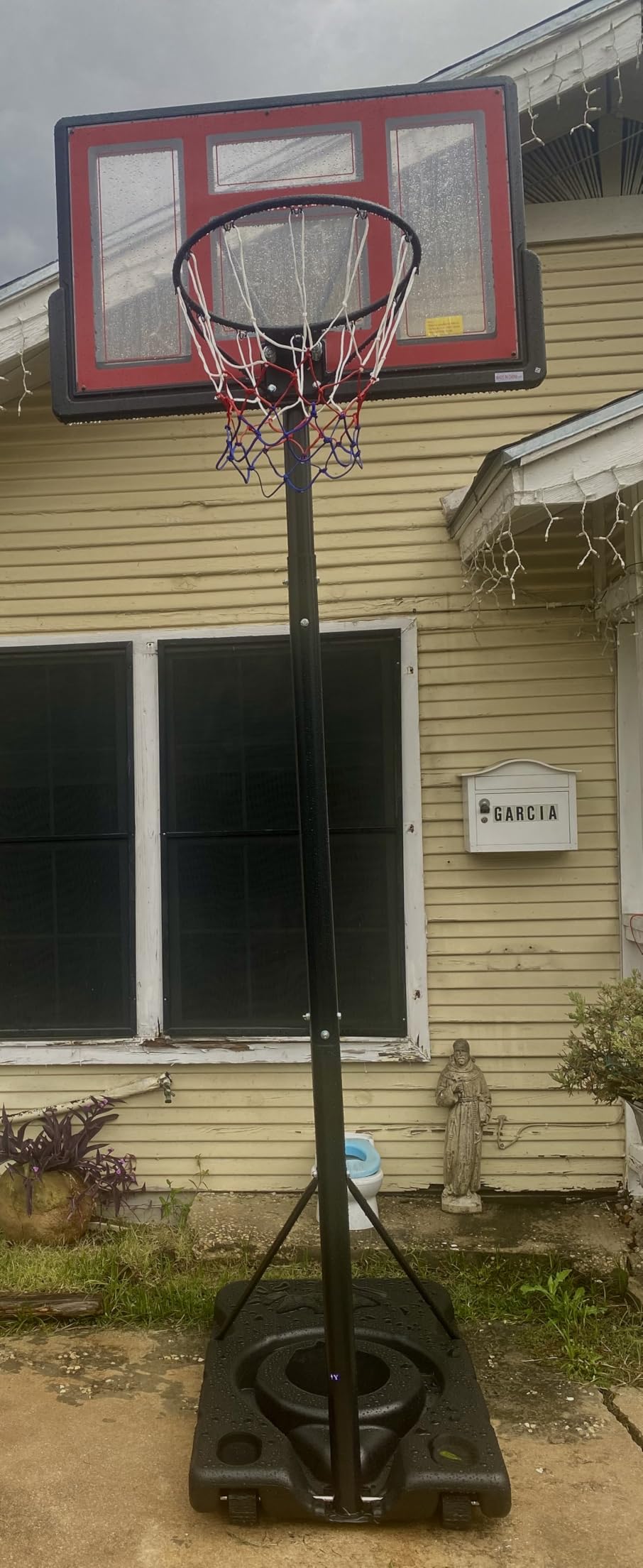
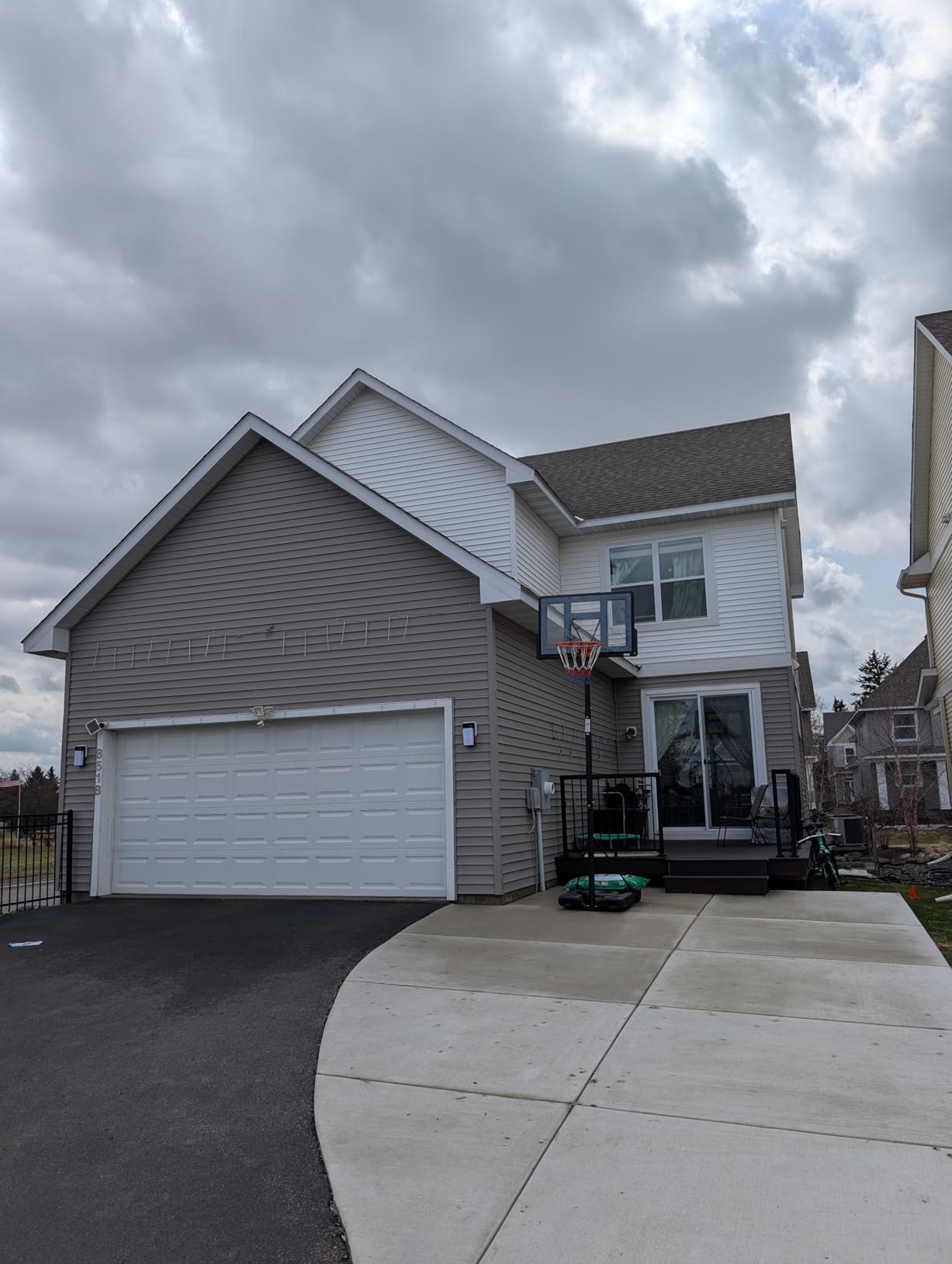
The design centers on a fillable base that takes water or sand, sized to resist tipping, plus a rigid frame geometry that owners report stays planted even when the ball hits hard off-center. At 44 by 44 inches the footprint is compact, which suits a tight driveway where a 60 inch board would be unusable.
Adjustment covers 6.1 to 10 feet, and two wheels let you move it between a backyard and a driveway without a second person. Reviewers call it a family favorite for exactly that reason.
What wobble does to your shot
A rim that rattles or a board that flexes does more than annoy you: it degrades your aim without you noticing until you move to a proper court. That is the argument for spending a little more than the cheapest option even on a tight budget. A dead-stable, quiet goal is worth more per shoot than a larger board that rings.
Where it falls short
The construction is plain metal with a one year warranty, and the polycarbonate board gives noticeably less life off the glass than a tempered glass system. Neither is a problem for shooting drills; both would be for someone who plays seriously.
For a household with very young children, the 6.1 foot floor is the limitation to check first. Otherwise this is a solid narrow-driveway choice that prioritizes the right things.
8. Silverback NXT54 54 Inch In-Ground Hoop – Best 54 Inch In-Ground System
Silverback NXT54 54″ Height Adjustable In-Ground Basketball Hoop
54 in Infinity Edge board
Concrete-set pole
7.5-10 ft actuator
Breakaway rim
Pros
- 54 inch Infinity Edge backboard wraps at the edges for rigidity
- Concrete-set pole is far more stable than any portable base
- Pro-style breakaway rim flexes on dunks and protects the board
- Pole pad and backboard pad included
- Quick-play preassembled design speeds installation
Cons
- Concrete installation is permanent and requires digging
- Only a 30 day warranty
- Biggest cost step between a portable and a full glass system
This is the compromise in-ground hoop for people who want permanence but do not have the room for a 60 inch board. The 54 inch Infinity Edge backboard wraps its edges around to the rear, which adds real rigidity and resists the flexing that makes a flat board feel cheap in wind.
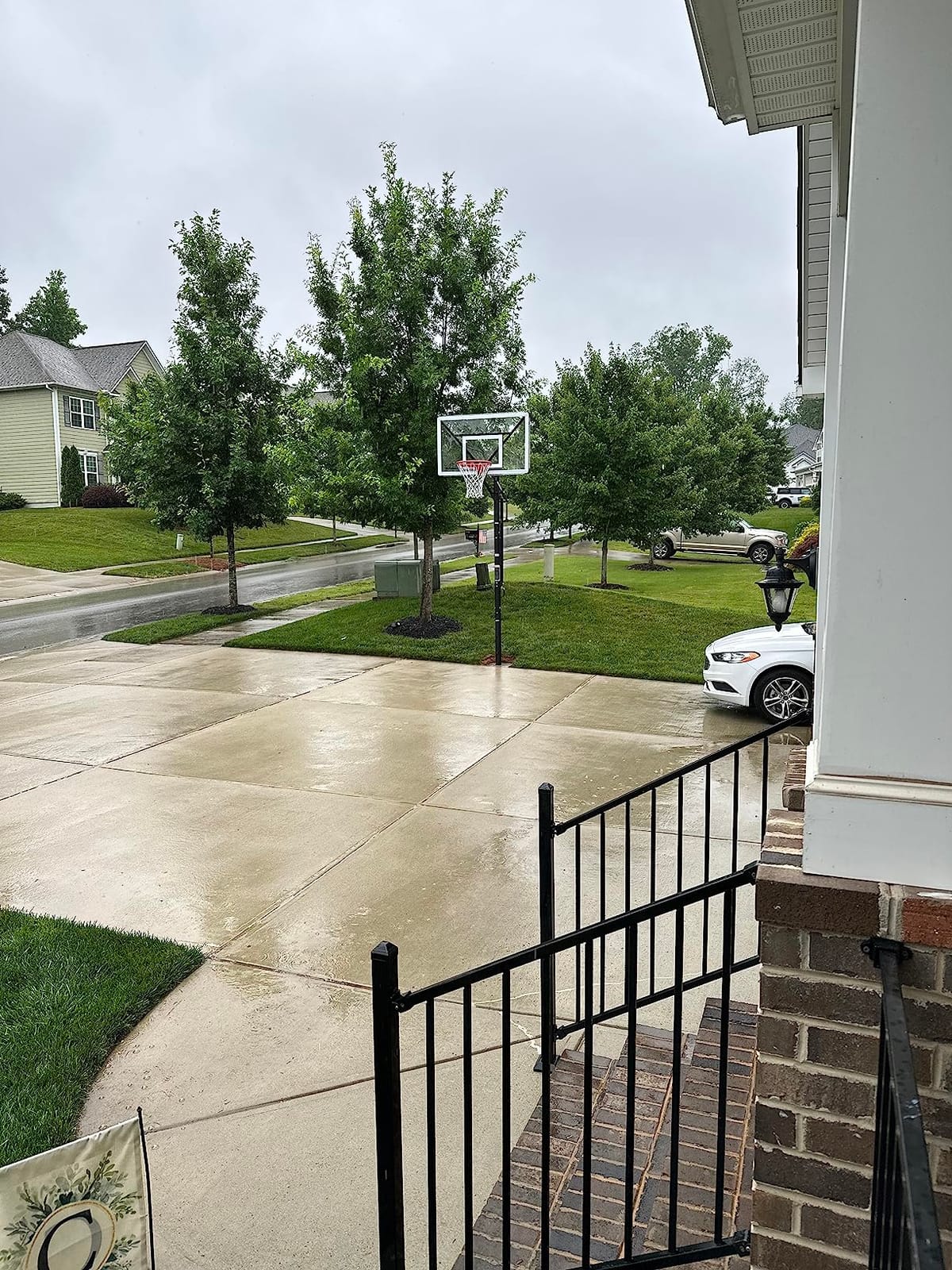
The pole is powder-coated steel, set into the ground and secured with concrete inside the pole itself. Owners who have done the pour describe the rigidity as the entire point: nothing shifts, in wind or in hard play, and the shot feels the same in January as it does in July. An all-steel actuator walks the rim from 7.5 to 10 feet.
A pro-style breakaway rim handles dunks, and both a pole pad and a backboard pad are included. The quick-play preassembled design means the on-site work is concentrated on the hole rather than the build.
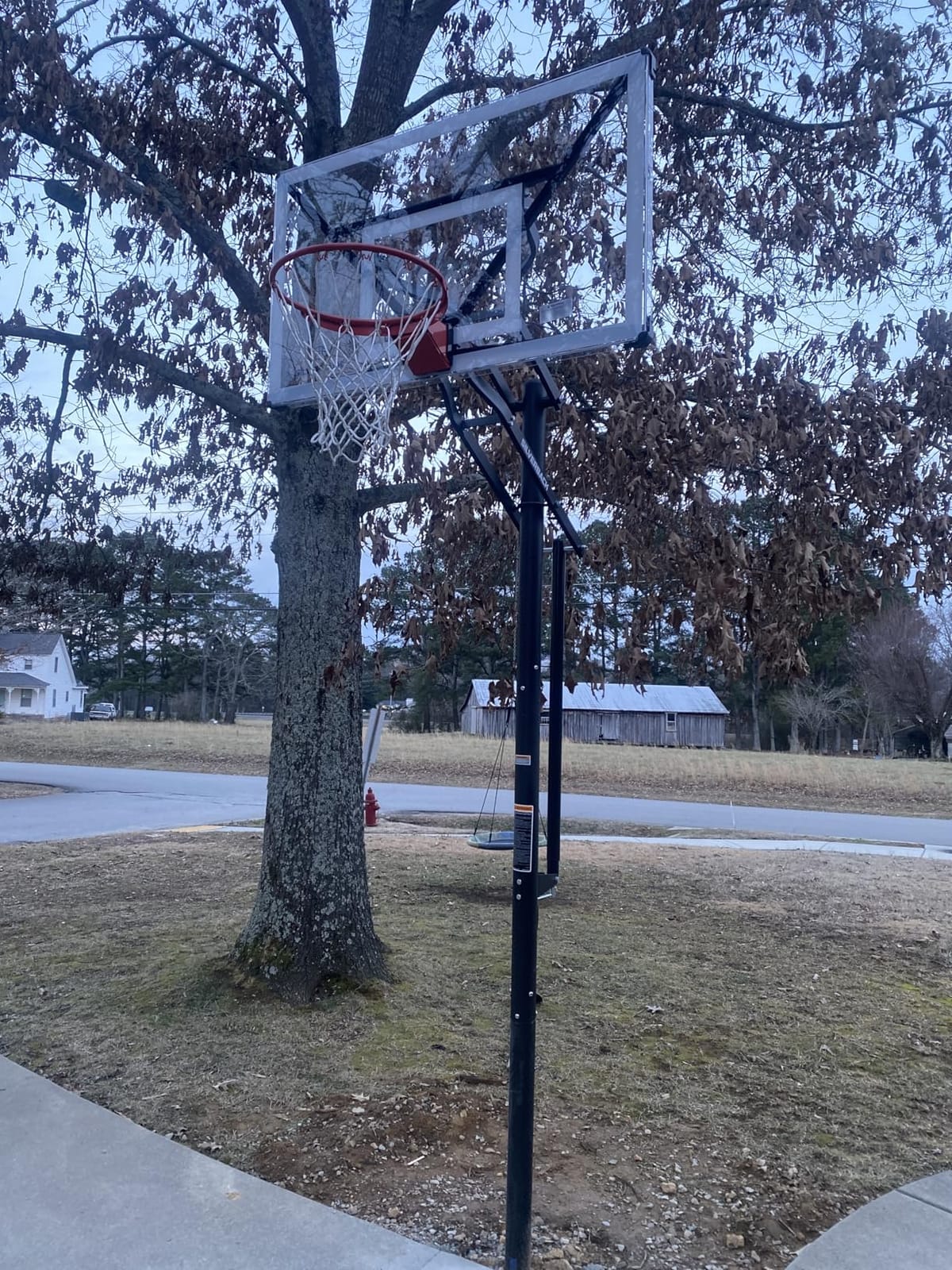
Why 54 inches is often the right size
Backboard size is a driveway constraint as much as a preference. A 54 inch board gives you a generous target and a square-ish shooting surface while keeping the footprint and the shooter’s approach inside a normal two-car driveway. It also leaves more room between the backboard and the garage door for a full-speed layup.
Forum threads about half-court play keep quoting roughly 30 by 60 feet as the working dimension. A 60 inch system eats more of that rectangle than a 54 inch one, and on a narrow drive the difference decides the purchase.
The warranty is the weak point
Thirty days of coverage is the shortest here, and it is the most common reservation among owners. On a cemented system the moving parts are fewer, but a failed actuator would be expensive to sort out.
Balance that against the fact that the pole will likely outlast any portable base by a decade. If you are installing once, the durability of the fixed structure may matter more than the paper on the box.
9. Lifetime 71281 In-Ground 52 Inch System – Best for Families
Lifetime Outdoor Basketball Hoop System – 52 in Shatterproof Backboard
Power Lift 7.5-10 ft
52 in steel-framed board
84 lb
5 year warranty
Pros
- Power Lift squeeze handle changes height in seconds
- 52 inch steel-framed polycarbonate backboard takes real play
- Friction weld joint on the three piece pole cuts movement and flex
- Powder coated steel with a UV protected finish
- 5 year limited warranty
Cons
- Concrete installation is permanent and needs a proper footing
- Polycarbonate surface does not rebound like tempered glass
- At 84 lb it takes more than one person to position
The Power Lift mechanism is the story here. A squeeze handle moves the rim from 7.5 to 10 feet without tools and without a second person, and reviewers describe it as changing height in seconds. On a fixed in-ground system that flexibility is unusual, and it is what makes one hoop serve a five year old and an adult.
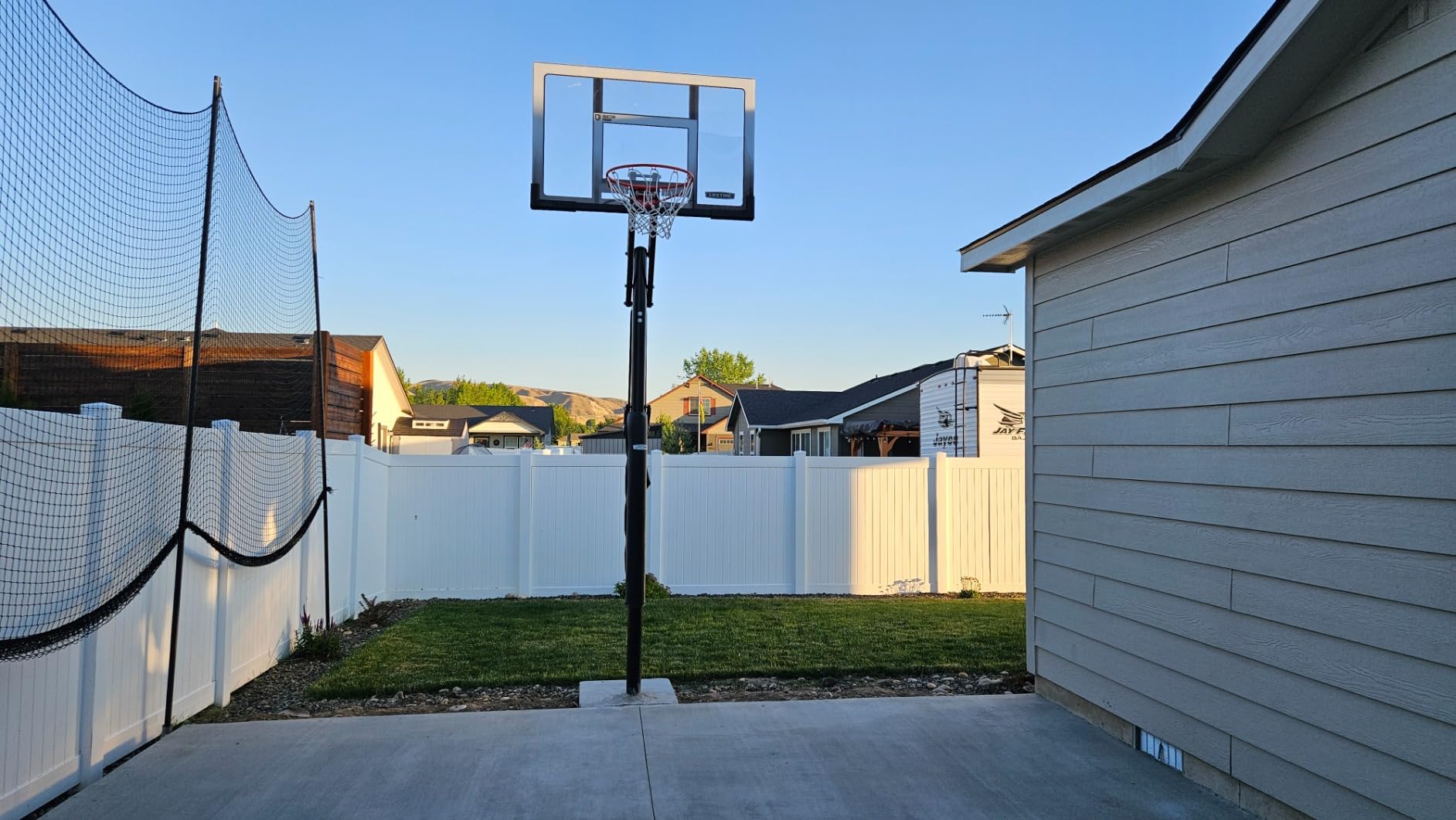
The 52 inch backboard is steel-framed polycarbonate, which is a heavier build than a thin plastic sheet and holds its shape better through seasons. The three piece 3.5 inch round pole uses a friction weld joint specifically to reduce movement, and the powder coat plus UV protected materials are rated to resist rust and fading.
At 84 pounds it is lighter than a full glass system, which matters on install day. The 5 year limited warranty is the longest in this group and is backed by a brand that has been selling in-ground goals for decades.
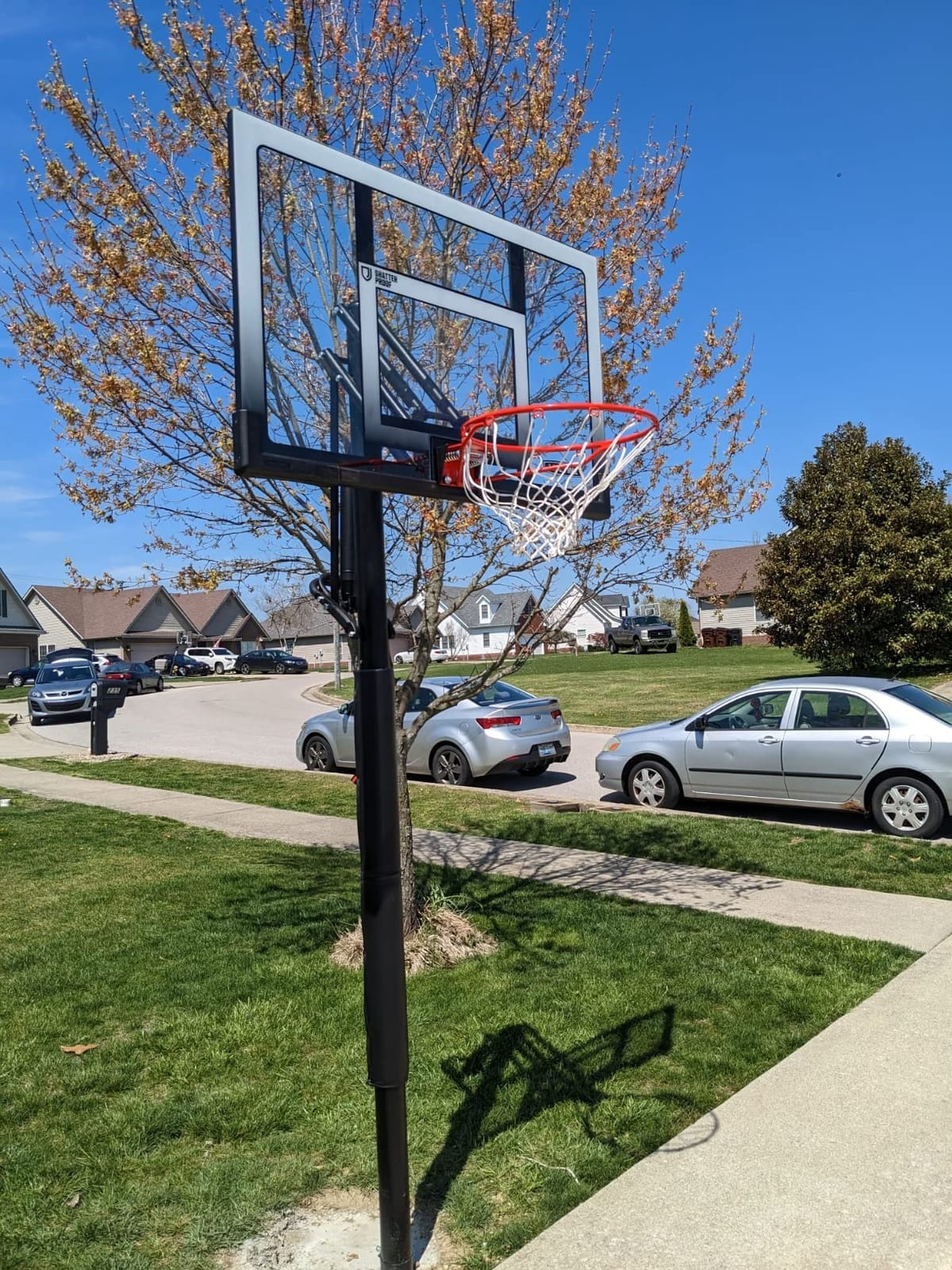
One system for a range of ages
Portable hoops reach low heights by adding pole sections that you then have to remove as the child grows, which usually means a second hoop later. This system covers 7.5 to 10 feet from a fixed pole, so a family that would otherwise buy twice buys once.
That makes it the strongest value in the in-ground group for a family with a wide age spread, and the warranty is the quiet reason it outranks higher-priced options over a ten year horizon.
What the polycarbonate board costs you
The board does not rebound like tempered glass, and on hard rim contacts you will hear more of the classic polycarbonate ping. For shooting practice and family games that is a fair trade. For a serious adult player who chases indoor-style feel, the Silverback 60 inch is the destination.
Also plan for two people on install day. Concrete and a 3.5 inch three piece pole are not a solo job, and the digging should be done before the pole is unpacked.
10. Yohood Crank 44/48 Inch Hoop – Best for Fast Height Adjustment
Yohood 10FT Portable Basketball Hoop Outdoor 44/48 Inch Height Adjustable
Rear crank 5.25-10 ft
Base holds 150 lb
60 lb
2 wheels
Pros
- Rear crank handle changes height in seconds across 5.25-10 ft
- Four support rods plus a front brace form a rigid triangle
- Base holds 150 lb of water or sand and stays steady in wind
- Spare hardware and a second net included
- Arrives level with no post-assembly alignment
Cons
- Rim and support rods can fail under constant daily use
- 60 lb plus a filled base is heavy to move
- Only a one year manufacturer warranty
The rear crank is the difference here. Most portable hoops change height by pulling and re-seating a bolt at 8 feet off the ground, which is awkward with a ball in your other hand. A crank on the back of the pole is a genuinely one-person operation, and it covers 5.25 to 10 feet.
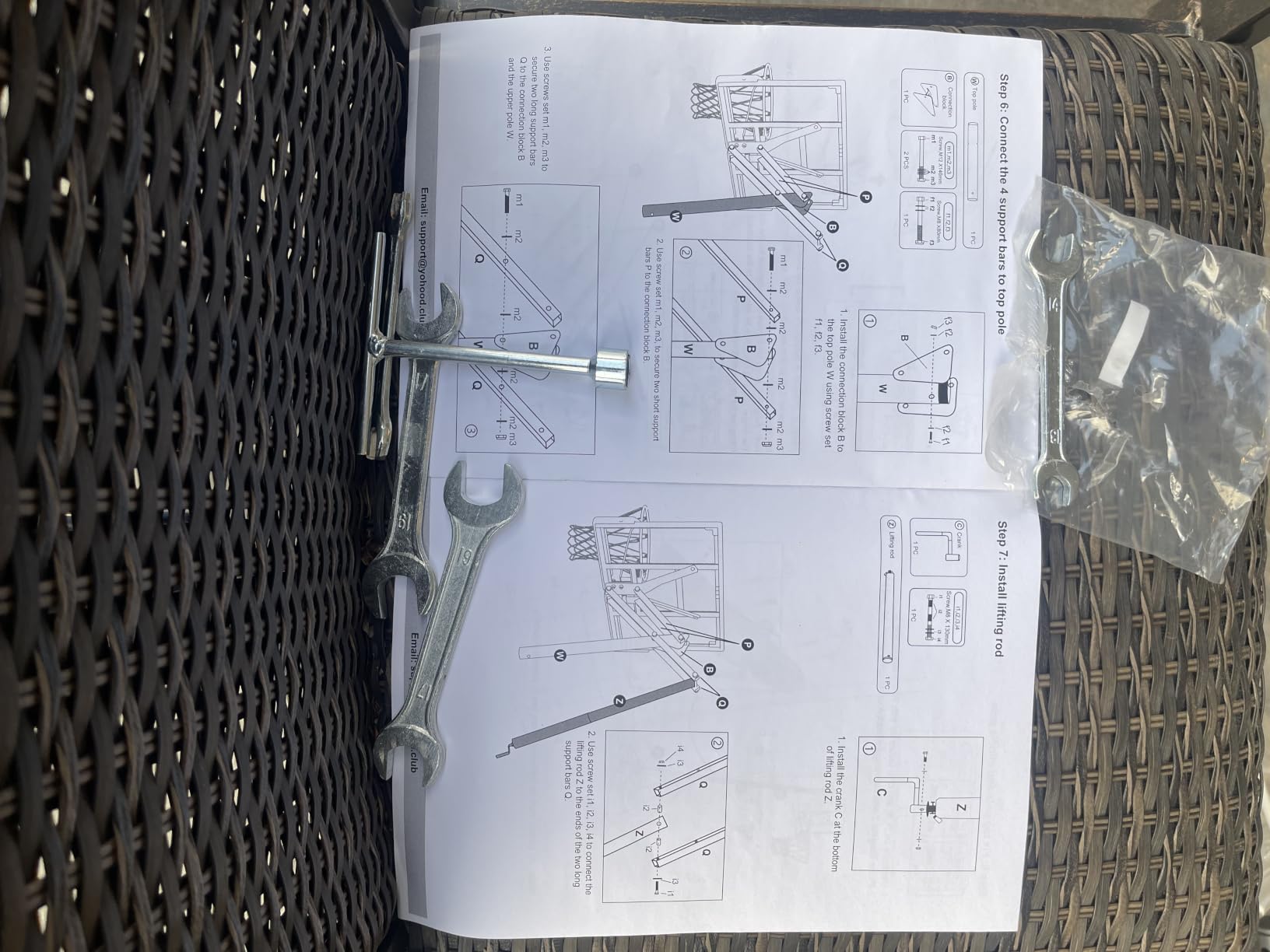
Stability comes from geometry. Four support rods plus a front board form a triangular brace, and the base takes 150 lb of water or sand. That is heavy ballast for a portable system, and owners report it staying planted through aggressive play and bad weather.
Two details stand out for anyone who has owned a cheap portable hoop. A spare set of nuts and bolts and a second net are in the box, which quietly solves the two most common replacement needs. And it arrives level, so there is no post-assembly alignment session.
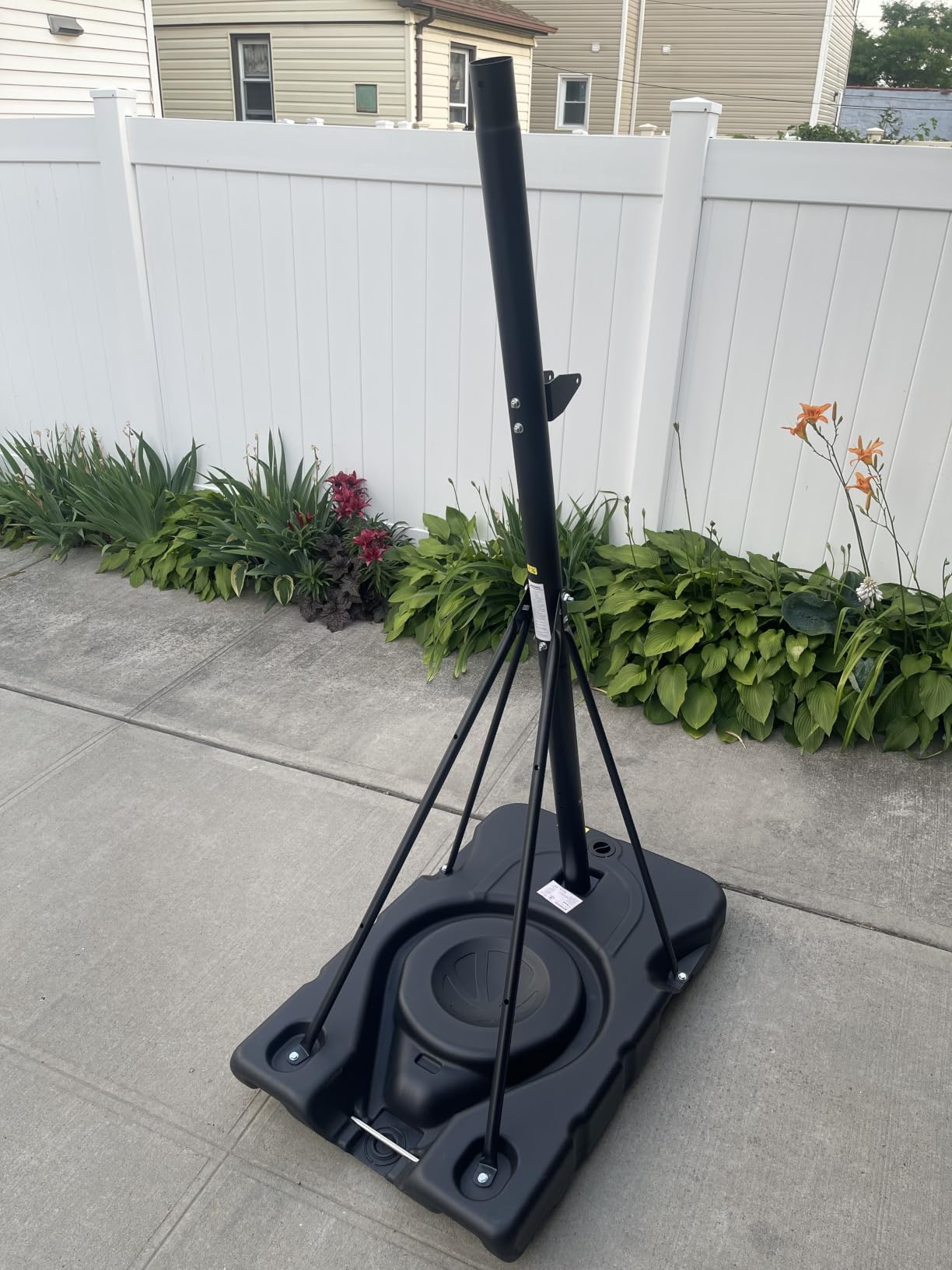
What daily use does to it
One reviewer replaced both the rim and then both support rods within four months of daily use. That is the single most serious failure report in the whole group, and the brand resolved it with a replacement goal and a partial refund, which is worth knowing.
Read it as a durability boundary rather than a defect. Casual shooting and family play suit it. Multiple kids playing every day for a season is where the hardware starts to fatigue.
Moving it is the price of stability
At 60 pounds empty with a base that takes 150 lb of fill, this is a two-person move even with wheels. That is the inverse of the DUMOS situation, where light weight is the selling point and ballast is the compromise.
If your driveway slopes, a heavy base plus a tall pole is a real consideration. Make sure the wheels are on level ground when you park it.
11. awii sport 40/44/48 Inch Hoop – Best for Durability in Sun and Weather
Basketball Hoop Outdoor 40Inch Impact Backboard 5.5-10FT Height Adjustable
5.5-10 ft in ten levels
PC board bonded with glue
Q195 steel rods
2 wheels
Pros
- Backboard permanently bonded with glue resists warping and cracking
- Ten-level single button quick lift changes height fast
- Q195 thickened steel rods hold up through sun and winter
- Brand sends free replacement rims when they are bent
- Three backboard sizes available at 40
- 44 and 48 inch
Cons
- Base needs both water and sand to be safe in strong wind
- Very heavy once assembled and needs a helper for the final lift
- Lowest setting with all three poles installed is 8 ft
- One fulfillment mix-up reported with a wrong part
The warping problem is the one that ends most portable hoops. A backboard screwed to a frame will slowly flex and twist, screws loosen, and eventually the board cracks along a stress line. This one is permanently bonded with glue to its frame, which removes the mechanism that causes the failure in the first place.
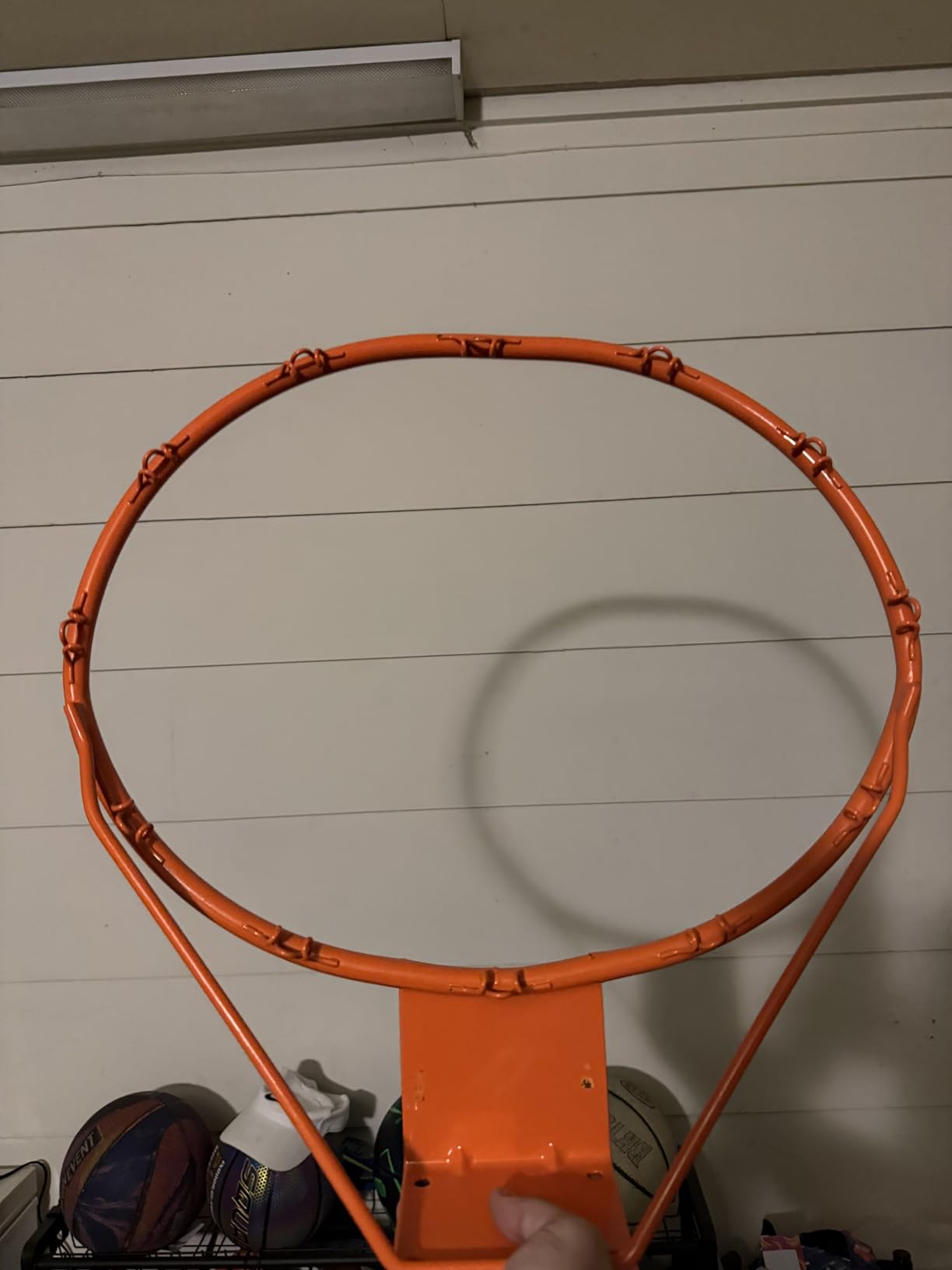
Long-term owners report that it outlasted several cheaper portable goals that cracked, warped or turned brittle after a summer of sun. The support rods are Q195 thickened steel with a weather-resistant coating rather than the light-gauge tubing used on entry-level hoops, and that is visible in how the frame feels under a hard shot.
Height adjustment runs through ten levels on a single button, from 5.5 to 10 feet, which is the quickest single-handed system in this group. The base is a high-strength PE triangular structure on two wheels, and it is offered in 40, 44 and 48 inch backboard sizes.
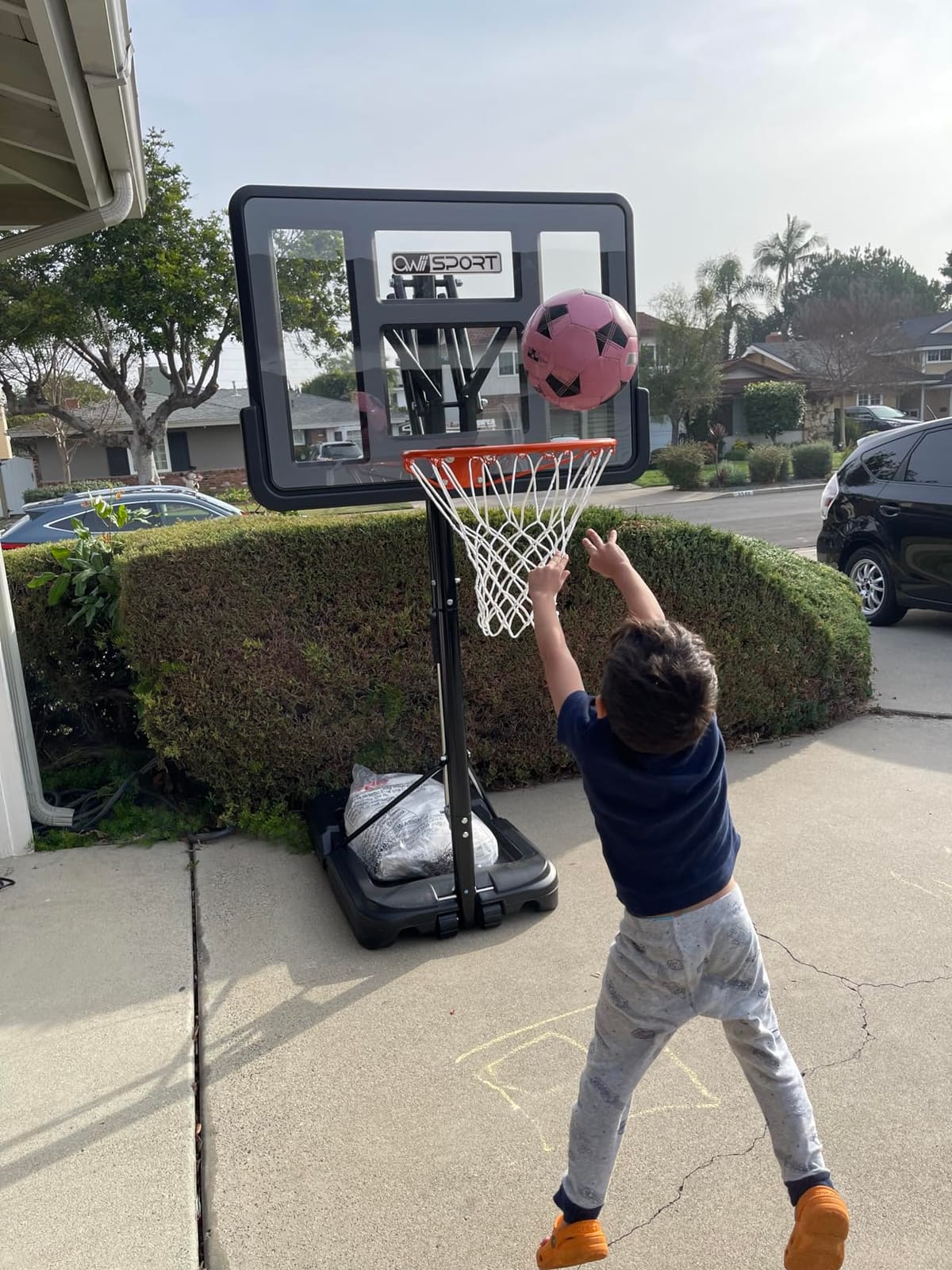
Customer service is part of the product here
Several reviewers bent the rim by hanging on it or by a wind gust, and each time the brand sent a free replacement. That is the main reason the reviews stay positive despite the rim being a weak point, and it is a real advantage over the one year, no-replacement service models.
It also means the question of whether you need a whole new hoop over a replacement rim is less expensive here. For a driveway that gets daily use, that changes the long-term math.
Plan the assembly properly
This one is heavy once built, and owners recommend a second person for the final lift. The base also wants both water and sand to stay safe in strong wind, which makes the filling job a two-stage task rather than a single pour.
One practical note on the height range: with all three poles installed the lowest setting is 8 feet, so shorter heights mean omitting a pole section. Plan for that before assembly, the same way you would with the Yohood 4.4-10 ft.
12. Lifetime 1084 In-Ground 50 Inch System – Best Value In-Ground
Outdoor Lifetime Basketball System 1084 50-in. Shatter Guard Backboard
Action Grip 7.5-10 ft
50 in Fusion board
Slam-It rim
5 year warranty
Pros
- Action Grip counterbalance adjusts one-handed from 7.5 to 10 ft
- 50 inch Fusion backboard pairs polycarbonate with a polyethylene frame
- Slam-It rim has double horizontal springs for real dunk flex
- 5 year warranty plus five years of spare part availability
- Powder-coated pole and UV protected graphics need little upkeep
Cons
- Concrete install is permanent and requires digging
- Polycarbonate face rebounds less than tempered glass
- Fixed height listing shows 10 ft with adjustment down to 7.5 ft
This is the in-ground system to buy if you want permanence without the glass premium. The Action Grip mechanism uses counterbalance springs to move the rim from 7.5 to 10 feet with one hand, and owners call it the smoothest one-handed adjustment they have used on a fixed system.
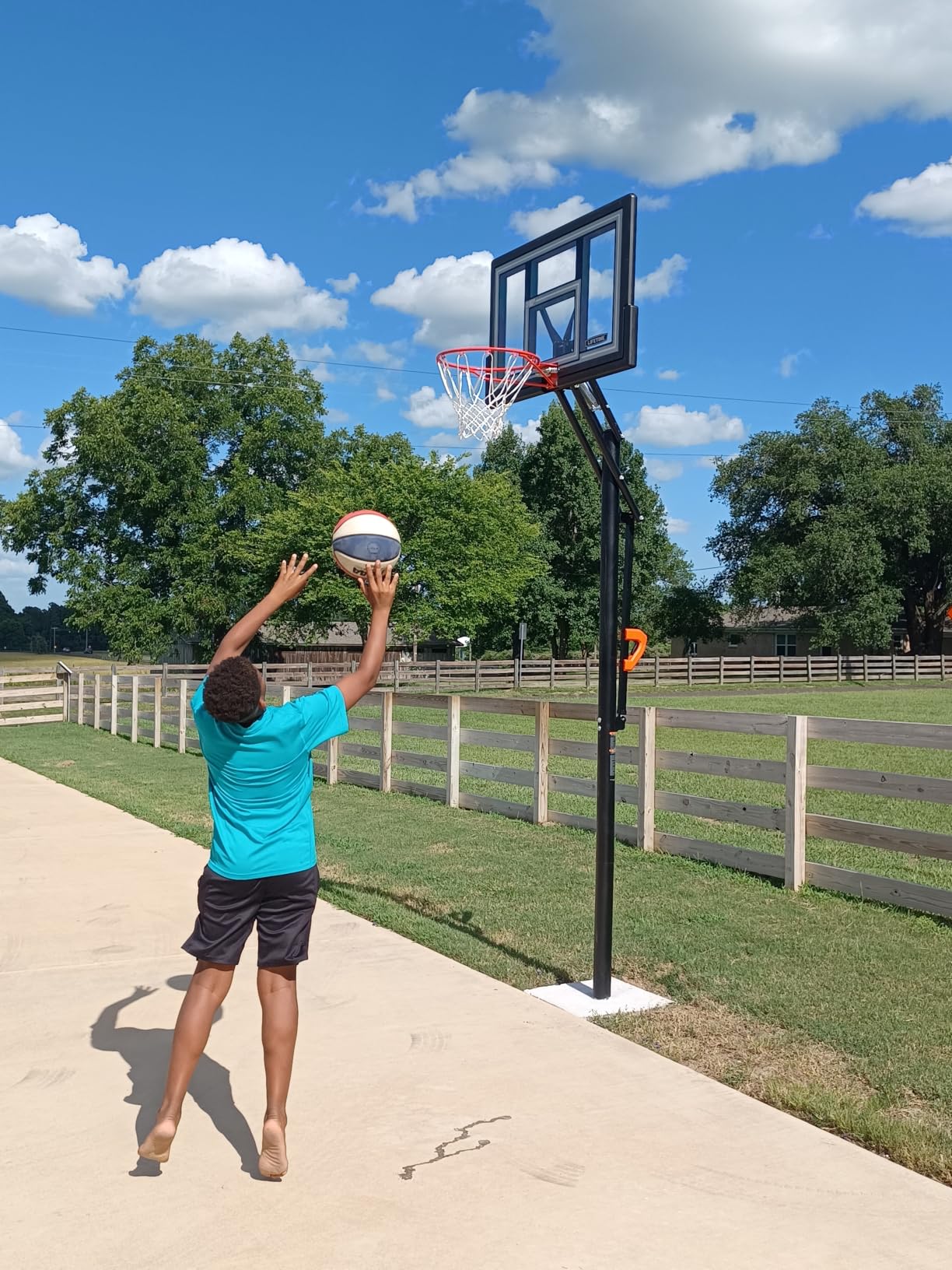
The 50 inch Shatterproof Fusion backboard pairs a polycarbonate playing surface with what the manufacturer calls an unbreakable polyethylene frame. The rim is the 18 inch pro-style Slam-It with double horizontal springs, which owners call the least rattly rim on a non-glass system.
The three piece powder-coated round steel pole and UV protected graphics mean very little seasonal maintenance. And the part that matters most over ten years: a 5 year limited warranty backed by five years of spare part availability from the manufacturer, so a failed net or a worn rim does not end the system.
Why parts availability changes the math
A hoop is not a single component. Nets wear out, rims bend, height mechanisms seize. A brand that commits to five years of spare parts means the first failure is a cheap part rather than a whole new system, and that is the single strongest argument for this pick over cheaper in-ground options.
This is also why we treat the Lifetime name appearing twice in this guide as a signal rather than repetition. The portable 1269 and the in-ground 1084 sit at opposite ends of the decision, and the same support policy covers both.
Where you give something up
The polycarbonate face gives back less than tempered glass, so the shot will never feel quite like the Silverback 60 inch. And concrete installation is permanent – plan the location carefully, because relocating means breaking out the footing.
The listed minimum height shows as a fixed 10 feet on the spec sheet, with the real 7.5 foot low point reached through the Action Grip mechanism. That is a data entry quirk rather than a limitation, but check it against your own needs if a low setting is critical.
How to Choose an Outdoor Basketball Hoop for Your Driveway
In-ground or portable: the honest ten-year check
Start with the question you will still care about in year five: can you move house, or can you pour concrete? A portable basketball hoop can be rolled into a garage, taken to a different driveway, or sold with the house. An in-ground basketball hoop stays where you set it, and the pole will outlast several portable bases.
Stability is where the difference shows. A cemented pole does not shift in wind, does not develop a lean as the pole telescopes, and returns the same shot every time. Forum discussions about long-term ownership reach the same conclusion: a weighted base cannot match a cemented pole through hard play and gusts, though it is a perfectly good option for most households.
Our rule of thumb: if you own the home, plan to stay five years or more, and have a clear spot on concrete or asphalt, go in-ground. If you rent, are undecided about the house, or want the hoop to leave with you, go portable. See our portable hoop guide for the portable branch in more detail.
Backboard material: glass, acrylic, or polycarbonate
Tempered glass is the only material that feels like an indoor court. It rebounds hardest, resists weather without fading, and does not yellow. It is also the heaviest, the most expensive, and the one you have to think about twice before putting it above a driveway where a child might reach it.
Polycarbonate is the workhorse in this list. It will not shatter, it is lighter, and the better versions pair the face with a steel or polyethylene frame. The cost is rebound: it gives back noticeably less than glass and tends to flex at the edges over time, which is why frame construction matters as much as the material name.
Acrylic sits in the middle, with better rebound than polycarbonate and worse UV resistance. Expect visible yellowing after a few summers in full sun, and check that the UV protection is real. If you want the midpoint, ask specifically about the warranty against yellowing rather than trusting a product page.
For a driveway that gets used most days, glass if you are in-ground, polycarbonate if you are portable. If you want a practice target for a single child learning to shoot, the material matters far less than the base not tipping.
Backboard size: how big should it be?
Size is constrained by your driveway, not by ambition. Portable systems in this group run 40 to 48 inches, and 44 inches is the most common because it fits a normal footprint. In-ground systems here run 50, 52, 54, and 60 inches.
Bigger is not automatically better. A 60 inch board is a genuinely larger target, but it demands more clearance from your garage and eats into the shooting approach. If your driveway is standard width, 54 inches gives most of the benefit in a smaller rectangle.
Leave room for a full-speed layup. The backboard needs clearance from the garage door and wall behind it, or the ball hits masonry. Homeowners planning real games keep quoting roughly 30 by 60 feet as the working half-court dimension – check that your driveway approximates it before committing to a large system.
What to put in the base of a portable basketball hoop
Sand is the default for a reason. It is denser than water, it does not freeze and expand, and it will not crack a poly base in a hard winter. If you live anywhere that drops below freezing, fill with sand.
Water is fine in mild climates and is easier to drain, but it is heavier per gallon and it will split a base that freezes. If you use water, add a small amount of antifreeze – not to prevent the water freezing, but to keep the base from splitting when it does.
Gel powder mixes combine with water to give a heavier, more stable fill than either alone, and they pour rather than shovel. One model in this guide uses that approach, and it suits anyone who does not want sand tracked across a garage floor.
Whatever you use, top it off after about 30 days. Fresh fill settles, and a base that was level on day one often leans slightly by the end of the first month. Owners who skip the top-off are the ones who report a mysterious wobble that nothing fixes.
And never rely on an empty base. A portable hoop with no ballast will tip in a gust, and tip-over is the one safety risk that can genuinely hurt.
Does it fit your driveway? A measurement checklist
Measure before you buy, not after. Six numbers decide whether a system works: the width of the driveway, the clearance from your garage door to the shooting position, the distance to the street curb, the distance to the nearest property line, the slope, and the overhead clearance for a full-size layup.
Check your local and HOA rules too. Hoops generally may not overhang a street or public sidewalk, and many associations restrict front-yard placement, visible lighting, and hours of use. Some CC&Rs require metalwork to be treated against rust where the pole meets concrete. If you live in a community with rules, read them before the pole arrives – moving a cemented system later is expensive.
For slope, a sloped driveway is workable but changes the calculation. A tall pole plus a heavy base on a grade is a stability concern, so weight the base fully and park it on the level part of the concrete.
In-ground installation: the cement footing sequence
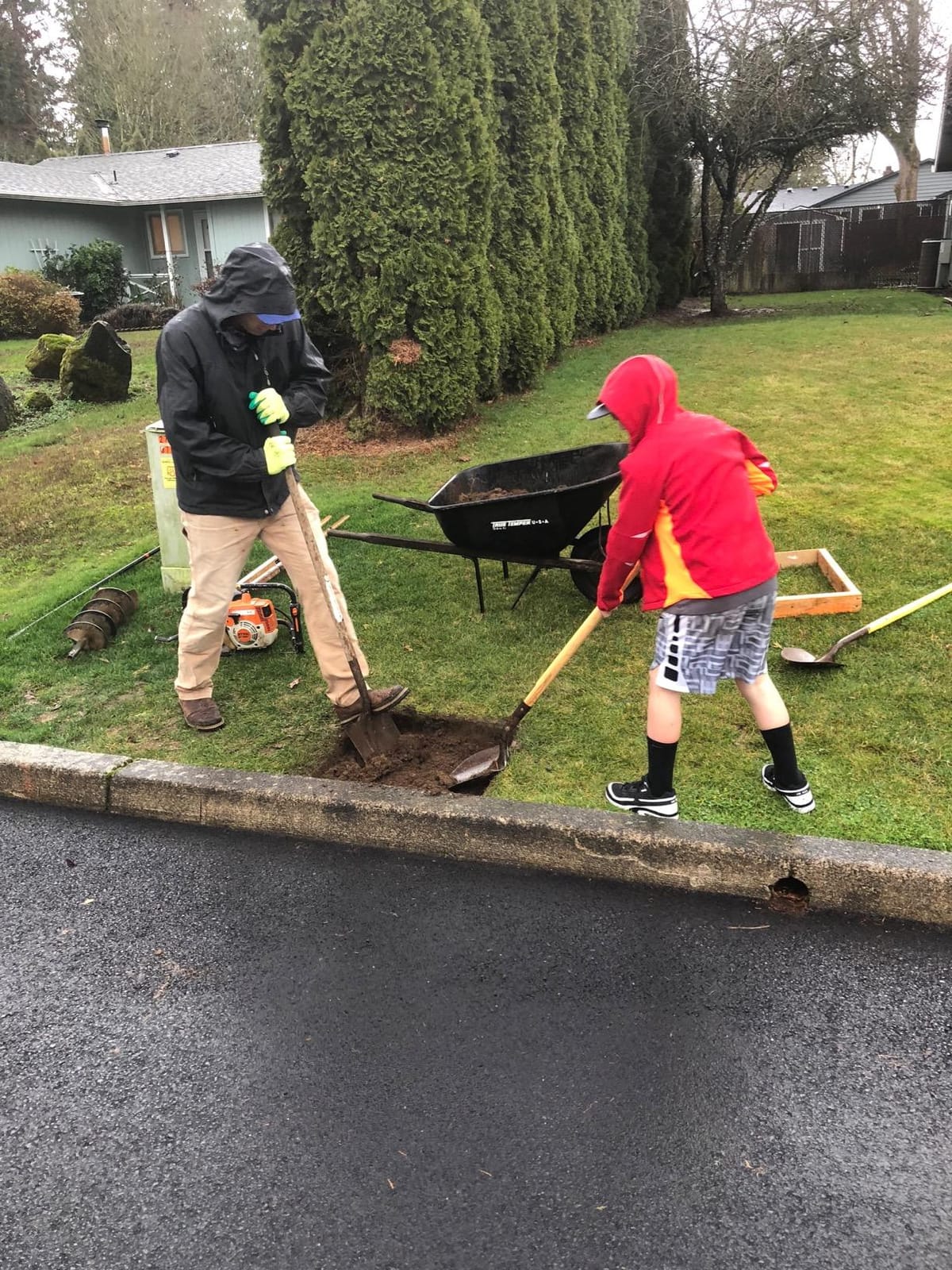
Call your utility company before you dig. There is a real chance of hitting a line, and the service fee is trivial next to a broken line.
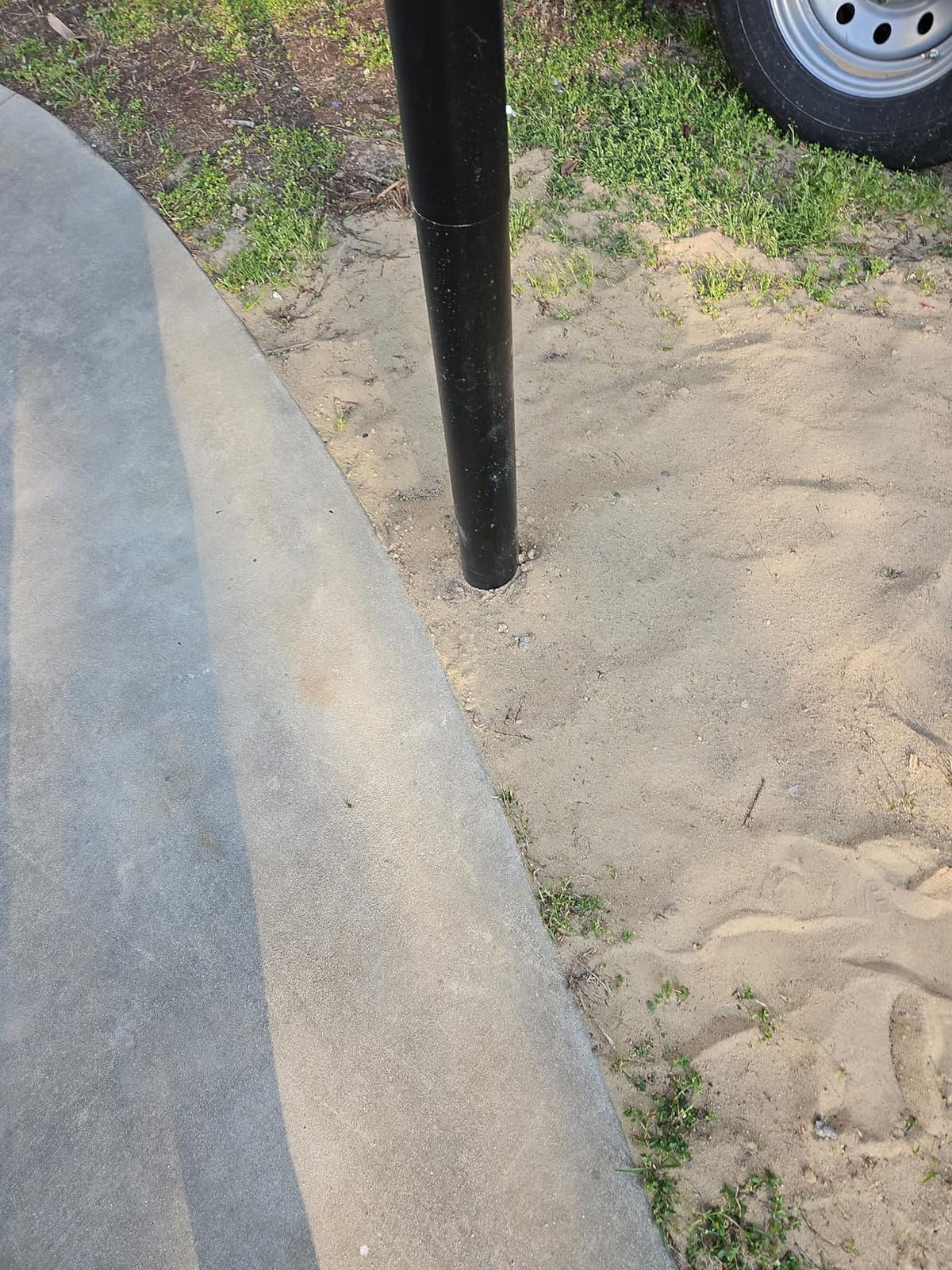
Then dig deep enough for frost. A footing that does not go below your local frost line will heave, and heaving is what cracks poles and tilts hoops a few winters after install. Backfill and set the pole in a plumb, straight position – the whole structure carries the load, and a leaning pole is a permanent leaning pole.
Pour concrete around the pole itself rather than only under it, which is how the in-ground models here specify anchoring. Keep the top of the footing slightly below grade so water sheds off it, and let it cure fully before you attach the backboard.
Budget two people for install day on any system over about 150 pounds, and expect the digging to take longer than the assembly. If you have never poured a footing, this is a reasonable job to hand to a concrete contractor.
Maintenance and replacement parts
Check the base fill, the rim bolts, and the pole coating once a year before spring play. Sand and gel fills compact, screws loosen, and powder coat chips at ground level first – which is the exact spot your HOA rule is probably about.
Know which parts your manufacturer sells before you need them. A net and a rim are cheap and universally replaceable. A backboard or a height actuator is not, and that is where brand support matters. One model in this guide commits to five years of spare part availability, which is unusual and worth real money over a decade.
Our basketball return system guide covers the practice equipment that pairs well with a new hoop, and if your focus is a younger child, the kids basketball hoop picks break down the low-height options.
Frequently Asked Questions
Can I put a basketball hoop in my driveway?
Yes, provided you have roughly a 30 by 60 foot area and comply with local and HOA rules. You cannot overhang a street or public sidewalk, and many associations restrict front-yard placement, lighting, and hours of use. Check the setback rules and the required clearance to a property line before you order.
What is the best outdoor basketball hoop for concrete?
For concrete, a cemented in-ground system is the most stable because the pole cannot shift in wind or flex during hard play. Portable systems also sit on concrete well, but only once the base is fully filled with sand or gel, since an empty or underfilled base tips. Fill the base, park it level, and both work.
What to put in the base of a portable basketball hoop?
Sand is the safest default because it is denser than water and will not expand and crack the base in freezing conditions. Water works in mild climates but must include a little antifreeze. Gel powder mixes combine with water for a heavier, mess-free fill. Whichever you choose, top it off after about 30 days as the fill settles.
Should I put antifreeze in a basketball hoop base?
Only if you are filling the base with water. The purpose is not to stop the water freezing, since a small amount will not achieve that, but to keep the base from splitting when the water does freeze and expands. If you use sand or a gel mix you do not need antifreeze at all, and sand is the better choice in cold climates.
What size basketball hoop is best for outdoor use?
For most residential driveways, a 44 inch backboard on a portable system or a 50 to 54 inch board on an in-ground system is the practical sweet spot. Regulation 10 feet is the rim height standard, not a backboard size. Bigger boards give a larger target but demand more clearance from the garage and street.
Do basketball hoops lower property value?
A well-maintained hoop is generally not a problem, and buyers with families often see it as a plus. The issues are condition and placement, not existence: a rusted or broken hoop left in view, or a portable system blocking the street, is what tends to bother neighbors and some appraisers. Keeping it level, clean, and out of common areas avoids the concern.
The Best Outdoor Basketball Hoop for Your Driveway
After comparing all 12, the Lifetime Portable 44 inch hoop is the best outdoor basketball hoop for driveways for most people, because it reaches 10 feet without tools, rolls anywhere on its wheels, and carries a 5 year warranty on a system you can move in an afternoon. The Silverback 60 inch in-ground model is the right call when you own the house, plan to stay, and want glass rebound and a rim that never rings. And if a small child is the primary user, the Yohood 4.4-10 ft is the only one here that comes low enough to matter.
Whatever you choose, measure the driveway before you order, fill the base completely, and top it off a month later. Those three steps solve most of the complaints owners have about 2026 driveway hoops. Compare the specs above, then take the pick that matches your household and get out there and shoot.