
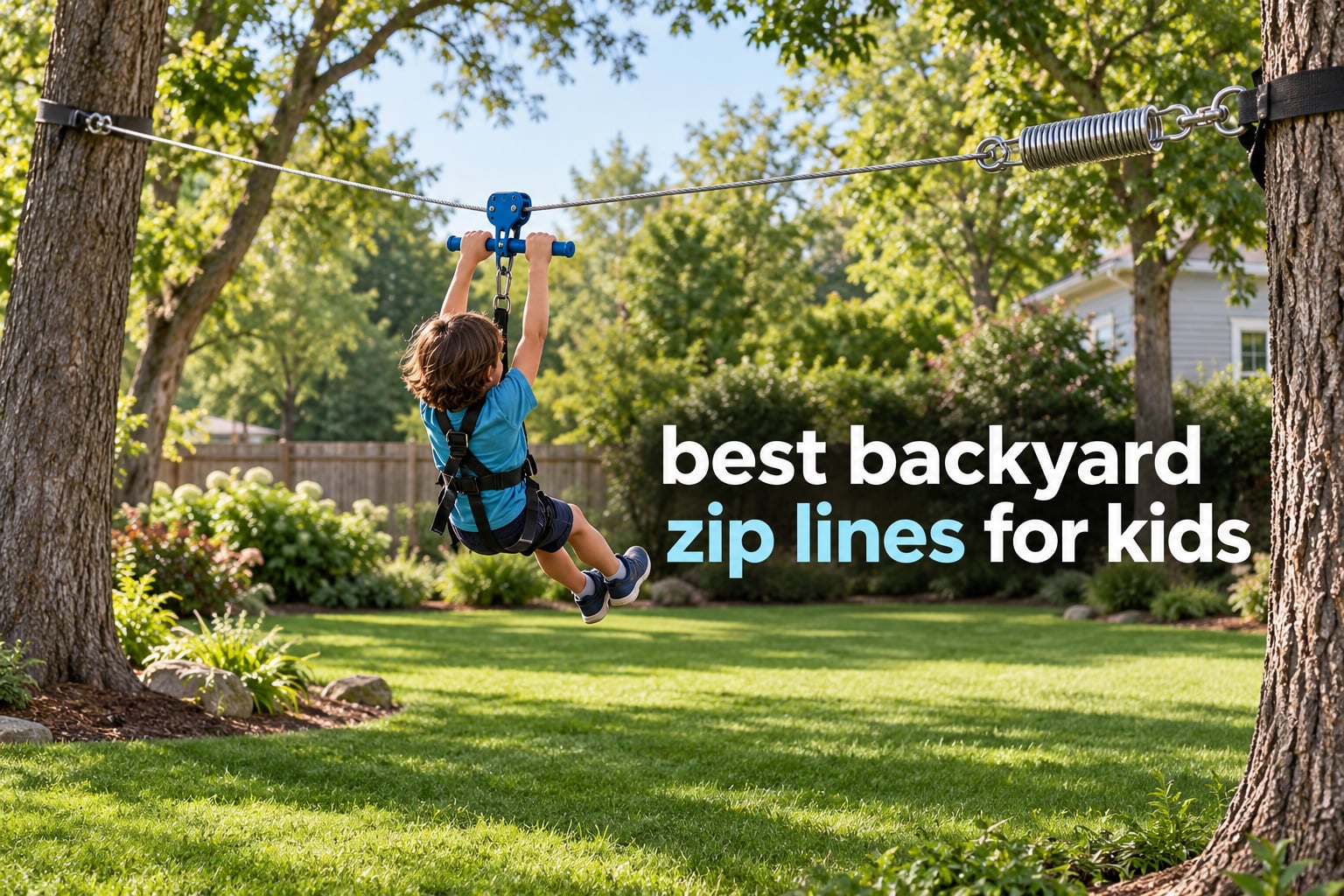
A backyard zip line is a length of steel cable strung between two anchors, usually a pair of mature trees, with a trolley, a brake, and a seat or harness your child rides across the yard on gravity alone. Picking the best backyard zip lines for kids comes down to two decisions that have nothing to do with the brand on the box: do you have two anchors that can hold the load, and do you have enough drop between them.
Get either one wrong and no kit saves you. A 100 ft line with only a foot of elevation change will not carry a rider to the far anchor, and a kit rated for 380 lbs hung between two undersized trees is asking the trees to do work they were not designed for. I have read the spec sheets, the instructions, and thousands of owner reviews on the ten kits below, and I have watched owners describe the same three install problems over and over: cable that will not tighten, hardware that arrives incomplete, and a stop block that gets mistaken for a brake.
What follows is a straight ranking of the ten best backyard zip lines for kids available now, organized around the situations families actually face: a first line for a five-year-old, a shared kids-and-adult line, a long rural run, a tight urban lot. I lean toward specs over marketing language, and I flag the differences between kits that look identical in a listing but are not.
If you are still building out the yard, our picks for the best backyard playsets and best pergolas for backyard shade are worth reading first, since a zip line usually lands better when it connects to an existing play structure.
Top 3 Picks for Backyard Zip Lines for Kids (October 2026)

CTSC Zipline Kit with Spring Brake
- 7 ft sling plus 105 ft main cable
- 6.4 ft stainless steel spring brake
- Adjustable harness and seat
- 2 nylon tree protectors
- CE and RoHS tested

Hyponix 200 ft Zip Line Kit
- 200 ft stainless steel cable rated to 350 lbs
- Seatbelt-style safety harness
- Quick-setup ratchet tensioning
- 10 year warranty

X XBEN 65 ft Zip Line Kit
- 65 ft stainless steel cable
- Seat adjustable from 3.6 ft to 7.5 ft
- 5.3 ft stainless steel spring brake
- Double sealed ball-bearing pulley
Best Backyard Zip Lines for Kids Compared in 2026
| Product | Specs | Action |
|---|---|---|
| CTSC Zipline Kit with Spring Brake |
|
Check Latest Price |
| Hyponix 200 ft Zip Line Kit |
|
Check Latest Price |
| X XBEN 65 ft Zip Line Kit |
|
Check Latest Price |
 HOKINETY 100 ft Zip Line Kit HOKINETY 100 ft Zip Line Kit |
|
Check Latest Price |
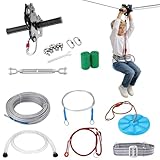 VEVOR 60 ft Zipline Kit VEVOR 60 ft Zipline Kit |
|
Check Latest Price |
 Slackers 40 ft Falcon Kit Slackers 40 ft Falcon Kit |
|
Check Latest Price |
 Perantlb 80 ft Zip Line Kit Perantlb 80 ft Zip Line Kit |
|
Check Latest Price |
 Just.smile Zipline and Slackline Set Just.smile Zipline and Slackline Set |
|
Check Latest Price |
 iZipline 95 ft Zip Line Kit iZipline 95 ft Zip Line Kit |
|
Check Latest Price |
 ZEROMX 150 ft Zip Line Kit ZEROMX 150 ft Zip Line Kit |
|
Check Latest Price |
One number in that table deserves a flag before you read further. The VEVOR listing names 500 lb in the product title and 330 lb in the technical details, then restricts the kit to teens. Treat the number on the box as a ceiling, not a promise, and treat the lowest of the three limits, cable, anchors, and brake, as the real one.
Can a 3 Year Old Go Ziplining?
Not on a typical residential kit, and the reason is grip and braking ability rather than an arbitrary birthday cutoff. Commercial ropes courses generally gate young children on height, with 48 inches used as the common threshold, because a child under that height cannot reliably hold a seat or grip with both hands and control their own stop.
The practical guidance for home use: a three-year-old can ride alongside an adult on a lap harness or in a bucket seat under direct supervision, but should not ride independently until they clear roughly 48 inches and can show you they can stop themselves. Every kit below ships with an adjustable harness or strap, and that strap is the piece that makes the difference for small riders. A parent on r/StLouis raised exactly this question after visiting a commercial park that enforced the same 48 inch rule for its ropes course, and the honest answer from parents there was the same one.
If your child is under five, look for a kit with a short spring brake and a seat that adjusts down low, like the short-run setups we cover later in this guide. Also consider pairing the line with a backyard sauna build or other slow-burn outdoor project so the yard keeps rewarding them after the zip line novelty fades.
How We Evaluated 10 Backyard Zip Line Kits
Every kit in this roundup was judged on the same six things, and each of them has been the deciding factor in a real owner complaint somewhere in the review data.
Cable gauge and material. We look for stated stainless steel or galvanized wire rope with a diameter, and we check whether the listed length actually covers the span after anchor wraps. A kit that ships 95 ft of cable for a 95 ft tree gap is undersupplied by design.
Real brake hardware. A spring brake compresses and absorbs energy. A stop block is a fixed no-pass point. Only the first one slows a rider down.
Stated weight limit versus stated age range. These frequently contradict each other, and the age range is what governs whether a child should ride alone.
Tensioning method. Ratchet systems with removable hardware are easier to install and easier to re-tighten after tree growth than fixed turnbuckles, though the turnbuckle is the more traditional design.
Documentation quality. Poor instructions are the single most common complaint in this category, so we weighted the clarity of the manual and whether the manufacturer will sell you replacement parts.
Warranty and support. We noted published warranty lengths where they are stated. Anything unspecified is called out in the review.
On testing honesty: this is a spec-and-owner-data evaluation, not a six-month ride test on all ten kits in one yard. We read manufacturer documentation, technical listings, and the full volume of owner reviews, and we cross-checked each claim against the product’s own stated tolerances. Where owners consistently report a problem the listing does not mention, we report it as a reviewer finding, not as a measured result.
1. CTSC Backyard Zip Line Kit – Best Overall
CTSC Zipline for Kids and Adult, Zip line Kits for Backyard with Stainless Steel Spring Brake, Cable Tensioning Kit, Safety Harness, 2 Tree Protectors and Full Set of Zip line Accessories
105 ft main cable plus 7 ft sling
Age 8+
6.4 ft stainless spring brake
Harness, seat, tensioning kit included
Pros
- Most complete box in the roundup with harness seat brake tensioning kit and tree protectors
- Ratchet strap tensioning reduces sag and speeds setup
- Nylon webbing tree protectors are gentler on bark than PVC tubing
- Highest review volume of any kit here at 2775 ratings
- Custom cable lengths available on request
Cons
- Cables are consumable and can corrode in humid climates
- Manual requires inspecting the cable before every single use
- Ages 8 and up
- which rules out independent riding for younger children
The CTSC is the kit I keep coming back to because it removes almost every decision from the shopping cart. Harness, seat, a 6.4 ft stainless steel spring brake, a cable tensioning kit, and two tree protectors all come in the same box. Most competitors in this category make you buy three of those five separately, and the parents who skip them are the ones who end up with a line that is genuinely unsafe.
The ratchet strap tensioning system is the part I would call the real upgrade. Owners consistently report faster setup and noticeably less sag than with the turnbuckle kits they had used before. On a 105 ft main cable plus a 7 ft sling, the extra sling length is what handles the wrap around the end tree, which is the detail that trips up most DIY installers.
It also carries CE and RoHS certification markings, and the nylon webbing tree protectors are a genuine improvement over the PVC tubing most kits in this class include. Bark matters here. Steel cable left bare will cut into a tree over a few seasons, and the protector is cheap insurance against a gouge you cannot undo.
Two honest caveats. First, the manufacturer states that cables wear with use and corrode in humid climates, which means this is a line you inspect before every session and replace eventually. That is normal for steel cable, but it is a maintenance commitment, not a set-it-and-forget-it purchase.
How the CTSC handles the age question
The listed age range of 8 and up is stricter than several competitors here, and honestly better than kits that list 3 and up alongside a 220 lb capacity. For a household with a six-year-old, the adjustable harness makes supervised riding practical, but you are the braking system, and that should be said plainly.
Custom cable lengths are available by request when your trees sit at an awkward distance. That is worth taking advantage of if your span is more than about 110 ft, because the standard 105 ft main cable will be tight once both anchor wraps are accounted for.
Where the CTSC falls short
The weight capacity is not stated as prominently as the capacity on some competitors, and the box is heavy at 17 lb, which tells you the hardware is substantial. It is also a tree-to-tree kit, so it assumes you have two mature anchors and no pole kit is included.
Bottom line: if you want the shortest path from unopened box to a rideable, braked, tensioned line, this is the one. It is the most reviewed kit in the roundup by a wide margin, and the volume of owner feedback is itself a form of quality control.
2. Hyponix 200 ft Zip Line Kit – Best for Long Runs
Hyponix Zip Line Kit for Backyard Kids and Adults 200 ft, Up to 350 Lbs
200 ft stainless steel cable
Up to 350 lbs
Age 3 and up
10 year warranty
Pros
- Longest span in the roundup at 200 ft of stainless steel cable
- Stated 350 lb capacity handles kids and adults on one line
- Seatbelt-style harness with adjustable seat height
- Quick-setup ratchet keeps cable tight and stable
- 10 year warranty with replacement part support
Cons
- Boxes sometimes arrive missing turnbuckle locking screws or tree straps
- Instructions are thin enough that many owners source their own cable gripper
- Heavier riders over roughly 120 lb produce noticeable sag on long spans
- Non-removable trolley configuration keeps the line permanently rigged
Nothing else in this roundup comes close on span. If you have rural acreage, a long side yard, or a slope, a 200 ft run turns a zip line into a genuine attraction rather than a 20-second ride across a suburban lot. It also carries a published 10 year warranty, which is a meaningful signal from a company willing to stand behind hardware for a decade.
Owner feedback splits into two clean groups. Parents running younger children love the seatbelt-style harness and the adjustable seat height, because it means one line serves a five-year-old and a 170 lb adult. The stainless steel hardware and the smooth spring-brake stopping draw consistent praise for how the hardware compares to smaller kits at similar sizes.
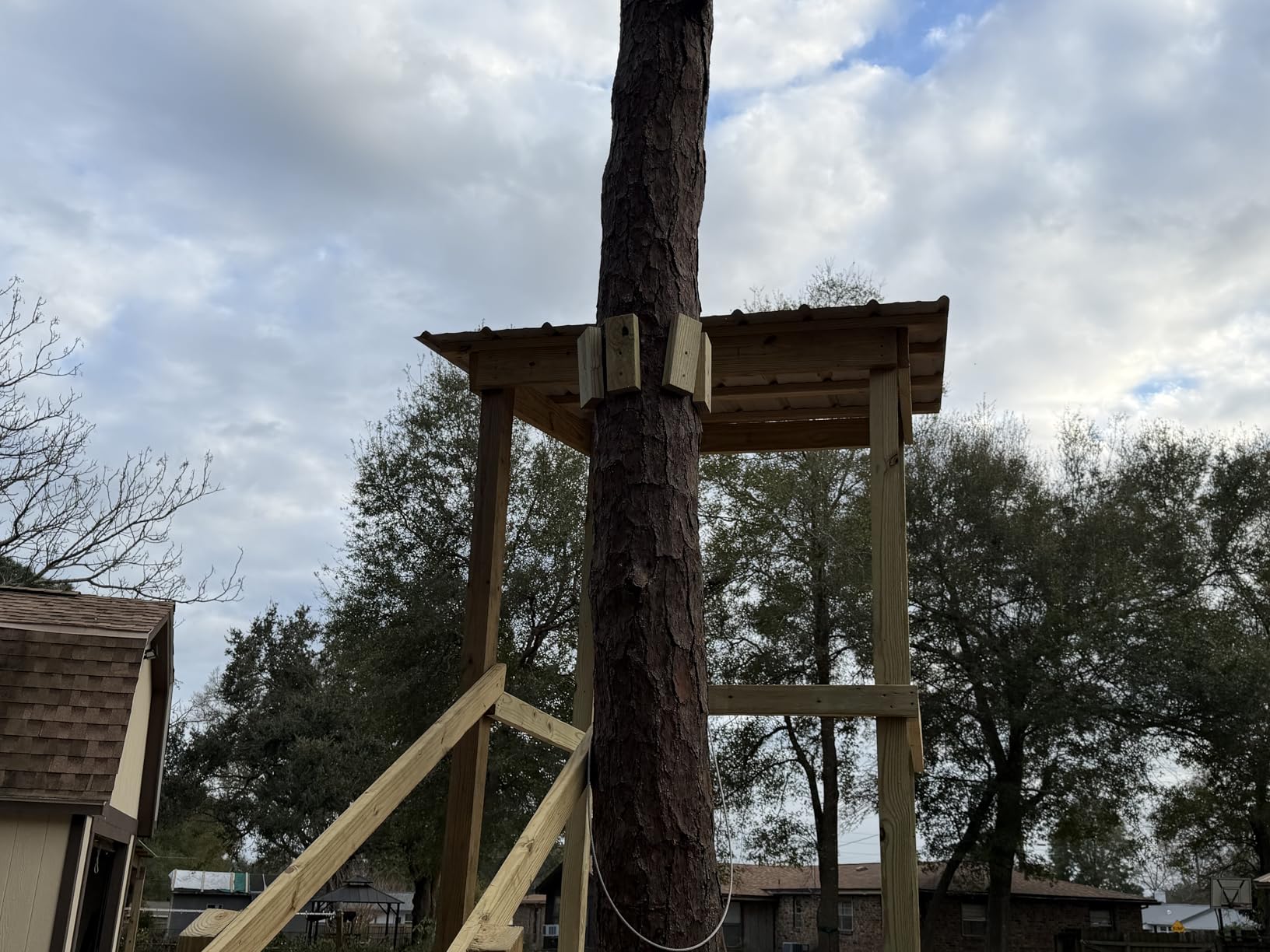
Support is the standout. Multiple reviews describe the company shipping replacement springs and missing parts quickly, which directly answers the after-sales anxiety that runs through this whole category. When a part breaks on a 200 ft line, a two-day fix matters.
The real limitation is physical, not electrical. Reviewers report that riders above roughly 120 lb create noticeable sag even when the cable is correctly tensioned, and a longer span amplifies that. The 350 lb figure is a hard limit on the rider, not a guarantee of a flat, fast run for a heavy adult across 200 ft.
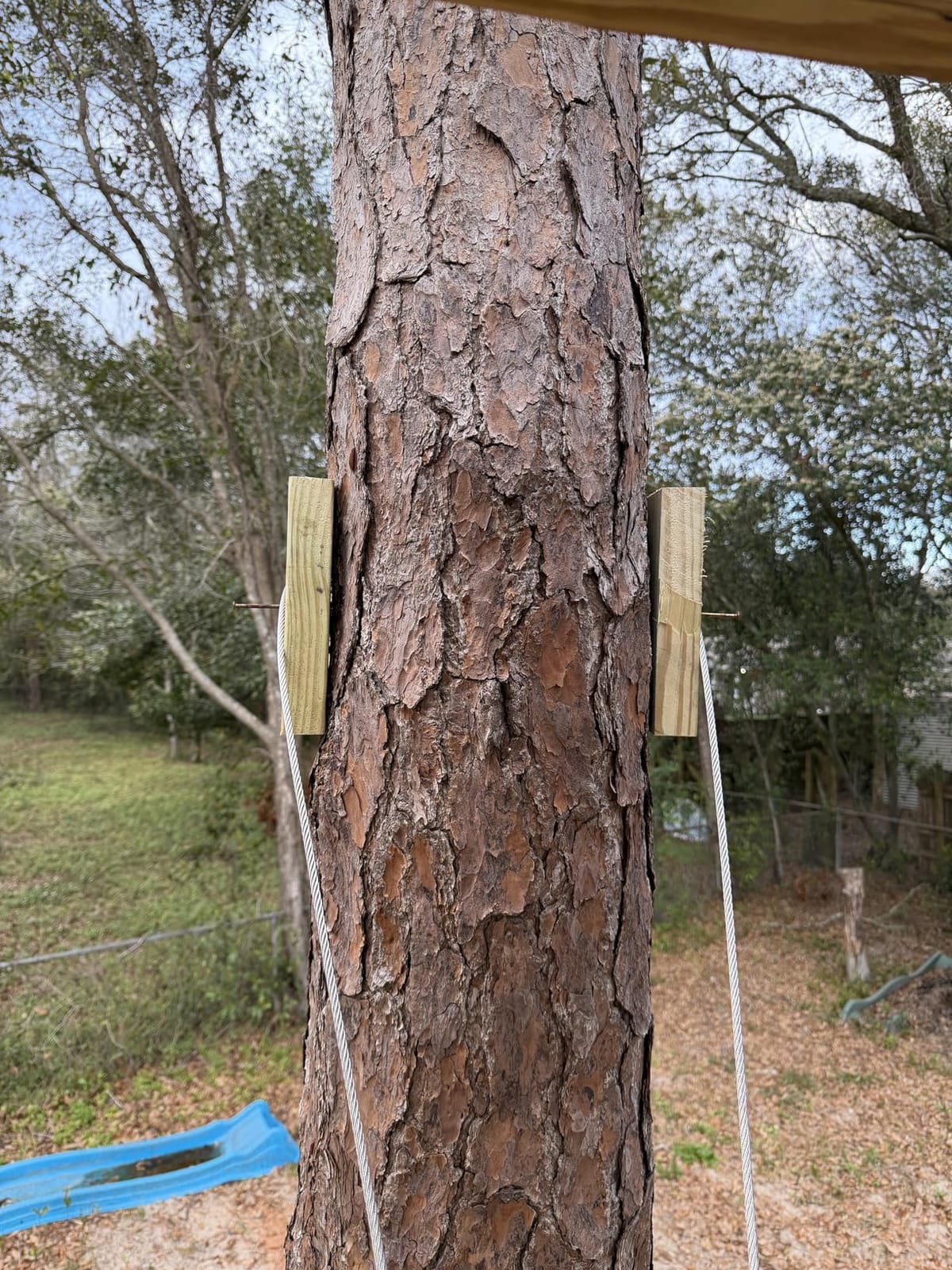
When a 200 ft line makes sense
A long run gives you far more ride per anchor than a short kit does, and it delivers a ride that photographs and video-plays far better. If you have a slope with real elevation change, this is the kit that turns a zip line into the centerpiece of the yard rather than one feature among a playset.
You need anchors spaced accordingly, and the elevation math matters more here than anywhere else on this list. A 200 ft run at 3 percent needs about 6 ft of drop, and getting 6 ft of measured elevation between two points 200 ft apart usually means a hill, a treehouse platform, or a built-up pole structure.
Where the Hyponix is the wrong choice
If your trees are closer than about 120 ft apart, the extra cable is dead weight you will have to coil and secure. Also expect to spend an evening filling gaps in the box. The recurring review theme is missing small hardware and vague instructions, and many owners ended up buying a separate cable gripper or come-along to finish the job.
Verdict: the best choice for a long property and the best warranty in the group, provided you are willing to source a few small pieces yourself and you have the elevation to make the span work.
3. X XBEN 65 ft Zip Line Kit – Budget Pick
X XBEN Zip line Kits for Backyard 65FT, Ziplines for Kids and Adults
65 ft stainless steel cable
Over 3 years old
5.3 ft spring brake
833 reviews
Pros
- Lowest entry cost of any kit here with stainless steel components throughout
- Adjustable seat strap runs from 3.6 ft to 7.5 ft
- Double stainless steel pulley with sealed ball bearings
- 5.3 ft spring brake stops riders well short of the end tree
- Setup in about an hour for most families
Cons
- Supplied turnbuckles can break after relatively short use
- Reaching the manufacturer for a replacement part is difficult
- Short 5.3 ft brake needs seat adjustment so small riders do not reach the tree
- Tightening the cable to a usable tension takes real effort
The X XBEN is the answer to the most common question in this category: is there a backyard zip line kit a family can set up in an afternoon without a major purchase. The hardware is stainless steel, the pulley has sealed ball bearings, and the adjustable seat strap from 3.6 ft to 7.5 ft is genuinely the widest adjustment range in the roundup.
That adjustment range is what makes it a strong first line for young children. Most competitors seat a five-year-old near the top of their range and then spend the first month lowering it. Here the range spans nearly four feet, so a 40 lb preschooler and a 130 lb adult can both ride the same line with a strap adjustment rather than hardware changes.
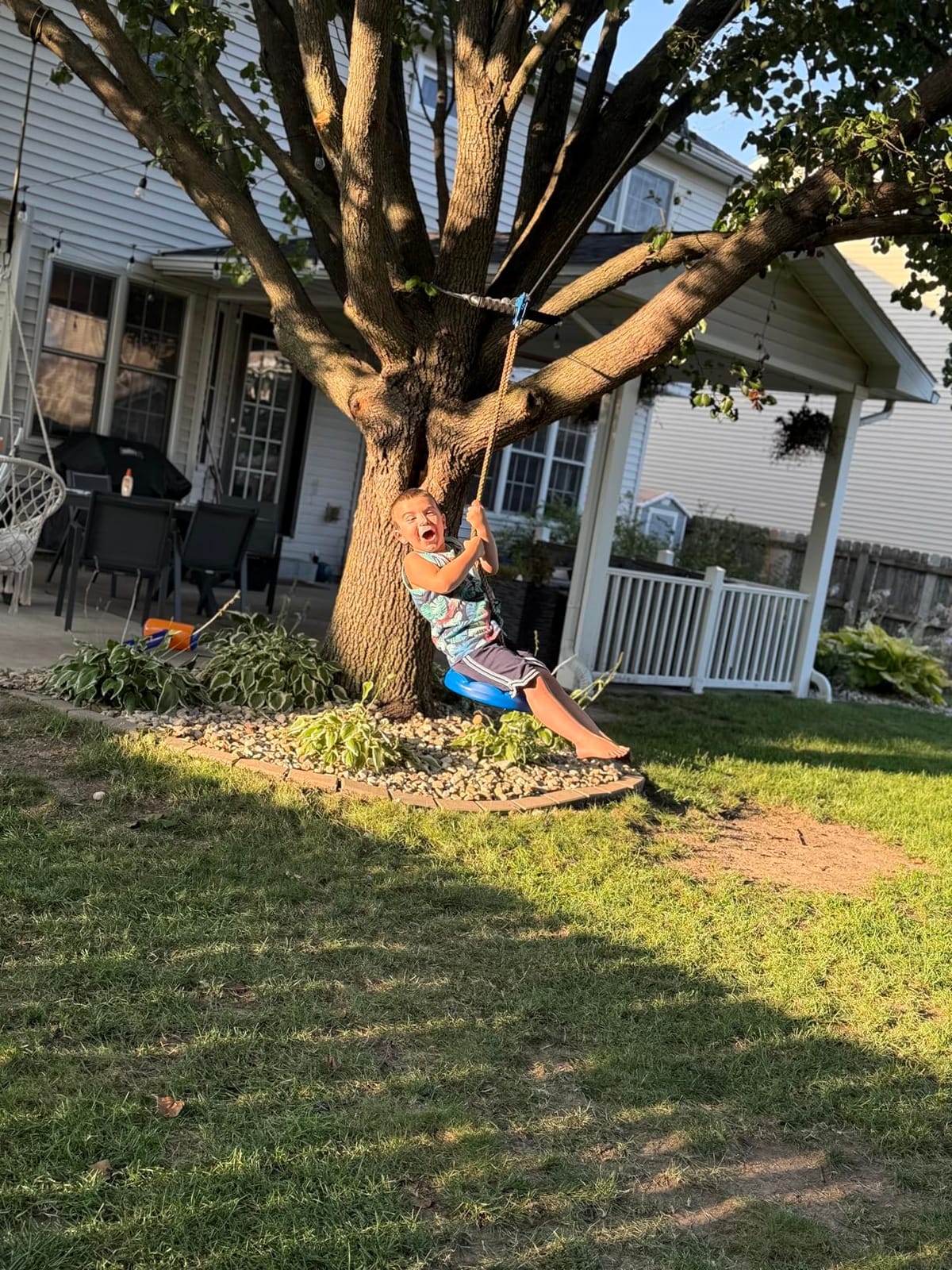
Reviews describe families where children ride it many times a day, which is the highest-use pattern we saw across all ten kits. For a screen-free outdoor activity, high repetition is the whole point, and a line that gets used forty times a week earns its footprint in the yard faster than any other purchase back there.
Seven length options from 65 ft up to 200 ft means the same brand covers a suburban lot and a rural property, which makes it a safe default when you are not yet sure how far your anchors sit apart.
What you trade away for the lower cost
The turnbuckle is the weak point. Owners report supplied turnbuckles breaking after relatively short use, and when one breaks, replacing it requires contacting a manufacturer that is difficult to reach. That is a real operational risk on a line that carries weight, and it is the single reason this is not the top pick.
Second, the 5.3 ft spring brake is short. For small riders that means lowering the seat position so the child’s hands and feet cannot reach the end tree, which is a setup step people miss. It is not a defect, but it is a thing to check before the first ride.
Best use case for the X XBEN
Buy this one if your kids are between roughly 5 and 10, your anchors are 60 to 70 ft apart, and you want a first zip line that will not require a second purchase to be safe. Do not buy it if you are the type of owner who will not re-tighten the cable, because tightening it well takes effort and the hardware does not help you.
Verdict: the most sensible first zip line in this roundup, with the caveat that you should expect to eventually replace the turnbuckle and that help is hard to get when you do.
4. HOKINETY 100 ft Zip Line Kit – Best Ratchet Setup
HOKINETY Zip Line Kit for Kids Adults : 100FT Up to 380Lbs – Quick Tighten Zipline for Backyard Outdoor with 100% Rust Proof Removable Trolley Seat Spring Brake
100 ft cable rated to 380 lbs
Age 8 and up
Removable trolley
6.5 ft heat-treated brake
Pros
- Ratchet and webbing tensioning replaces fiddly turnbuckles
- Removable trolley can be taken off the cable when the line is not in use
- 6.5 ft heat-treated spring brake with a protective iron tube
- 10 year limited warranty
- Reported by owners to assist children with mobility needs as a walking aid
Cons
- Instructions are poor and many owners wish for a step-by-step install video
- Cable can be hard to get tight enough and the trolley may derail at low tension
- U-bolt nuts are not lock nuts and can work loose
- Seat rope length can be too long for small children
- Nominal cable length is barely enough for the stated span
The HOKINETY is the kit whose single design decision I would copy if I were building one. It replaces the traditional turnbuckle entirely with a ratchet and webbing line, and in practice that means tensioning a 100 ft cable is a ten-minute job with a tool you already own rather than a threading-and-tapping exercise with two wrenches.
The removable trolley is the second good decision. Owners take it off the cable when the line is not in use, which removes the low-hanging-hardware problem entirely and means a line strung over a shared play area is not a head-height obstacle during the other ninety percent of the day. On a residential line that is a genuine safety improvement, not a gimmick.
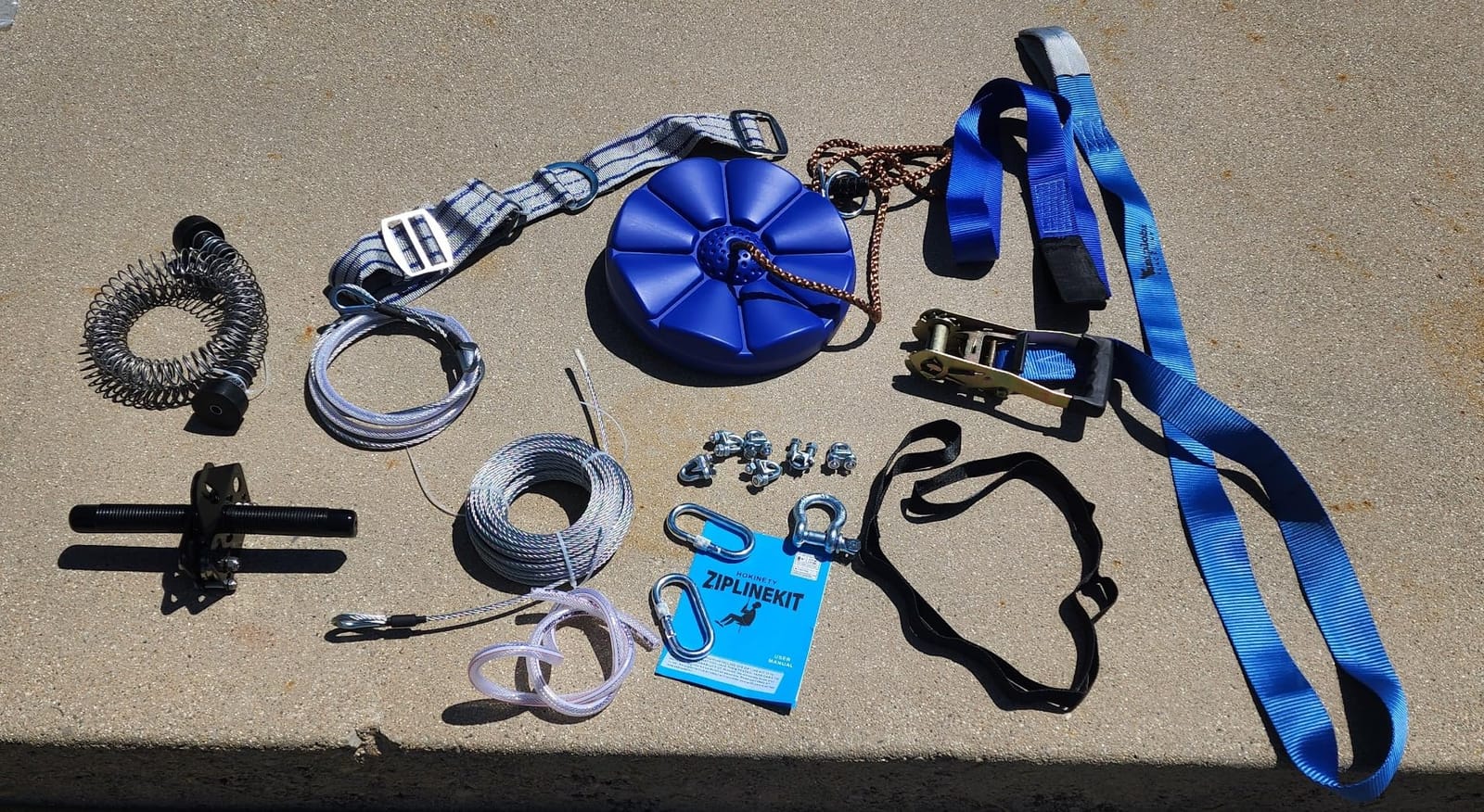
There is one owner-reported use that stands out. Several reviewers describe using the line as an assisted walking aid for children with mobility needs, supporting a child at the trolley while they move across the yard. It is not the intended use, and we are not endorsing it as supervised therapy, but it tells you the trolley takes a static load without deflecting.
The 6.5 ft heat-treated steel spring brake is among the longest in the roundup and adds a protective iron tube around the spring, which is the part that normally takes the wear from repeated compression.
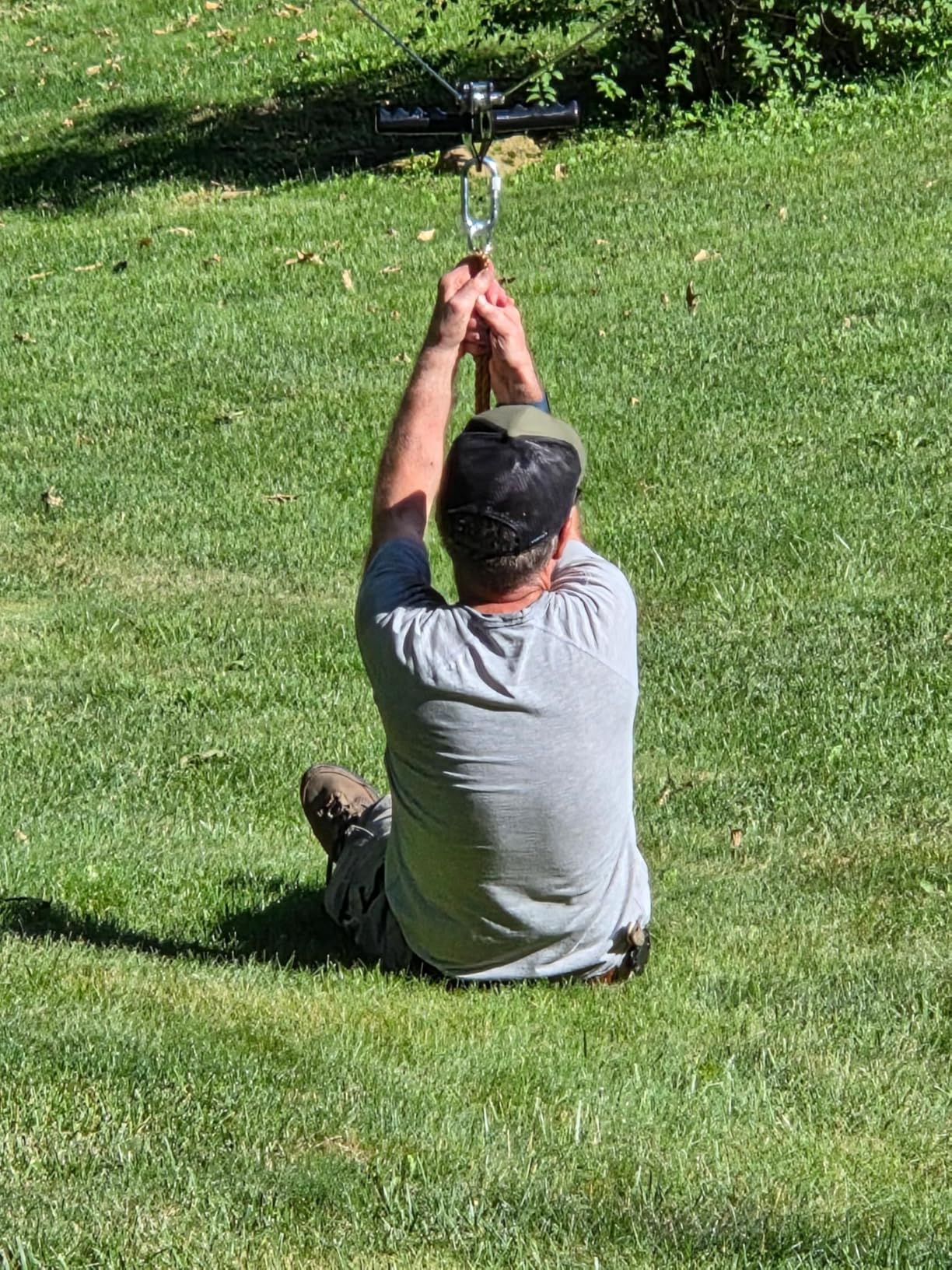
How the ratchet system compares to a turnbuckle
A turnbuckle is a threaded tensioning sleeve. It is precise, it does not slip, and it is genuinely harder to install. A ratchet strap is faster, more forgiving, and easier to re-tension six months later when your trees have grown, which is why it is becoming the default in this category.
The trade-off is that the ratchet does not hold a fine, repeatable tension setting, so getting it tight enough still takes effort. Owners report this directly: the cable can be hard to get tight enough, and a trolley running on an under-tensioned cable can derail. Tension is a skill you build over two or three sessions.
Where the HOKINETY frustrates owners
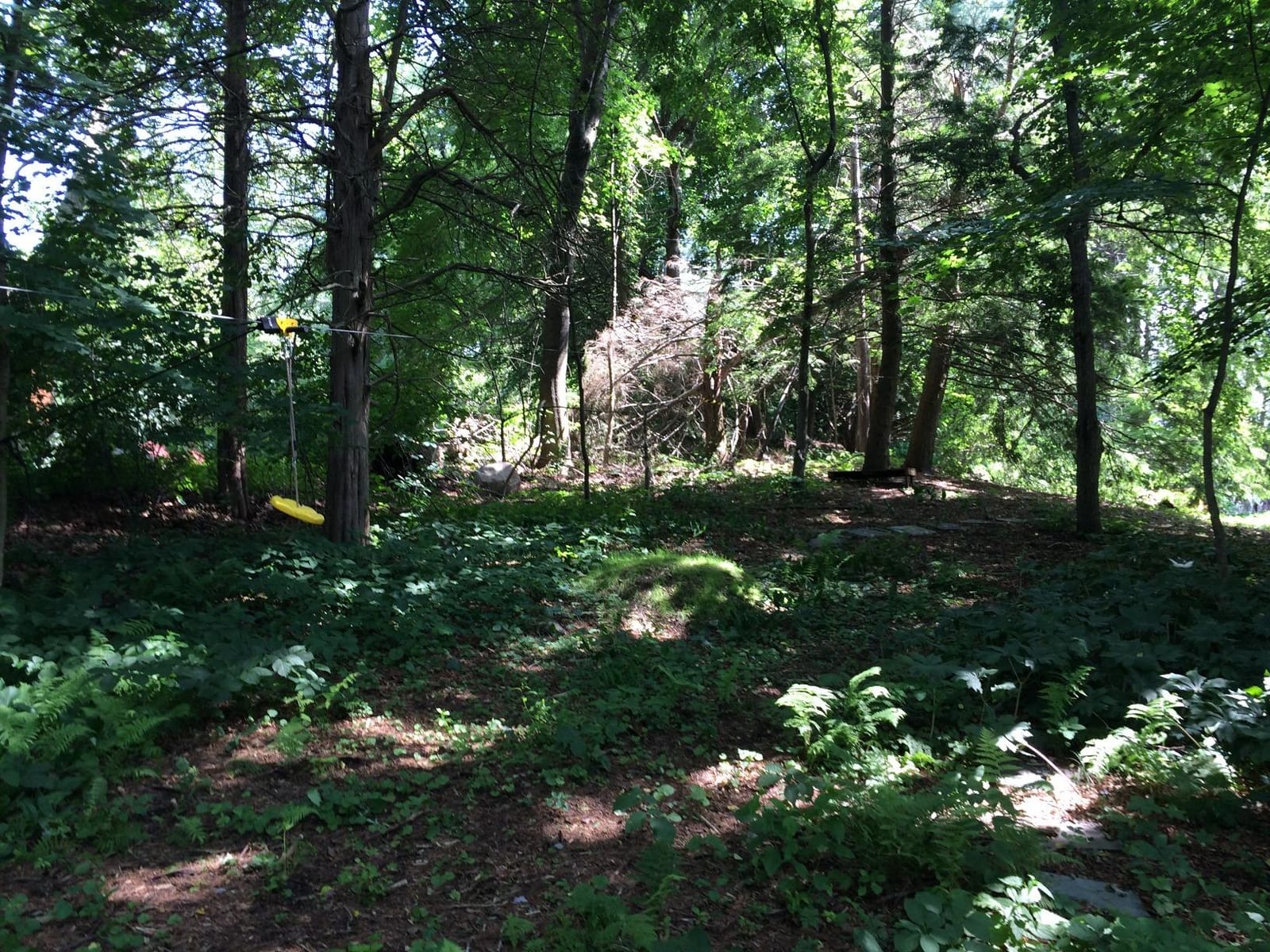
Documentation is the weak point, and it is the most common complaint in the reviews. Many buyers specifically wish for a step-by-step install video, which tells you the written manual is not carrying its weight. Also note the U-bolt nuts are not lock nuts, so they need a periodic check, and the stated 100 ft of cable is described by owners as barely enough for the span once anchors are accounted for.
Verdict: the best tensioning system in the roundup and the best removable trolley, held back by documentation and a cable length that leaves no margin.
5. VEVOR 60 ft Zipline Kit – Best for Teens
VEVOR Zipline Kit, 60 ft Zip Line Kits Up to 500 lb, Backyard Outdoor Quick Setup Zipline, Playground Entertainment with Stainless Steel Zipline, Spring Brake (Note: for Teens Only. Not for Adults)
60 ft quarter inch steel wire rope
6.4 ft spring brake
CPC certified
330 lb in tech specs
Pros
- Quick setup with an included wrench and clear elevation guidance
- Holds up outdoors through a full year of weather exposure
- Easy to take down at the end of the season
- Dual safety with both a seat belt and a rope harness
- Concave polished ball-bearing pulley reduces rope wear
- 52 ft and 65 ft variants also available
Cons
- Listing restricts the kit to teens and not adults due to strap flex
- Strap attachment hardware can feel marginal under heavier loads
- Supervision is needed at both ends to stop riders reaching the tree
- Some units arrive with missing parts and seller response is slow
- Assembly instructions are not always easy to follow
This is the lowest-rated kit in the roundup at 4.2 stars, with a documented 10 percent one-star share, and I am including it because it still does several things well and because the reasons for the low score are informative.
VEVOR is the most widely listed brand in this category across retail search results, and the hardware is credible. The quarter inch thickened steel wire rope with a concave polished ball-bearing pulley is a sound design choice, and the pulley shape is specifically intended to reduce rope wear, which extends cable life. The included wrench is a small touch that saves you a trip to the garage before the first install.
Dual safety is worth calling out: you get both a seat belt and a rope harness, so a child can be secured two ways. Owners also report the line holding up outdoors over a full year including weather exposure, and being easy to remove at the end of the season, which matters more than it sounds in a climate with freeze-thaw cycles.
Why the teen-only restriction matters for your family
The listing states the kit is for teens only and not for adults due to strap flex, which is the manufacturer telling you the attachment hardware does not hold under adult load. That is a more credible signal than an inflated capacity number, and it is why I would not put an adult on this line even though the product title mentions a higher figure.
The technical details list 330 lb of capacity, which sits alongside the 500 lb in the title. When a listing gives you two different capacity numbers, the one in the technical section is the one the manufacturer actually tested against.
When this kit is the right pick
Teen and preteen riders, a 60 ft span, and a family that wants seasonal install and removal. The dual belt and harness setup genuinely helps with younger teenagers who are still building confidence, and the 52 ft and 65 ft variants let you size down if your anchors are closer together.
Verdict: solid hardware held back by incomplete quality control. Reviews describe some units arriving with missing parts and slow seller resolution, so buy from a seller who will replace a short shipment, and check the box before you start.
6. Slackers 40 ft Falcon Kit – Best for Small Yards
Slackers 40’ Zipline Falcon Series Kit with Seat
40 ft steel cable
Sealed ball-bearing trolley
Single tree protector
Smooth self-stopping end
Pros
- Installs in about 10 to 30 minutes with thorough illustrated instructions
- Closed roller mechanism keeps small fingers away from the cable
- Smooth consistent speed with a gradual stop and no separate brake required
- Handle and seat sizes suit children's bodies
- Steel trolley arrives fully assembled with sealed ball bearings
- Easily removed for winter storage
Cons
- Only one tree-protecting tube ships for a two-tree mount
- Steel rope can dig into bark without separate tree protectors
- 40 ft is tight once anchor wrap is accounted for
- Anchor hardware can slip and need repeated re-tightening
- Some units run too fast for small children without lowering the start point
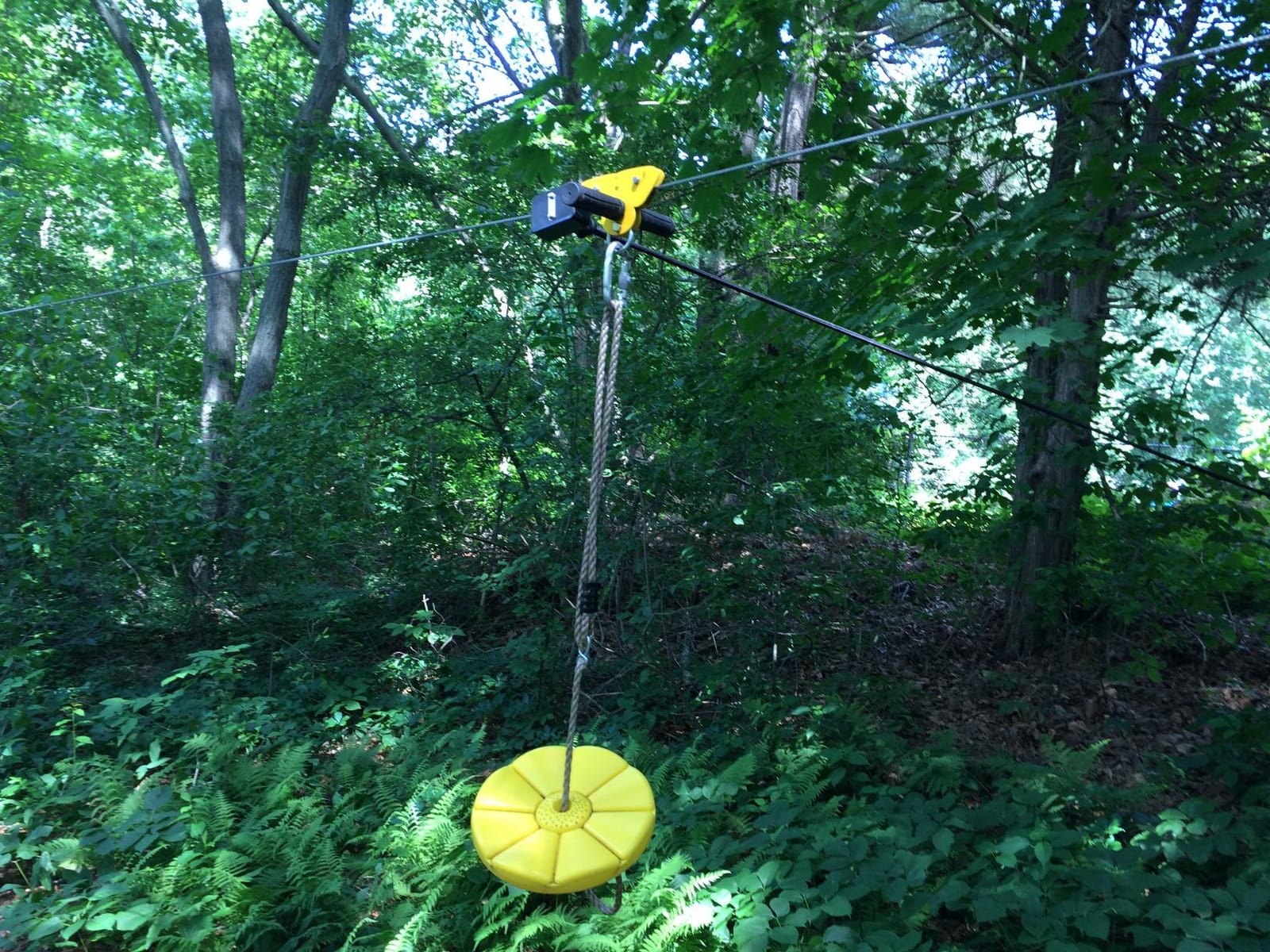
The Slackers is the odd one out in this roundup because it is not a spring-brake kit. There is no separate brake component. The ride ends with a gradual stop built into the line geometry, and owners describe the result as smooth and consistent with no hard arrival at the far end.
That design choice comes with a genuine safety advantage for a specific group. The closed roller mechanism means a child’s fingers cannot reach the cable, that is the injury small riders are most exposed to on any line in this category. Several reviewers call it the safest option in the category for that reason alone.
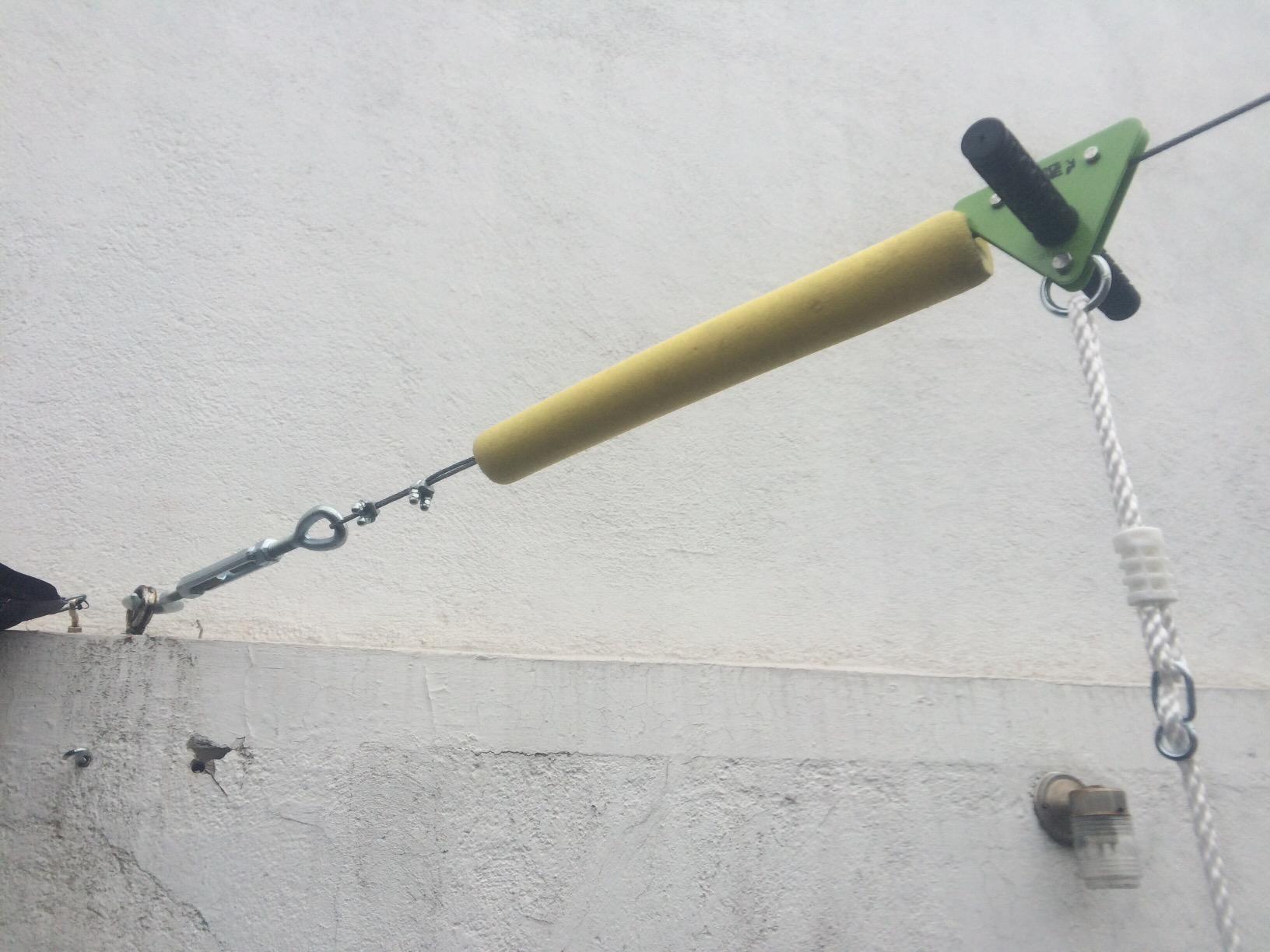
Setup is the other headline. Owners report 10 to 30 minutes with thorough illustrated instructions, and that is the best documentation in this roundup by a wide margin. If you have never installed anything like this, the Slackers is the kit where the manual actually matches the job in front of you.
It is also a long-running kit from an established outdoor brand, and reviewers frequently single it out as strong value in the category. It is a single-piece steel trolley that arrives fully assembled, which means fewer small parts to lose.
Why 40 ft is both a strength and a limitation
Short is the entire point for a small lot. A 40 ft run finishes before a child can build enough momentum to get hurt, and the lower speed is a real safety margin for a first-time rider. Parents with younger children value that the handle and seat sizes suit children rather than requiring an adult harness to fit.
But 40 ft is genuinely short once you subtract the wrap around two trees. Owners report the cable is tighter than it looks, and that 50 to 60 ft suits most yards better. Also flag that the line can run too fast for small children if you do not lower the starting height, which is an adjustment you should make before the first ride rather than after the third.
Before you buy the Slackers
Only one tree-protecting tube is included for a two-tree mount, so plan to buy a second one or use another bark protection method. Anchor hardware can slip and require repeated re-tightening, so expect to check tension a few times in the first season as the cable settles.
Verdict: the safest and fastest-to-install kit for small children in a small yard, with the trade-off of a short span and one missing tree protector.
7. Perantlb 80 ft Zip Line Kit – Best Quick-Release Trolley
Zipline for Backyard Kids and Adults,Zipline Kits for Backyard with 80ft Cable,6ft Zipline Spring Brake and Belt,Zip line Trolley with Handle,seat and Bag
80 ft quarter inch stainless cable
6 ft galvanized spring brake
220 lb capacity
Carry bag included
Pros
- Bottom-opening quick-release trolley opens for fast install and removal
- Quarter inch stainless cable is a heavier gauge than most kits at this size
- Everything in one kit including trolley seat belt spring brake and carry bag
- Spring brake stops riders well short of the end tree
- 80 ft 100 ft 120 ft and 160 ft versions available
Cons
- Stated 220 lb capacity is lower than most competing kits
- Cable and hardware are thinner than premium kits
- Spring brake is galvanized rather than stainless
The Perantlb solves a specific problem better than anything else here: how to get a trolley on and off the cable without dismantling the line. The trolley opens from the bottom, so you clip it closed, tension, and later open it and lift it off. On a kit you might take down for winter or reposition, that is the difference between a five-minute job and a reassembly.
The cable is quarter inch ultra-high-strength stainless steel, which is a heavier gauge than most kits in this class ship. That is the spec that matters most for long-term safety, and it is worth noting that at 80 ft the Perantlb is competing on hardware spec rather than on feature count.
The carry bag is a small thing that matters. It lets you store the whole line out of the weather between seasons, and cable stored coiled and dry lasts considerably longer than cable left racked in a shed through a wet winter.
Is 220 lb enough for your family?
That is the honest limitation and it is a real one. A 220 lb stated capacity suits children and most adults up to about 180 lb with reasonable margin, but it will not comfortably take a larger adult. If your plan is a line the whole family shares including a heavy parent, look at the Hyponix at 350 lb or the ZEROMX at 380 lb instead.
Reviewers also note that the cable and hardware are thinner than premium kits. The 6 ft spring brake is galvanized rather than the stainless steel used by the top three picks, so in a coastal or humid climate that is the part you will inspect most closely each season.
Why the 80 ft length is the sweet spot
Eighty feet is long enough to feel like a real ride and short enough that the braking distance stays modest. Owners also like the 100 ft, 120 ft, and 160 ft versions from the same line, which means you can start at 80 ft and move up later if you re-anchor.
Verdict: the strongest hardware in its class here if your household riders stay under 220 lb, and the trolley design is worth paying extra for. Check the spring brake annually if you live somewhere wet.
8. Just.smile 60 ft Zipline and Slackline Set – Best for Balance Practice
Zip ine Kit for Kids,Stainless steellackline Pulley Slider with Swing seat Zip line,Kids Zipline kit for Backyard with 60ft Ninja Slackline
60 ft zipline plus 60 ft slackline
Double stainless bearings
Stated 440 lb capacity
Swing seat included
Pros
- Two in one design pairs a zipline with a slackline for balance practice
- Polyester slackline self-softens the ride which suits younger children
- Double stainless steel bearings give a smooth glide
- Ratchet tensioning strap makes setup quick
- Portable and easy to relocate between trees
- Children reportedly use it daily
Cons
- Instructions are confusing especially for working the ratchet
- Both ends often need several readjustments to settle on angle and height
- Polyester line is better suited to small children than older kids or adults
- No tie-off point for the unused tail end of the line
This kit does something none of the other nine do. You get 60 ft of zip line and 60 ft of slackline in the same package, and the slackline is a flat polyester webbing that the child balances across rather than rides. For a family whose main goal is core strength and coordination rather than speed, that second line is arguably more valuable than the first.
There is a physics reason younger children do well on this one. The polyester slackline is compliant, so when a child loses balance the line deforms and absorbs energy instead of snapping them taut. Reviewers consistently note it works better for small children than a rigid steel cable would.
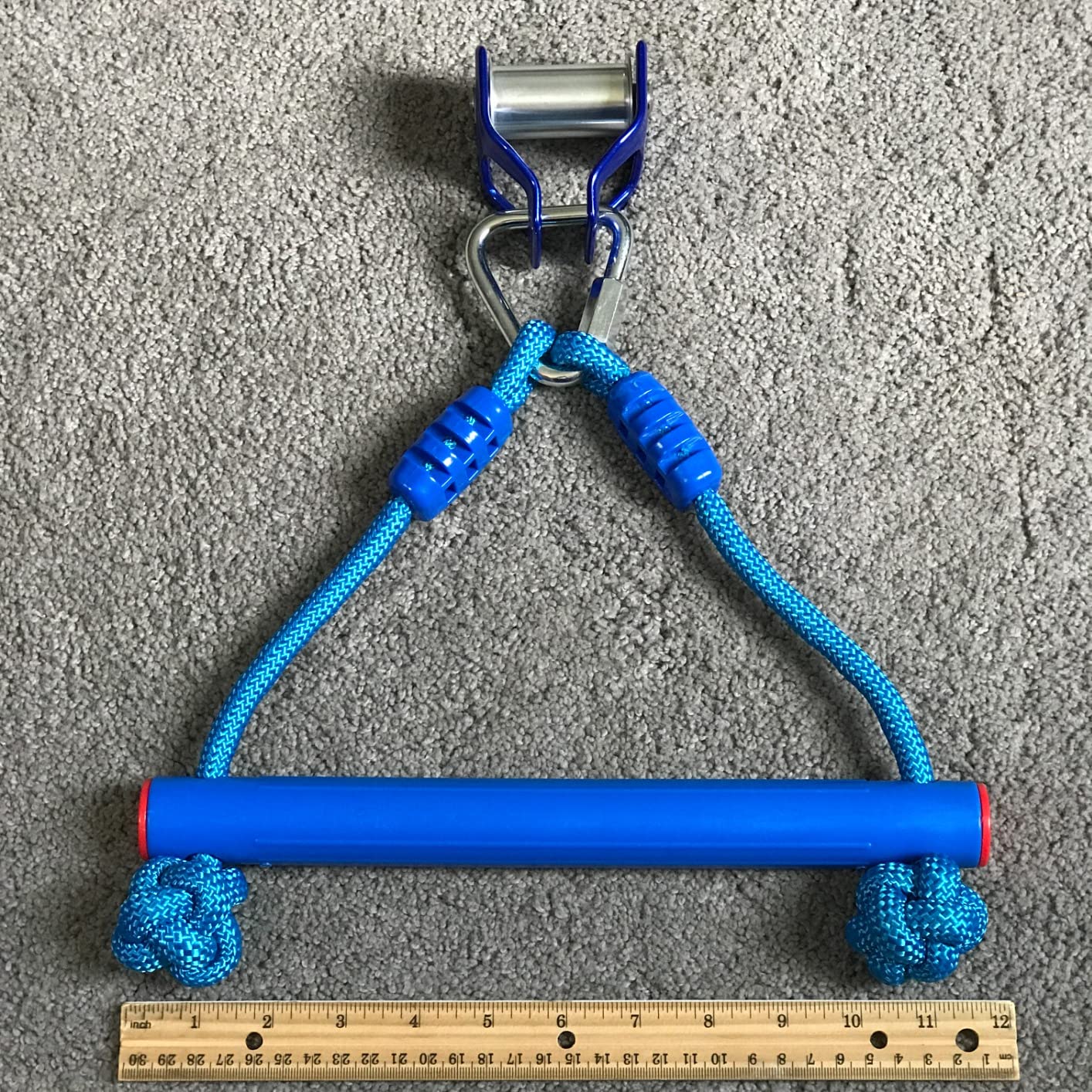
The stated 440 lb load capacity is the highest number in this roundup, and it applies to the load rating rather than to a specific rider weight. Treat it as a hardware figure and let the age and size of the rider be the deciding factor.
Daily use is the pattern owners report. Children use it and it packs away easily, which is what you want from something that will only be interesting for a few years.
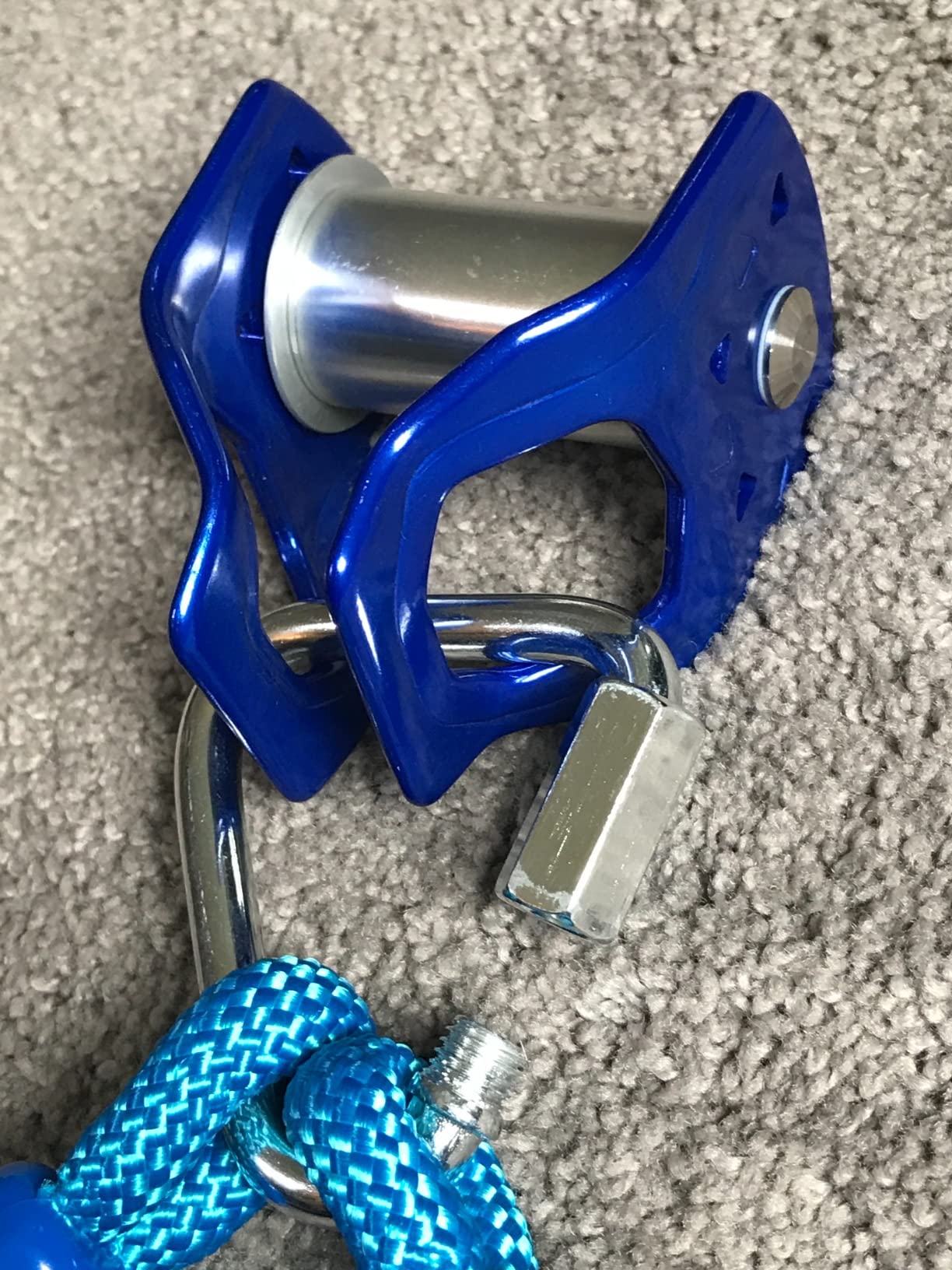
The rigging caveats you need to know
Two real issues. There is no tie-off for the unused tail end of the line, which is sloppy rigging on a product intended to be moved between trees, and both ends frequently need several readjustments before the angle and height settle. Plan to spend the first session tuning rather than riding.
The polyester line is the reason this kit suits young children and the reason it is wrong for older kids or adults. A 120 lb teenager on polyester webbing is a different proposition than the same rider on the stainless Hyponix or ZEROMX. Match the kit to the rider, not just the yard.
Who should buy this one
Households with children roughly 5 to 11 who want a balance and coordination challenge alongside the thrill of a ride. The double stainless steel bearings give a noticeably smooth glide, and the ratchet strap keeps tension simple once you understand it.
Verdict: the most educational kit in the roundup, and the only one that doubles as an obstacle course. The trade is less headroom for older riders and tail ends you have to secure yourself.
9. iZipline 95 ft Zip Line Kit – Best Soft Stop
iZipline 95 feet Zip line Kit with Stainless Steel Spring Brake and Seat
95 ft main cable plus 5 ft sling
5.3 ft stainless spring brake
250 lb maximum weight
Age 8 and up
Pros
- Spring brake is designed to prevent a sudden stop and to avoid burning out
- Fixed steel trolley with a firm handle grip and included seat
- SUS304 stainless wrapped sling rings add a secure secondary connection
- Custom cable lengths available by request when 95 ft does not fit
- 250 lb maximum weight is stated clearly and conservatively
Cons
- Threading the SUS304 rings into the clevis is fiddly and safety-critical to get right
- Fixed trolley must be threaded onto the cable before the line is fully tightened
- Smaller review base than most kits in this roundup at 61 ratings
- 250 lb capacity is the second lowest here
The iZipline is the one to look at if the ride quality matters more to you than the box contents. The 5.3 ft stainless steel spring brake is explicitly designed to prevent a sudden stop and to avoid burning out under repeated compression, and that is the difference between a child stepping off the seat and a child being thrown slightly forward as the spring bottoms out.
It is also one of the few kits here that states a conservative weight limit. The 250 lb maximum weight recommendation, combined with an 8 years and up age range, is a manufacturer telling you the real envelope rather than a marketing maximum. We would rather see that than a 500 lb claim contradicted by a teen-only note in the same listing.
The SUS304 stainless steel wrapped sling rings add a secondary connection between the trolley and the cable loop, which is a genuine safety feature on a fixed trolley design.
The assembly step that catches people
The fixed trolley must be threaded onto the cable before the line is fully tightened. If you tension first and then try to thread the trolley, you will be working against a cable under load, which is both harder and less safe. This is a sequencing problem, not a hardware problem, and it costs an hour if you learn it the hard way.
The other reported hurdle is threading the SUS304 rings into the clevis, which owners describe as fiddly and requiring patience. It is the safety-critical connection on the whole kit, so take the time, and check it by hand before anyone rides.
Is 95 ft the right length for you
Ninety-five feet sits in the sweet spot for a suburban lot with mature trees at opposite ends. Custom lengths are available by request when the spacing does not match, which is unusually accommodating and worth taking advantage of if your measurement is awkward. If your anchors are much closer, go with the Slackers instead.
Verdict: the softest, most conservatively specced ride in the roundup, with a smaller review base and one assembly step that demands care.
10. ZEROMX 150 ft Zip Line Kit – Best All-in-One Box
ZEROMX 150ft Zip Line Kit for Kids and Adults Up to 380lb
150 ft stainless steel cable
Up to 380 lbs
Removable ratchet and trolley
6.5 ft spring brake
Pros
- Removable ratchet tightens in about 10 minutes and detaches afterward to avoid weather damage
- Removable lion-pattern steel trolley locks securely and stores easily
- Harness thickened adjustable seat and two heavy-duty tree protectors all included
- 6.5 ft spring brake gives a soft stop for riders up to 380 lbs
- No separate safety purchases required
- Highest average rating in the roundup at 4.6
Cons
- Listing age range and marketing copy conflict with an over 14 spec against a 5-and-up claim
- Published item dimensions of 1 by 2 by 2 inches are implausible for the kit contents
- Only 36 ratings
- the smallest review base here
The ZEROMX is the most complete box in the roundup after the CTSC, and it pairs 150 ft of stainless steel cable with a harness, a thickened adjustable seat, two heavy-duty tree protectors, and a 6.5 ft spring brake. Nothing else needs to be purchased to make the line safe and rideable.
Its best idea is the removable ratchet. You tighten the cable in about ten minutes, then detach the ratchet assembly and store it indoors, so the one part with exposed moving metal is not sitting in the weather year round. Combined with the removable trolley, the entire running line reduces to cable, brake, and anchors.
It holds a 4.6 average, tied with the CTSC for the highest rating here, and no one-star ratings are reported. The 380 lb capacity and the 6.5 ft brake are the most generous combination in this roundup for a family sharing one line.
The listing inconsistencies you should ignore or question
There are two internal contradictions in the product data. The age range is listed as over 14 years in one place and referenced as 5 and up in the marketing copy. We would follow the more conservative one until the manufacturer clarifies. The published item dimensions of 1 by 2 by 2 inches are clearly not right for a kit containing 150 ft of cable, a harness, a seat, and tree protectors, which is a listing quality signal worth noting.
The honest caveat is the review base. Thirty-six ratings is the smallest sample in this roundup, and a 4.6 from 36 owners is a much weaker signal than a 4.6 from nearly three thousand.
When the ZEROMX is the right call
A long suburban or semi-rural property where 150 ft of run is realistic, a household sharing one line between a child and a parent up to 380 lb, and a family who wants everything in a single box with a removable ratchet that stores indoors. It is also one of the better options alongside a treehouse platform, where the extra span pays off.
Verdict: the best complete package for a long shared line, discounted slightly for thin review history and contradictory age guidance you should confirm with the manufacturer.
Is a Backyard Zip Line Safe? Read This First
Yes, with conditions, and the conditions are mostly about installation and operation rather than the product. Documented root causes of backyard zip line accidents cluster into two buckets: poor design and operator error. A kit does not protect you from either if you skip the measurements.
The governing standards are worth knowing by name even as a homeowner, because they are the vocabulary of the industry. ACCT, the Association for Challenge Course Technology, publishes the 8th edition of its industry standards. ASTM F2959 covers zip line design and construction. ANSI standards and OSHA regulations apply to commercial operations, and state rules can apply to a fixed installation in some jurisdictions. Your kit will not be certified to any of them, which is normal for a residential product, but knowing the names helps you judge what a serious manufacturer is describing.
You will also see a one-year money-back guarantee and 365-day return windows from the better sellers in this category. That is a reasonable baseline expectation from any brand you buy, and a brand that only offers a 30-day return on a product that lives in your yard for a decade is telling you something.
A stop block is not a brake
This is the single most misunderstood thing in the category, and at least one major manufacturer states it explicitly on its own product page. A stop block provides a no-pass point at the end of the line. It is a physical end stop, not a braking device. A rider arriving at a stop block arrives at speed and stops because the line physically ends.
A spring brake is a different device. It is an extension of cable or strap with a compressed spring that absorbs kinetic energy gradually, so the rider decelerates over several feet rather than in an instant. Every kit in this roundup except the Slackers ships one.
If a listing describes a stop block using braking language, treat that as a warning sign rather than a feature. Ask whether a real spring brake is included.
The weight limit on the box is not the limit that matters
This point causes more real problems than any other on this page. A kit rated for 380 lbs tells you what the manufacturer tested the cable and trolley against. It says nothing about what your two trees or your two poles can hold, and the trees are almost always the weaker link.
The effective weight limit on your line is the lowest of three numbers: the kit’s rated capacity, what your anchors can safely carry, and what your brake can absorb. In practice the brake is rarely the constraint. Anchors are the constraint, and a mature tree with a healthy trunk is usually fine while a young or hollow tree is not.
Screening riders matters for the same reason. A 250 lb line is not a line for a 250 lb rider with an extra 50 lb of backpack, and a child who cannot grip with both hands and control their own stop should not be riding a high-capacity line alone.
Test before you ride, and test with weight
Load test the finished line with sandbags or water bags of a realistic total weight before anyone rides it. This is the standard advice from industry operators and it catches the majority of installation errors: a cable that slips at the anchor, a trolley that derails, a brake that is not positioned correctly.
Never test with a live rider. The whole point of a weighted test is that it removes the variable you cannot control, which is a child’s grip and a child’s weight distribution.
On the ground rules that matter: one rider at a time, always. Clear the entire runway and the landing zone, not just the obvious path, because a child at speed travels further than a parent expects. Supervise the landing end specifically, since the VEVOR reviews note that riders reaching the end tree is a recurring issue across kits regardless of brand. And check your homeowner insurance policy, because fixed backyard structures can fall under exclusions or require a rider count, age limit, and supervision condition to be covered.
Buying Guide: How to Choose the Right Zip Line Kit
Measure your elevation change before you measure anything else
Slope percentage is simply feet of drop per 100 feet of run. A 3 percent slope means the line drops 3 feet for every 100 feet of horizontal distance. The working rule is a 3 percent target, a maximum of 3 percent with no brake, and a maximum of 6 percent when a bungee or spring brake is fitted to absorb the extra energy.
Concretely: a 50 ft line needs about 1.5 ft of drop, and a 100 ft line needs about 3 ft. A 200 ft line needs about 6 ft. That is why the long kits in this roundup work best on sloped ground, a treehouse platform, or a built-up pole structure, and why a 100 ft kit on a dead-flat lot simply will not carry a rider across.
You can measure elevation without survey equipment. Hold a four foot carpenter’s level against a wall or post at the high anchor, walk out four feet toward the low anchor, and mark where the bubble level reads. The difference between the two marks, measured vertically, is your drop over four feet. Multiply by 25 to get your drop over 100 feet, and that number is your slope percentage.
How long should your zip line be?
Match the length to your anchors, not to your ambition. Forty to 50 ft suits a small or flat lot and gives a slower, safer ride. Sixty to 100 ft is the sweet spot for a typical suburban backyard and covers most of this roundup. One hundred twenty to 200 ft needs real property, real elevation, and anchors rated for the load.
Remember that cable length must exceed the span. Every kit in this roundup needs additional length for the wrap around each anchor tree, and the 7 ft and 5 ft slings included with the CTSC and iZipline exist for exactly that purpose. Buying a kit with cable length equal to your span guarantees a frustrating install.
Cable gauge and material
Quarter inch stainless or galvanized wire rope is the common residential standard and appears throughout this roundup. Thicker is better for long spans and heavier riders, and the Perantlb’s quarter inch cable is worth noting because it ships thicker than most kits at the same 80 ft length.
Stainless steel resists corrosion and is the better choice in humid or coastal climates. Galvanized steel is cheaper and adequate inland, but it is the part to inspect first each season. Avoid any cable listing that does not state a material or a diameter, because you cannot verify what you are loading a child onto.
MBS, minimum breaking strength, is the cable’s rated failure load, not its working load. You will rarely see it stated on a residential kit, which is one of several reasons residential lines are hard to assess from a product page alone.
Brake types compared
A stop block is a no-pass physical end point and does not slow a rider down. A spring brake compresses and absorbs energy over several feet, which is what most of the kits here use. A bungee brake uses elastic cord stretched at the end of the run to decelerate a rider and is what allows a steeper line, up to 6 percent, to stay controlled. A hand brake is a manual or powered device that stops a rider on command, typically a commercial-park feature rather than a residential one.
For a residential kit, a spring brake is the target. A bungee brake is the upgrade if you have more slope than you need. A stop block alone is not enough for a child.
Trolley types
A ball-bearing trolley with sealed bearings runs smoother and lasts longer than a plain-bushing roller, and every kit in this roundup uses sealed ball bearings. A removable trolley, as on the HOKINETY and ZEROMX, lets you take the running hardware off the cable when nobody is riding, which removes a head-height hazard on a shared play space. A fixed trolley is simpler but stays on the line permanently.
A handlebar trolley lets a rider stop themselves by gripping and dragging, which is the design that supports older children and teenagers riding independently.
Trees versus poles, and what to avoid
Most kits here are tree-to-tree. Trees need to be mature, healthy, and large enough that the wrap hardware is not crushing the trunk, and you should use tree savers or protectors so the cable does not cut into bark. Note that the Slackers ships only one protector for a two-tree mount.
On a flat lot with no suitable trees, a pole kit is the answer, and building a pole structure means setting posts deep enough to resist the lateral load of a moving rider. An 8 foot pole set 6.5 feet in the ground is the configuration technical builders in forum discussions describe for a 4 percent decline line. That is a build, not a purchase, and it is worth a professional.
Avoid these five kit features: a stop block described in braking language, a stated weight limit with no mention of anchor capacity, instructions provided only as loose tips with no engineering basis, a slope requirement of 6 percent or more with no included brake, and cable with no stated material or diameter.
On tiers, the market runs from very cheap short kits for a 40 ft run, through a well-equipped mid tier covering most family needs, to premium long-span systems built for heavy shared use. Most families should be shopping the mid tier: a proper spring brake, an adjustable harness, tree protectors, and a tensioning kit in one box.
Installing Your Zip Line: A Step-by-Step Walkthrough
Installation is the part of a backyard zip line that determines whether it is safe, and the good news is that the process is the same for every kit in this roundup. Budget a full afternoon for your first one, two people, and do not rush the tensioning step.
1. Confirm your anchors. Check that both trees are mature, healthy, and free of rot or damage. Measure the span at the height you intend to attach, not at ground level, because trees are rarely plumb. Rule of thumb from the industry: trunk diameter at attach height should be well above the hardware width, and if you have any doubt about a tree’s condition, use poles instead.
2. Measure elevation change. Use the four foot carpenter’s level method described in the buying guide. Write down both the span and the drop. If your drop is less than 3 percent, stop and solve that before buying anything. There is no kit that fixes a flat yard.
3. Calculate your slope and pick your brake. Divide the drop by the span and multiply by 100. Above 3 percent, you need a real brake and you need more runway clearance. At 6 percent or more, a residential install is not a good idea.
4. Clear the runway and the landing zone. Walk the entire path from start to landing at the height a child would occupy. Remove branches, hoses, fence lines, and hard edges. The landing zone needs to be flat, clear, and long enough that a rider does not arrive into an obstacle.
5. Install the tree protectors first. Fit every protector before the cable goes on. This is the step people skip, and it is the step that determines whether you leave gouges in mature trees. Add a second protector if your kit only ships one.
6. Wrap the cable and fit the hardware. Thread the fixed trolley onto the cable before you fully tension. Fit the spring brake at the low end and confirm it is oriented so the rider compresses it, not the reverse. Set the start height low enough that a small rider cannot reach the end tree at speed.
7. Tension gradually. With ratchet systems, work in short pulls and check tension after each one. With turnbuckles, tighten in small increments in both directions. Stop when the cable has minimal visible sag and the trolley runs without derailing. Over-tensioning loads your anchors far beyond the static rider weight, which is the failure mode that injures trees.
8. Load test with weight, not riders. Hang sandbags or water bags totalling a realistic combined rider weight from the trolley. Push the load through the full run a dozen times. Watch the anchors for slip and the trolley for derail. Only after that does a child ride, and the first ride should be with an adult at the landing end.
Re-tension the line a few times in the first season as the cable stretches, and again every spring as trees grow. Inspect the cable for rust or kinks before every session, and replace it if you see either.
Frequently Asked Questions
Are backyard ziplines safe?
Yes, when they are designed and installed correctly. The documented causes of backyard accidents are poor design and operator error, not the product itself. Install to a roughly 3 percent slope, use a spring brake rather than relying on a stop block, load test with sandbags before anyone rides, clear the landing zone, supervise the landing end, and remember that the kit’s stated weight limit says nothing about what your trees can hold.
Can a 3 year old go ziplining?
Not independently on a typical residential kit. Commercial ropes courses use 48 inches of height as the common threshold, because a smaller child cannot reliably grip with both hands and control their own stop. A three-year-old can ride with an adult using a lap harness or bucket seat under direct supervision, but should not ride alone until they clear that height and can demonstrate a controlled stop.
What is a good length for a backyard zipline?
Match the length to your anchor spacing and available elevation. Forty to fifty feet suits small or flat yards, sixty to one hundred feet works for a typical suburban backyard, and one hundred twenty to two hundred feet needs a large property with real elevation drop. Remember that cable must be longer than the span to allow for the wrap around both anchor trees.
How much slope does a backyard zip line need?
About three percent, which means three feet of drop for every one hundred feet of run. A fifty foot line needs roughly one and a half feet of drop and a one hundred foot line needs roughly three feet. Keep the slope at or below three percent with no brake, and never exceed six percent, and only with a bungee or spring brake fitted to absorb the extra energy.
What is the best zipline kit for home use?
The CTSC Zipline Kit is the best all-round choice for home use. It ships the adjustable harness, seat, a six foot stainless steel spring brake, a cable tensioning kit, and two tree protectors in one box, so you are not assembling a safe line from parts bought separately. Its ratchet tensioning system controls sag better than the turnbuckles used by most kits at this level.
Do zip lines have a weight limit?
Yes, and the number on the box is a ceiling rather than a guarantee. The effective limit is the lowest of three figures: the kit’s rated capacity, what your anchors can safely carry, and what the brake can absorb. In practice your trees or poles are the weakest link. A line rated for 380 pounds is still unsafe on anchors that cannot hold a loaded rider.
Do I need a brake on a backyard zip line?
Yes, a spring brake or bungee brake, and it should come in the kit. A stop block is a physical no-pass end point, not a braking device, and several listings describe a stop block using language that sounds like braking. A spring brake compresses over several feet and absorbs kinetic energy gradually, which is what stops a child gently rather than abruptly.
Conclusion
Start with the yard, not the product. If you have two mature anchors and roughly three feet of drop per hundred feet of run, you can pick from anywhere in this roundup. If your lot is flat or treeless, solve that first, because no kit compensates for a missing anchor or a missing foot of elevation.
For most families, the CTSC is the shortest path to a line that is complete, braked, and tensioned on day one. Go to the Hyponix if you have property for a 200 ft run and want one line for both kids and adults, and pick the X XBEN if you are building a first line on a tight budget with children between five and ten. On a small lot, the Slackers gives the safest short ride and the best instructions in the category.
Whatever you choose, check the anchors, measure the slope, and load test with bags before the first ride. That habit is worth more than any brand name on the box. If you are building out the rest of the yard this year, our backyard playset guide covers the structures most families pair a zip line with.