
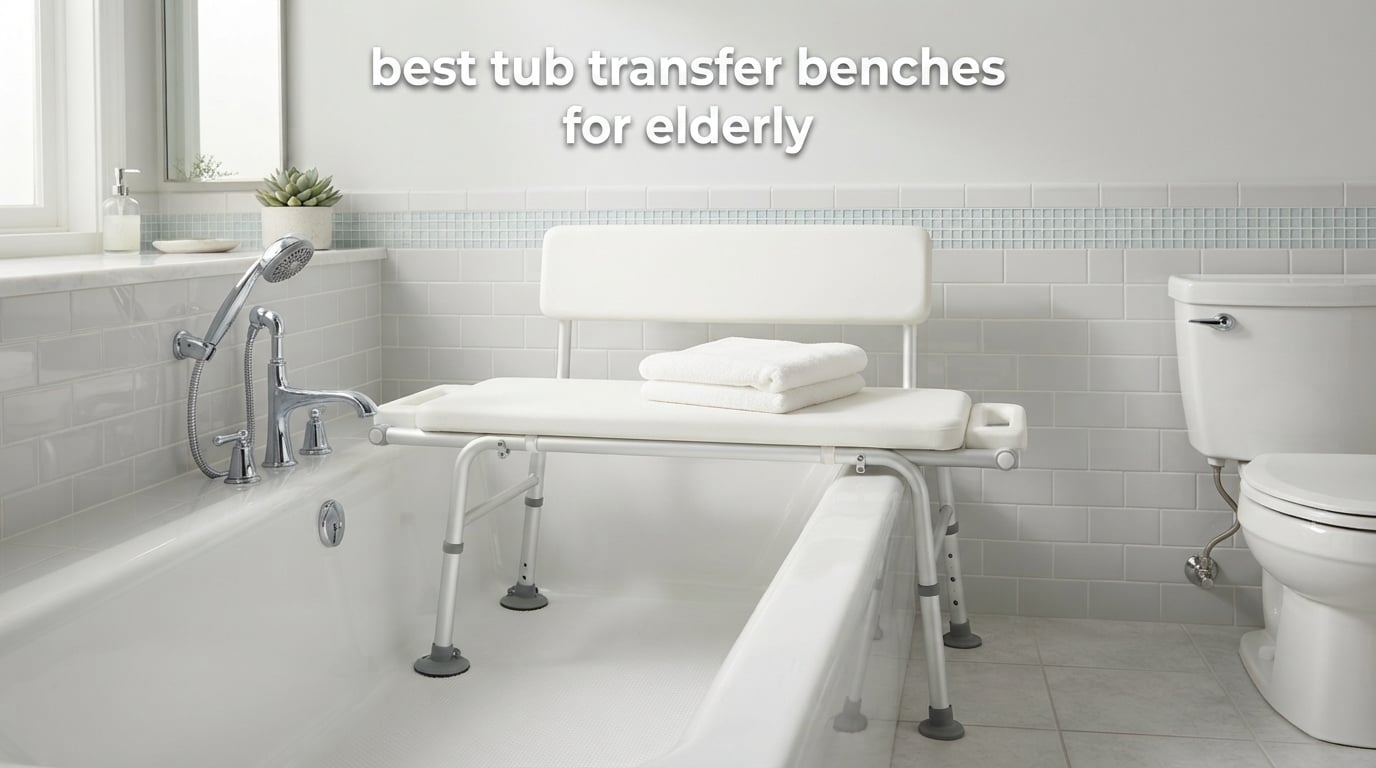
A tub transfer bench is a long, sturdy seat that straddles the bathtub wall, with two legs inside the tub and two on the bathroom floor, so an older adult can sit down outside the tub and slide across into it without ever stepping over a high tub edge. That single change removes the riskiest moment in bathing.
If you are shopping for the best tub transfer benches for elderly parents, you are probably doing it for someone who has had a fall, a hip or knee replacement, a stroke, or a slow decline in balance. The decision usually belongs to an adult child or a paid caregiver, and the questions pile up fast: will it fit, will it hold the weight, can they use it alone, will the bathroom floor stay dry.
Our team compared ten of the most-reviewed benches in this category, checking rated capacities, height ranges, seat dimensions, foot and suction systems, and the complaints that recur in verified buyer reviews. Ten is deliberate, because the category stratifies into distinct tiers and the wrong pick in a small bathroom simply will not work.
One thing no product page will tell you: the majority of people who buy a transfer bench cannot use it solo. On r/eldercare, one user wrote that their bench came second-hand and their hygiene aide still had to assist with every bath. On r/AgingParents another described the two-class mental model most buyers already have, one solid bench you scoot across and one whose seat pivots and slides. We answer both questions directly, and we flag which of the ten benches state clearly enough that a second person is expected.
If you are still deciding between product classes, our guide to transfer benches in general covers the other types of mobility seat, and we have a separate look at bathtub and shower combinations for bathrooms you may be remodeling.
This guide was last reviewed in October 2026. Nothing here is medical advice. If your loved one has a new diagnosis, a recent fall, or an upcoming surgery, ask an occupational therapist or a physician to assess their specific transfer needs before you buy.
Our Top 3 Tub Transfer Benches in October 2026
The three below are the picks we would hand to a family first, and each won its place for a different reason. The Medline is the safest default buy, the Platinum Health is the most capable mechanism in the group, and the Moen is the most stable on awkward tubs.

Medline Transfer Bench…
- 400 lb capacity
- 17.5-22 inch push-button height range
- Reversible backrest
- Tool-free assembly

Platinum Health Carousel…
- 90-degree locking swivel
- Medical-grade padding
- Flip-up locking armrests
- Seat belt included

Moen DN7105 Premium Transfe…
- 400 lb capacity
- Single wide pedestal leg
- 16.5-21 inch height range
- Limited lifetime warranty
10 Best Tub Transfer Benches in October 2026
This table lists every bench in the roundup with the three numbers that decide whether a product fits your bathroom: rated capacity, seat height range, and the product weight that affects whether a non-caregiver can move it. We sort the list by how often each model comes up in buyer feedback, not by marketing language.
| Product | Specs | Action |
|---|---|---|
| Medline Transfer Bench for Bathtubs and Showers |
|
Check Latest Price |
| Platinum Health Carousel Sliding Shower Chair |
|
Check Latest Price |
| Moen DN7105 Home Care Premium Transfer Bench |
|
Check Latest Price |
 DMI Tub Transfer Bench and Shower Chair DMI Tub Transfer Bench and Shower Chair |
|
Check Latest Price |
 Vive Heavy Duty Tub Transfer Bench Vive Heavy Duty Tub Transfer Bench |
|
Check Latest Price |
 Drive Medical Splash Defense Transfer Bench Drive Medical Splash Defense Transfer Bench |
|
Check Latest Price |
 Carex Universal Tub Transfer Bench Carex Universal Tub Transfer Bench |
|
Check Latest Price |
 HOMLAND Tub Transfer Bench with Backrest HOMLAND Tub Transfer Bench with Backrest |
|
Check Latest Price |
 TABEKE Tub Transfer Bench and Shower Chair TABEKE Tub Transfer Bench and Shower Chair |
|
Check Latest Price |
 Flash Furniture HERCULES Transfer Bench Flash Furniture HERCULES Transfer Bench |
|
Check Latest Price |
1. Medline Transfer Bench for Bathtubs and Showers, Aluminum, 400 lb Capacity
Medline Transfer Bench for Bathtubs and Showers, Adjustable Shower Bench and Bath Seat For Seniors and adults, Slip-resistant Feet, Heavy-Duty 400 lb. Weight Capacity, Tool-Free Assembly
400 lb capacity
17.5-22 inch seat height
Reversible backrest
12.6 lb
Pros
- Rust-resistant aluminum frame rated to 400 lb
- Push-button height adjustment across 17.5-22 inches
- Reversible backrest fits either side of the seat
- Slip-resistant feet plus wide suction cups inside the tub
- Tool-free locking push-button assembly
Cons
- Single fixed arm rest rather than two flip-up arms
- Backrest is fixed once the legs are set
We put the Medline at number one because it is the least likely purchase to disappoint in an ordinary bathroom. It is one of the highest-rated benches in this group at 4.6 stars across 7,487 reviews, and it does the ordinary things exceptionally well: the aluminum frame is rust-resistant, the height moves in clean push-button steps, and the backrest can be fitted to either side of the seat so it suits almost any tub layout.
The seat is 16 inches deep by 26.5 inches wide, which is wide enough that a user does not have to perch on the edge, and the listed height range of 17.5 to 22 inches covers a wide spread of users without requiring you to hunt for a taller model. Owners consistently mention that the feet resist slipping even with soap and conditioner on the floor of the tub, because the in-tub legs sit in wide suction cups.
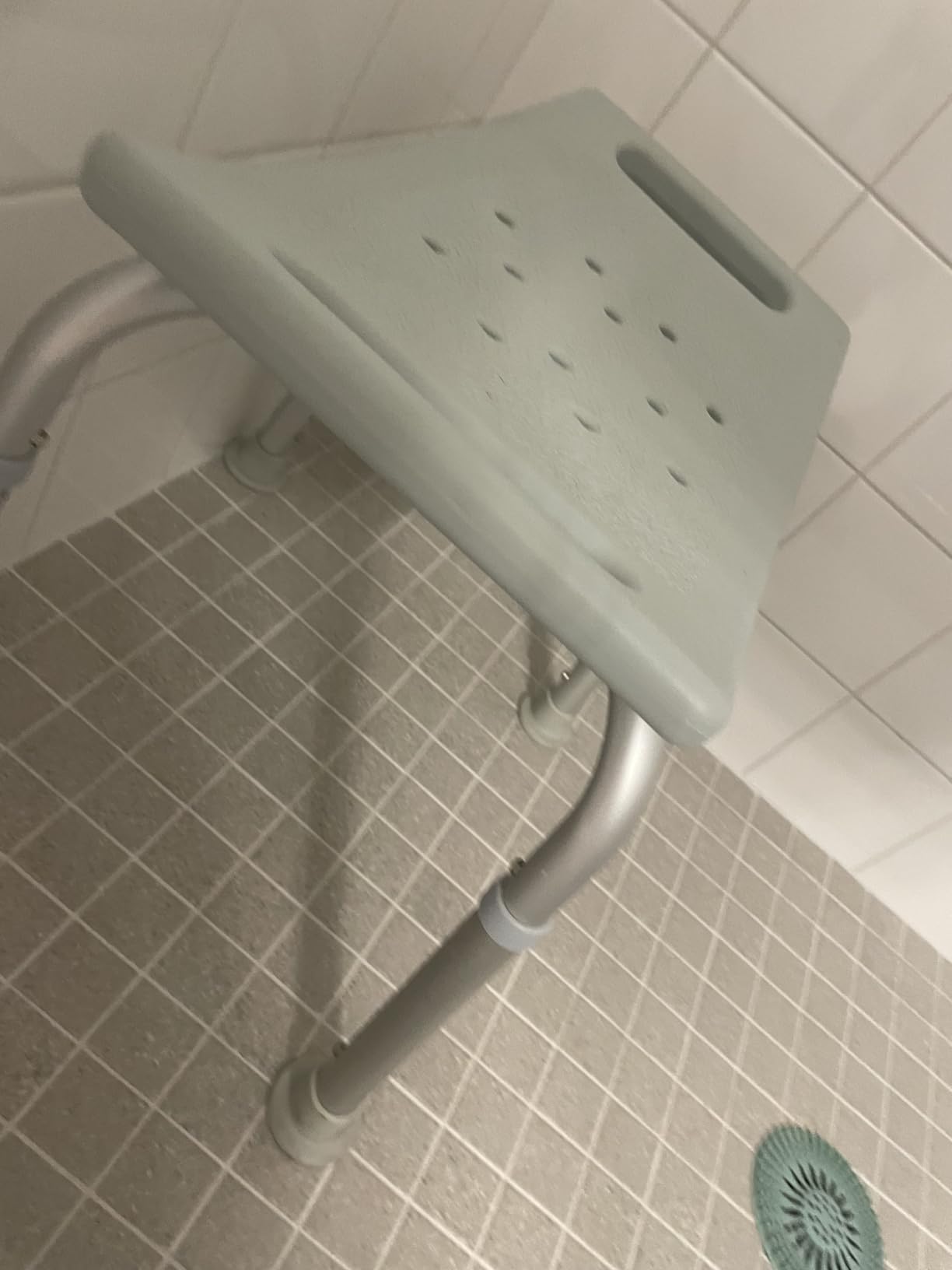
What stands out when reading the reviews is how few real complaints there are. A high-strength aluminum frame rated to 400 lb, a stationary arm rest that helps a user lower themselves and push back up, and tool-free assembly with locking push buttons that do not drift out of position. Several buyers mention that the backrest swaps sides in a couple of minutes rather than requiring a rebuild.
It is worth understanding the design limits before you commit. The single arm rest is fixed, so a user transferring laterally from a wheelchair does not have a flip-up arm to clear the way, which is exactly the situation many caregivers describe. The backrest is also fixed in height once the legs are set, so it does not follow the seat upward as a person grows more frail and slouched.
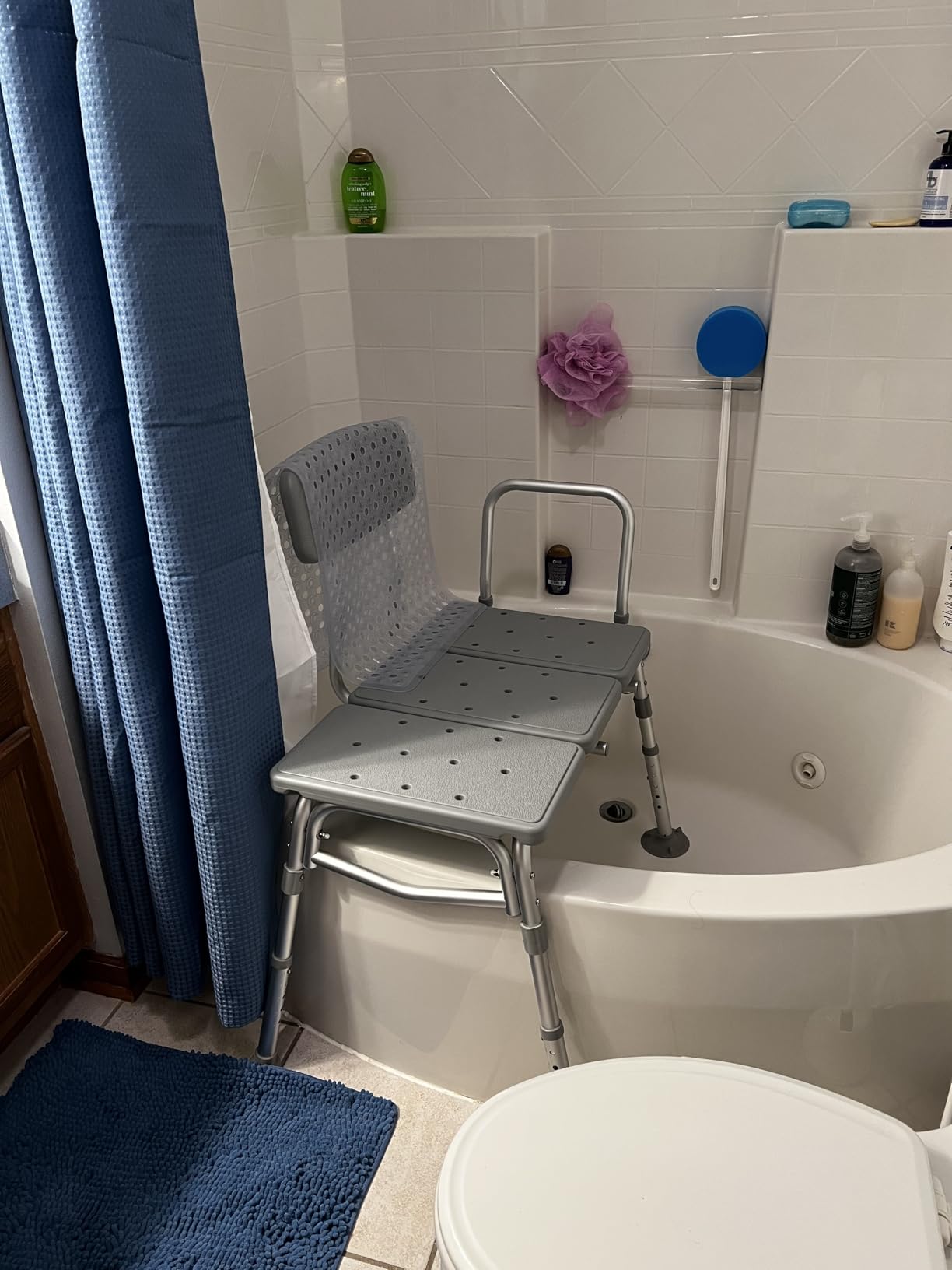
What to check before you order this bench
Measure your tub wall height and the distance from the tub to the nearest toilet or vanity. This bench needs 32 inches of width, and the outer legs have to land on floor that is clear, dry, and level enough to level the frame between the tub floor and the bathroom floor.
Then think honestly about whether a single arm is enough. If the transfer is a lateral move from a wheelchair, or if the user’s stronger side is the far side from the arm, you may want two arms. If the transfer is a careful step and sit, the fixed arm is a genuine benefit because there is nothing to knock over.
Where it falls short
The arm configuration is the main one, and it is the reason we did not place this as our only recommendation. Caregivers on r/AgingParents consistently ask whether the person can use the bench alone, and with one arm to push up from, a weak user will be slower and more dependent than with a two-arm model.
Roughly one in five five-star reviews in this category mention wanting more arm support, and that pattern applies here too. Nothing about the Medline is unsafe, but if your loved one needs a firm push-off point on both sides, look at a bench with flip-up armrests before you finalize the order.
2. Platinum Health Carousel Sliding Shower Chair Tub Transfer Bench with Swivel Seat
Platinum Health Carousel Sliding Shower Chair Tub Transfer Bench with Swivel Seat, Premium Padded, Pivoting Arms, Adjustable Space Saving Design for Tubs, Inside Shower, for Handicap & Seniors, Blue
330 lb capacity
19-34.5 inch overall height
90 degree swivel locks
20 lb
Pros
- Swivel seat locks every 90 degrees so the user can face the faucets and drain
- Medical-grade closed-cell padding on seat back and arms
- Flip-up locking armrests double as leverage points
- Protrudes far less into the bathroom than a fixed-seat bench
- Seat belt included
- Tool-free and light enough to move without help
Cons
- Solid seat with no perineal cut-out for seated washing
- Slide and swivel release lever sits on the right side
- 330 lb capacity is below the 400 lb standard here
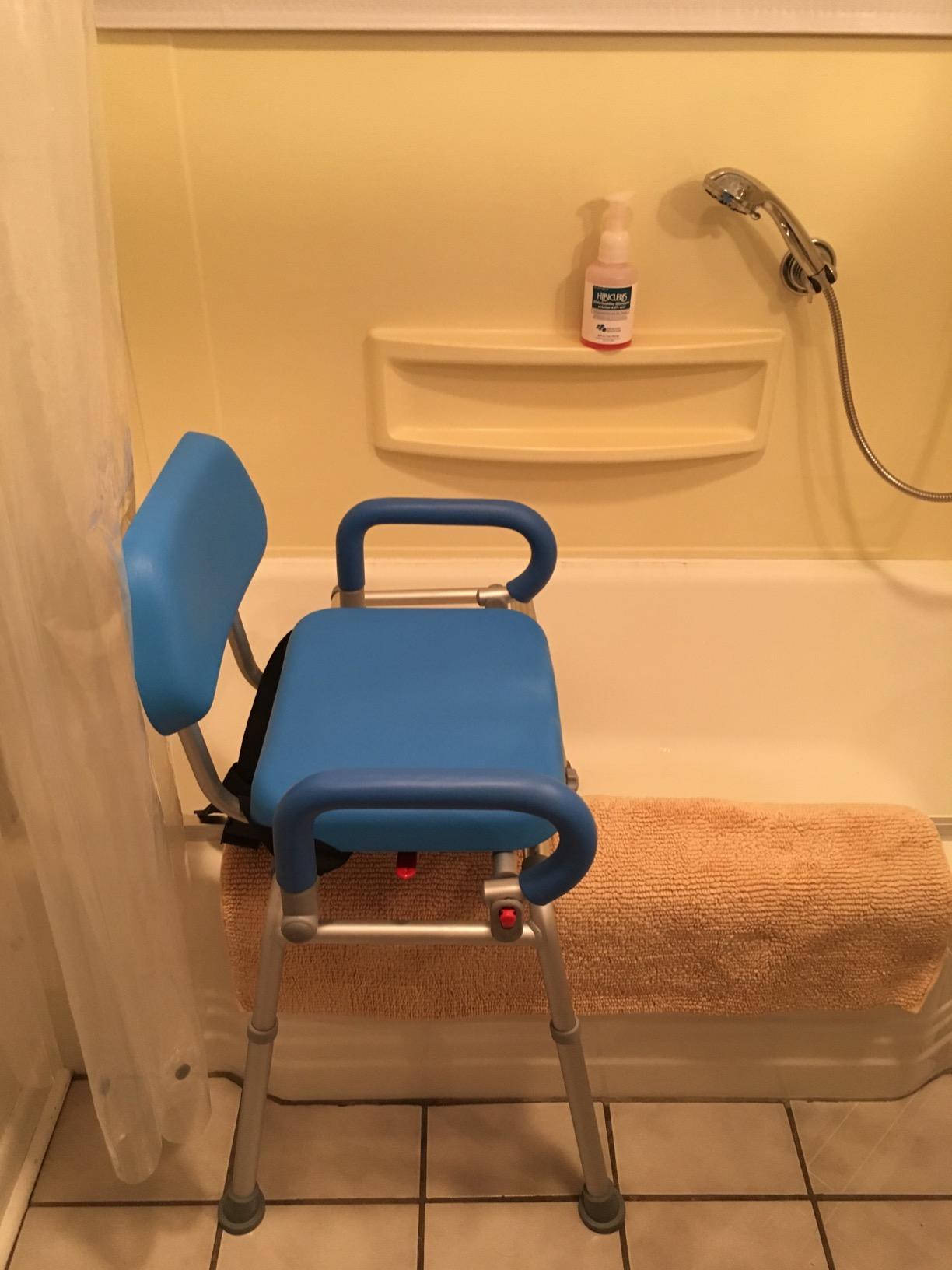
The Carousel is the only bench in this group with a locking 90-degree swivel built into the base model, and that changes how bathing actually feels. The user sits outside the tub, swivels to face away, slides across the rail into the tub, then rotates to face the faucets and drain. Owners recovering from stroke, multiple sclerosis, hip and knee procedures describe the swivel as the feature that gave them back independence in a small bathroom.
The padding is the second thing that separates it. Commercial-grade closed-cell polyurethane on the seat, back, and armrests feels warm under the hand, sheds water, and wipes down with disinfectant. For a user who is cold, or who has reduced sensation in the arms, a bare plastic seat is a genuine complaint we saw repeatedly on cheaper benches.
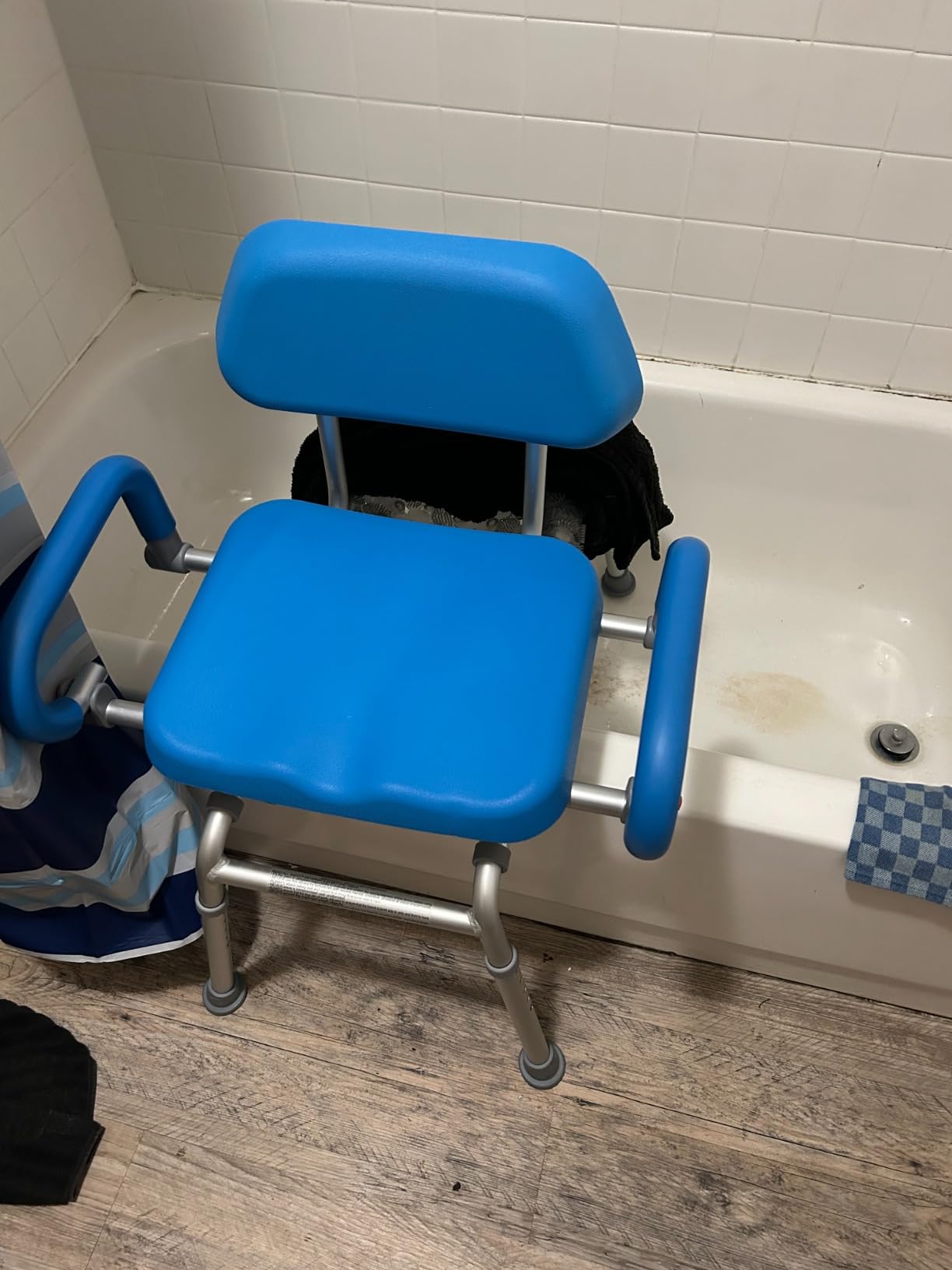
Mechanically this is the most considered design we reviewed. The legs adjust in half-inch increments so the frame can be leveled between two different floor heights and raised to clear a taller tub wall. Angled rubber feet rotate to match the contour of the tub, and the armrests are weight-bearing enough to be used as leverage points when sliding across.
It is also the only one here that protrudes minimally into the bathroom, which matters a great deal in a small space. The space-saving layout is the reason many buyers with tight bathrooms chose it over a fixed-seat bench, and it pairs well with a transfer bench curtain when water control matters.
What to check before you order this bench
Two things will disqualify it fast if you do not check them. The rated capacity is 330 lb, which is below the 400 lb carried by most of the field here, and the release lever for both slide and swivel is located on one specific side, which is a problem for a user with paralysis on that side.
Also check your tub depth. Deep soaker tubs need a separate leg extension kit, and a specialty transfer-bench shower curtain is usually needed to keep water off the floor because the seat is solid and low to the tub surface.
Where it falls short
The solid seat has no perineal cut-out, so a user with limited reach cannot wash while seated and needs a handheld shower or caregiver help. Combined with the one-sided release lever, that is the honest reason this is not our number one even though it shares the top rating in the group.
At 20 lb it is also the heaviest bench here, so if a non-caregiver needs to remove it between bathers, that is more of a lift. Our team awarded it our premium pick rather than best overall because the mechanism is more capable but the fit requirements are stricter.
3. Moen DN7105 Home Care Premium Tub Transfer Bench
Moen DN7105 Home Care Premium Tub Transfer Bench
400 lb capacity
16.5-21 inch seat height
Single pedestal leg
Lifetime warranty
Pros
- Single wide pedestal leg outside the tub resists tipping
- Stays stable on sloped tub bottoms where other benches wobble
- Each inner leg adjusts separately for leveling
- Wide 33 inch seat with a rounded end
- Integrated grab handle and cup holder
- Back and handle can be fitted on either side
Cons
- No drainage holes so water pools on the seat
- Single wide outside leg fights a standard shower curtain
- Handle can only be fitted on one side at assembly
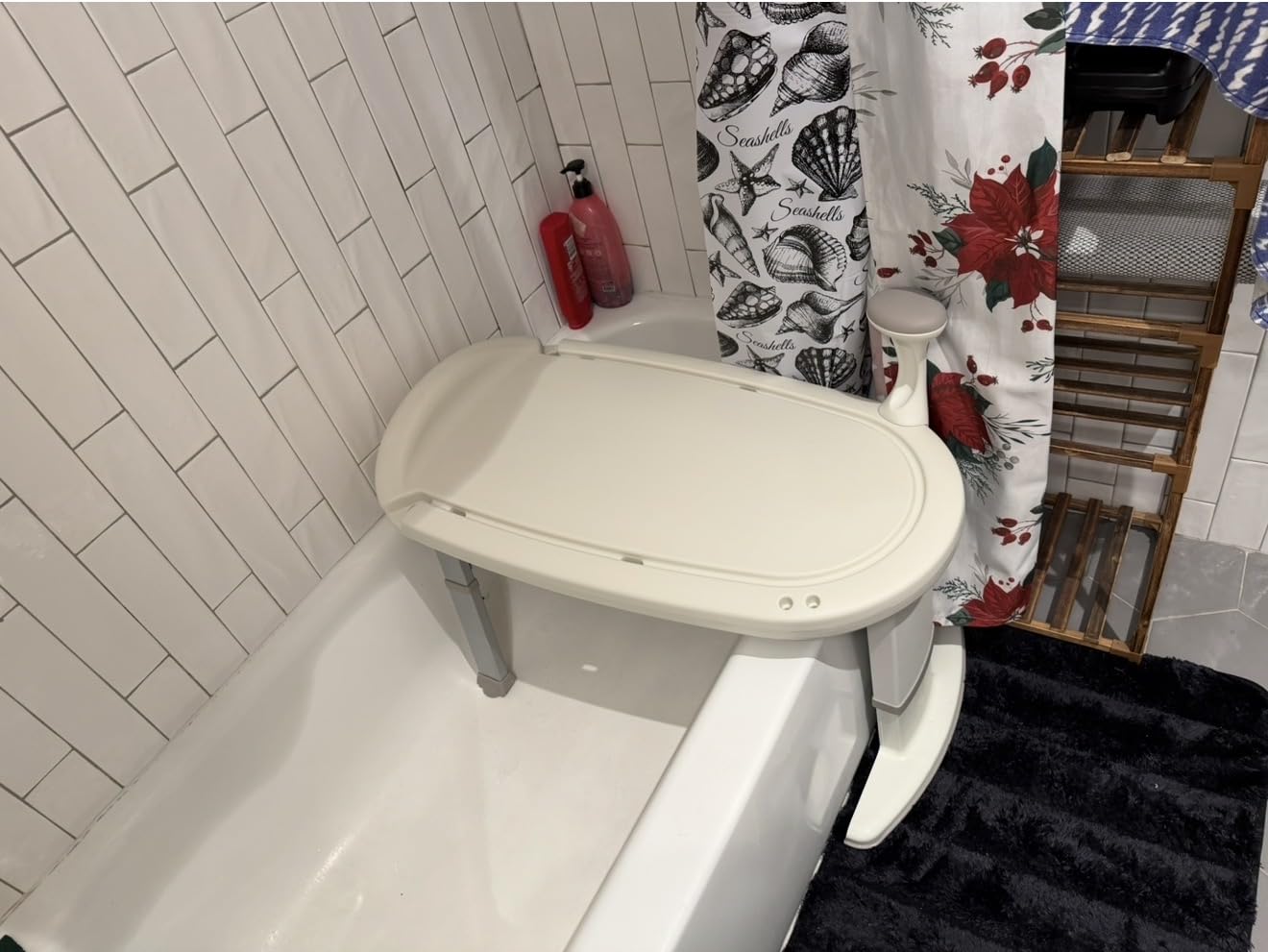
The Moen solves a specific problem that the other four-legged benches cannot: tub bottoms that slope. Instead of four independent legs, it uses a single wide pedestal leg outside the tub, and owners repeatedly report that it will not rock or tip even on a badly sloped tub floor. One of the longest review histories in this category, with owners citing eight years or more of use, supports that claim.
It is also the widest seat we reviewed at 33 inches, with a rounded end that makes sliding across feel less like a balancing act. The integrated grab handle gives a solid push-off point for exiting, and the built-in cup holder with a removable receptacle for a handheld shower head is a thoughtful detail that most competitors skip.
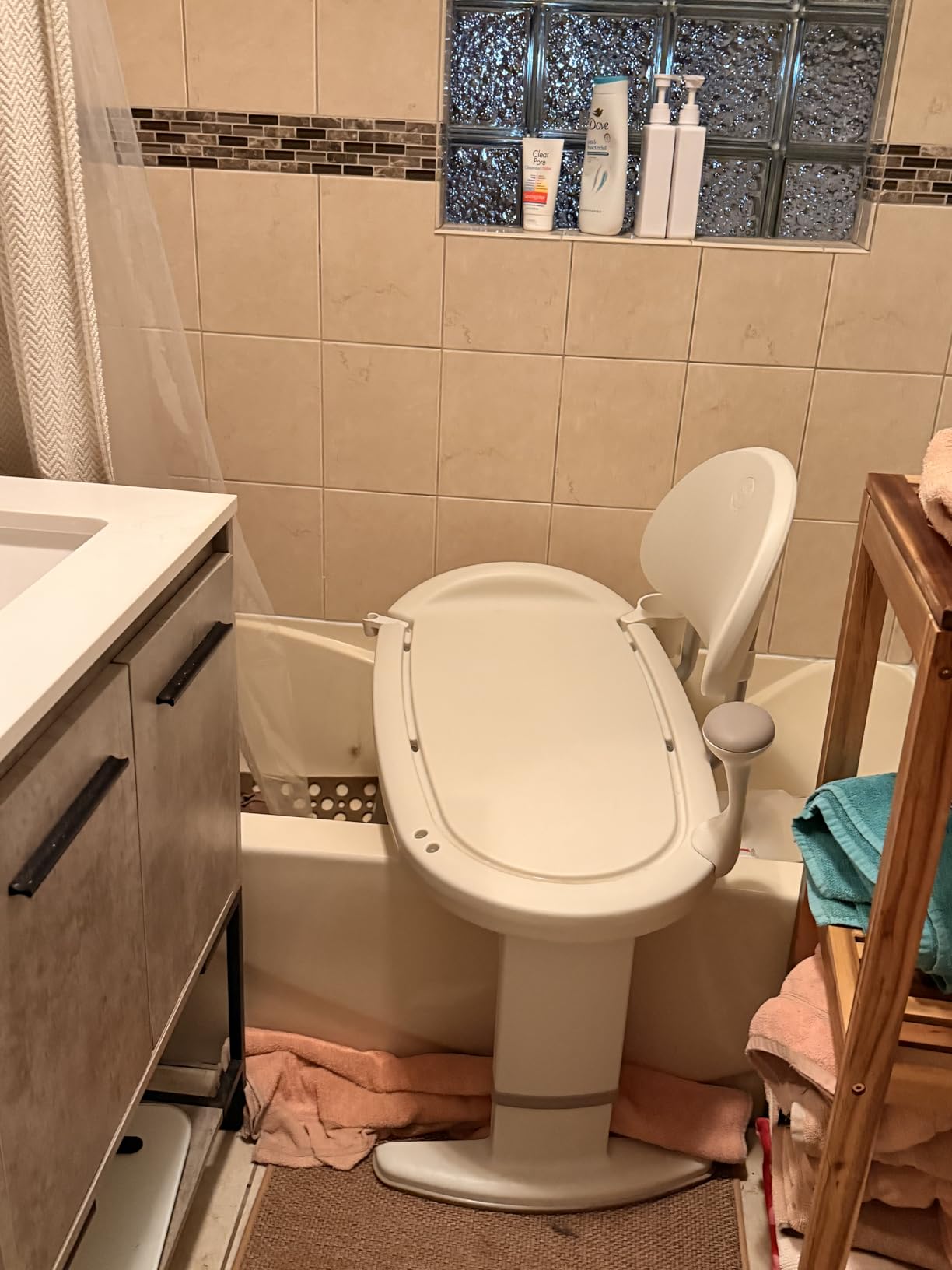
This is a Moen product with a limited lifetime warranty, and the styling is deliberately non-institutional, which matters when the bench stays in view in a bathroom used by the whole family. The seat height runs from about 16.5 to 21 inches, the material is a high-density polyethylene seat and back on aluminum legs, and the feet are thermoplastic rubber.
It has been on sale since long before most of this roundup existed, and the long tenure is itself a signal. Products that survive a decade of daily wet use are worth paying a little more for than a disposable-looking alternative.
What to check before you order this bench
Measure the height of your tub wall from the floor. This bench adjusts from about 16.5 to 21 inches, and at full extension the legs may not reach the floor of a high-walled one-piece tub and shower unit. If your tub wall is tall, this is the wrong shape of product.
Look at how your shower curtain will work. The single wide outside leg is hard to work around with a standard curtain, so water tends to end up on the bathroom floor. If the toilet sits close to the tub, the outer handle position and leg can impede entry and exit.
Where it falls short
The seat has no drainage holes, so water pools on the surface, and two small holes can remain open at the outer edge depending on assembly orientation with no plugs supplied. The handle can only be fitted on one side when you build it, and if you assemble it facing the wrong way for the user’s weaker side, that is a problem you cannot correct later.
At 17.2 lb it is not easy to lift in and out of the tub, and the adjustment buttons are stiff. For a household where the bench has to be moved for other bathers, that is a real daily friction.
4. DMI Tub Transfer Bench and Shower Chair with Non Slip Aluminum Body
DMI Tub Transfer Bench and Shower Chair with Non Slip Aluminum Body, FSA Eligible, Adjustable Seat Height and Cut Out Access, Holds Weight up to 400 Lbs, Bath and Shower Safety, Transfer Bench
400 lb capacity
19-23.5 inch seat height
Sliding seat
10.7 lb
Pros
- Largest review base in this roundup at 8260 ratings
- Sliding rail lets a user move from a wheelchair into the tub
- Textured seat stays secure when wet with drainage holes
- Safety belt and strap locks hold the seat in place
- Configurable for either side install
- Tool-free assembly
Cons
- Perineal cut-out cover sits loosely and tends to pop up
- Only about a third of the seat is usable outside the tub
- No grab handle on the outside edge for seating
The DMI has the largest review base we found, 8,260 ratings, and that matters in a category where a bad mechanism can fail in wet conditions over years. At 4.2 stars it is not the highest rated, but the volume of long-term feedback is more informative than a small, perfect score, and the recurring feedback is about layout rather than failure.
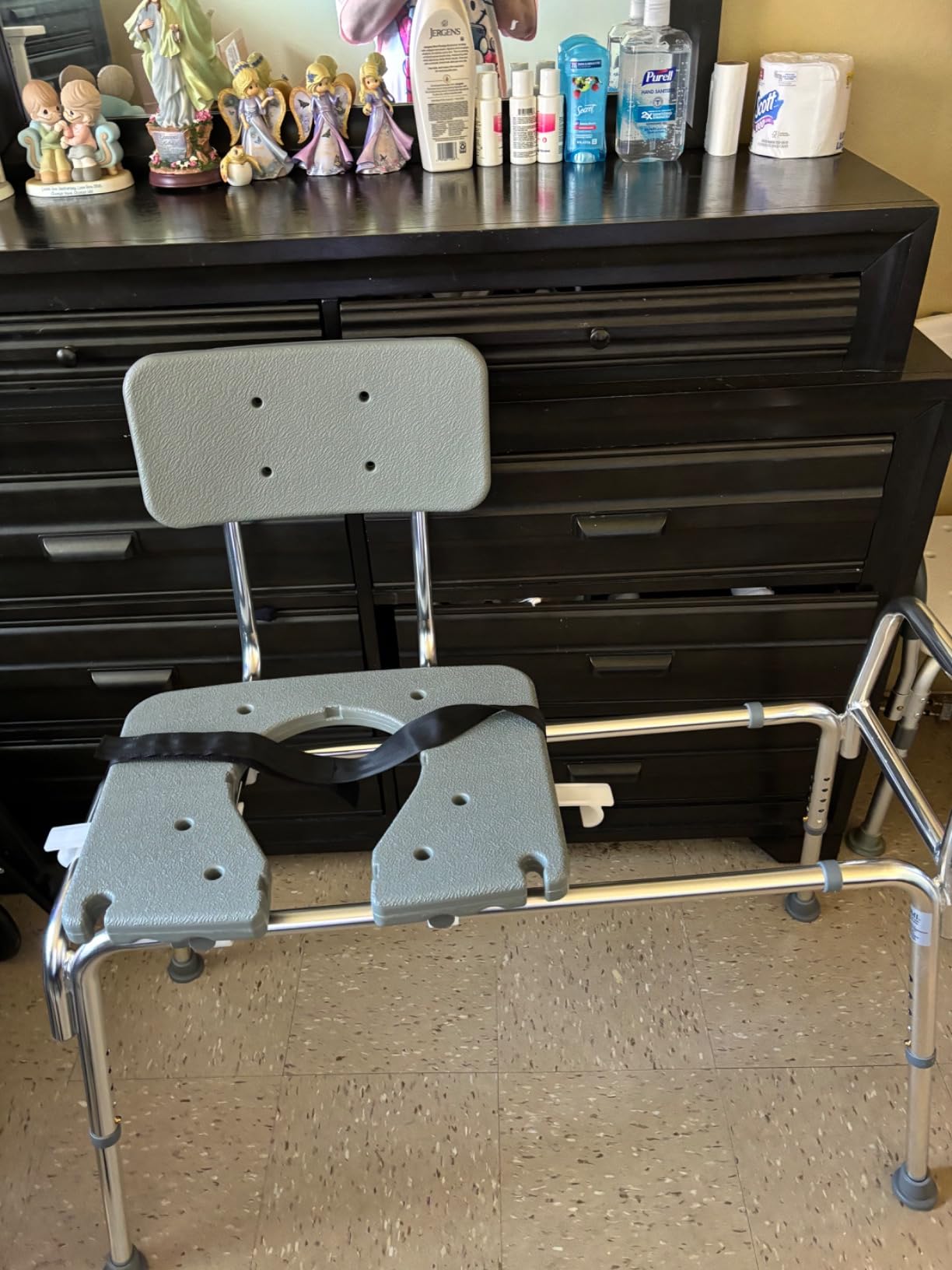
The sliding rail is the point of this bench. The user sits on the floor-level end outside the tub and slides along the rail into the tub with minimal strain, which is the mechanism many people mean when they say they want a sliding transfer bench. A hook-and-loop safety belt and nylon strap locks hold the seat in position once it is over the tub.
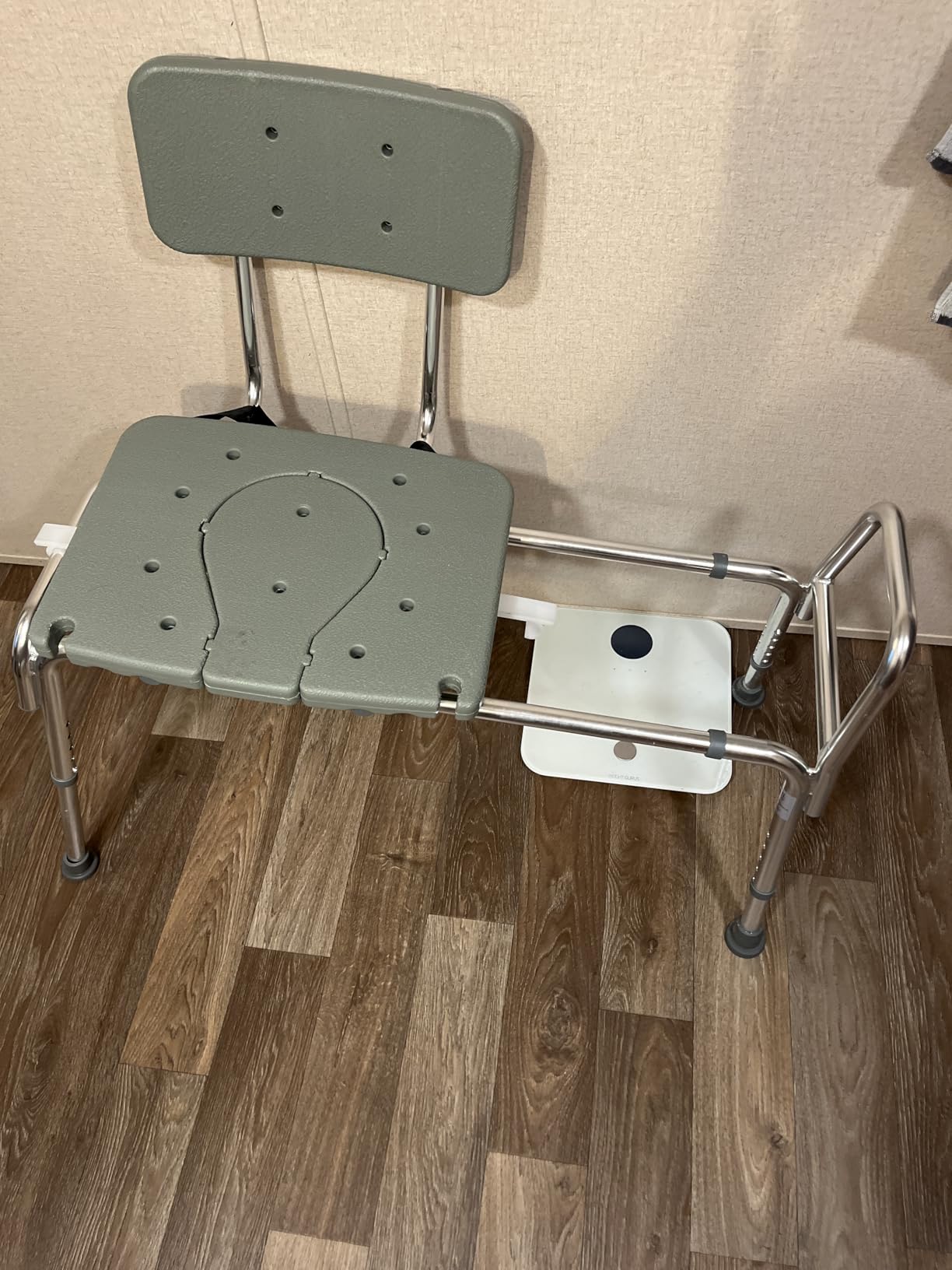
Adjustment happens through two rows of offset buttons on the legs, which makes leveling between the tub floor and the bathroom floor easier than single-row leg buttons. The seat is 19 inches wide by 14.5 inches deep, the whole unit is 10.7 lb, and the frame is a rust-resistant aluminum body with a blow-molded plastic seat and backrest.
One user on r/AgingParents singled this model out as easy to put together and adjust, and specifically said it was ideal to have their mother in the bathroom during setup so they could test the fit. That is exactly the approach we recommend to anyone buying for an elderly parent.
What to check before you order this bench
Check the total footprint, which is 39 inches wide. That is the largest span in this roundup, and in a small apartment bathroom or a narrow tub it can be the reason a bench simply will not work. The height range of 19 to 23.5 inches is also the highest minimum in the group, so a shorter user may end up sitting too high.
Think about who helps with transfers. The main handle is on the inside of the tub only, so there is nothing on the outside edge to hold onto while lowering yourself into the seat, and the slide-lock latch can be hard for a frail user to lift over the rail.
Where it falls short
The removable perineal access cover is the most repeated complaint in the reviews. It sits loosely and tends to pop back up when a user settles, and with the cover removed, only about a third of the seat remains usable outside the tub, which makes it awkward for a small, frail person who has to scoot into position.
The backrest also sits further back than some users like, and at 10.7 lb the frame feels light duty rather than heavy duty when you push on the rail. If the user is very small, or if seated washing is a requirement, the cover behaviour is worth thinking through before you commit.
5. Vive Shower Bench for Transfers, Heavy Duty Tub Transfer Bench for Bathtub
Vive Shower Bench for Transfers – Heavy Duty Tub Transfer Bench for Bathtub
400 lb capacity
Adjusts up to 23.5 inches
32 x 24 inch base
30 drainage holes
Pros
- Dual column extension legs reach 23.5 inches
- taller than most competitors
- Molded seat with 30 drainage holes prevents puddling
- Large suction cup caps stop the bench sliding in a smooth tub
- Reversible arm and backrest suit either tub side
- Fits small bathrooms including an 8 by 5 foot space
- Arrives partly assembled so setup takes ten minutes or less
Cons
- Outer legs extend past the seat so a toilet or cabinet can limit placement
- Assembly instructions are unclear and a pin can arrive dislodged
- Strong suction cups resist breaking loose when repositioning
The Vive is the tallest-adjusting bench in this roundup, with dual column extension legs that reach 23.5 inches. That single fact makes it the pick for anyone tall, or for a user who measures closer to 6 foot than 5 foot, because every other bench here tops out lower and would leave their knees raised uncomfortably.
It also scores 4.6 stars, and the reviews skew toward post-surgical users recovering from knee or foot procedures where leg extension is the priority. The stainless steel frame carries a molded plastic platform seat with 30 drainage holes, which is the most thorough drainage we saw in this group.
Two details set it apart for small bathrooms. The frame is reversible for the arm and backrest, so it can be configured for either side of the tub, and owners specifically report that it fits comfortably in a space as tight as 8 feet by 5 feet. The base measures 32 inches wide by 24 inches deep, which is compact for a 400 lb bench.
It also carries a two-year unconditional guarantee and is HSA and FSA approved, which matters if you are paying from a health account rather than out of pocket.
What to check before you order this bench
Look at what sits next to the tub. Because the outer legs extend beyond the seat edge, a toilet or a vanity in the way can limit where the bench can be placed at all, and unlike a compact-footprint bench you cannot tuck the legs out of the way.
Check your tub wall height against that 23.5 inch maximum as well. A high bench needs a high wall to clear, and if the frame is set too high the user cannot get their feet flat on the tub floor, which is a stability problem rather than a comfort one.
Where it falls short
The instructions are the weak point. Some owners report a brass pin and spring arriving dislodged inside a leg tube, and the assembly sequence is not clearly illustrated. Budget a careful ten minutes rather than assuming a quick setup, and check the parts list before you throw the box away.
The large suction cup caps inside the tub hold extremely well, which is exactly what you want when someone is transferring, and exactly what you do not want when you need to move the bench. Owners report real difficulty breaking the cups loose to reposition the unit.
6. Drive Medical Splash Defense Tub Transfer Bench, Adjustable Height
Drive Medical Splash Defense Tub Transfer Bench, Adjustable Height, White
400 lb capacity
0.5 inch height increments
Curtain channel cut-out
Tool-free setup
Pros
- U-shaped cut-out and curved bars let the shower curtain close inside the tub
- Wide suction cups hold the bench very firmly in place
- Pinch-free lever system removes the risk of finger injury
- Dual column extending legs level between tub and floor
- Stabilizing backrest and reversible design
- Tool-free assembly
Cons
- Curtain channel bars sit too low to clear a standard tub wall
- Wide bench is a tight fit in smaller tubs
- Limited height range makes leveling on a tall tub difficult
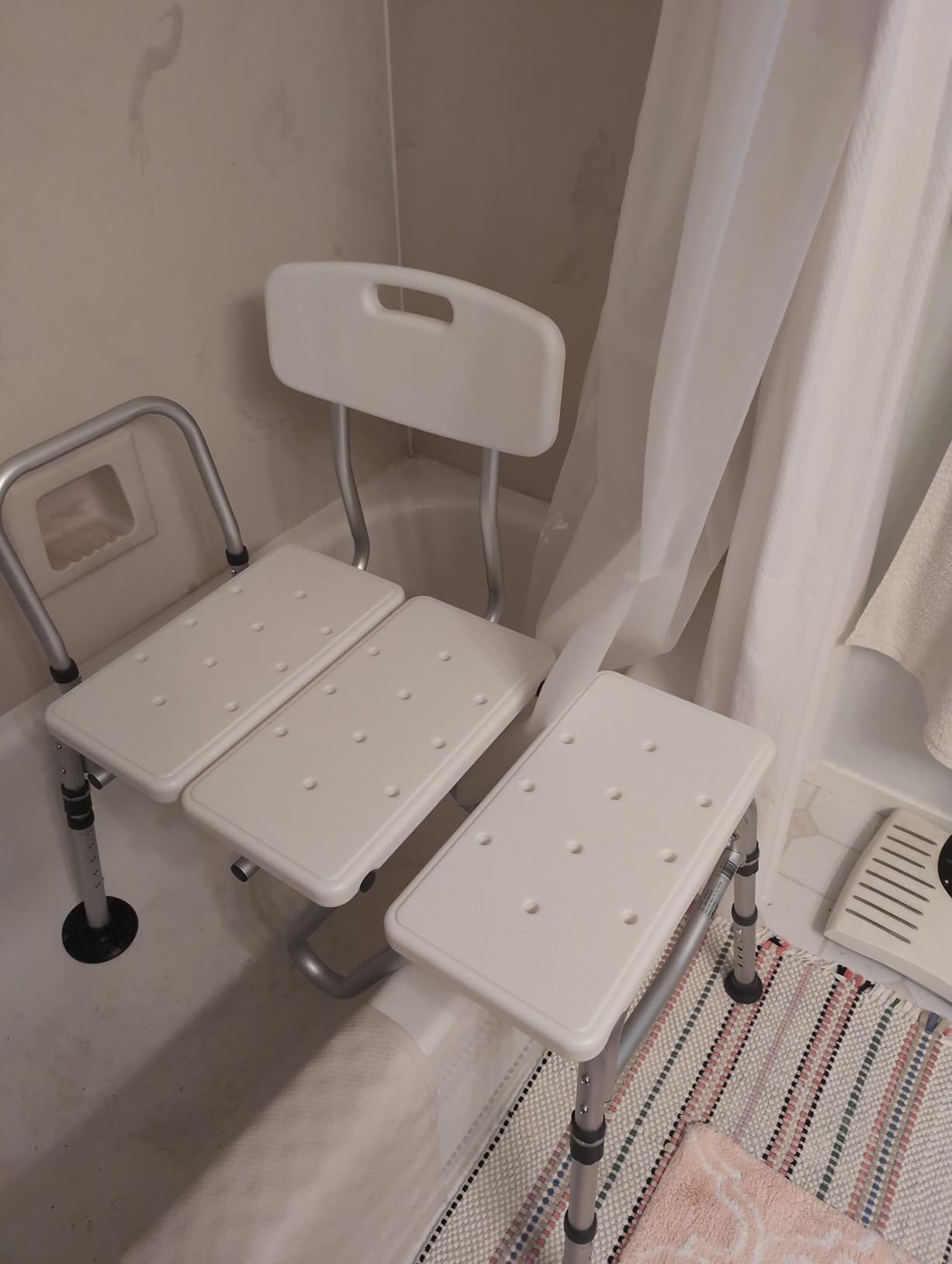
Water on the bathroom floor is the most common complaint in every review of every sliding bench, because a standard shower curtain simply cannot close around a bench that straddles the wall. The Drive Medical Splash Defense is the only design here with a dedicated channel for it, using a U-shaped cut-out and curved bars that let the curtain run through and close inside the tub.
Owners describe it as the only bench that kept water off the floor in their bathroom, and in a bathroom shared by a senior and a family, that is a safety issue rather than an aesthetic one. A wet tile floor next to a mobility aid is a slip hazard every time someone else walks through.
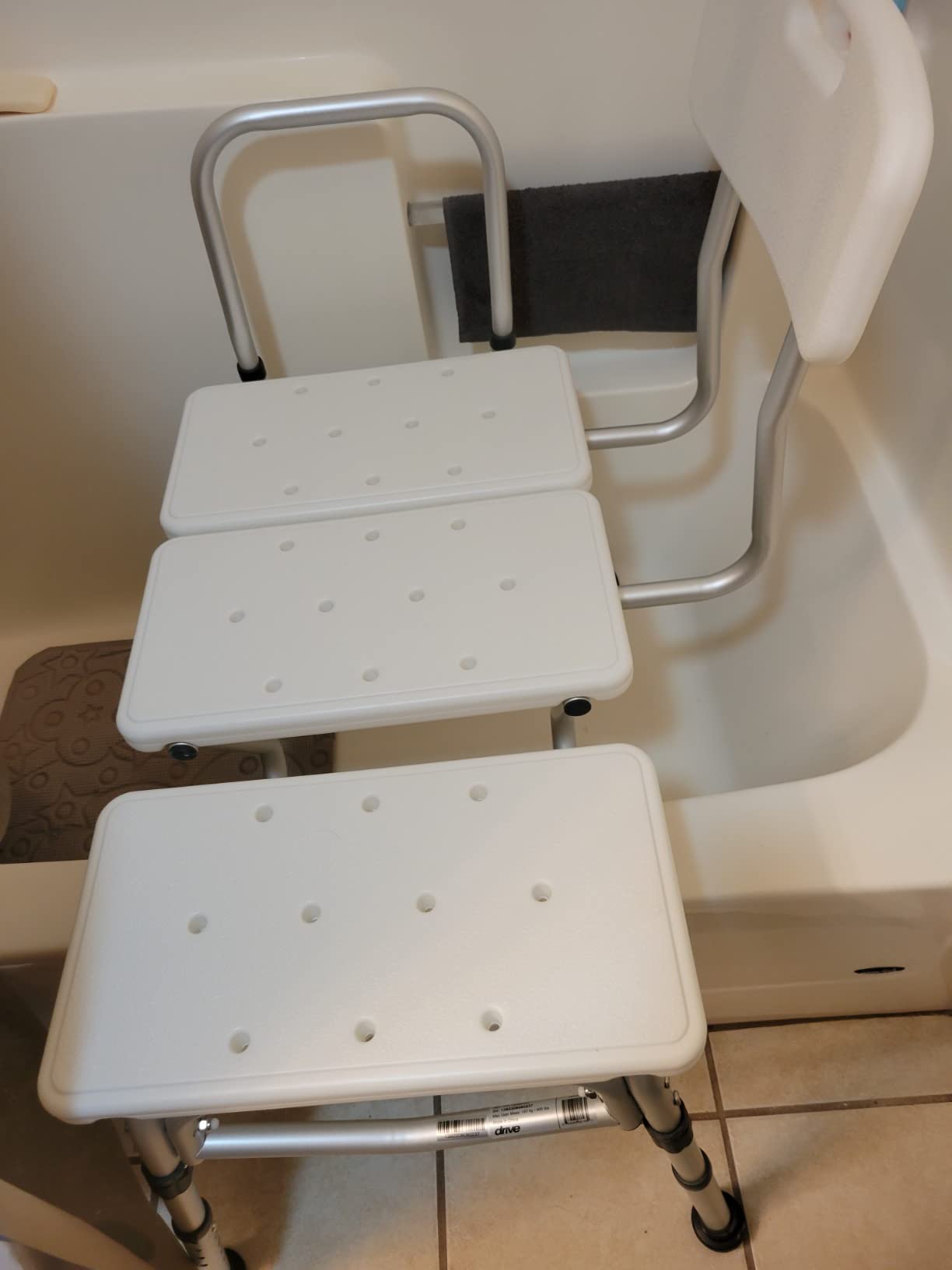
The second thing to like is the pinch-free lever system. Height adjustment runs in 0.5 inch increments on dual column extending legs, and the lever design removes the finger-crush risk that comes with spring-button legs. Several owners mentioned that as the reason they chose it, having pinched fingers on a different model.
The bench is 400 lb rated, weighs 12.7 lb, arrives nearly assembled, and the wide suction cups on the tub legs hold so firmly that the unit barely moves when pushed, which is reassuring during a transfer.
What to check before you order this bench
Measure the height of your tub wall, and this is the decisive number. The curtain channel bars are low enough that they only clear a low-profile or roll-in tub. If your tub has a standard or tall wall, the feature that makes this bench special simply will not engage, and you are left with an ordinary bench plus extra hardware.
Then check tub width. At 28 inches long by 16 inches deep with drop-down loops, it is a tight fit in a smaller tub, and owners report the loops can hit the front tub edge as the frame flexes under load.
Where it falls short
It is a specialized fit rather than a general-purpose one. The height adjustment range is limited compared with the Vive, so leveling on a tall tub is difficult, and the rods can be too long for a small bathroom, which complicates repositioning the backrest after assembly.
Our team still recommends it, but honestly. If your tub wall is low and your household includes someone who walks barefoot on a wet floor, this is the one. If you have a standard-height tub, choose one of the other nine and manage the curtain instead.
7. Carex Universal Tub Transfer Bench, Bath Seat with Backrest
Carex Universal Tub Transfer Bench, Bath Seat with Backrest, Shower Chair for Elderly and Disabled, Transfer Bench & Shower Seat for Bathtub with Adjustable Legs, Converts to Right or Left Hand Entry
400 lb capacity
All-plastic build
14.51 lb
Converts to either side
Pros
- Entirely plastic construction with no metal parts to rust or corrode
- Holds 400 lb in a compact footprint
- Backrest with two built-in handles makes positioning easier
- Converts for either right-hand or left-hand entry
- Disassembles quickly for storage or travel
- Tool-free exact-level leg adjustment
Cons
- All-plastic frame may flex more than aluminum under heavy use
- No dedicated shower head holder or grab handle on the seat side
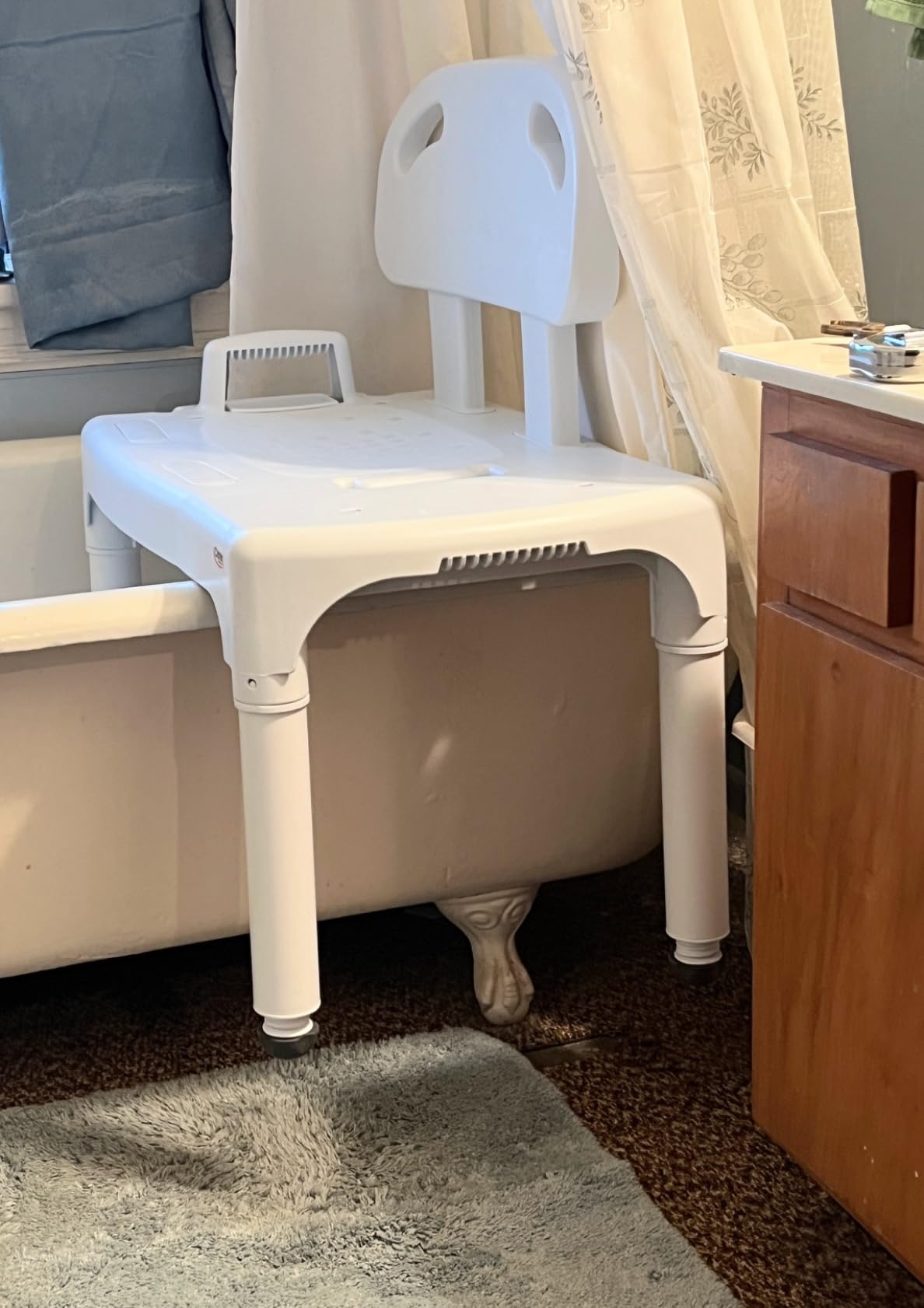
If your bathroom is permanently damp, or you live somewhere with hard water, the Carex is the interesting pick. It is built entirely of plastic with no metal parts anywhere, so there is nothing to rust or corrode. That single design decision removes the most common long-term failure in this category for good.
It is also one of the longest-standing products here, listed since 2004, and that longevity tells you something. Buyers highlight the built-in handles on the backrest, which give a place to grip during positioning, and the reversible entry conversion that lets it suit either side of the tub.
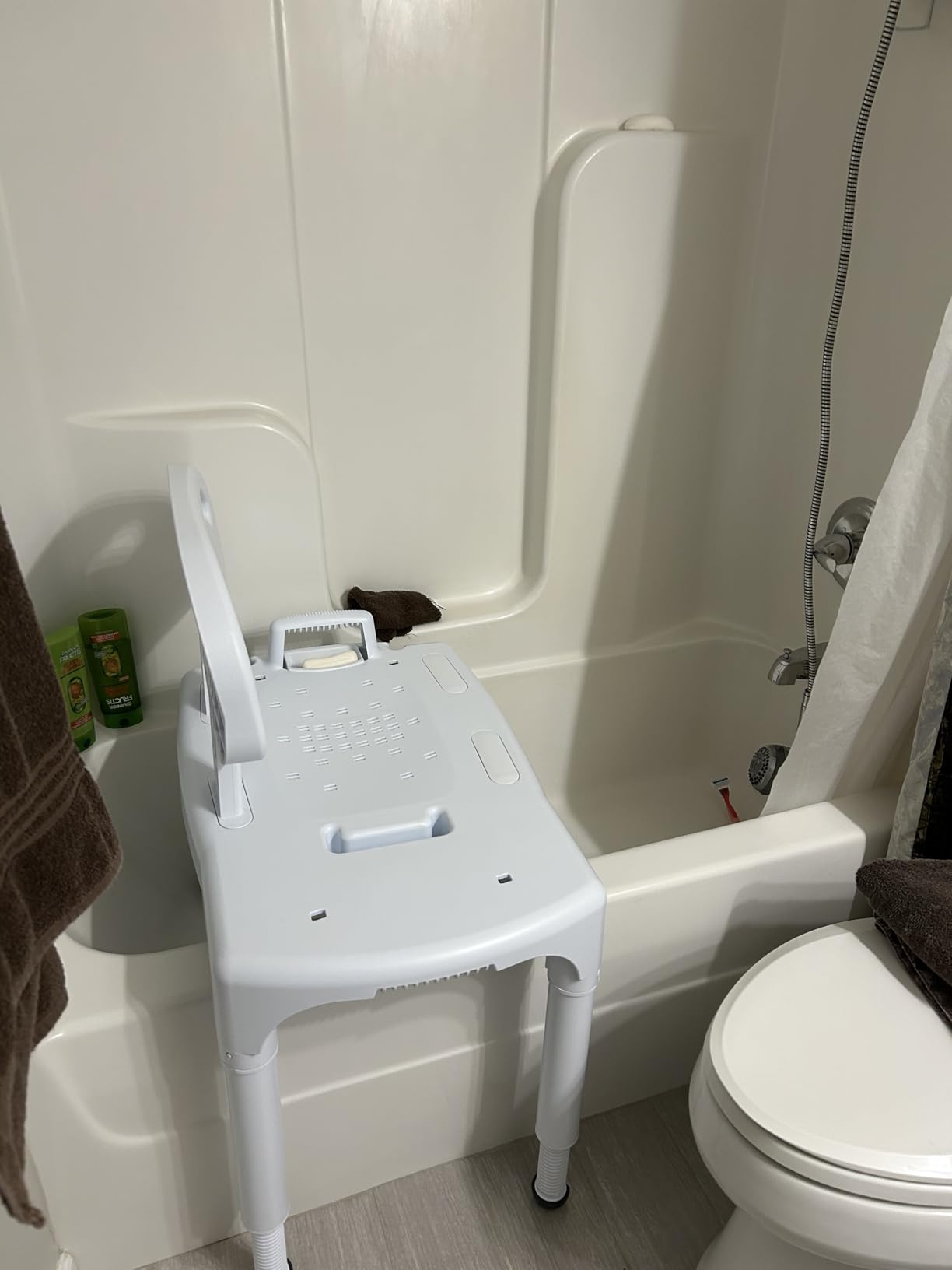
It holds 400 lb in a compact 19.02 by 29.76 by 32.99 inch footprint, which is one of the smaller spans in the roundup, and it disassembles quickly for storage or travel. That matters in a bathroom where a bench needs to disappear between baths, or in a holiday home used only a few weeks a year.
The height adjustment is tool-free and precise, letting you level each leg exactly, which is a genuine advantage on a tub floor that is not flat.
What to check before you order this bench
Check the total width against your bathroom. At roughly 29.76 inches, it is narrower than most of the group, so it is a good candidate for a tight bathroom where a 39 inch model would never fit.
Think about whether the user needs grip points. There is no dedicated shower head holder and no grab handle on the seat side, so if your loved one baths with a handheld shower, plan where that will live before you assemble.
Where it falls short
The trade-off for a metal-free frame is rigidity. Some users report a flex or spring under load that aluminum competitors do not have, and that matters most for a bariatric user or anyone transferring with a caregiver applying weight to one side.
The second limitation is padding. This is a hard plastic seat, and users with reduced sensation or arthritic hands report it feels cold and slippery compared with a padded bench. Adding a thin non-slip cover is the usual fix, provided it does not bunch under load.
8. HOMLAND Tub Transfer Bench with Backrest for Bathtub, Height Adjustable
HOMLAND Tub Transfer Bench with Backrest for Bathtub, Height Adjustable
400 lb capacity
17.5-22.5 inch height
Thicker aluminum A-frame
Reversible back
Pros
- Sturdy A-frame structure in thicker aluminum tubing than standard models
- Non-slip rubber feet grip wet surfaces
- Push-button height adjustment from 17.5 to 22.5 inches
- Reversible backrest switches sides for different layouts
- Drainage holes in the seat prevent water buildup
- Light enough to move between baths at a 400 lb rating
Cons
- Lower overall height with backrest at 30.12 inches than many competing benches
- Replacement parts only supplied if hardware is missing from the box
The HOMLAND is the pick if you are unimpressed by the tubing on other benches in this price range. It uses an A-frame structure in thicker-gauge aluminum than typical, and owners consistently note the difference in how solidly it feels under load compared with spring-button benches at the same rating.
At 4.5 stars across 995 reviews it holds a strong category rank, and the feedback is unusually clean. Buyers point to the non-slip rubber feet, the drainage holes in the seat, and the reversible backrest, with few complaints beyond the backrest height.
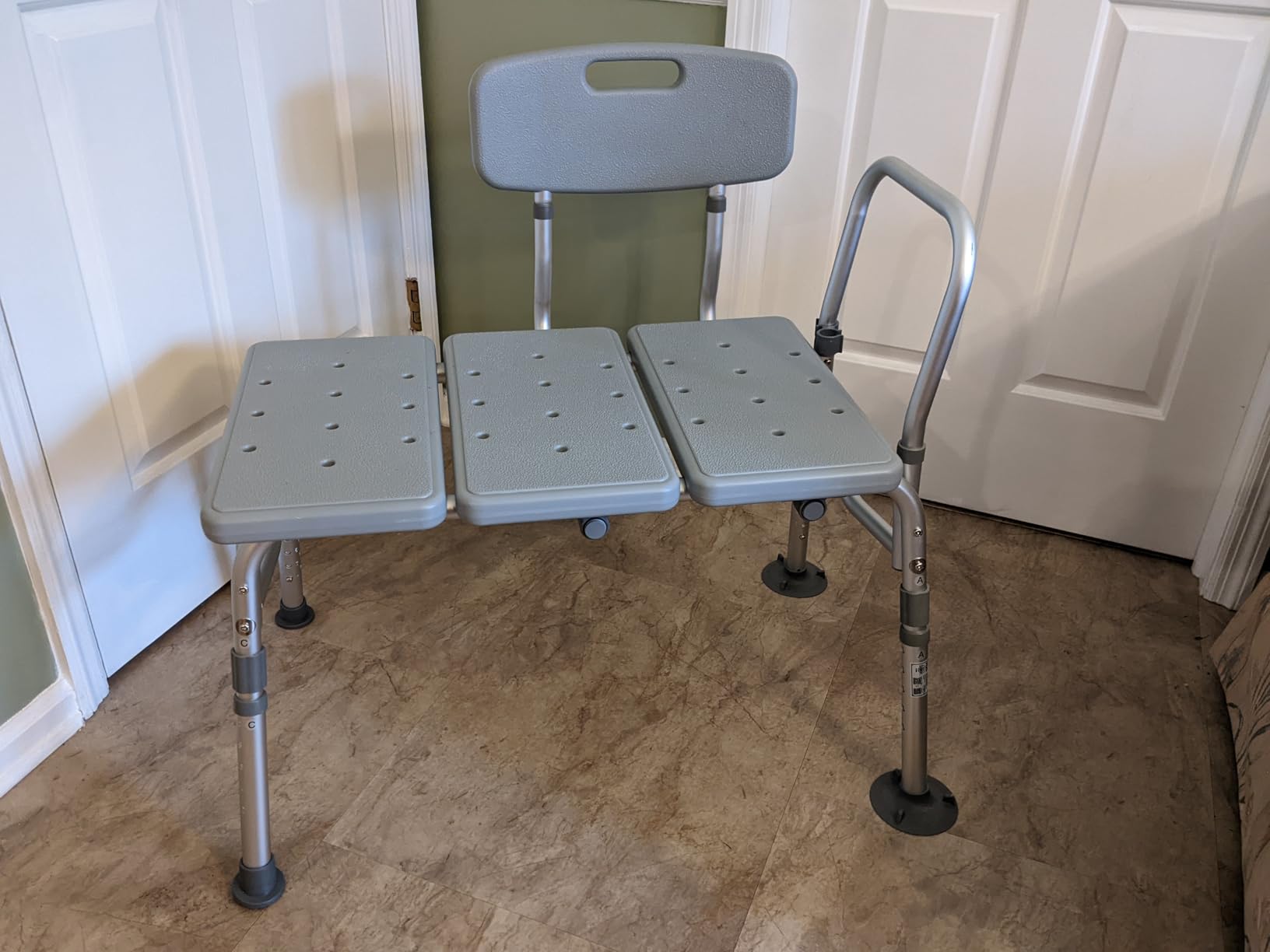
The seat measures 16.14 inches deep by 27 inches wide and adjusts from 17.5 to 22.5 inches, so the range is comparable to the Medline at the top end and slightly taller. The unit is light enough to move between bathrooms without help, which is unusual for a 400 lb rated frame.
A button-lock design keeps assembly quick, and the manufacturer will replace parts if hardware is missing from the package rather than only on a warranty claim, a small thing that reduces the risk of a box arriving incomplete.
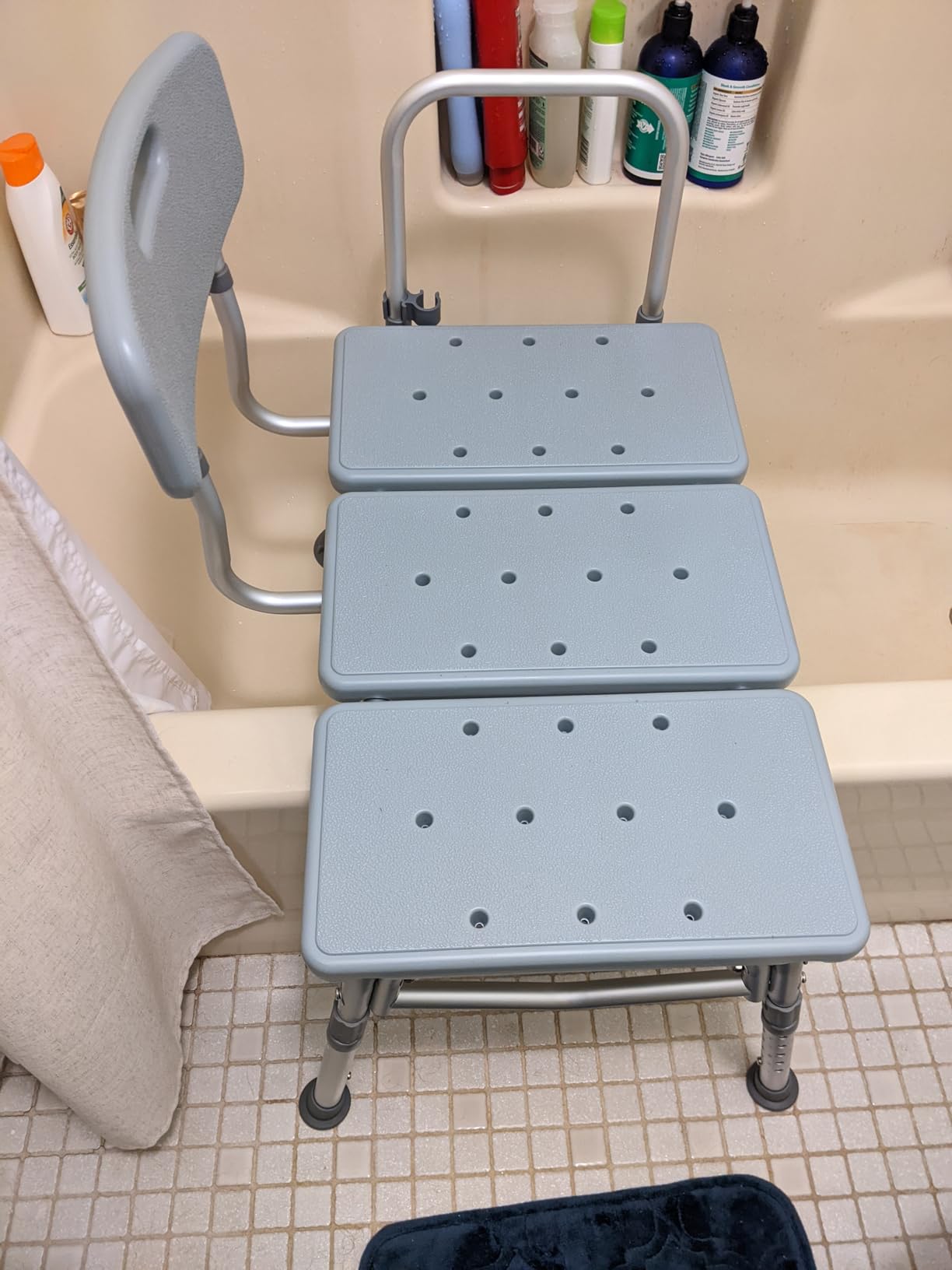
What to check before you order this bench
Measure overall height against your user. With the backrest, the unit stands 30.12 inches, which is shorter than several competitors in this roundup, so a taller user gets noticeably less back support than they would on a taller frame.
Check the 32.3 inch width and 22.4 inch depth against your bathroom. It is a reasonable footprint, but not the smallest here, so a very tight room may rule it out.
Where it falls short
The overall height with the backrest is the honest limitation, and it is the complaint that appears most often in the reviews. For a user who slouches or who has lost postural control, a taller back would be more supportive than this frame allows.
The parts policy is also narrow. Replacement components are supplied when hardware is missing out of the box, not for general wear, so if a height-adjustment button cracks after two years of daily use there is no guaranteed path to a replacement. Budget for that possibility if you are choosing on a long horizon.
9. TABEKE Tub Transfer Bench and Shower Chair for Bathtub
TABEKE Tub Transfer Bench & Shower Chair for Bathtub, Elderly & Disabled
400 lb capacity
10 height settings
17.75-22 inch range
Needs 32 inch clearance
Pros
- Quad-bolt cross tubes secure the backrest with four bolts rather than spring buttons
- Seat height adjusts 17.75-22 inches across 10 distinct settings
- Non-slip rubber tips plus two suction cups inside the tub
- Thick foam padding on side handles gives a soft warm grip
- Reversible backrest for either side entry
- Shower head clamp included
Cons
- Requires 32 inches of total width clearance from the tub wall to the floor legs
- Compatible only with tub walls up to 19.75 inches high
- Bolted construction means more parts and a longer assembly
The TABEKE is the only bench in this group where the backrest is held on with four bolts rather than spring buttons, and that is the entire point of the design. Spring buttons work loose over years of wet, loaded use. Four bolts do not, and owners buying this bench almost always say the same thing, that it feels noticeably more stable than the button benches it competes with.
It also has the widest set of height settings here at 10 distinct positions between 17.75 and 22 inches, which gives fine-grained control for a user who is very light or very tall. The side handles carry thick foam padding, which sounds like a small detail until you consider that a bare aluminum grip is painful for arthritic hands.
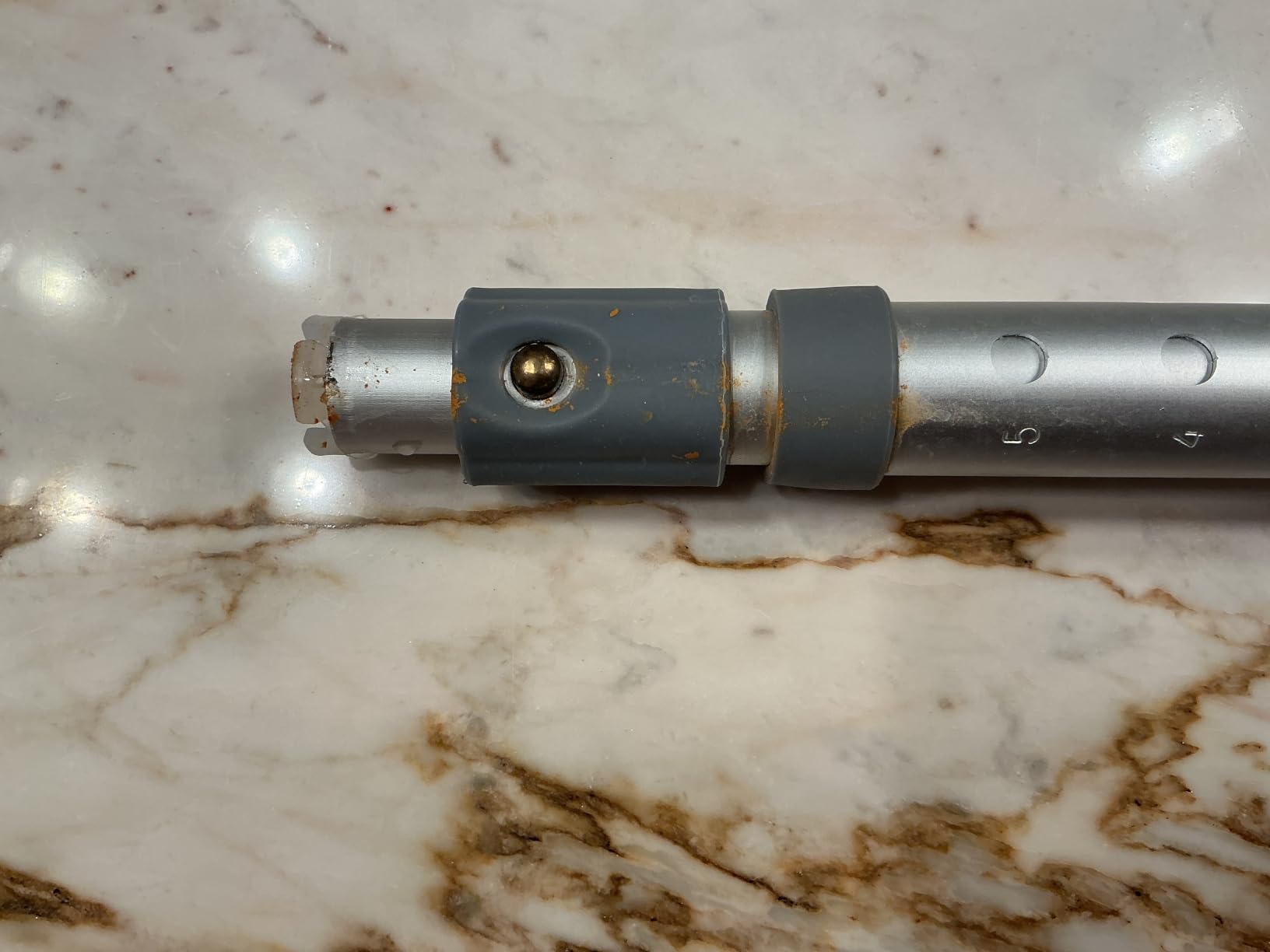
The bench is aluminum tubing with a white HDPE seat at 400 lb rated, weighing about 12.3 lb, and it includes a shower head clamp, which is convenient enough that we were not expecting to see it at this level. There is also free replacement parts and round-the-clock customer support listed.
Rubber non-slip tips on the outside legs and two suction cups inside the tub give it grip at both ends, which is the correct arrangement for a wet environment.
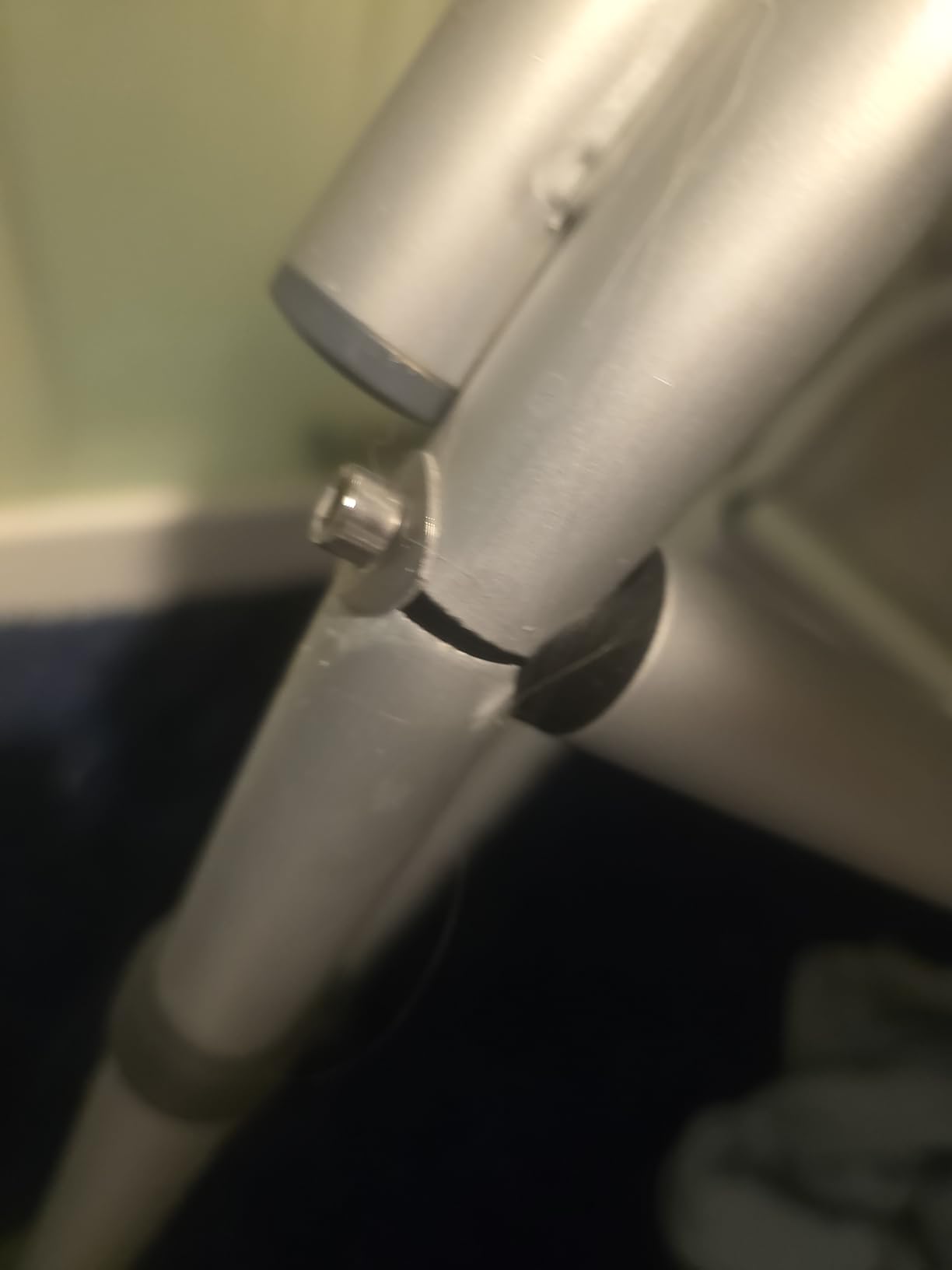
What to check before you order this bench
This is the one product in the roundup with a published clearance figure, and you should take it literally. The manufacturer states it requires 32 inches of total width clearance from the interior tub wall to the exterior floor legs, which rules it out of many compact bathrooms outright.
The second published limit is a tub exterior wall height of up to 19.75 inches. Measure yours before you order, because a taller wall means the legs do not reach the floor on the tub side and the frame cannot be leveled.
Where it falls short
The clearance requirements are the honest drawback and they are the reason this bench is not higher in the list. Buyers with larger bathrooms love it. Buyers in apartments report measuring twice and being disappointed.
Bolted construction also means more parts and a slightly longer assembly than an all-plastic or push-button design. Expect to spend more time with the instructions, and check every bolt is tight before anyone sits on the bench.
10. Flash Furniture HERCULES Series 300 lb Capacity Bath and Shower Transfer Bench
Flash Furniture HERCULES Series 300 Lb. Capacity Adjustable Gray Bath & Shower Transfer Bench with Back and Side Arm
300 lb capacity
17.25-21.25 inch height
10.5 lb
Drainage holes
Pros
- Lightest bench in the roundup at 10.5 lb and easy to reposition
- Seat drainage holes reduce standing water
- Backrest plus a side arm support sitting down and standing up
- Corrosion-resistant aluminum frame with rubber feet
- Conforms to the ANSI/BIFMA X5.1-17 standard
- Adjustable range covers most users
Cons
- 300 lb capacity is the lowest in this roundup
- Only one side arm is provided
- Hard plastic seat can feel cold compared with padded benches
The HERCULES is the lightest bench in this roundup at 10.5 lb, and that weight is the feature. In a bathroom where the bench has to be moved out of the way for other bathers, or lifted into and out of a tub by one person who is not a trained caregiver, a 10.5 lb frame behaves very differently from a 20 lb one.
It conforms to the ANSI and BIFMA X5.1-17 standard for bath and shower seats, which is a real specification rather than a marketing claim, and the seat has drainage holes so it does not hold standing water. The backrest and the single side arm both help a user lower themselves and push back up.
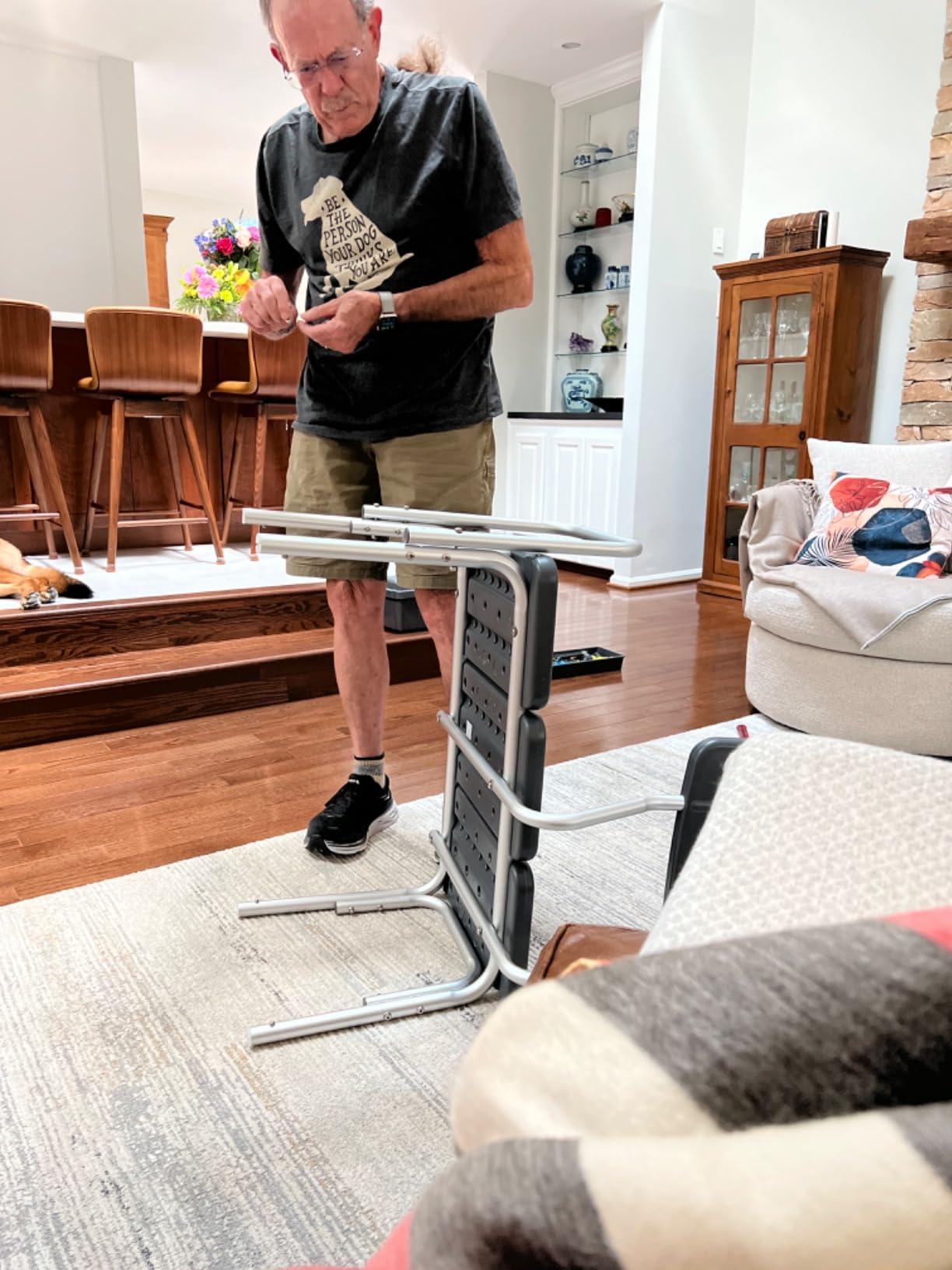
Dimensions are 30 inches wide by 20.5 inches deep, with a 27 by 16.5 inch seat that adjusts from about 17.25 to 21.25 inches. The frame is a corrosion-resistant aluminum with rubber feet, and the seat and back are plastic.
At 4.2 stars across 1,538 reviews it sits in the middle of the group, which is honest for a straightforward bench with no swivel mechanism and no premium padding.
What to check before you order this bench
Weigh your loved one and be honest about the margin. The 300 lb rating is the lowest in this roundup, and while it is a real rating, sitting at 280 lb on a 300 lb bench leaves no headroom for the leverage a caregiver applies during a transfer. Most people in this category are better served by a 400 lb model.
Confirm that one arm is enough. There is a single side arm at 6.5 inches above the seat, and there is no second arm to flip up, so a lateral wheelchair transfer into this bench will need a different strategy.
Where it falls short
The 300 lb capacity is the recurring complaint and it is not a close call. Every other bench in this roundup is rated at 400 lb except the Platinum Health at 330 lb, so choosing this one is a decision to accept a lower ceiling in exchange for lower weight.
The hard plastic seat also comes up in reviews as feeling cold and hard, and the single side arm limits transfer options. It remains a good choice for a lighter, stronger user whose main need is simply a stable place to sit while bathing.
Tub Transfer Bench vs Shower Chair: Which One You Actually Need
The short answer is that a tub transfer bench is the right product if your loved one already uses a mobility aid or if a fall in the bathroom would be a serious event. A shower chair is the right product if they can step into the tub safely on their own and mainly need a seat to lower onto.
The mechanism is what separates the two. A shower chair sits entirely inside the tub or shower, on the tub floor, and the user has to step up and over the tub wall to reach it. A transfer bench straddles the wall, with legs on both sides, so the user sits down at floor level outside the tub and moves across without ever putting a foot over the edge.
That difference is the whole argument. Tub entry and exit is where most bathroom falls happen, and for anyone with limited balance, arthritis, Parkinson’s, one-sided weakness after a stroke, or a hip or knee replacement, the step over the wall is the moment the risk concentrates. An occupational therapist framed it plainly when describing the product to us: tub benches allow safe seated entry across the tub wall with no stepping required.
Five signs point toward a transfer bench rather than a shower chair. First, your loved one already uses a walker, wheelchair, or other aid. Second, they have had a fall in the bathroom. Third, they cannot lift a leg over a tub wall of more than about a foot without holding something. Fourth, they tire quickly on standing and need to sit immediately. Fifth, they are recovering from hip, knee, or stroke rehabilitation.
A shower chair still makes more sense in two situations. If the tub has a very wide, low opening that the user can step into easily, and their balance is genuinely good, a chair is simpler and cheaper. And if the bathroom has no floor space outside the tub at all, a chair may be the only thing that physically fits.
If you are also planning a bathroom update, our guide to bathtub and shower combinations covers walk-in conversions, which remove the need for a bench of either type but are a much larger project.
How to Measure Your Tub and Bathroom Before You Buy
Measurement is where most returns in this category come from, and it takes about ten minutes. No competitor we reviewed covers it, so here is the complete checklist, in the order you should work through it.
1. Measure the tub wall height. This is the height from the bathroom floor to the top of the tub wall where the bench legs will straddle it. Compare it against the bench’s stated maximum seat height, not the overall frame height. A bench with a 22 inch maximum seat height cannot sit on a 26 inch tub wall no matter how long you extend the legs.
2. Measure the tub length and depth inside. The seat needs to land fully on the tub floor with the back legs inside the tub wall, and the user’s feet need somewhere to sit or rest. Deep soaker tubs need a leg extension kit, which not every model offers.
3. Measure the clearance from the tub wall to whatever is opposite it. This is the number that catches people. A sliding bench needs roughly 32 inches of floor space beyond the tub wall, and longer models need 39 inches. The TABEKE states its 32 inch requirement outright, and the DMI at 39 inches wide is the largest in this roundup. Measure from the tub wall to the toilet, the vanity, or the opposite wall, whichever is closest.
4. Measure the width of the tub wall itself. A narrow wall that the bench can straddle comfortably is different from a thick or tiled wall that pushes the seat outward. If your tub is an old cast iron model with a wide rolled rim, the seat ends up further into the bathroom and the clearance problem gets worse.
5. Check the door swing and the floor outside the tub. The bench has to be positioned where the user can be lowered onto the seat, which means the bathroom door and any cabinet must not block the transfer side. On r/eldercare, users ask this question constantly, and the honest answer is that if the door opens against the transfer side, the layout is wrong for a bench.
6. Confirm the tub floor is clean and reachable for drainage. Benches with drainage holes and suction cups work properly only when the tub floor is free of soap residue. A bench on a soapy floor is a slipping risk, and a quick rinse before each bath solves it entirely.
Before you finalize, have the person who will use the bench sit in the bathroom while you set it up. One r/AgingParents user described exactly this, saying it was ideal to have their mother in the bathroom to test the bench out. Height adjustment that looks right on paper can still be wrong for a particular body.
If your tub is outdoors or exposed, or if you are protecting a new installation, our picks for hot tub covers are a separate matter, but the same measurement discipline applies to any wet environment.
How to Use a Tub Transfer Bench Safely, Solo and With a Caregiver
Read this section before the first bath, not after. The transfer sequence is simple, but the simple version is the one that causes falls when a person is tired, rushed, or in pain.
1. Set the bench before the person arrives. Level the legs so the frame is stable, lock the height adjustment, test the sliding or swivel lock by pushing the seat firmly, and confirm the suction cups are seated on a clean tub floor. Do this every few weeks, not just at assembly.
2. Position the seat on the outside of the tub. The user backs up to the seat, feels for it with their hands, and lowers themselves slowly rather than turning and dropping. The armrests, where fitted, are the push-off points on the way up and the control points on the way down.
3. Move across, do not stand up. On a sliding bench, release the lock and push the seat along the rail with the hands and feet, keeping the hips on the seat at all times. On a swivel bench, rotate to face away from the tub, slide across, then rotate to face the drain. On a stationary bench, the user scoots across in small increments and takes several attempts rather than one big move.
4. Settle and secure. Once in the tub, engage the safety belt if the bench has one, and check the backrest is behind the user rather than to one side. Many people wash more easily facing the shower head, so the swivel position matters more than it seems.
5. Reverse the sequence to exit. Exit is where more injuries happen than entry, because the user is wet and has less leg strength. The single most common piece of advice from caregivers we reviewed is to dry the seat and the user’s hands before standing, and to let the user rest seated for a moment before attempting the move.
For caregiver-assisted bathing, the protocol is different and the bench changes character entirely. One r/eldercare user put it plainly: their tub transfer bench could not be used solo, and their hygiene aide assisted with every bath. That is the normal case for many people, and it is why the armrests, the lever handles, and the padding on this list matter more than the seat dimensions.
Position the caregiver facing the seated user, with one hand on the backrest and one on the armrest or belt, and move on the count of three rather than when the user moves first. Never lift a person by their underarms. And never let a user attempt a lateral transfer from a wheelchair without someone stabilising the wheelchair, since the wheels can catch on the bench frame.
A few safety rules that apply to every product on this list. Never exceed the stated weight capacity. Never use a bench on a stair or step. Never stand on the seat. And if a sliding rail starts to stick or jam, stop using the slide immediately, because a bench that binds mid-transfer is far more dangerous than one that simply will not move.
Frequently Asked Questions
What is the best tub transfer bench?
The Medline Transfer Bench is the best overall choice for most people. It is rated to 400 lb, adjusts from 17.5 to 22 inches with push-button legs, has a reversible backrest, and carries a 4.6 star rating across 7,487 reviews. The Platinum Health Carousel is the better pick if you need a true swivel-and-slide mechanism, padded seating, or 360 degree positioning, but it is rated to 330 lb and needs more clearance.
What is the best sliding transfer bench for a bathtub?
For sliding mechanisms specifically, the Platinum Health Carousel is the strongest option because it combines a slide with a swivel seat that locks every 90 degrees, so the user can sit outside the tub, rotate, slide in, and finish facing the drain. The DMI is the alternative if sliding is the priority and you want a removable perineal cut-out, though at 39 inches wide it needs the largest footprint in this roundup.
Does Medicare pay for a tub transfer bench?
Original Medicare does not typically cover a tub transfer bench as a standard benefit, because it is not on the covered durable medical equipment list. Coverage is more often available through a Medicare Advantage plan, through Medicaid, or through a prescription as a DME item when an occupational therapist documents a medical necessity. Flexible Spending Account and Health Savings Account funds usually work for the purchase, since the product is not a drug. Confirm all of this with your plan before you buy.
What is the safest shower chair for the elderly?
Safety comes from the fit rather than the model. A bench rated well above the user’s weight, with non-slip feet or suction cups, a backrest, and at least one armrest to push up from, is safer than a bare plastic stool with suction pads. For anyone who cannot step over a tub wall, a transfer bench is safer than any shower chair, because it removes the step entirely. Ask an occupational therapist to assess the specific situation before purchase.
Can a shower chair be used in a bathtub instead of a transfer bench?
Only if the person can safely step up and over the tub wall, which is exactly the situation a transfer bench was designed to avoid. A shower chair inside the tub does nothing about the entry and exit step, which is where most bathroom falls occur. It remains a good choice for a low, wide-opening tub where the user steps in without help. If the user already uses a walker or wheelchair, choose a transfer bench.
The Best Tub Transfer Benches for 2026: Final Verdict
For most households, the Medline Transfer Bench is the right place to start. A 400 lb rating, a 17.5 to 22 inch height range, a reversible backrest, suction cup feet, and 7,487 reviews at 4.6 stars make it the least risky purchase in the category, and its one-arm design is the only compromise you are likely to hit.
If your loved one needs the seat itself to move rather than the body, choose the Platinum Health Carousel for its locking 90 degree swivel, medical-grade padding, and low bathroom footprint, and accept the 330 lb ceiling and the one-sided release lever. If your tub bottom slopes or your tub wall is awkward, the Moen DN7105 is built for it, with a limited lifetime warranty behind it.
Everything else in this roundup is a specialist answer. The Vive goes highest for tall users, the Drive Medical Splash Defense is the fix for water on the floor, the Carex never rusts, the HOMLAND has the thickest tubing, the TABEKE has the most rigid bolted backrest, and the Flash Furniture is the lightest and least costly option for a lighter user.
So tell us the three numbers that decide this purchase: the user’s weight, the tub wall height, and the clearance from the tub wall to the opposite fixture. With those, the right bench for the best tub transfer benches for elderly search is one of these ten, and you will not need to return it.