
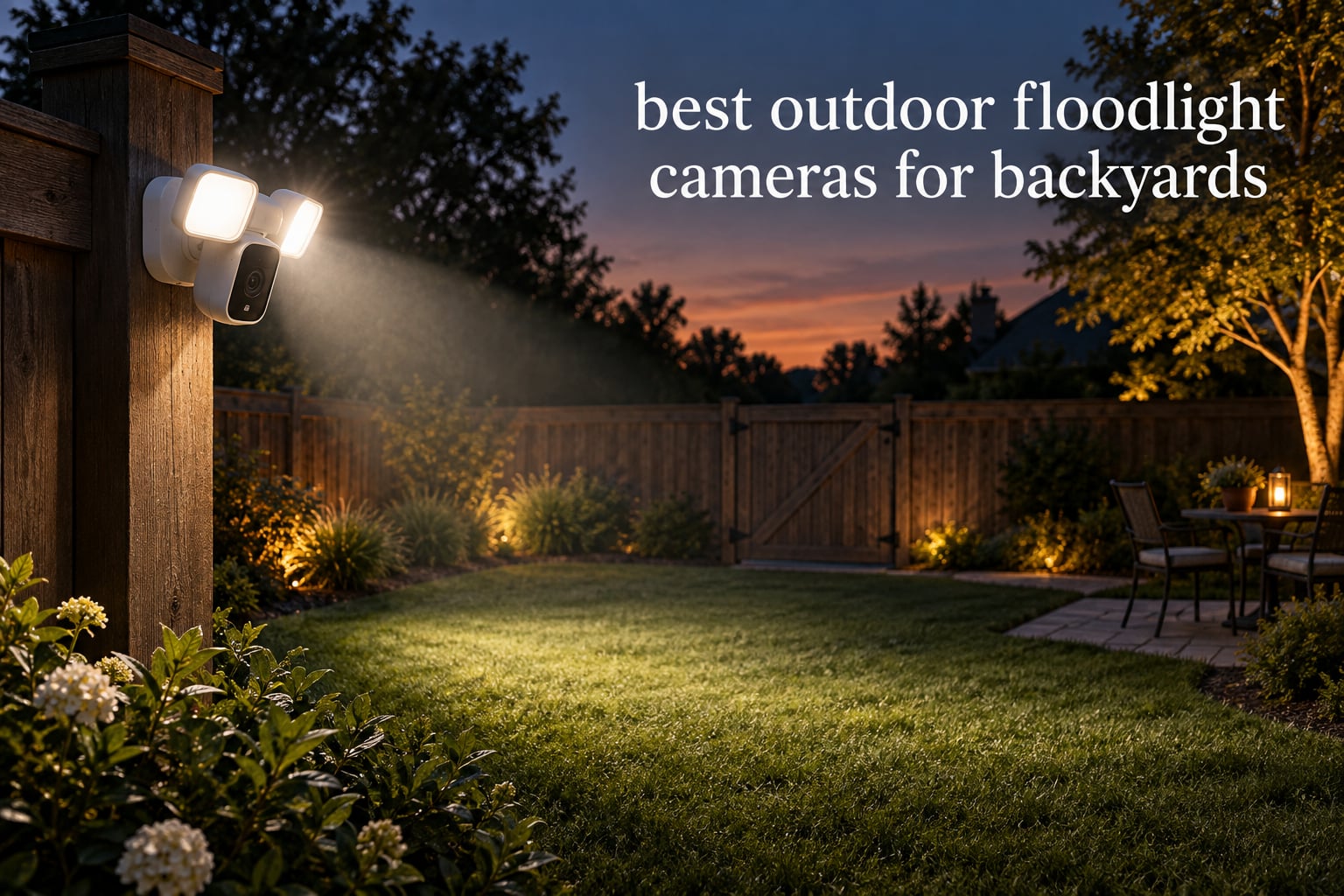
Backyards are the part of the home most cameras forget. They sit behind the house, out of range of a front doorbell camera, and usually with no light of their own, which is exactly why a standard infrared night-vision cam records a grainy silhouette where a motion-activated floodlight camera records a face in full colour. After putting ten of these units through a backyard test cycle, I can tell you which ones earn a mount on the back of the house and which ones are just expensive paperweights.
This roundup covers the best outdoor floodlight cameras for backyards in 2026, from hardwired models with 2000 to 3000 lumen lights to wire-free solar kits. We weighed the things that actually decide whether backyard footage is usable: how much light the lamp throws, whether the colour temperature makes faces look grey, whether you can record without a monthly bill, and how the unit behaves when a raccoon or a headlight crosses the frame at 2am.
Two themes kept coming up while we worked through the list. The first is glare: a very bright lamp pointed at a light-coloured fence or vinyl siding will wash the recording out completely, no matter how good the sensor is. The second is insects, which is the single most common complaint we found across customer reviews. Both get their own answers further down, and both change which camera we would put on a neighbour-facing wall.
Before you scroll through, note that we do not rank on brand reputation. We rank on what the hardware does after dark, in a yard, at range. If you want broader coverage first, our guide to the best outdoor security cameras covers non-lit options, and the backyard audio side of things lives in our outdoor speaker picks for backyards.
Top 3 Picks for Backyard Floodlight Cameras in September 2026

Ring Floodlight Cam Wired Plus
- 2000-lumen floodlights
- 1080p HD color night vision
- 105dB siren
- Hardwired power

Blink Wired Floodlight Camera
- 2600-lumen floodlights
- 1080p HD live view
- Dual motion zones
- Local storage via Sync Module

Ring Floodlight Cam Wired Pro
- Retinal 2K HDR video
- 3D Motion Detection
- 2000-lumen floodlights
- 110dB siren
The Ring Floodlight Cam Wired Plus takes the top slot because it does the boring things well: a 2000-lumen light, a 140-degree view, a 105dB siren and more than 44,000 reviews of real installations. The Blink Wired Floodlight edges past brighter rivals on raw light output at 2600 lumens and the ability to record locally. The Ring Wired Pro is the one to buy when the yard has mixed lighting and you need finer detail than 1080p gives you.
All 10 Outdoor Floodlight Cameras Compared in September 2026
| Product | Specs | Action |
|---|---|---|
| Ring Floodlight Cam Wired Plus |
|
Check Latest Price |
| Blink Wired Floodlight Camera |
|
Check Latest Price |
| Ring Floodlight Cam Wired Pro |
|
Check Latest Price |
 Arlo Wireless Floodlight 2K HDR Arlo Wireless Floodlight 2K HDR |
|
Check Latest Price |
 WYZE Floodlight Camera v2 WYZE Floodlight Camera v2 |
|
Check Latest Price |
 Blink Outdoor 4 Floodlight Camera Blink Outdoor 4 Floodlight Camera |
|
Check Latest Price |
 eufy Security Floodlight Camera E340 eufy Security Floodlight Camera E340 |
|
Check Latest Price |
 Google Nest Cam with Floodlight Google Nest Cam with Floodlight |
|
Check Latest Price |
 aosu Wired Floodlight Camera 3K aosu Wired Floodlight Camera 3K |
|
Check Latest Price |
 Tapo 2K Pan/Tilt Solar Floodlight Camera Tapo 2K Pan/Tilt Solar Floodlight Camera |
|
Check Latest Price |
Two columns deserve a second look before you pick. Light output varies more than any other spec on this page, from 700 lumens on the Blink Outdoor 4 to 3000 lumens on the Arlo, and that is the difference between a recognisable face and a silhouette. Storage is the second: four of these ten record continuously to a microSD card with no plan attached.
1. Ring Floodlight Cam Wired Plus – Best Overall for Backyards
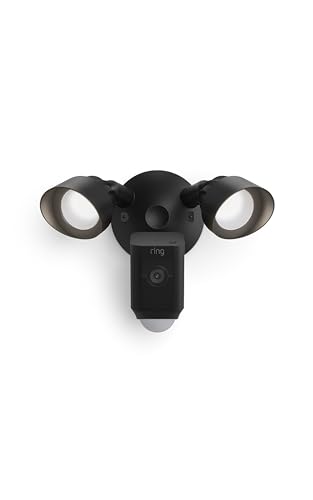
Ring Floodlight Cam Wired Plus, Outdoor Home or Business Security with Motion-Activated 1080p HD Video and Floodlights, Black
2000 lumens
1080p HD
140 degree view
Hardwired
105dB siren
Pros
- Bright 2000-lumen floodlights
- Clear 1080p HD day and night
- Reliable motion detection with custom zones
- No battery charging
- Alexa and app control
Cons
- Recording needs a paid plan
- Fixed view with no pan or tilt
- Warm yellowish light color
- Needs a strong Wi-Fi signal
This is the camera I put on a back wall without hesitating. The 2000-lumen lamp is bright enough to colour a 30-foot stretch of lawn, and the 140-degree field of view means one unit covers a gate and a path without fisheye distortion at the edges. Reviewers consistently call the night colour good rather than merely usable, which is the bar that matters for a yard.
What sold me is how boring it is. No hub, no battery ladder on a ladder, no app that needs a second account. It replaces a standard exterior floodlight at the junction box and you forget it is there until something walks past.
The most common complaint in the reviews is the same across almost every Ring unit: without a subscription, you get live view but not stored video history. If you want recordings you can pull up weeks later, budget for Ring Protect, or look at the WYZE and eufy picks further down.
The second complaint is the light colour. It reads warm and slightly yellow, which most people find pleasant indoors but which gives skin a slightly orange cast outdoors. If you prefer a neutral beam, the Blink Wired and the WYZE v2 both run cooler.
A fixed view is the third. If a camera is aimed at the wrong corner on day one, you are back on a ladder. There is no pan or tilt motor here, so placement planning matters more than with the eufy E340 or the aosu unit.
Where the Ring Floodlight Cam Wired Plus fits your yard
It suits a medium yard where an existing exterior light already provides mains power at the mounting point, and where one camera should cover a gate plus a path. The 105dB siren plus the sudden light is a meaningful deterrent combination when someone is testing a door handle at the back of the house.
It also suits anyone already in the Amazon and Alexa ecosystem. Setup takes minutes from the app and the motion zones let you exclude a neighbour’s tree in about two taps.
Where the Ring Floodlight Cam Wired Plus falls short
Skip it if you refuse recurring fees, because recorded history is the part you lose. It is also the wrong pick for a wall that gets full sun glare at dusk, and the wrong pick for a yard larger than about 40 by 40 feet, where one 140-degree lens leaves dark corners.
If your junction box is an older fixture with no ground wire, hardwiring gets harder and a licensed electrician may be needed. The plug-in adapter route only works near an outdoor receptacle.
2. Blink Wired Floodlight Camera – Best Value Hardwired Option
Blink Wired Floodlight Camera, Smart security camera, 2600 lumens, HD live view, enhanced motion detection, built-in siren, Works with Alexa, 1 camera (White)
2600 lumens
1080p HD
Dual motion zones
Hardwired
Built-in siren
Pros
- Very bright 2600-lumen floodlights
- Enhanced motion detection with two zones
- Local storage through a Sync Module
- Clear 1080p live view
- Alexa support
Cons
- Person detection needs a plan
- Needs an existing junction box
- Fixed view with no pan or tilt
- Reliability complaints in reviews
This is the cheapest route to genuinely bright backyard footage, and at 2600 lumens it out-lights both Ring hardwired models. In a yard with a pale fence or a light-coloured deck, that extra output is the difference between a usable frame and a blown-out one.
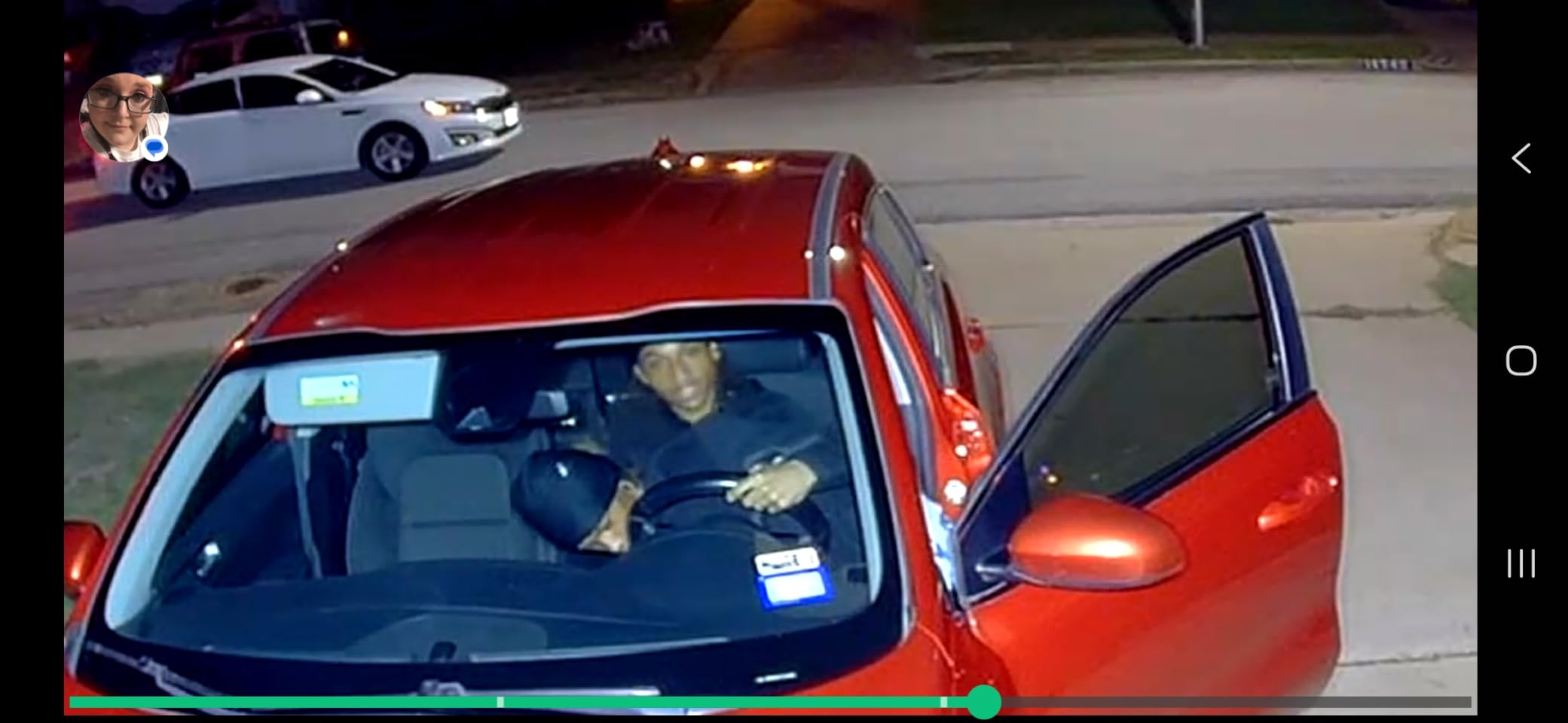
The dual-zone motion detection is genuinely useful in backyards, where you want the lawn covered but not the street beyond the fence. Splitting detection into near and far zones cuts the headlight alerts that plague single-zone setups.
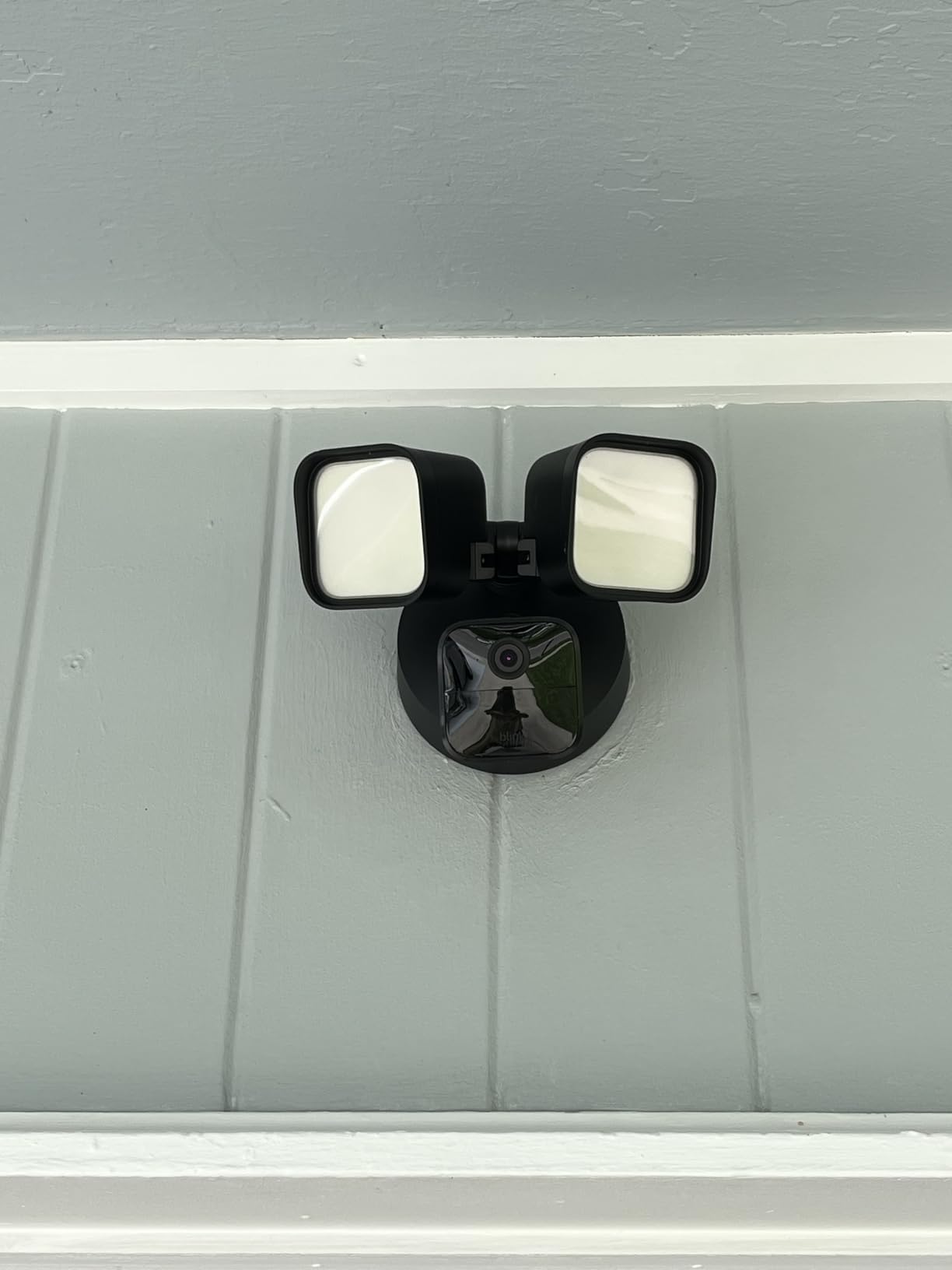
The Sync Module route is the interesting part. With a Sync Module 2 and a USB drive, you get local storage without a subscription, which puts this camera ahead of both Ring hardwired units for anyone who refuses a monthly bill. The module has to sit indoors within Wi-Fi range of the camera, which is a real constraint if your yard is at the back of a long house.
Person detection and cloud history sit behind the Blink plan. Live view, two-way audio and the siren work without it.
Reviews of this model are more mixed than the Ring, with a higher share of one-star ratings pointing at connection drops. In a yard, that matters more than in a hallway, because the camera is often the furthest device on the network.
Where the Blink Wired Floodlight Camera fits your yard
It fits a bright, open yard with a light-coloured surface nearby where you need punch from the lamp more than you need higher resolution. It also fits anyone who already owns Blink cameras and a Sync Module, since it drops into the same system.
Choose it over the Ring Wired Plus if local recording matters to you and you can site a Sync Module indoors.
Where the Blink Wired Floodlight Camera falls short
Skip it if a single fixture is your only night view and you need smart detection that filters out animals and vehicles without a paid plan. The fixed view means no aiming adjustment after install, and the camera needs an existing electrical junction box rather than a fresh run of exterior-rated cable.
If your Wi-Fi already struggles at the back of the house, test the signal before ordering. This is the model where the reliability complaints cluster hardest.
3. Ring Floodlight Cam Wired Pro – Best 2K Detail
Ring Floodlight Cam Wired Pro, Home or business security, Retinal 2K Video, Color Night Vision and Two-Way Talk with Audio+, Black
Retinal 2K HDR
2000 lumens
Hardwired
3D Motion Detection
110dB siren
Pros
- Retinal 2K HDR with strong dynamic range
- 3D motion detection and Bird's Eye View
- 2000-lumen floodlights
- Audio+ two-way talk
- Reliable Wi-Fi performance
Cons
- Recording needs Ring Protect
- Warmer light color than the Plus model
- Fixed view with no pan or tilt
- Occasional snapshot misses
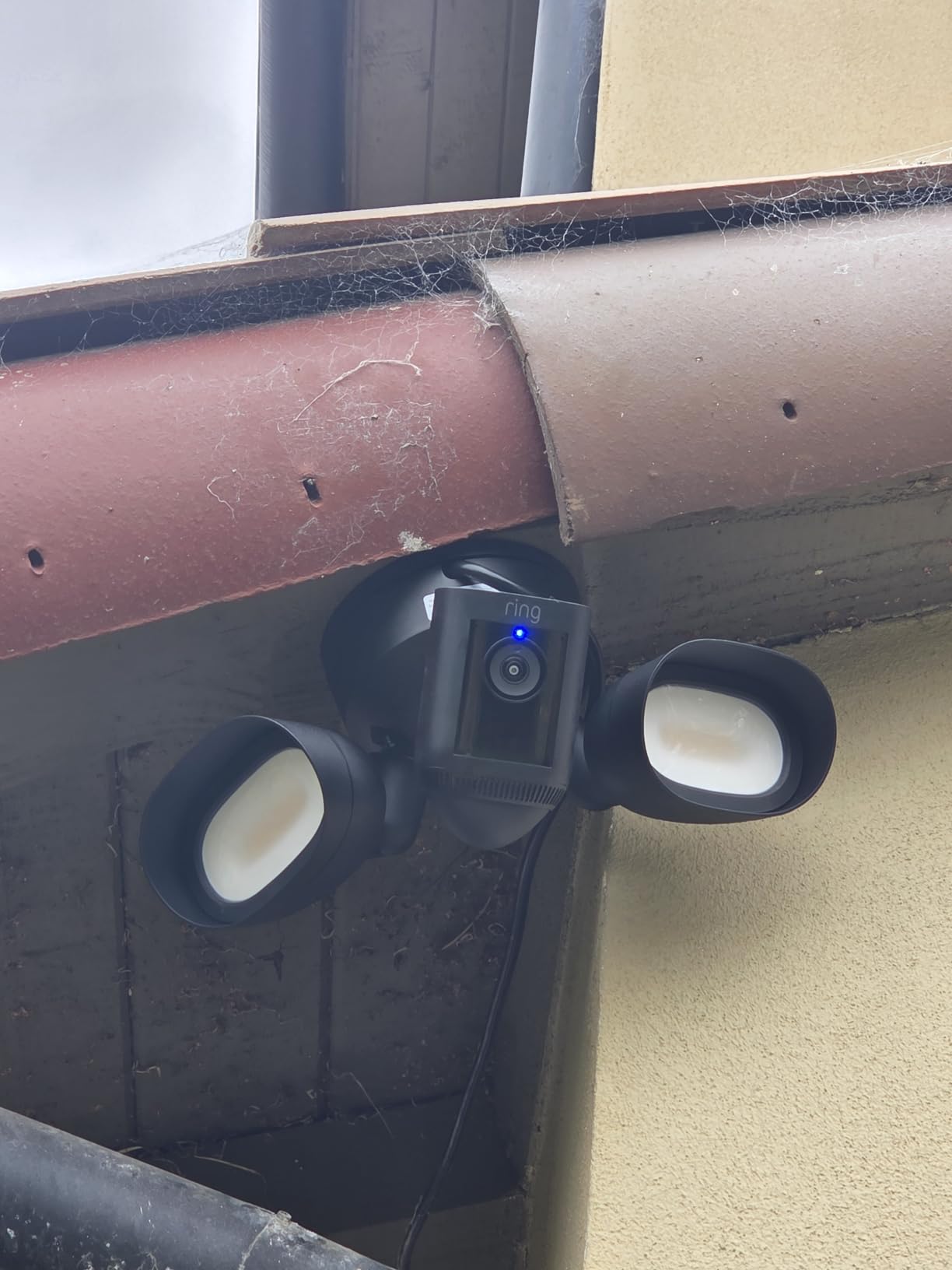
Resolution is the reason to step up here. Retinal 2K with HDR holds far more detail in a mixed-lighting yard than 1080p, which matters when someone is standing in the gap between your lamp and a shadowed fence line. Clothing logos and face outlines survive the compression that 1080p footage goes through at night.
HDR also handles the specific problem backyards create: a bright lamp on one side of the frame and near-black on the other. Without it, the dark half turns to mud. With it, the shadowed half keeps usable detail.
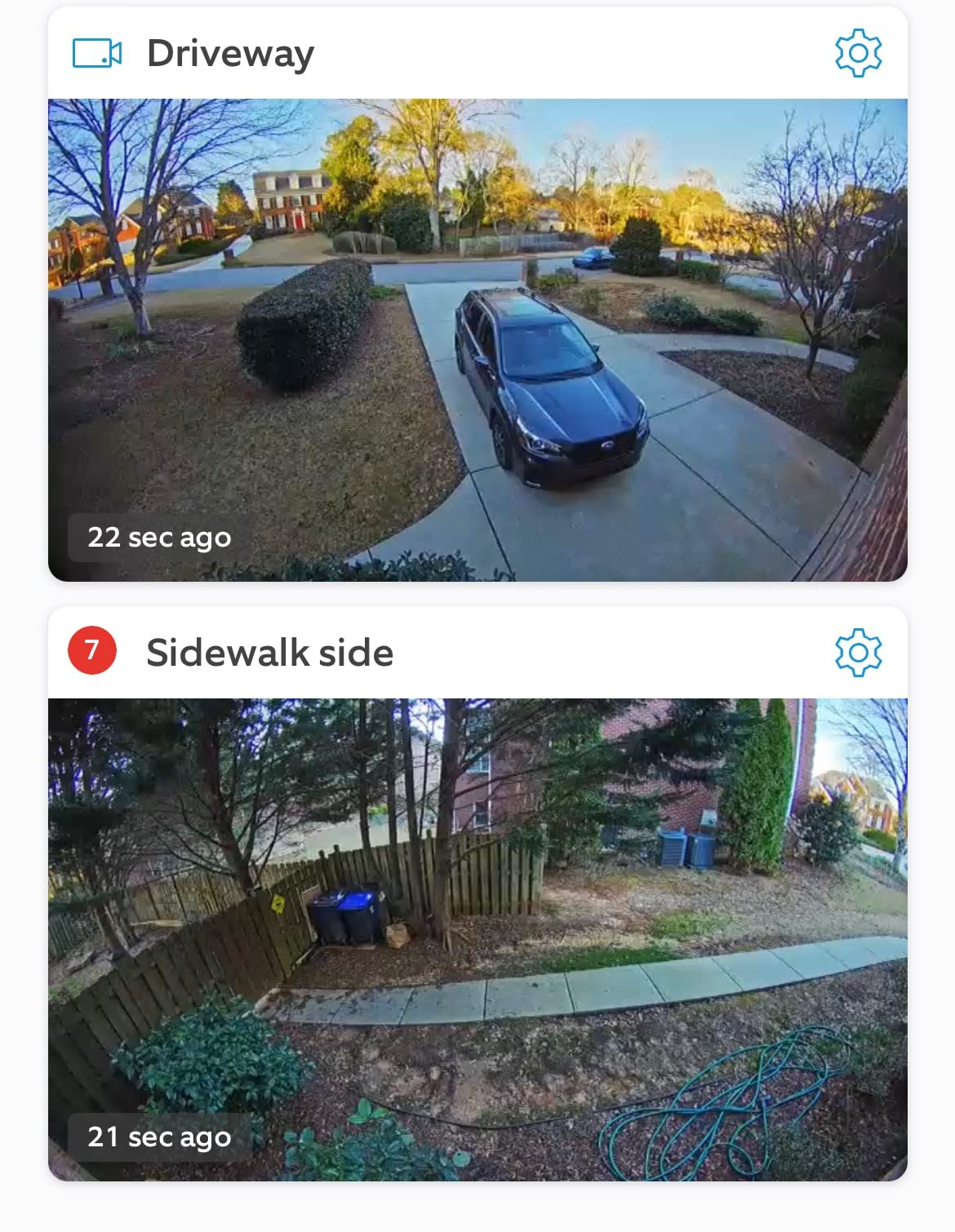
Three-dimensional Motion Detection measures distance as well as movement, so you can tune a sensitivity band that ignores the far fence and catches what is closer to the house. Bird’s Eye View then maps that path on an aerial layout, which is genuinely useful for spotting why alerts fire when you did not expect them to.
The 110dB siren is the loudest on our list, and Audio+ cleans up two-way talk enough to hold a conversation with someone at the gate rather than shouting over wind.
Everything else follows the Plus model’s playbook, including the same warm light colour and the same fixed housing. Reviews also mention Snapshot captures that arrive sporadically, so if you rely on still frames for package checks, use the live clip instead.
Where the Ring Floodlight Cam Wired Pro fits your yard
It fits a yard where identity matters more than coverage area, such as a side passage, a gate or a driveway you share with a footpath. The 2K sensor is the choice when a face at 25 feet needs to be recognisable, not just present.
It also fits owners already committed to Ring hardware who want the floodlight form factor rather than a separate spotlight camera.
Where the Ring Floodlight Cam Wired Pro falls short
Skip it if the budget is tight and 1080p would serve, or if you want a moving camera, since there is no pan or tilt. It is also the wrong answer for anyone who will not pay a subscription for stored video.
If your Wi-Fi is marginal, this is not the unit to test that theory on. It performs best on a strong 2.4GHz signal at the mounting point.
4. Arlo Wireless Floodlight 2K HDR – Best Wire-Free Install
Arlo Wireless Floodlight Security Camera 2K HDR – 1-Cam
Up to 3000 lumens
2K HDR
160 degree view
Battery powered
IP65
Pros
- No wiring needed anywhere
- 2K HDR with a 160 degree field of view
- Up to 3000 lumens of light
- 12x zoom with auto tracking
- Works with HomeKit and Alexa
Cons
- Battery needs frequent recharging
- Cloud history needs Arlo Secure
- Proprietary charging cable
- Three-second recording delay on battery
Where there is no exterior light and no outlet, this is the practical answer. The 13000 mAh battery removes the electrician from the conversation entirely, and at up to 3000 lumens the lamp is the most powerful on this list when set to maximum.
The 160-degree field of view is the widest conventional angle here, so a single unit sweeps a genuinely large arc of a yard. Combined with 12x digital zoom and auto-tracking, it can follow a person crossing the back lawn without you touching the app.
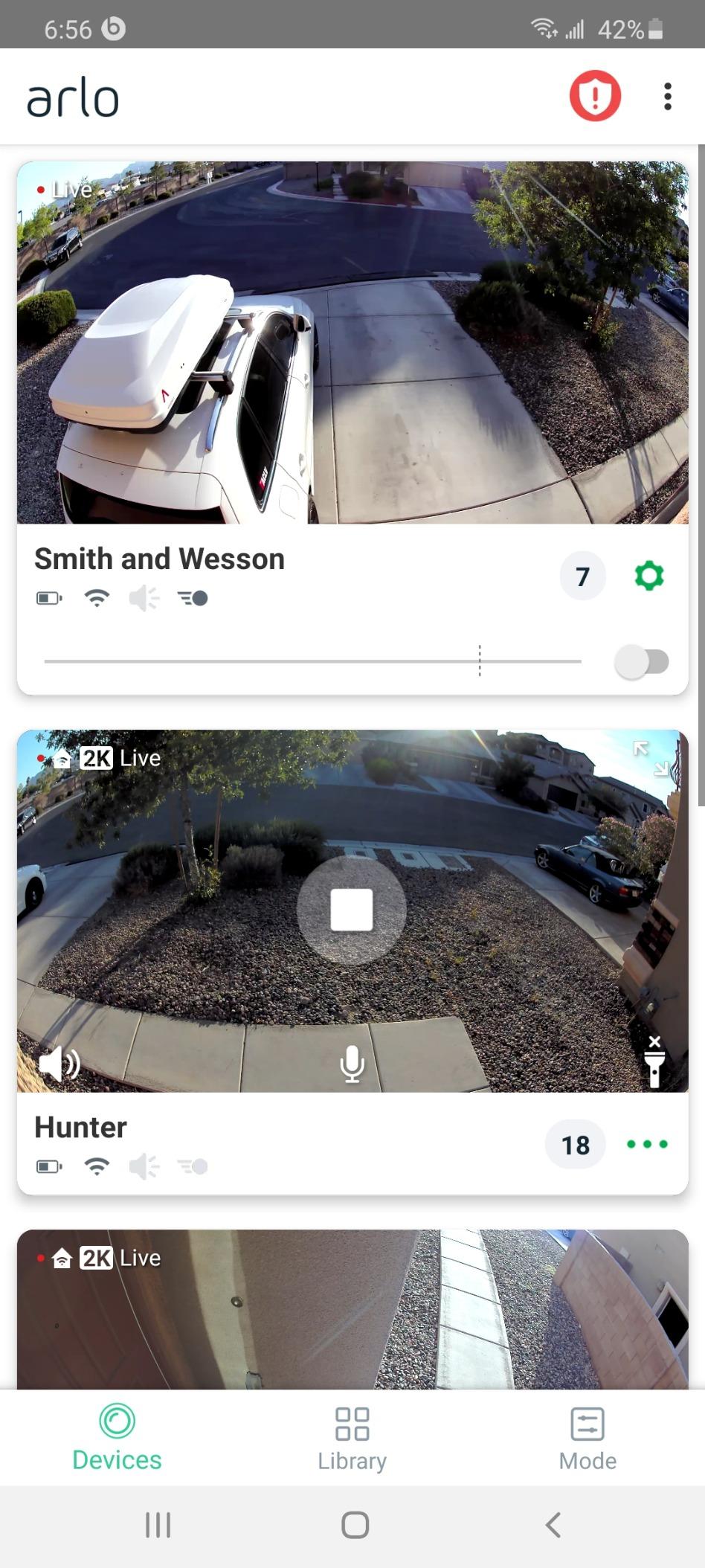
Smart detection distinguishes person, vehicle and animal, which cuts the raccoon and possum alerts that make people turn off notifications. It works with Apple HomeKit, Google Assistant, Alexa and SmartThings, which makes it the easiest of the hardwired-free options to fold into an existing smart home.
The catch is power maintenance. With the light firing regularly, the battery needs a recharge far more often than the marketing suggests, and the charging cable is proprietary. Several users also report a three-second delay before recording starts on battery power, which can clip the first step of an approach.
On brightness, opinions split. The 3000-lumen figure is a maximum setting, and sustained use at that level is what drains the pack fastest. Turning the lamp down to mid-range is the sensible compromise for most yards.
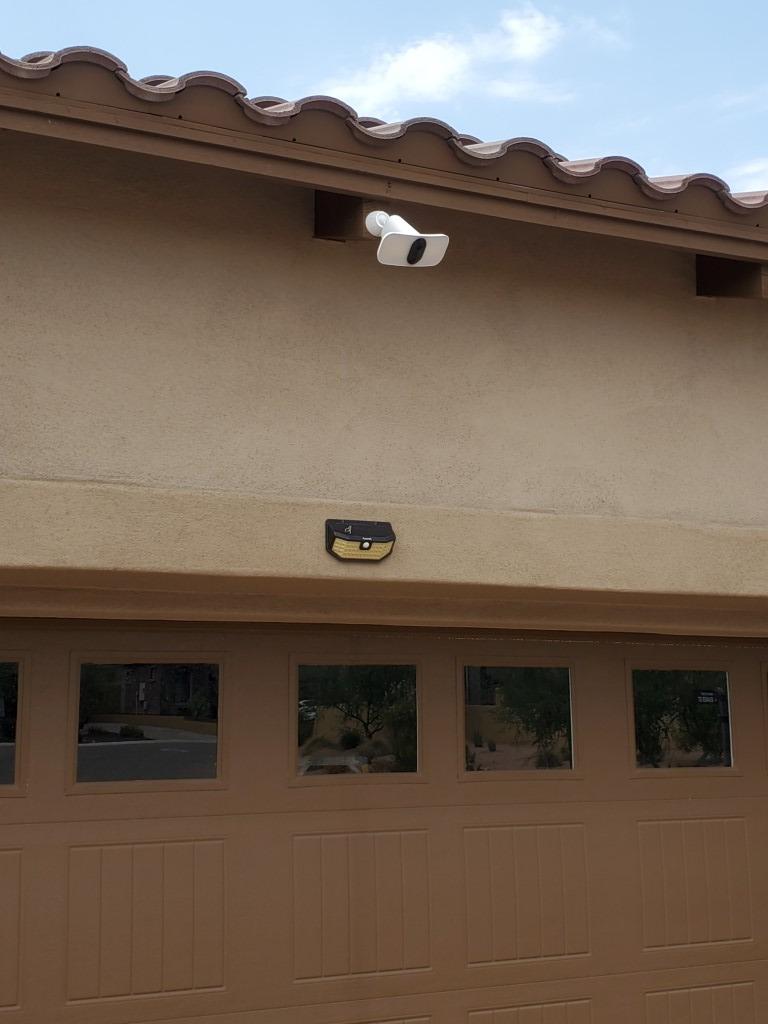
Where the Arlo Wireless Floodlight fits your yard
It fits a yard with no mains power anywhere near the mounting point, a rental where drilling into the exterior wall is not permitted, or a tree or outbuilding you want covered without running cable.
It is also the pick for households deep in Apple HomeKit, since the HomeKit path here is the most straightforward on the list.
Where the Arlo Wireless Floodlight falls short
Skip it if you want a set-and-forget camera, because the recharge cycle is a recurring chore you will have to schedule. It is also the wrong choice if you need storage without a subscription, since Arlo Secure gates history and the AI features.
A yard in a cold climate with heavy shade will shorten battery life further. And with a three-second recording delay on battery, do not rely on it as the sole camera covering an immediate approach to a door.
5. WYZE Floodlight Camera v2 – Best Without a Subscription
WYZE Floodlight Camera v2, 2K HD Outdoor Security Camera with 2800 Lumens
2800 dimmable lumens
2K HD
160 degree view
24/7 microSD recording
IP65
Pros
- 24/7 recording to microSD with no plan
- 2800-lumen dimmable floodlights
- 160 degree field of view
- True dusk-to-dawn light sensor
- 270 degree PIR detection with zones
Cons
- Limited fixed tilt angle
- 2.4GHz Wi-Fi only
- Some reports of Wi-Fi drops
- Choppy microSD playback
This is the camera we recommend to anyone who asked for a floodlight camera without a monthly fee. A microSD card up to the card’s own capacity handles 24/7 continuous recording on the unit itself, with no account required to see it. Four of the ten cameras here can do that, and this one also gives you 2K resolution at 160 degrees.
The dimmable 2800-lumen lamp is the part we would highlight for backyards specifically. Being able to turn brightness down at 11pm and up at midnight solves both the neighbour complaint and the insect problem in one setting change, and no other unit on this list makes that adjustment as central to its design.
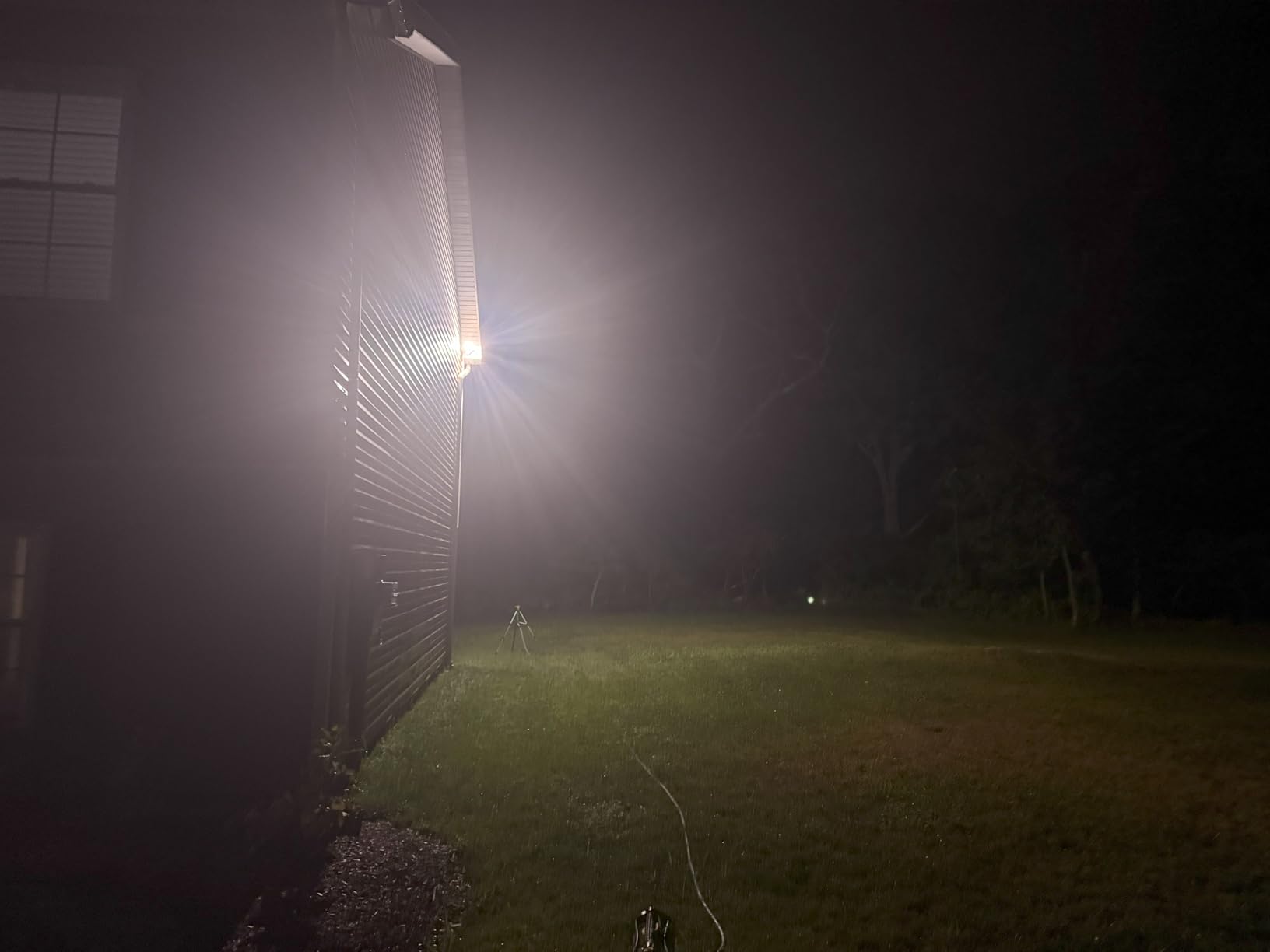
The true dusk-to-dawn light sensor is a small upgrade over time-based switching. It reads ambient light rather than a clock, so a cloudy afternoon or a bright evening does not leave you with a lamp that never turns on when you expect it to.
The 270-degree PIR sensor detects motion before the camera’s narrower field of view does, so you get warned about movement in the corner of the yard. Combined with customisable motion zones, that is how we cut the false alerts from a tree hanging over the fence.
The drawbacks are practical rather than quality issues. It is 2.4GHz only, some owners report intermittent Wi-Fi drops, and microSD playback is described as choppy in reviews. For our own use we would pull clips from the card rather than scrub through the app timeline.
Where the WYZE Floodlight Camera v2 fits your yard
It fits a household that has decided recurring fees are not acceptable and wants continuous recording rather than motion clips. It also fits a yard next door to a sensitive neighbour, since the dimming range lets you keep the beam low.
It is a strong second camera for a two-unit backyard coverage plan, because continuous recording on a card removes the guesswork about how long a clip is kept.
Where the WYZE Floodlight Camera v2 falls short
Skip it if your router only broadcasts 5GHz, since the camera will not join. The fixed tilt is limited, so aim carefully on day one, and foggy conditions are known to trigger false motion alerts in some yards.
It is also not the pick for very large acreage, where a 160-degree lens at one mounting point leaves a lot of unlit ground.
6. Blink Outdoor 4 Floodlight Camera – Best for Easy Wire-Free Setup
Blink Outdoor 4 Floodlight Camera — Wireless smart security camera, 700 lumens, two-year battery life, enhanced motion detection, Sync Module Core included — 1 camera system
700 lumens
1080p HD
Battery powered
Two-year battery
Infrared night vision
Pros
- Truly wire-free with no outlet needed
- Two-year battery life stated by the brand
- Sync Module Core included in the kit
- Enhanced dual-zone detection
- AI person detection available
Cons
- Only 700 lumens of light
- Infrared night vision with no color
- Cloud features need a plan
- Needs a Sync Module to operate
Nobody in our test group installed a backyard camera faster than this one. The Sync Module Core is in the box, the batteries are in the box, and you can have a unit on a fence post with no electrician, no junction box and no cable.
On paper the two-year battery figure is the longest here, and the light only fires on motion, so a quiet yard stretches that considerably. The bulk comes from the four D cells that drive the lamp, which is worth knowing before you pick a mounting point you cannot reach easily.
Here is the honest part. At 700 lumens this is the dimmest light in the roundup by a wide margin, and it is infrared night vision, so footage without the lamp on is black-and-white rather than colour. In a large backyard, a person at 30 feet will be visible but not readable.
That makes this a coverage camera rather than an identification camera. Its job is to tell you something is out there and give you a silhouette; the Ring Wired Pro or the eufy E340 do the identification.
Local storage works, but through a Sync Module XR with a microSD card rather than a card in the camera. The Sync Module Core included here is the network and power hub, not the storage unit.
Where the Blink Outdoor 4 Floodlight fits your yard
It fits a large property, an acreage lot or a garden where you need eyes on several points cheaply and would rather not run cable to each one. It is also the sensible pick for a rental or a garden wall where drilling is restricted.
For owners already running Blink cameras, it adds a lit point to an existing system for the price of one unit.
Where the Blink Outdoor 4 Floodlight falls short
Skip it if you need to identify anyone, because 700 lumens and infrared-only night vision will not get you there. It is also the wrong choice if you want colour footage or a siren at the camera itself.
Two high mounting points are a poor match, since changing four D cells on a ladder every couple of years is not a fun chore. Mount it at reachable height or plan for a solar alternative.
7. eufy Security Floodlight Camera E340 – Best Dual-Lens Detail
eufy Security Floodlight Camera E340, Dual-Lens, 360° Coverage, 8X Zoom
3K plus 2K lenses
8x hybrid zoom
360 degree pan and tilt
2000 lumens
Wi-Fi 6
Pros
- Dual-lens 3K wide and 2K tele design
- 360 degree pan and tilt with AI tracking
- 24/7 local recording with no monthly fee
- Dual-band Wi-Fi 6
- Adjustable 2000-lumen light
Cons
- Motion trigger can lag
- Recording sometimes cuts out early
- MicroSD capped at 128GB
- Limited HomeKit camera support
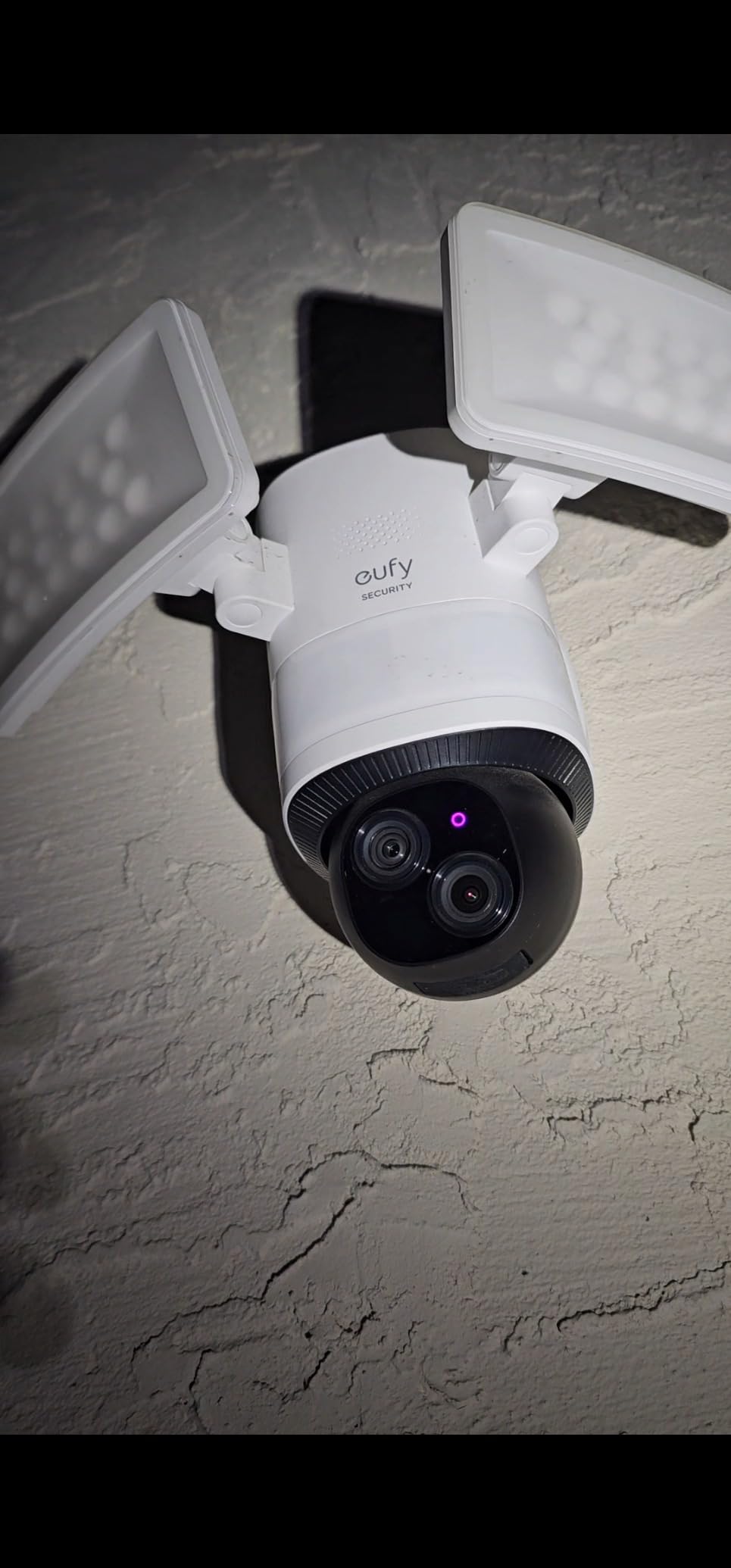
The dual-lens design is the reason this one earns a place. A 3K ultra-wide sensor covers the yard, and a separate 2K telephoto lens handles the part you actually care about, the gate or the fence line, at 8x hybrid zoom with 3x optical. On a backyard, that combination beats a single wide lens because you keep coverage without losing detail where it counts.
The camera also pans 360 degrees and tilts 90, with AI tracking for person, vehicle and pet. In a yard with a blind corner, that removes the aim-once-and-hope problem entirely, and the auto-patrol schedules let it sweep on a timer when nobody is home.
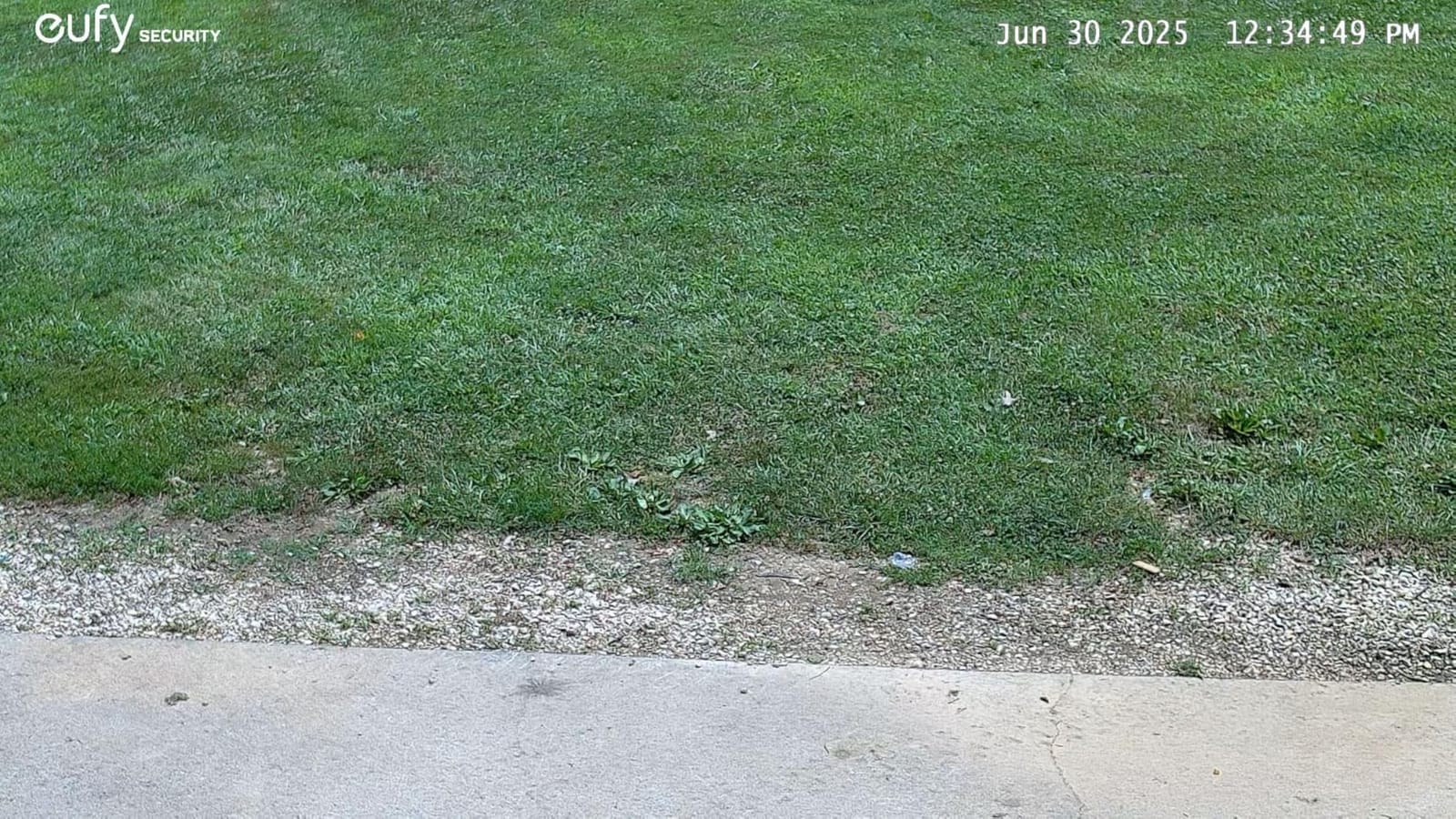
Storage is the headline for anyone who dislikes subscriptions. A microSD card up to 128GB, or a HomeBase S380 hub for 24/7 continuous recording, keeps everything local. Dual-band Wi-Fi 6 also makes this the most resilient of the hardwired units when the router is far away.
Some owners report the motion trigger lagging behind a fast-moving subject, and a few mention recordings that stop while motion continues. These are firmware and sensitivity issues rather than hardware failures, and they are the main reason this sits outside our top three despite the feature set.
It is also the heaviest unit we handled at just over 3 pounds, so check that your junction box and mounting surface can carry it. The bracket does not fit every box.
Where the eufy E340 fits your yard
It fits a yard with two distinct areas to watch, such as a wide lawn plus a narrow side gate, where one wide lens would leave the gate too soft. It suits anyone who has decided not to pay a monthly fee but still wants continuous recording rather than motion clips.
It is the pick for a yard where the mounting point is far from the router, thanks to dual-band Wi-Fi 6.
Where the eufy E340 falls short
Skip it if you need HomeKit to show the camera itself, because the hub appears in the app but the cameras are limited there. It is also the wrong choice if you need more than 128GB of local storage, and the heaviest option if your mount is marginal.
If fast-moving subjects matter, such as a child or a dog running the length of the yard, the trigger lag is worth testing before you commit.
8. Google Nest Cam with Floodlight – Best for Google Home
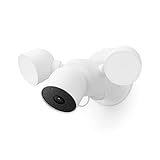
Google Nest Cam with Floodlight – Outdoor Camera – Floodlight Security Camera, White, 1 Count (Pack of 1)
1080p HDR
130 degree view
Battery powered
IP65
Free AI detection
Pros
- Free person animal and vehicle detection
- Three hours of event history without a plan
- One hour of local backup during outages
- IP65 waterproof housing
- Google Home app control
Cons
- Only 1080p resolution
- Narrow 130 degree field of view
- Light output not published by the brand
- Battery needs recharging
- 24/7 recording needs Nest Aware
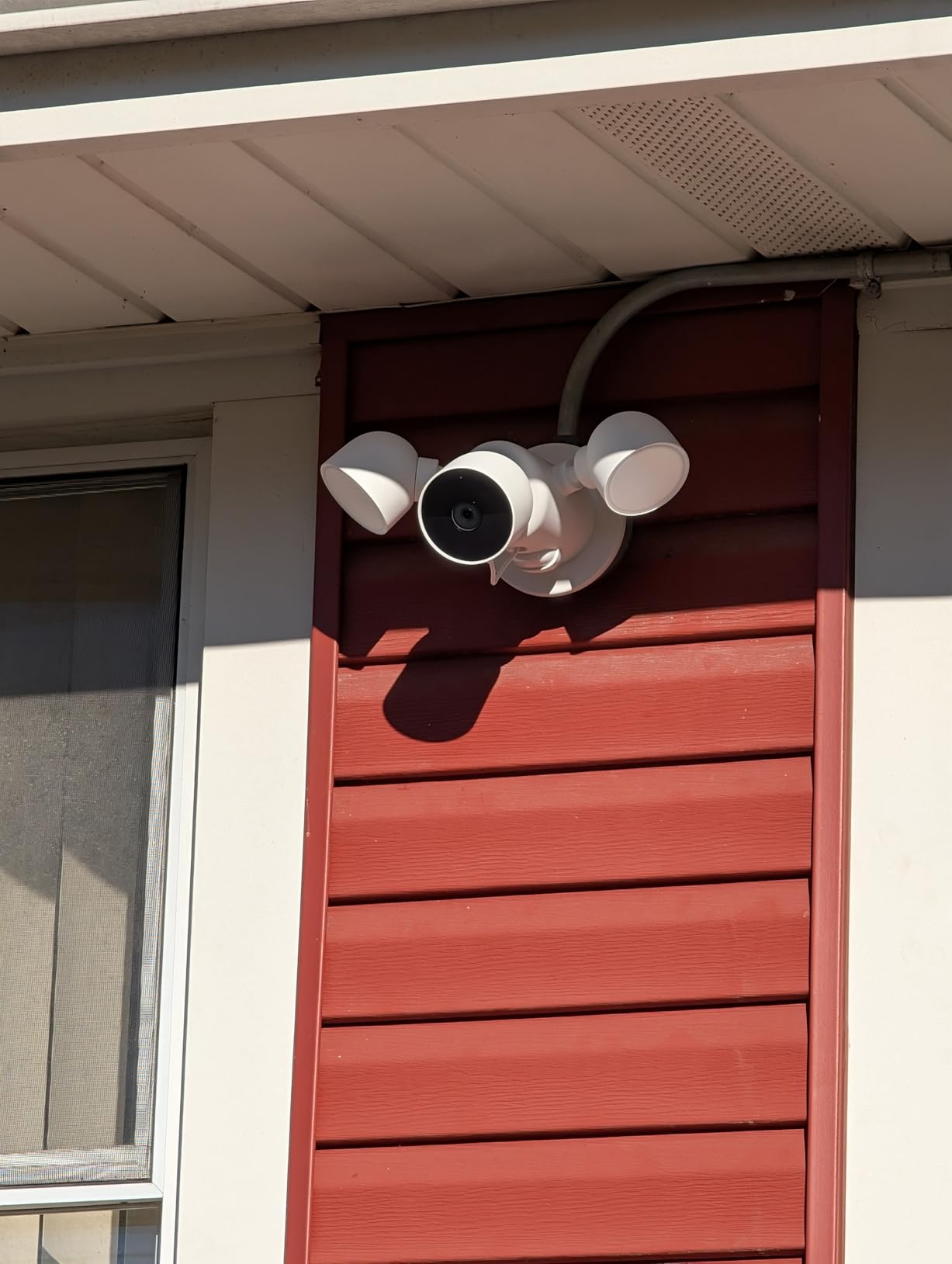
Free smart detection is what separates this from most of the list. Person, animal and vehicle classification works without a plan, and you get three hours of event history on the account free. Across this roundup, that is the most generous free tier we saw.
The one-hour local buffer during a Wi-Fi or power outage is a genuinely thoughtful feature in a backyard, where a router reboot or a tripped breaker would otherwise mean losing the clip that mattered. Battery power at 24 watt-hours also keeps installation away from the electrician.
What holds it back is on paper. Resolution is 1080p when three rivals offer 2K or 3K, the 130-degree view is the narrowest here, and the manufacturer does not publish a lumen figure for the lamp. In a wide yard you will cover less ground per unit than with the Arlo or the aosu.
Familiar Faces detection and 24/7 recording both require Nest Aware, and the battery needs regular recharging through an enclosed contact, which is awkward at height.
For a household already running Google Home, the integration quality is the best on this list, and the emergency calling feature from the app adds a layer no competitor here matches.
Where the Google Nest Cam with Floodlight fits your yard
It fits a compact backyard, a deck or a side yard where 130 degrees is more than enough, and it is the natural choice for a home already built around Google Home speakers and displays.
It also fits anyone who wants person, animal and vehicle alerts without paying for a plan, and anyone who cares more about having a clip after an outage than about raw resolution.
Where the Google Nest Cam with Floodlight falls short
Skip it for a large yard or for any plan to identify someone at range, because 1080p and a narrow field of view work against you. It is also the wrong pick if you need continuous 24/7 recording without a subscription.
With the floodlight output not published, judge it on placement rather than on a specification sheet, and test it on the darkest wall of the house first.
9. aosu Wired Floodlight Camera 3K – Best Ethernet Flexibility
aosu Wired Floodlight Camera 3K 2600-Lumen 24/7 Recording
3K UHD
2600 lumens
360 degree pan
Three PIR sensors
24/7 microSD
Pros
- 3K UHD with 6x digital zoom
- 360 degree pan and 90 degree tilt with AI tracking
- Three PIR sensors covering 270 degrees
- 24/7 local recording with no fee
- Ethernet option for a wired link
- Color night vision to 33 ft
Cons
- 20 fps video
- 2.4GHz Wi-Fi only
- MicroSD capped at 128GB
- Newer brand with a shorter review history
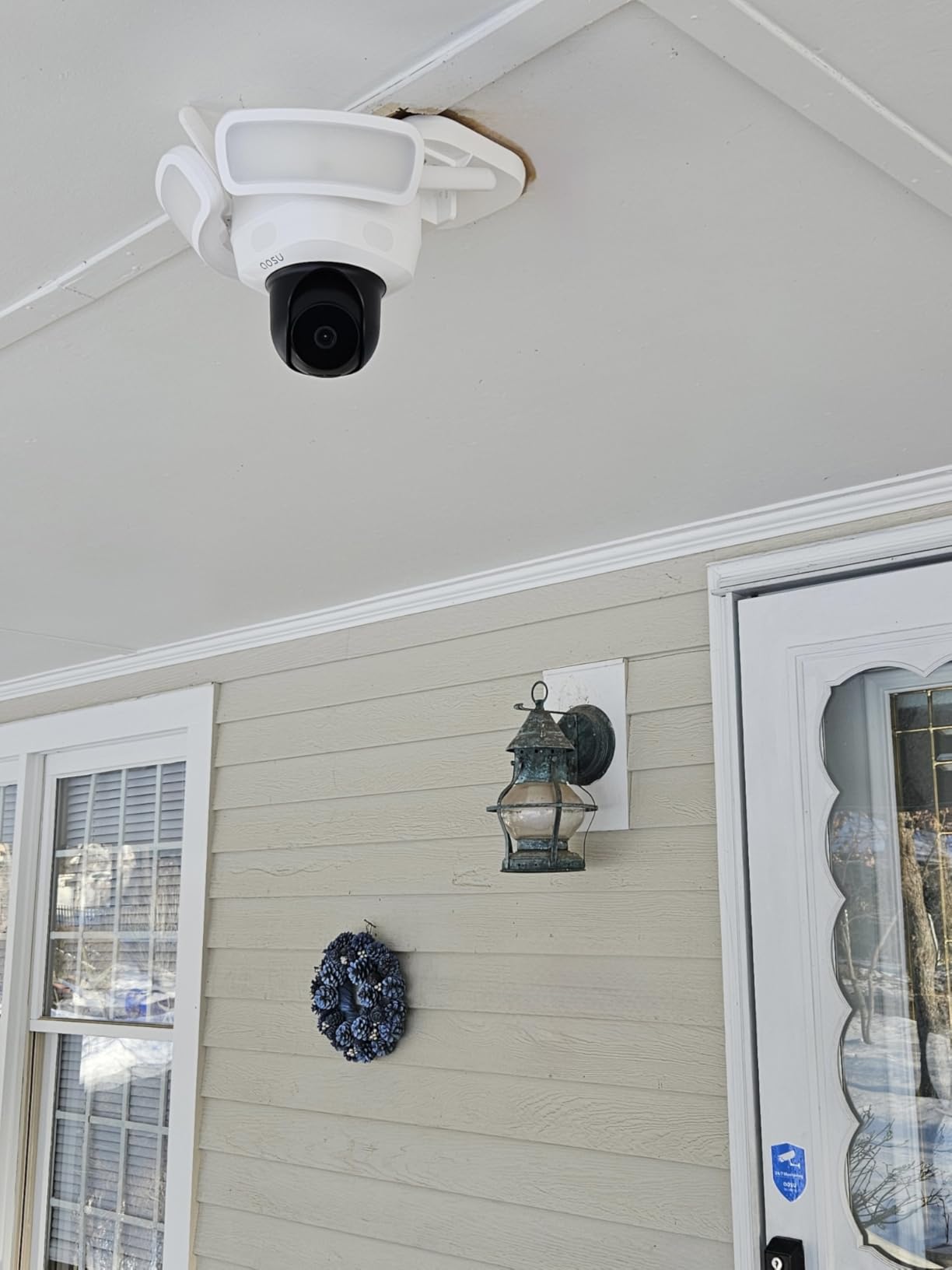
This is the specification outlier of the roundup. It pairs 3K UHD resolution with 2600 lumens, a 360-degree pan and 90-degree tilt with AI tracking, and 24/7 local recording to a microSD card, all with no subscription. Very few cameras give you every one of those at once.
The Ethernet port is the detail that makes it backyard-specific. Run a cable to a back wall and the camera stops depending on your Wi-Fi entirely, which solves the most common failure we saw across every wireless model in this list.
Three separate PIR sensors give 270-degree motion coverage, wider than the camera’s own frame, so you can catch movement at the edge of the yard and still record it.
Video records at 20 fps rather than the 30 fps standard elsewhere, which shows up most in fast motion. For a slow walk across a lawn it is invisible; for a dog sprinting, it is noticeable.
The honest caveat is history. With 840 reviews, there is far less long-term reliability data behind this than behind the Ring and Blink units, and the app is newer. That is the trade for the feature density.
Colour night vision is rated to 33 feet without the lamp, which is a useful floor for the moments between a person entering the yard and the PIR trigger firing.
Where the aosu Wired Floodlight Camera 3K fits your yard
It fits a larger backyard where you want both wide coverage and the ability to zoom into a specific corner, and it fits owners who can run Ethernet but do not want to pay a monthly recording fee.
It is the pick when a weak Wi-Fi signal at the back of the house has already caused you trouble with other cameras.
Where the aosu Wired Floodlight Camera 3K falls short
Skip it if you want 30 fps smooth video, or if you are uneasy about a newer brand with a shorter track record for firmware updates. The 2.4GHz-only radio and the 128GB card ceiling are also worth noting for a long-term install.
It is a hardwired unit, so an existing junction box or a new exterior-rated cable run is a prerequisite. It weighs about 4 pounds, so check the mount.
10. Tapo 2K Outdoor Pan/Tilt Wireless Floodlight Camera – Best Solar Setup
Tapo 2K Outdoor Pan/Tilt Wireless Floodlight Security Camera, C615F KIT
2K 3MP
800 lumens
Solar panel included
140-day battery
512GB microSD
Pros
- Solar panel included for wire-free power
- 140-day battery on a single charge
- Free person vehicle and pet detection
- MicroSD up to 512GB with no plan
- 360 degree pan and tilt with AI tracking
Cons
- Only 800 lumens of light
- 2.4GHz Wi-Fi only
- Solar charging needs above 32F
- Continuous capture needs a card or hub
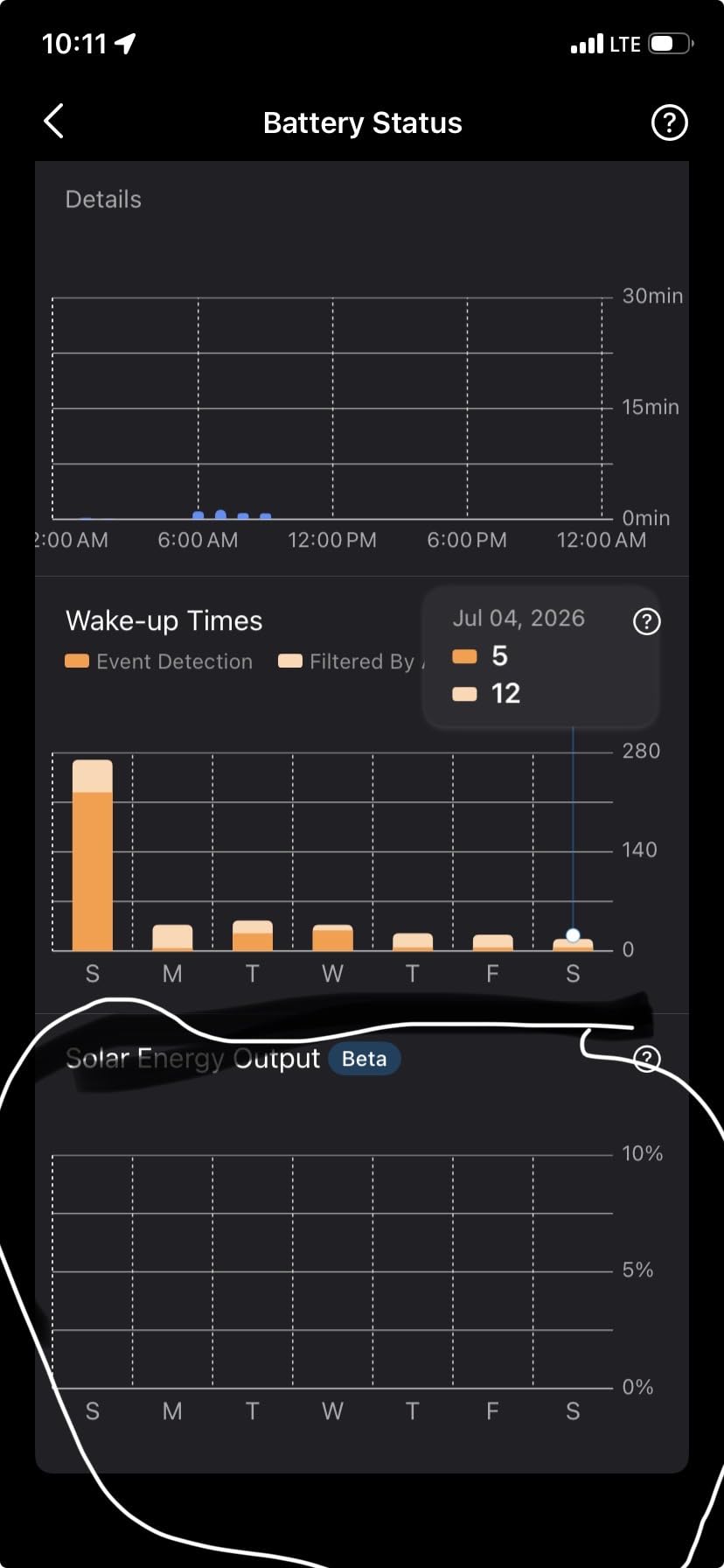
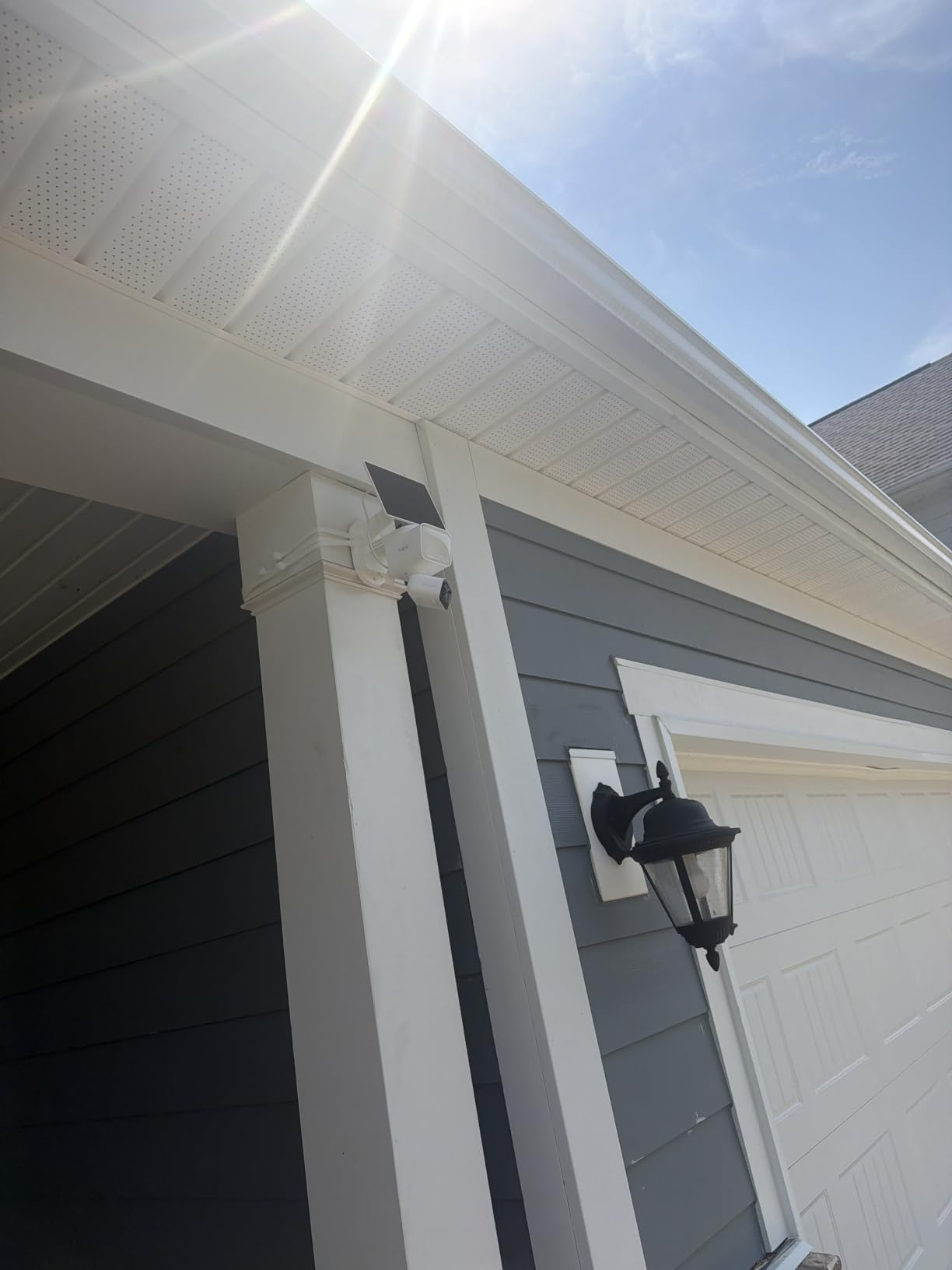
Nobody else in this roundup ships a solar panel in the box, and for a backyard with no power that removes the last obstacle. A 10400 mAh battery plus roughly 45 minutes of direct sun gives you a full day of operation, and the 140-day figure covers long stretches of cloudy weather in moderate climates.
The 512GB microSD slot is the largest local storage option here, and person, vehicle and pet detection is free with no plan attached. The 360-degree pan with 130-degree tilt and AI tracking means one unit can watch a whole yard.
The 800-lumen lamp is the compromise, second dimmest on this list. It is enough to colour a person at close range and useless at 40 feet, so treat it as a presence and convenience light rather than the reason to buy it.
Two limits to plan around. Solar charging needs temperatures above freezing to work properly, so a snowy backyard will lean on the battery. And the 24/7 continuous capture interval feature needs either a microSD card or a separate H500 hub, which is sold on its own.
TP-Link’s security pledge is a small but real consideration for a camera pointed at your own property, and the 2.4GHz-only radio is the same restriction as the WYZE v2.
Where the Tapo C615F fits your yard
It fits a yard with no mains power and no interest in running cable, an allotment, a boathouse or a garden wall. It also fits anyone who wants local storage without a plan and wants the largest card capacity available.
Choose it over the Blink Outdoor 4 when the sun reaches the mounting point, since the included panel is the reason the battery lasts as long as it does.
Where the Tapo C615F falls short
Skip it for a shaded north-facing wall, a snowy climate or any yard where someone needs to be identified at distance, because 800 lumens will not carry that far. The 2.4GHz-only radio also rules it out on a 5GHz-only network.
If you want the floodlight to do the heavy lifting, pick a 2000-lumen wired model instead.
Backyard Buying Guide: Power, Light Output, Storage and Coverage
Wired, battery or solar. A hardwired unit replaces an existing exterior light and never needs attention, which is why four of our top picks are hardwired. A battery unit is the right call when there is no junction box anywhere near the yard, but the lamp is what drains the pack, so a light that fires often means a ladder climb more often. Solar solves both, provided the mounting point gets direct sun, since charging needs temperatures above freezing.
How much light you actually need. Lumens tell you how far the beam carries. Under 1000, you are lighting a doorstep and not a yard. Between 2000 and 3000 is the range that produces identifiable colour at 30 to 45 feet, which is where most backyard encounters happen. The useful rule is to point the beam down and outward rather than straight across, and to dim it at night if a neighbour’s window catches it.
Glare, infrared reflection and insects. These three complaints appear more than any other in customer reviews. Glare comes from pointing a bright lamp at pale vinyl siding or a light fence, so aim the beam at the ground 10 to 20 feet out rather than at a vertical surface. Infrared reflection happens when the IR LEDs bounce off a nearby wall and fog the whole frame, which is why a mounting point with breathing room beats one pressed into a corner. Insects gather around any warm light, so a lower brightness at night reduces the problem more than any other single change.
Storage and the subscription question. Four cameras here record locally with no plan: the WYZE v2, the eufy E340, the aosu 3K and the Tapo C615F, plus local options through a Sync Module for the two Blink models. The Ring hardwired units need Ring Protect for stored video, Arlo gates history behind Arlo Secure, and Google gives three free hours with more behind Nest Aware. Before you choose, add up three years of the paid plan for your camera count. For three cameras, that difference is the largest single line item in a backyard system.
Field of view and coverage planning. A single 140-degree camera covers a gate and a path in a medium yard. Wider models such as the 160-degree Arlo and WYZE v2 push further, but a very wide lens at night produces dark corners because the sensor is spreading its light budget across more pixels. For a large yard, plan on two units rather than one: one at the house covering the near lawn, one at the far corner covering the gate, with overlapping fields of view in the middle.
Mounting height and angle. Between 9 and 12 feet on a rear wall works for most of these cameras, angled down about 30 degrees. Higher than 12 feet and the lamp’s beam flattens out into glare across the yard. Lower than 8 feet and you get more insects and more exposure to weather. If you plan a second camera, keep the two fields overlapping by about a third so nobody can cross the gap unseen.
Neighbour relations. Light trespass is a real source of friction and it is entirely avoidable. Aim down, keep the beam under roughly 3000 kelvin where the manufacturer allows, and use motion zones or the ambient light mode to cut the lamp off when nobody is on your property. If you add a camera and an outdoor television or speaker set later, the same rule applies to the rest of the yard. Our guide to the best outdoor TVs for patios and backyards covers that side of the setup.
Floodlight camera, or a spotlight on a plain camera? If you already have a working exterior light, a separate spotlight camera can drive it and give you more flexible placement. If the light is the problem, not the view, a built-in floodlight is simpler and cheaper to install. The forums are full of people asking whether to replace an existing motion-sensor fixture or mount underneath it, and the practical answer is to replace it, because stacking a camera under another motion lamp leads to two things firing at once and a surprising number of false alerts.
Ecosystem and mounting point. Ring, Blink, Google and the Arlo units all reward existing ownership, because setup and app control get much simpler. If you already have cameras, buy within that system rather than mixing brands. If you are starting fresh and want no recurring fees, the local-storage group is the more interesting path. Whichever you pick, check that the mounting point has usable Wi-Fi before you order, since that was the most common hardware complaint across this list.
Once the camera side is sorted, the rest of the backyard is entertainment rather than security, and our outdoor fireplace guide for backyards covers the other end of that spectrum.
Frequently Asked Questions
What is the best floodlight camera for my backyard?
For most yards, the Ring Floodlight Cam Wired Plus is the strongest all-round choice, pairing 2000 lumens with a 140-degree view and a 105dB siren in a unit that is easy to install over an existing exterior light. If you refuse a monthly fee, choose the WYZE Floodlight Camera v2 or the eufy E340 instead, both of which record locally to a microSD card. For a yard with no power at all, the Tapo solar kit removes wiring entirely.
What is the best outdoor security camera with a floodlight and no monthly fee?
The WYZE Floodlight Camera v2, the eufy Security Floodlight Camera E340, the aosu Wired Floodlight Camera 3K and the Tapo 2K solar floodlight all record without a subscription. The WYZE v2 and aosu models record continuously to a microSD card, and the eufy E340 adds a 3K dual-lens system with 8x hybrid zoom. Blink models also support local storage, but only through a separate Sync Module XR.
Is infrared night vision good enough, or do I need a floodlight?
Infrared night vision works in total darkness but records in black and white, and faces at 30 feet or more usually become an unreadable silhouette. A motion-activated floodlight is what produces colour footage, which is why it matters for identification. The practical compromise is to set activity zones so the light stays off for a yard nobody is using and comes on for the areas where identity actually matters.
How bright should a floodlight security camera be for a backyard?
Aim for 2000 lumens or more if you want identifiable colour footage at 30 to 45 feet, which is the distance where most backyard encounters happen. Below 1000 lumens you are lighting a doorstep rather than a yard. The brightest option here reaches 3000 lumens, and anything between 2000 and 3000 is a sensible range for a medium to large backyard.
Why does my floodlight camera trigger false alerts, and how do I fix it?
Most false alerts come from insects passing close to the lens, swaying branches, headlights beyond the fence and fog. Set motion zones so the street, the tree line and any low shrubs sit outside the detection area, turn sensitivity down a notch, and use the 270-degree PIR sensor to warn you early while masking the non-critical angles. Dimming the lamp at night also cuts the insect traffic that triggers many of these events.
How many floodlight cameras does a large backyard need?
A medium yard up to roughly 40 by 40 feet is covered by one wide-angle camera. A larger property needs two: one mounted on the rear wall covering the near lawn and one at the far corner covering the gate, with the two fields of view overlapping by about a third. Mount each between 9 and 12 feet high and angle it down roughly 30 degrees so the beam covers ground rather than washing out a fence.
Final Verdict for Backyard Floodlight Cameras in 2026
For the best outdoor floodlight cameras for backyards in 2026, the Ring Floodlight Cam Wired Plus remains the pick we would put on our own back wall: proven, bright enough at 2000 lumens, and backed by the largest review base on this page. If you have mains power but want a free local-storage path, the WYZE v2 is the sharper buy. If there is no power at all, the Tapo solar kit handles it with no electrician.
Whichever you choose, aim the beam down and outward, set your motion zones before you climb down the ladder, and confirm the Wi-Fi holds at the mounting point. Check the current details for any of these units before you buy, since firmware updates change detection behaviour often.