
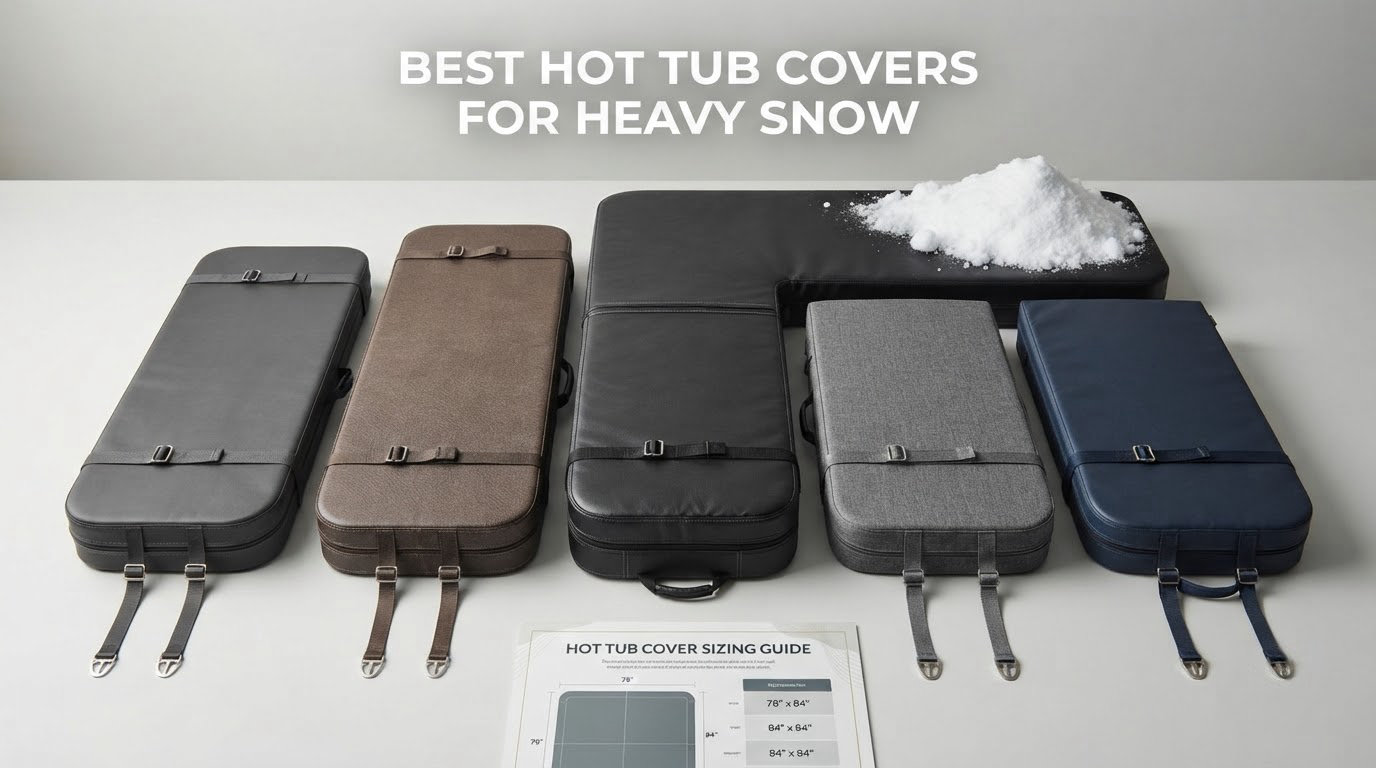
Wet snow is heavier than people expect. A foot of it on a 7 by 7 foot spa puts roughly 500 pounds of load onto the cover, and that weight does not sit over the frame the way a person does. It presses straight down onto the foam core in the middle, where there is no internal support, and the cover bows. Once the foam crushes, the meltwater pools in the low spot, refreezes, and the whole panel is permanently dished. The second failure mode is the opposite one. An empty spa with a cover on it turns that cover into a sail, and wind tears out springs and ratchet straps before the season is half over.
Those two failures are why the best hot tub covers for heavy snow are not the fabric covers that dominate the shopping results. Most of what shows up when you search this topic is a cover protector, an uninsulated outer shell that protects a hard cover from leaves and UV. They add nothing structural. This roundup is built the other way around: I compared the actual insulation cores, taper profiles, vapor barriers and tie-down systems, and I looked hard at what each one can physically carry when the snow turns wet.
We spent several weeks going through spec sheets, warranty terms and owner reviews across ten covers, from custom foam builds down to the fabric caps people layer over an existing hard cover. The picks below span the full spectrum, because the right answer genuinely differs depending on whether you get 40 inches of snow or 100, and whether your spa is under a deck or sitting in an exposed yard.
If you want the general-purpose answer instead, our best hot tub covers roundup covers the off-season basics. This one is only about surviving winter.
Top 3 Picks for Snowy Climates for October 2026
These three came out ahead on the combination of structural core, snow-shedding profile and warranty length. The rest of the list is still worth reading, particularly if you need a fabric layer over a hard cover.

The Cover Guy Premium Custom Cover
- Upgradeable 2 lb foam
- 6-5-4 taper options
- R19 insulation
- Zero water absorption wrap

ULTCOVER 85 inch Waterproof Cap
- 600D polyester canvas
- Waterproof backing
- Side air vents
- Elastic cord fit
MySpaCover Custom EPS Foam Cover
- High-density virgin EPS core
- Tapered snow-shedding foam
- 5-year warranty
- Custom up to 96 inch
All 10 Covers Side by Side for October 2026
Every cover in this roundup, with the specs that matter most once snow is in the forecast.
| Product | Specs | Action |
|---|---|---|
| The Cover Guy Premium Custom Cover |
|
Check Latest Price |
| ULTCOVER Waterproof 85 inch Cap |
|
Check Latest Price |
| MySpaCover Custom EPS Foam Cover |
|
Check Latest Price |
 UCEDER Waterproof 95×83 Cap UCEDER Waterproof 95×83 Cap |
|
Check Latest Price |
 Kipiea 600D Waterproof Cap 85 inch Kipiea 600D Waterproof Cap 85 inch |
|
Check Latest Price |
 Porch Shield 80×80 Waterproof Cap Porch Shield 80×80 Waterproof Cap |
|
Check Latest Price |
 MADHOLLY 7×7 ft 16 mil Spa Blanket MADHOLLY 7×7 ft 16 mil Spa Blanket |
|
Check Latest Price |
 Covermates Classic 84 inch Vinyl Cap Covermates Classic 84 inch Vinyl Cap |
|
Check Latest Price |
 Enzeno 86 inch 420D Waterproof Cap Enzeno 86 inch 420D Waterproof Cap |
|
Check Latest Price |
 QH.HOME 85 inch Ratchet Tie-Down Cap QH.HOME 85 inch Ratchet Tie-Down Cap |
|
Check Latest Price |
1. The Cover Guy Premium Custom Cover – The Snow Load Pick
The Cover Guy Premium Hot Tub Cover | Custom Made Replacement Spa Cover | Energy-Saving Hot Tub Covers Built for All Climates | 6, 5, or 4 inch Taper
R19 insulation
Zero water absorption foam
6, 5 or 4 inch taper
Upgradeable to 2 lb foam
Pros
- Custom built to exact dimensions
- Upgradeable to 2 lb high-density foam
- Zero water absorption foam wrap
- Marine-grade vinyl sheds snow and rain
- 3-year warranty
Cons
- Upgrade consultation required before build
- Longer production window
- Build-to-order lead time
This is the only cover in the whole lineup that lets you specify 2 lb high-density foam in a 6-4 or 5-3 taper, which is exactly the combination you want if wet snow is a regular event. Most owners who have moved up to that density report the difference is not that the cover feels warmer. It is that it does not sag.
The base build is foam wrapped in marine-grade vinyl at R19, cut to your dimensions with a plus or minus half inch tolerance. Zero water absorption construction is the detail I care about most, because it is the thing that keeps the compressive strength intact after the second and third melt cycle.
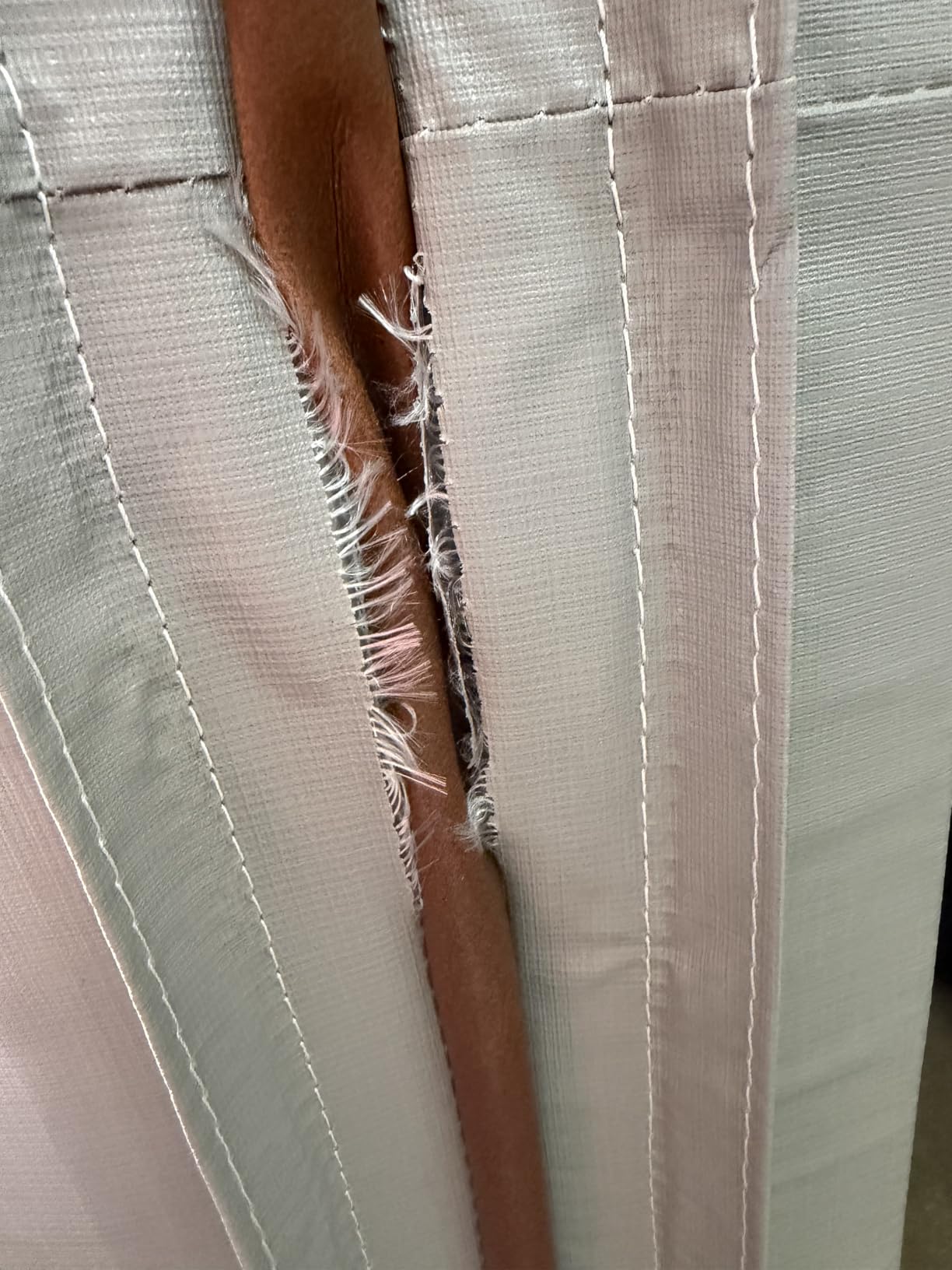
Owners consistently call out the stitching quality and the fact that you can reorder just the vinyl skin later instead of replacing the whole foam core. That single feature changes the economics of a snow-belt cover, where UV and ice damage usually hit the skin long before the foam.
The hinge is insulated, zippers tuck away from the elements and side flaps overlap, all of which cut down the drafts that make a spa expensive to run. In practice the overlap between top and side is where a lot of owners say water still collects, so it is worth watching in the first winter.
Why this survives the snowiest sites
Because you can order the core at 2 lb density, which is roughly 30 percent stronger in compression than a 1 lb core. Add the 6-4 taper and you have the thickest section sitting directly over the center span where a person would stand. That is the load path that keeps the middle from dishing out.
The marine-grade vinyl skin is also the right material for snow. It stays flexible in cold weather and sheds meltwater downhill instead of letting it sit flat and refreeze. Custom fit means there is no loose perimeter flapping in the wind to start with.
Where it falls short
The order starts as a base configuration. A representative contacts you to go over the foam density and taper upgrades, so you cannot simply add 2 lb foam at checkout. Plan for that conversation, and have your exact measurements ready before you call.
Production takes longer than an off-the-shelf cover, and this is a made-to-order build. There is also a persistent tail of reviews about covers arriving mis-built and slow remediation on corrections. Measure twice and photograph the existing frame before you order.
2. ULTCOVER Waterproof 85 Inch Cap – Best Value Outer Layer
ULTCOVER Waterproof Square Hot Tub SPA Cover 85 inch
600D polyester canvas
Waterproof backing
Side air vents
Elastic cord fit
85x85 inch
Pros
- Highest review volume in the roundup
- 600D canvas sheds rain hail and snow
- Side vents reduce trapped moisture
- Adjustable heavy-duty elastic cords
- 3-year warranty
Cons
- No insulation of its own
- Fabric can tear after heavy UV exposure
- Can lift in gale-force wind
With over 8,000 reviews this is the most thoroughly battle-tested cover on the list, and in a snow belt that volume matters. Reviewers describe it as an outer shell that buys extra seasons for an expensive insulated hard cover underneath.
The build is 70 percent polyester with 30 percent PVC in a 600D canvas with waterproof backing, sized 85 by 85 inches. Structured air vents on two sides let trapped moisture escape, which is the detail that keeps mildew from developing under a layer that sits on a tub for five months.
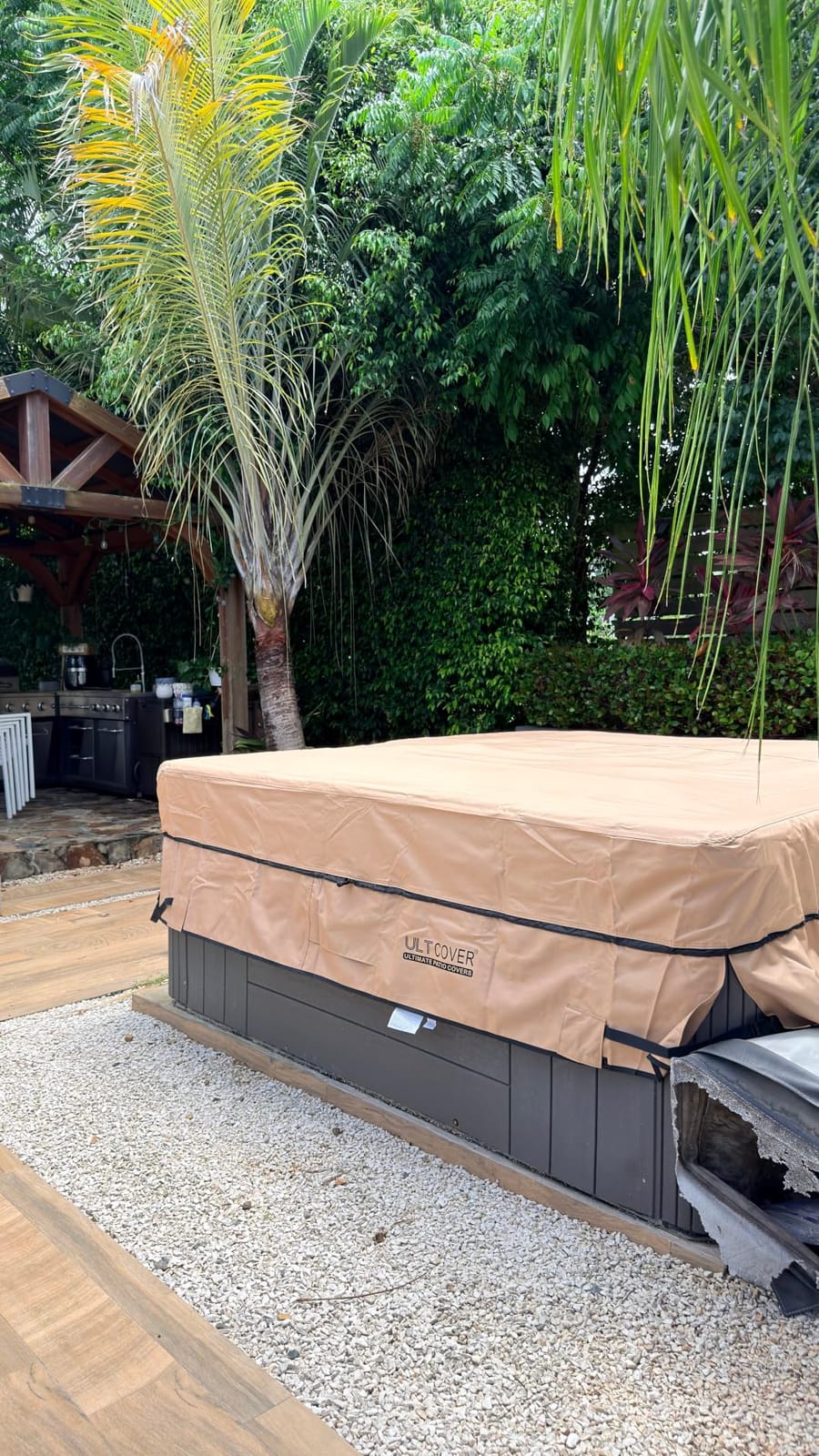
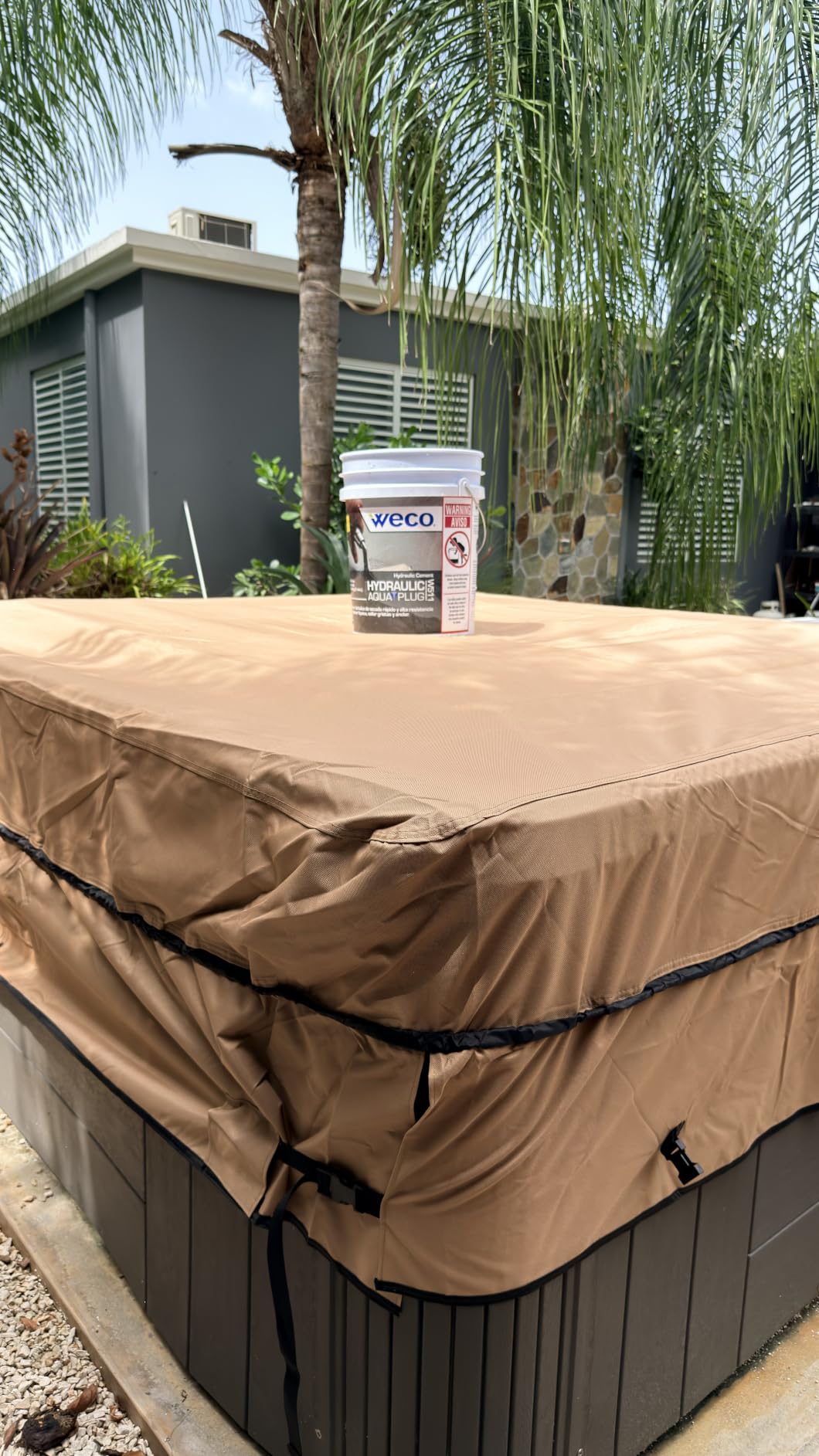
Closing is adjustable heavy-duty elastic cords, and the full-coverage design does an excellent job of shielding the spa shell and hard cover from UV. For a tub you want to keep looking new through a long off-season, that is the real value here.
The limitation is important enough to state plainly. This cannot be your only cover. It provides no insulation, so in real cold it does nothing for heat loss, and the snow still lands directly on whatever hard cover you own.
Best used as the top layer of a two-cover setup
Pair it over a hard cover and it earns its place. UV degradation is the leading cause of hard cover failure, and a full-coverage fabric layer takes the bulk of that exposure. Owners running this combination report three to five years of added life on the insulated cover underneath.
It is also the easiest cover here to throw on during a storm and pull off the next morning. That convenience is the reason it stays in service year after year.
What to watch in a snow climate
Fabric degradation from intense sun exposure shows up after roughly two and a half years, and that is a UV problem more than a cold problem. Expect to replace the cap on a cycle, not the hard cover.
Wind is the other weak point. Reviewers report the cover lifting even with cords tightened during extreme gusts, so in an open yard you should plan to add your own restraint rather than relying on the elastic alone.
3. MySpaCover Custom-Made EPS Foam Cover – Longest Warranty
MySpaCover Custom-Made Hot Tub and Spa Cover Replacement | High-Density EPS Foam Insulation | HydroTex 600D or Marine Vinyl | Any Shape and Size up to 96 x 96 in. | 5-Year Warranty
High-density virgin EPS core
Tapered foam sheds snow
5-year warranty on 600D
Custom to 96 x 96 inch
Pros
- Custom fit in square and specialty shapes
- Sloped core sheds melting snow
- Sealed foam wrap resists moisture
- 5-year warranty on 600D version
- Reinforced double stitching
Cons
- Custom build takes 1 to 2 weeks
- Size and color cannot change after ordering
MySpaCover is the strongest warranty in the group, five years on the HydroTex 600D fabric version, and that is a signal worth paying attention to. Manufacturers extend coverage when they expect their product to sit through harsh winters without complaint.
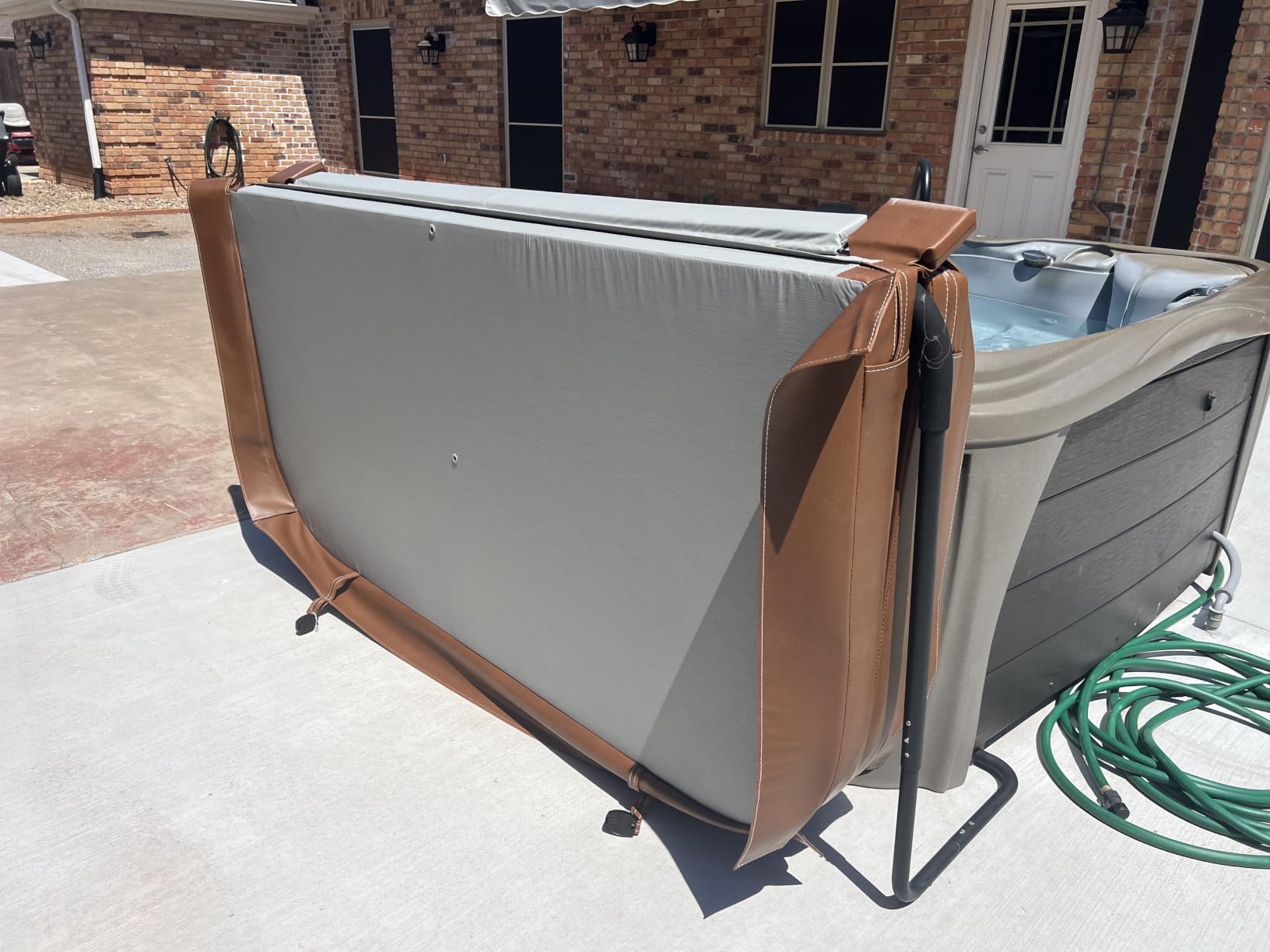
The core is high-density virgin EPS foam, and the geometry is a sloped core rather than a flat panel. That slope is the snow feature: melting snow runs off instead of pooling in the center, which removes the standing water that causes ice dams and drives meltwater into the seams.
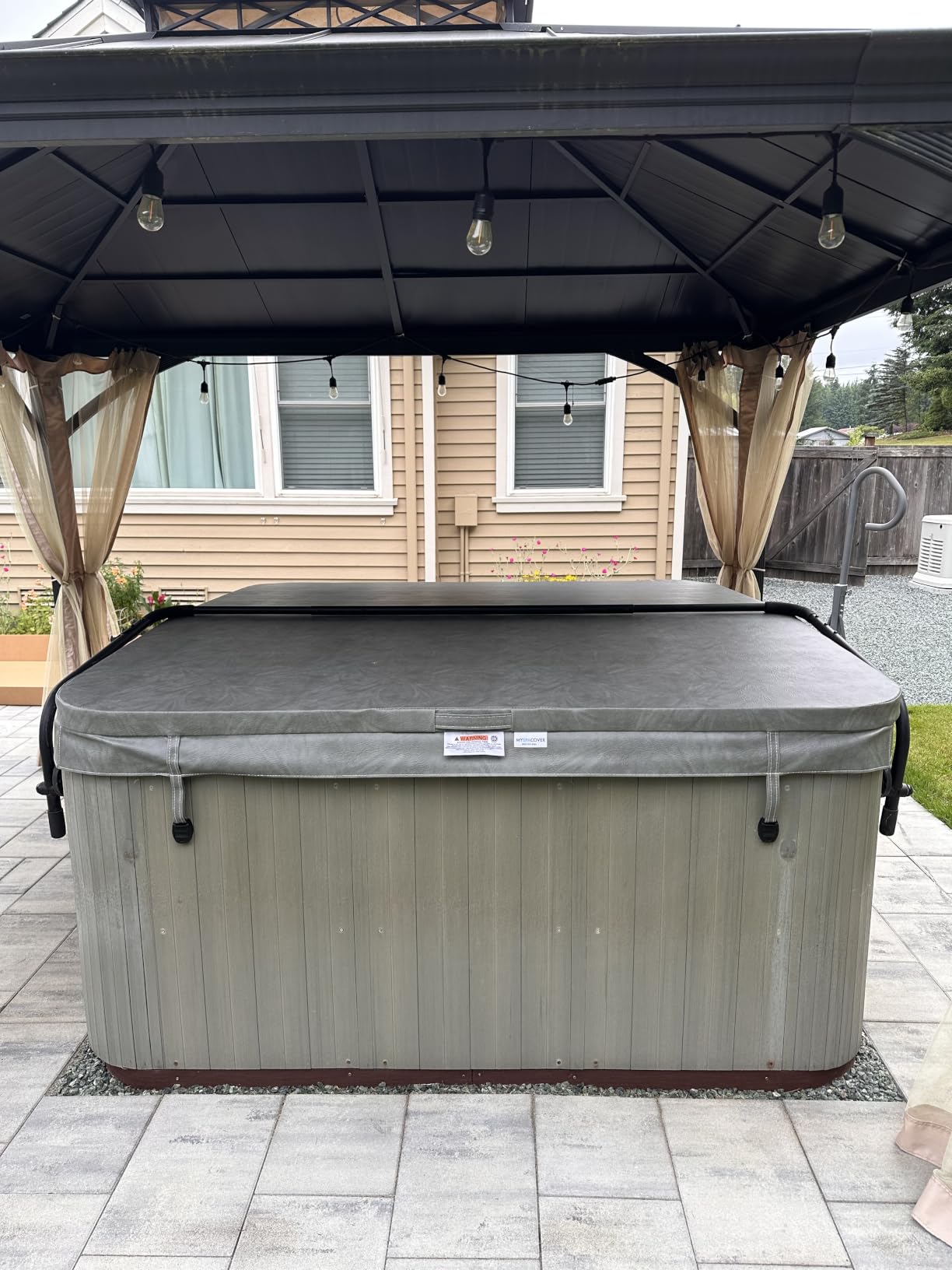
You can order it in square, rectangular and specialty shapes with five corner radius options, up to 96 by 96 inches at plus or minus half inch tolerance. Buyers consistently praise the precise fit and report noticeable cuts in heater runtime once the cover is on.
Two material choices are offered. The 600D HydroTex fabric carries the five-year warranty, while 30 oz marine vinyl comes with three years. For snow, the sealed foam-core wrap is doing the heavy lifting in both versions.
Where the tapered core earns its keep
Almost every cover failure we read about in owner forums traces back to water sitting on the cover. A sloped core pushes that water off, so the foam never spends months partially submerged and saturated. Snow load still matters, but water management is what decides whether the core stays stiff for five seasons.
The custom sizing also helps in snow country, because a tight perimeter removes the flapping edge that lifts and slaps in wind. Every extra inch of gap is another inch of sail.
Where it falls short
It is a made-to-order build. Budget roughly one to two weeks before delivery, which matters if you are ordering in October and expecting to be covered before the first storm.
Once you place the order, size and color are locked. Get the measurements right the first time, and if your tub is an unusual shape, check that the corner radius options cover it before you commit.
4. UCEDER Waterproof 95 x 83 Inch Cap – Best for Deep Cold Fabric
UCEDER Waterproof Hot Tub Cover -Outdoor Spa Cover Cap(95”x 83”)
600D polyester with TPU backing
Cold resistant to -15 C
Dual side air vents
Side zipper
Pros
- TPU backing rated near -15 C
- Thicker material than most caps
- Side vents reduce internal moisture
- Works over cover lifters
- Owners report 3 to 5 years protecting hard covers
Cons
- Built-in bungee straps ineffective in strong wind
- Runs slightly large
- Needs an insulated hard cover underneath
This is the cap to look at if your winters are genuinely cold rather than merely snowy. The backing is TPU rather than PVC, and owners describe it as rated for temperatures down to about -15 C, which is where PVC starts to get stiff and brittle.
That matters more than it sounds. Cold-stiff fabric cracks along fold lines, and a crack in a cover protector is an opening that lets meltwater reach the hard cover underneath, which is the exact failure you are paying to prevent.
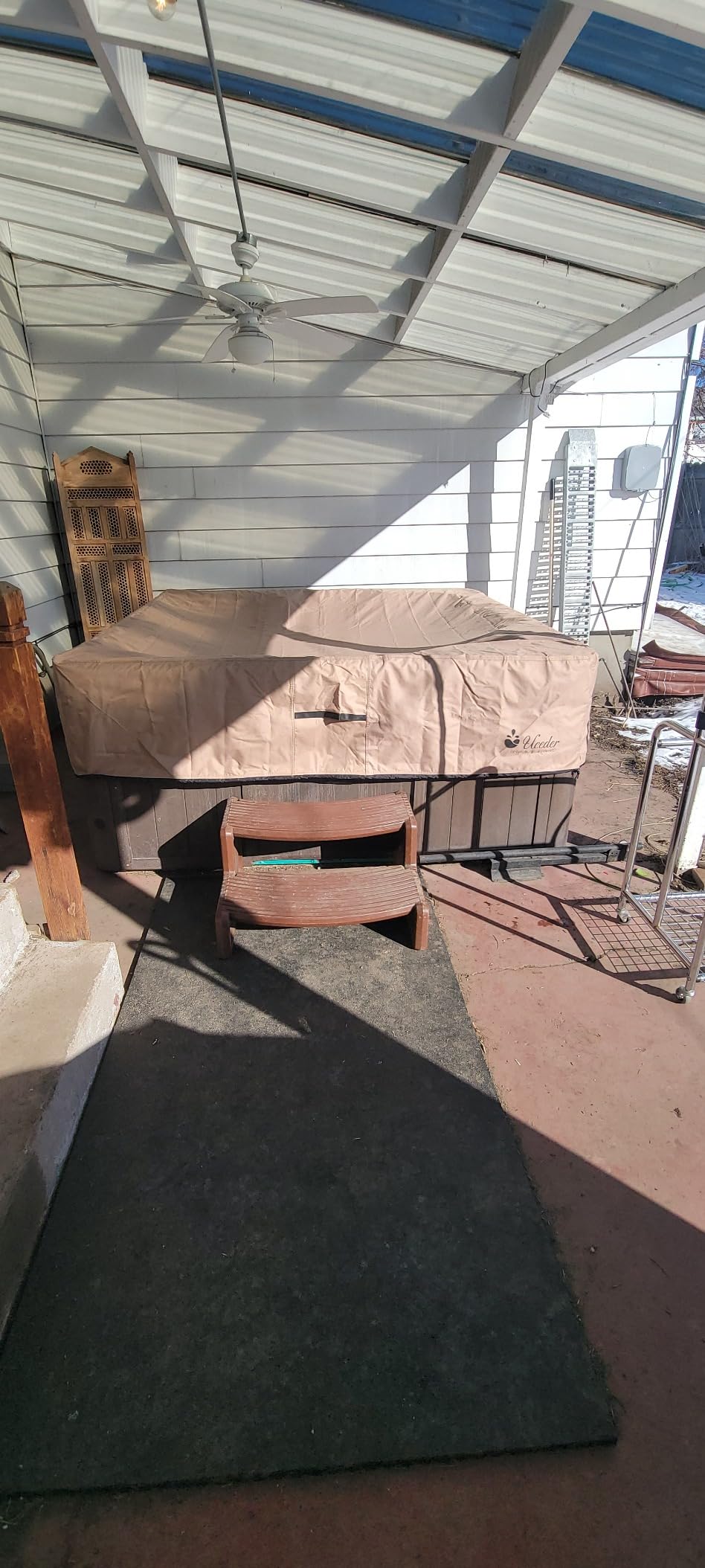
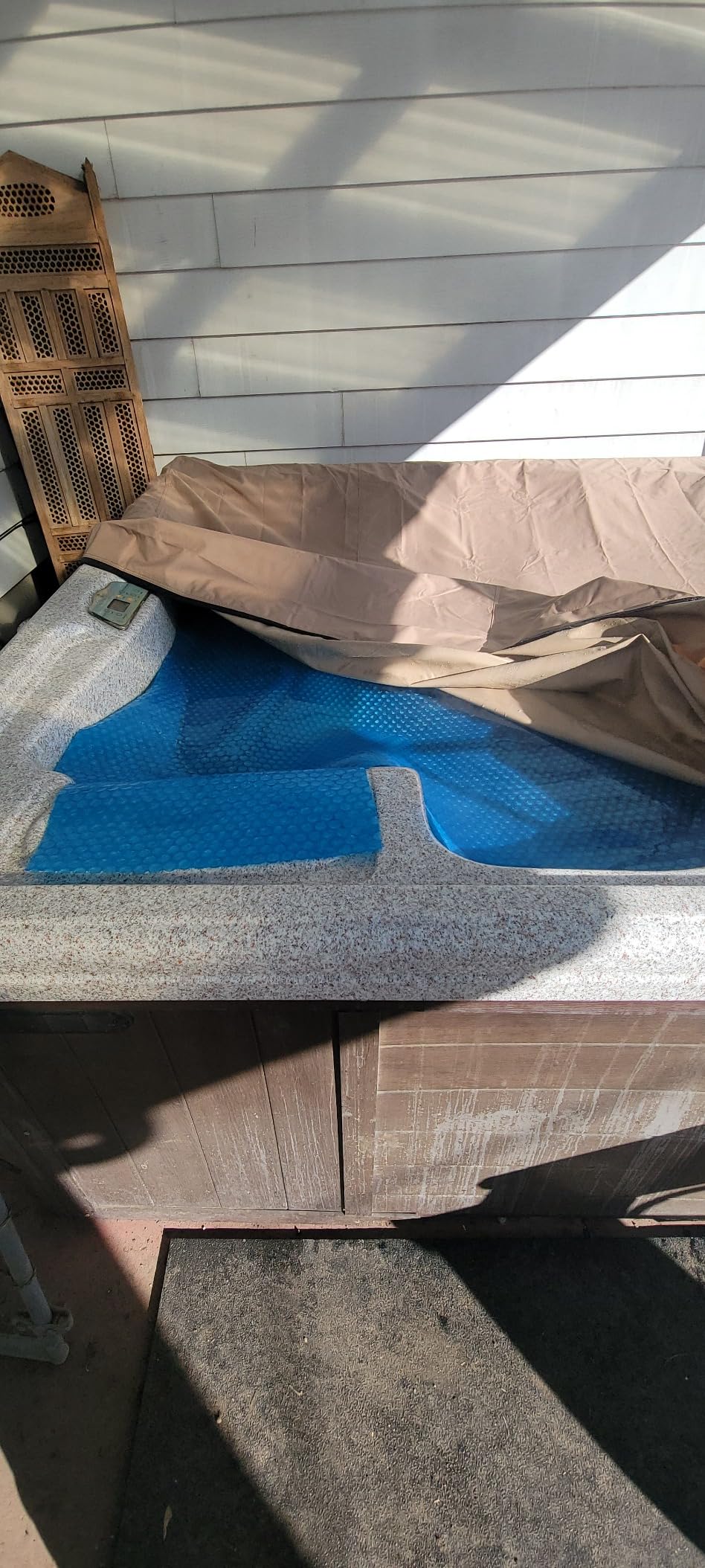
The material is noticeably thicker than most competing caps, at 95 by 83 inches with a 20 inch drop. Dual side air vents circulate air so moisture does not sit between the layers, and the side zipper makes it manageable when you need to get at the tub quickly.
Owners report three to five years of service protecting expensive hard covers, and the fit works well over a cover lifter. Compatibility is listed with Hot Spring, Essential Hot Tubs and Life Smart among others.
Why cold-rated backing matters more than thickness
A thicker cover made of a material that goes brittle at minus 15 is worse than a thinner one that stays supple. Flexibility is what lets fabric drape over a snow load instead of cracking and letting water through. TPU holding its properties in deep cold is the reason this one stands out.
The air vents and the 20 inch side drop also do quiet work. The drop weights the lower edge so it stays seated, and the vents keep the trapped-air pocket from turning into a condensation chamber over five months.
Where it falls short
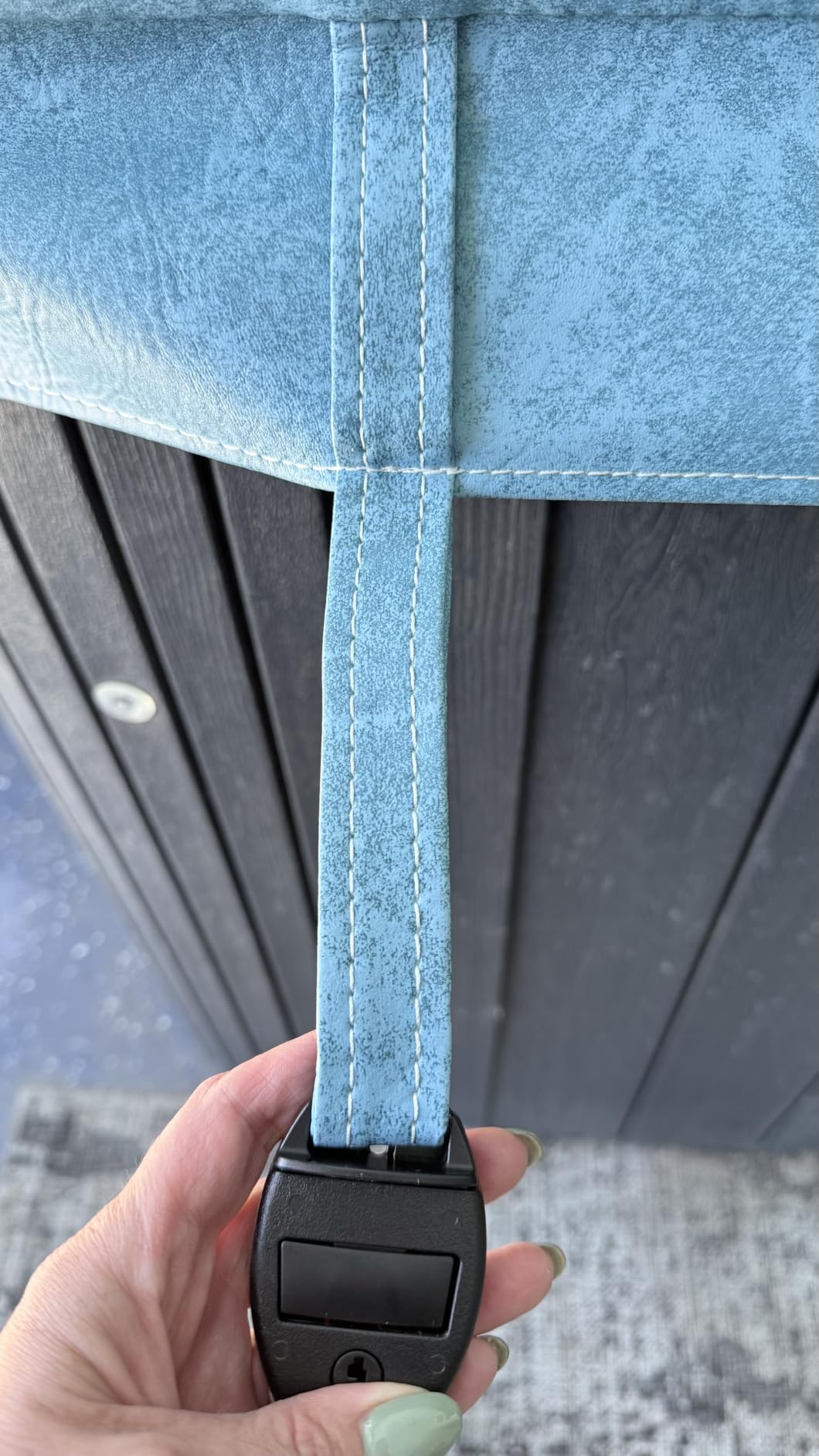
The built-in D-ring strap and bungee cords are the weak point, and owners are blunt about it: in strong wind they do not hold the cap down. Many owners add their own tie-down straps, which defeats some of the convenience but solves the problem.
It also runs slightly large, and for a 95 by 83 inch footprint that makes it awkward to put on and remove in the cold. Plan for two hands and a step stool rather than trying to wrestle it on alone.
5. Kipiea 600D Waterproof Cap – Best Wind Strapping
Kipiea 600D Outdoor Waterproof Square Hot Tub Cover Protector, Heavy Duty Polyester SPA Cover UV Protection Cover 85″ L x 85″ W x 20″ H, Black
600D Oxford fabric
Double-layer PU coating
Taped seams
4 side plus 4 corner straps
85x85x20 inch
Pros
- Highest rating in the roundup
- Taped seams rated for high water pressure
- Four side plus four corner windproof buckles
- UV coating blocks nearly all rays
- 16 size options including 111x95 inch
Cons
- Sizing runs generous
- No insulation value of its own
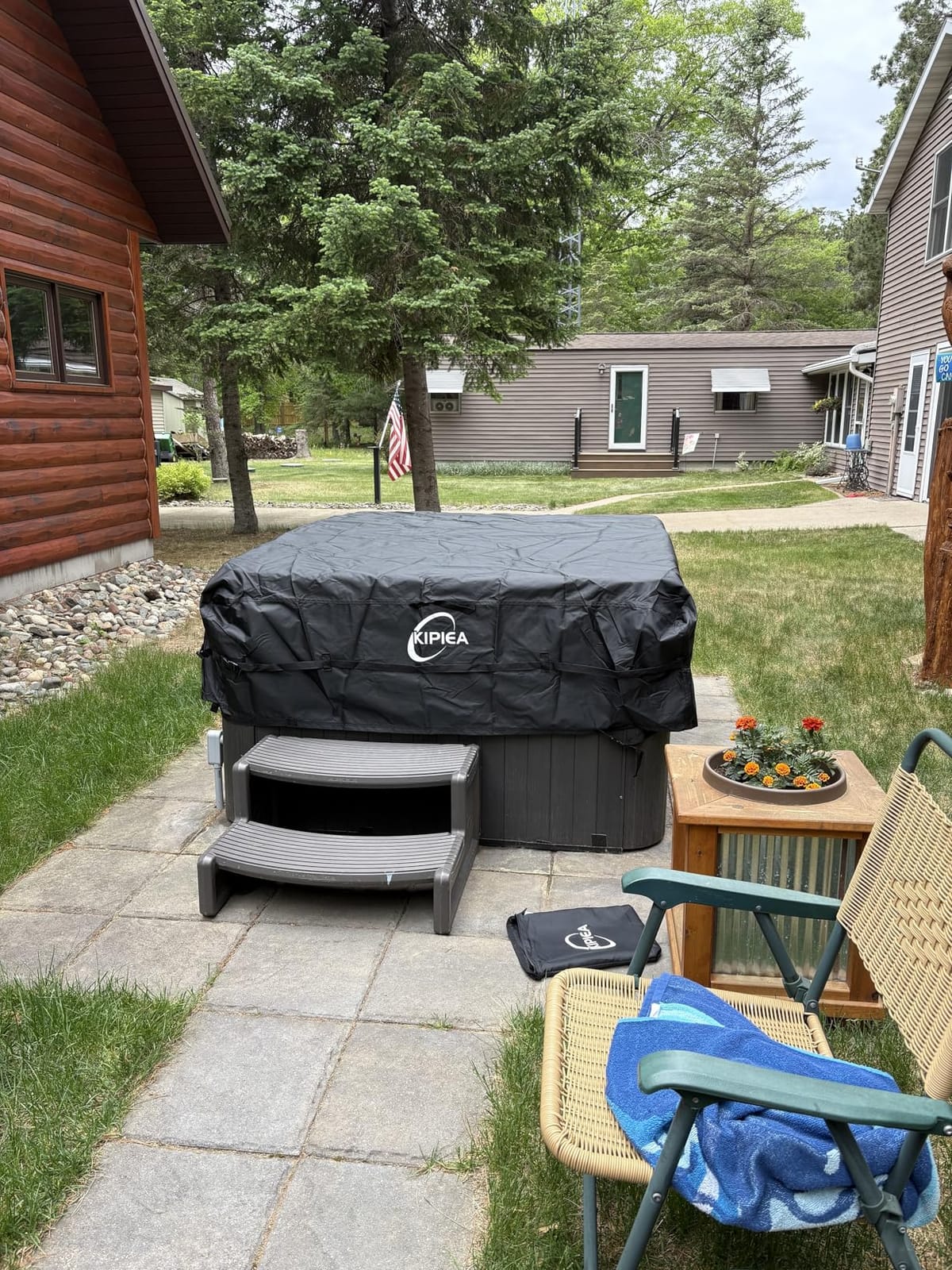
The restraint system is the headline here. Four side straps plus four corner straps with windproof buckles is more attachment points than any other cap we reviewed, and 81 percent of its reviews are five star. Owners single out the strap placement as the reason theirs has stayed put.
Strap placement is not a detail. Buckles at the corners resist the diagonal pull that lifts a square cover off a square tub, while mid-side anchors stop the long edges from flapping. Covers with elastic only lose at the corners first.
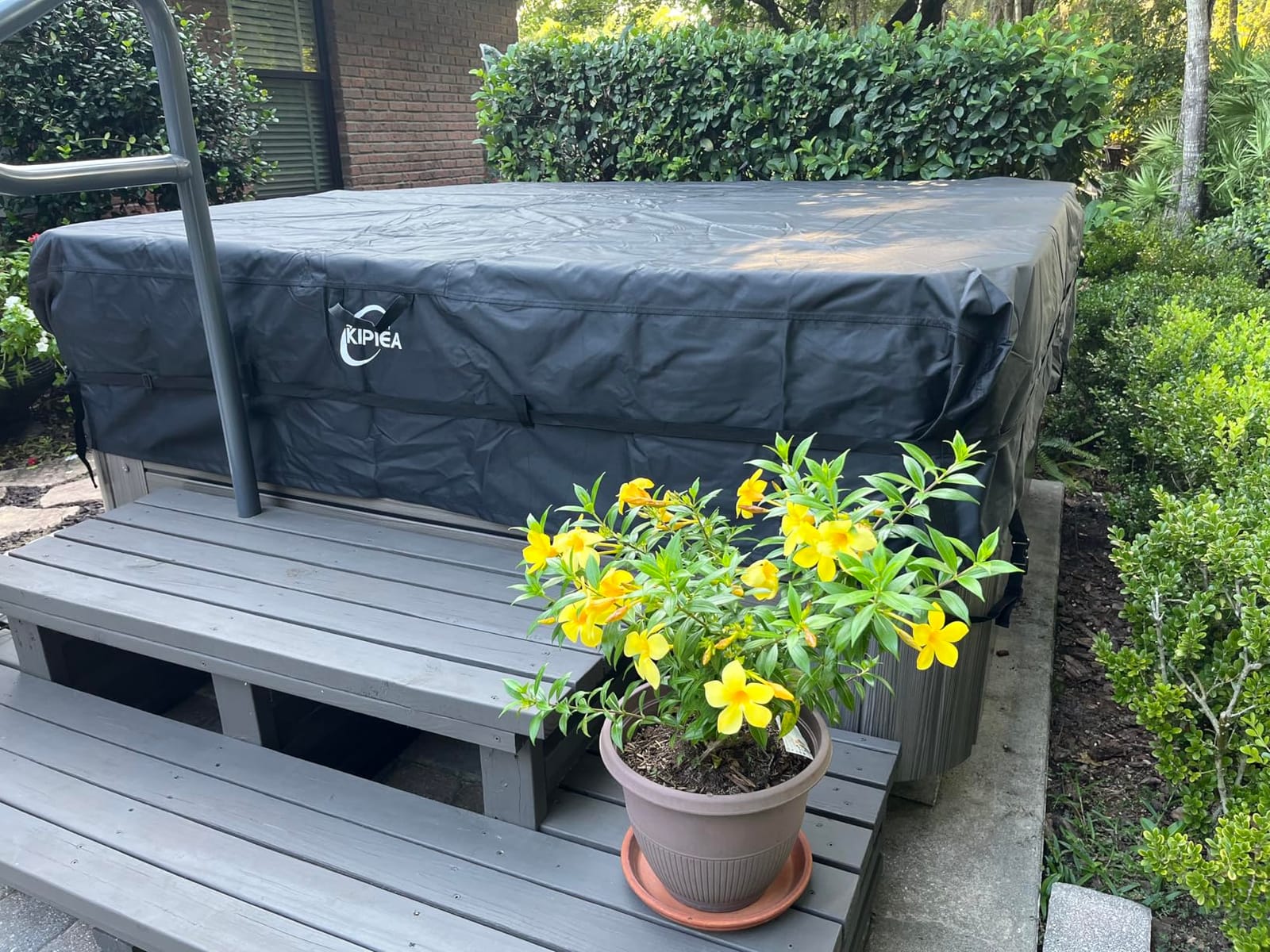
The fabric is 248 GSM 600D Oxford with a double-layer PU waterproof coating and taped seams rated to withstand high water pressure. Several owners use it as a second layer over an existing hard cover straight through winter, which is the role we would put it in.
The UV coating is aggressive, blocking close to 99.99 percent of rays, and that is what limits fading and cover aging on the shell below. Size choice runs to 111 by 95 inches for very large spas.
Best pick for an exposed or windy yard
Eight buckle points is the answer to the wind-lift problem that owners complain about repeatedly in cheaper caps. In an open backyard or a lakefront property with nothing to break the wind, this is the cap most likely to still be there in March.
The high-and-low watershed strap arrangement keeps the cover planted on both square and rectangular tubs, which matters because a cover that shifts a few inches every storm wears its own seams out faster than the fabric wears out.
Where it falls short
Sizing runs generous, so it is easy to over-order and end up with a loose fit that undermines the very strap security you are paying for. Measure the tub rather than the hard cover, and check against the listed dimensions.
As with the other caps here, it provides no insulation. It belongs over an insulated hard cover, not instead of one.
6. Porch Shield 80 x 80 Inch Cap – Best for Daily Access
Porch Shield Waterproof Outdoor Hot Tub Cover SPA Protector 80 x 80 inch
600D polyester undercoating
Double-stitched sealed seams
Sliding clips and buckles
Folds over a cover lifter
3-year warranty
Pros
- Folds back over a cover lifter in seconds
- Double-stitched sealed seams
- Large air vents reduce condensation
- Long sidewalls resist blowing off
- 3-year warranty with replacement support
Cons
- Fabric can fade after a year or two in direct sun
- Some fail within one harsh winter
- Not insulated
The defining feature is how it interacts with a cover lifter. Owners with lifters fold this cap back over the mechanism and get to the water in seconds, which is exactly what you want if you are soaking through a January in a snow belt.
That use case changes what matters. A winter-only cover can be whatever is most durable, but a cover you open twice a week has to be convenient or you will stop bothering with it. This one is built for that.
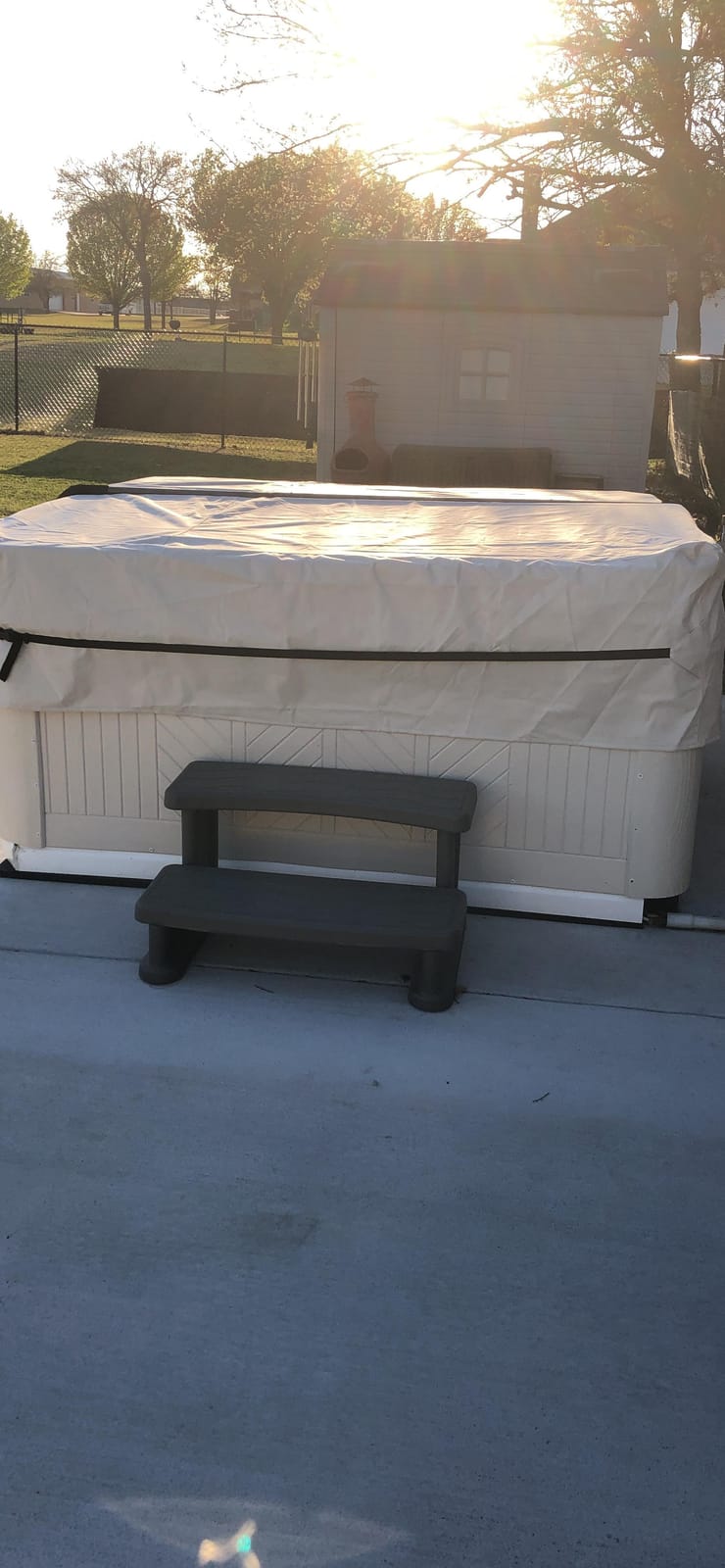
Construction is 600D polyester with a waterproof undercoating, UV-resistant treatment, double-stitched and sealed seams, and large air vents that prevent condensation and mold between the layers. It fits hard covers up to 80 by 80 by 20 inches.
Restraint comes from adjustable sliding clips plus quick-release buckle straps, and the long sidewalls are what make it hard to blow off. Ribbon-weaving handles make install and removal straightforward.
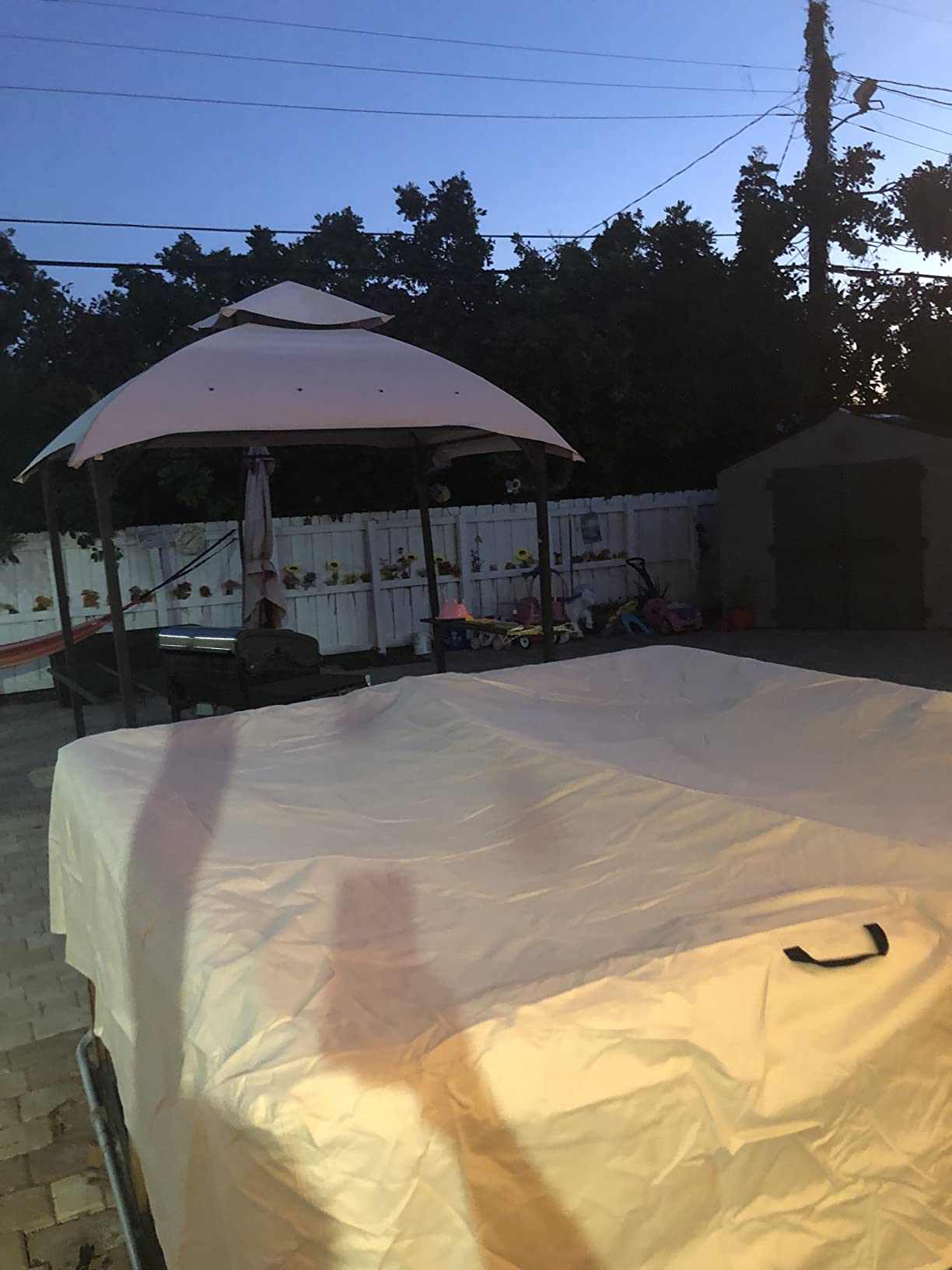
Best when you want to use the spa all winter
Quick access is the whole point. If you plan to keep the water hot and soak through the cold months, a cap you can throw back and fold over the lifter changes how often you actually use the tub. Heavy snow and frequent access are in direct tension, and this resolves it.
The vents matter here too. A cover opened and closed repeatedly traps more moisture than one that stays shut, and the large vent openings keep that moisture moving instead of settling into the foam.
Where it falls short
Durability splits by climate. Mild-snow owners report getting several years out of the fabric, while owners in harsh sun or severe conditions report failure inside a single winter. At 4.13 kg it is also one of the heavier caps, which is awkward when it is wet or snow-laden.
Reviewers also note that a strap can snap if over-tightened, and fading shows up after a year or two of constant direct sun. Replace it on a cycle rather than expecting it to last a decade.
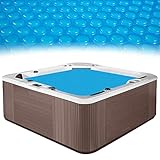
7. MADHOLLY 7 x 7 Ft 16 Mil Spa Blanket – Best Floating Blanket
MADHOLLY 7×7FT Square 16Mil Heavy-Duty Spa Hot Tub Cover for Heat Retention
16 mil LDPE bubble
7x7 ft trimmable
Floats on water
Cuts snow melt on hard cover
Pros
- 16 mil is about 50 percent heavier than typical bubble blankets
- Cuts evaporation substantially
- Reduces snow melt on the hard cover
- Trim to fit with scissors
- Transparent blue adds solar heating
Cons
- Bubbles go brittle after 12 to 18 months
- Cutting leaves scrap on round tubs
- No storage bag included
This one works differently from everything else here. It floats on the water rather than sitting above it, which means it never takes a direct snow load at all. Snow lands on the hard cover, and this blanket sits underneath, holding heat and slowing the melt.
The 16 mil LDPE bubble is roughly 50 percent heavier than the typical 8 to 12 mil blankets, and that is the point. Thin bubbles crack and delaminate under freeze-thaw cycling, and 16 mil is what keeps them intact through a full season.
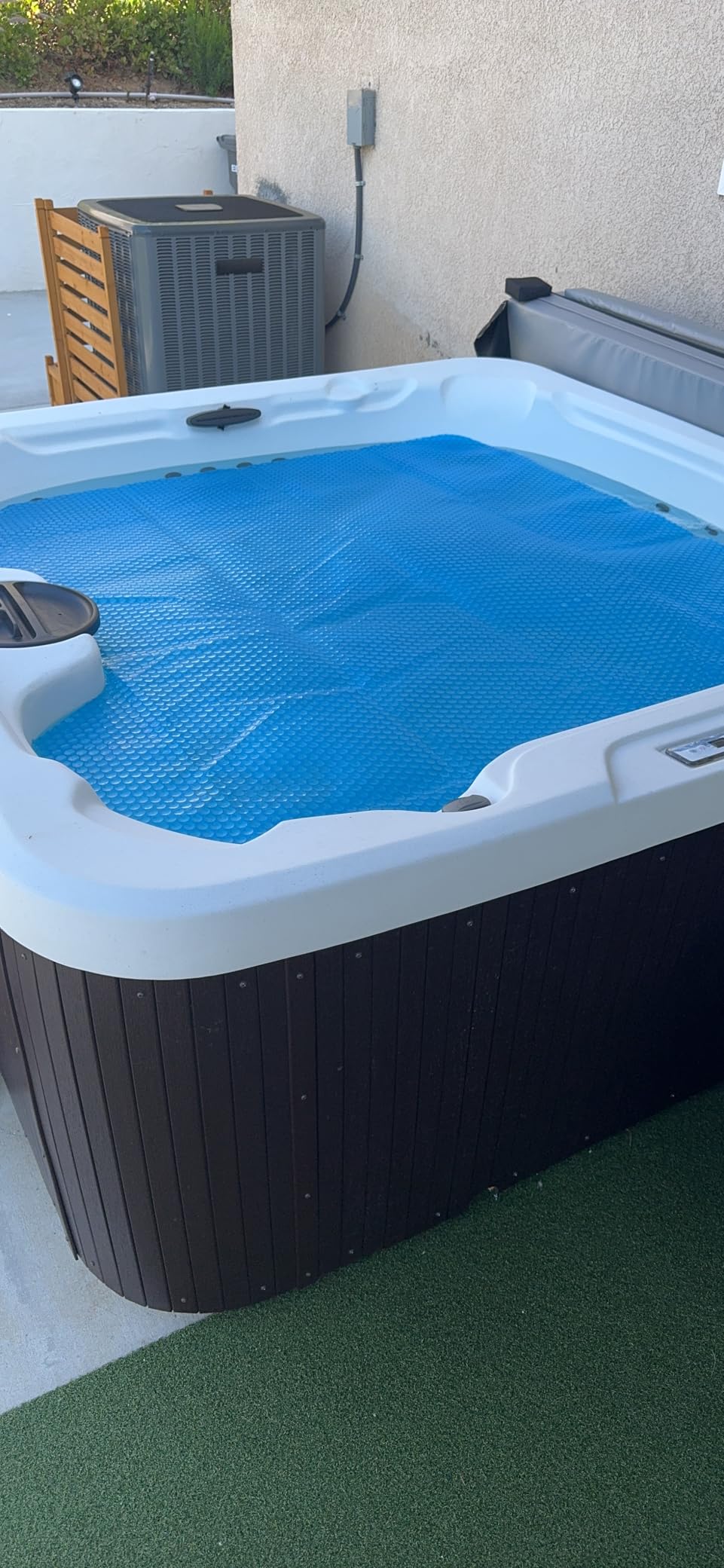
Owners report water levels that stop dropping, and reduced snow melt on the hard cover, which retains heat longer in cold weather. The blanket reduces evaporation by up to 95 percent, and transparent blue lets sunlight through for solar gain on clear winter days.
Installation is the easiest in the roundup. It floats with no tools, no anchors and no straps. You trim it to fit with scissors, bubbles down and smooth side up.
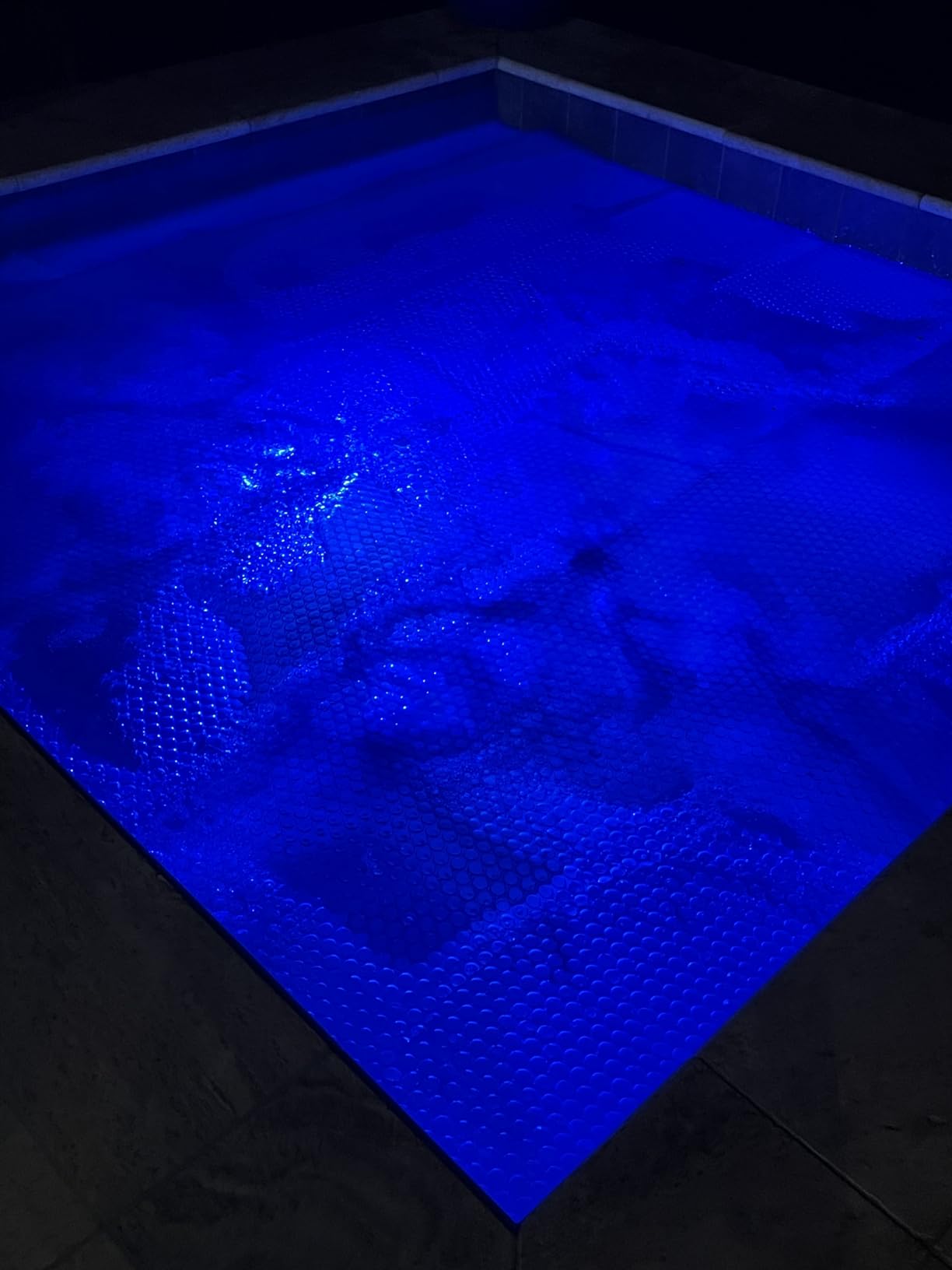
Best as the bottom layer, not the top layer
Put it in the right position and it solves a problem the others cannot. Because it floats on water, a full tub supports it, and it never becomes a membrane that snow can press down on. Pool and spa forum discussion makes the same point about filled tubs generally.
The combination that works is this blanket floating inside, an insulated hard cover on top, and optionally a fabric cap over that. Each layer handles something different: evaporation, load, and UV and wear.
Where it falls short
Bubbles become brittle and crack after roughly 12 to 18 months of heavy use, so this is a seasonal consumable rather than a long-term investment. Budget for replacing it most winters in a cold climate.
You have to trim it yourself, and rushed cuts leave gaps at the edges. Cutting a round tub also produces real scrap. No storage bag is included, and storing a brittle blanket folded in a cold shed is how it cracks early.
8. Covermates Classic 84 Inch Vinyl Cap – Best for Storage Seasons
Covermates Classic Square Hot Tub Cover – 84W x 84D x 14H, Tan
84x84x14 inch fit
12-gauge vinyl with polyester lining
Elastic bottom hem
2-year warranty
Pros
- 12-gauge vinyl resists scratches in storage
- Elastic bottom hem holds without a drawcord
- Blocks UV on the hard cover and shell
- Wide size range for square and round tubs
- 2-year warranty
Cons
- Only 14 inch tall so it will not clear a taller cover
- Heavier than polyester alternatives
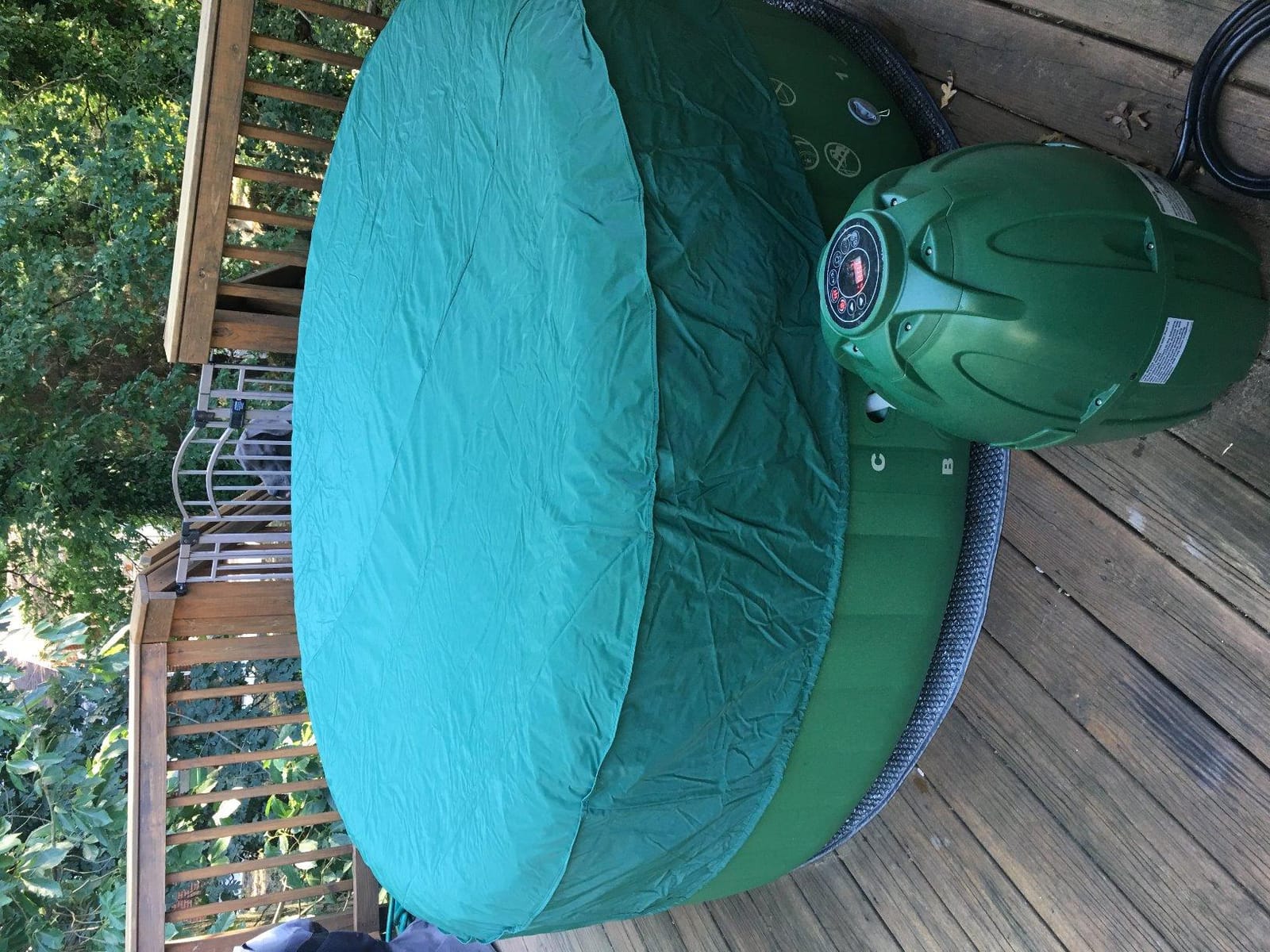
Not every hot tub gets used in winter. For a seasonal tub that is sitting covered from October to April, the job is purely protection, and this cap is built for that. The 12-gauge vinyl with a soft polyester lining takes scuffs and abrasion during storage without marking the shell.
The elastic bottom hem grips the tub without needing a drawcord, which means nothing to freeze stiff and nothing to snap. There are no buckles to lose in the snow.
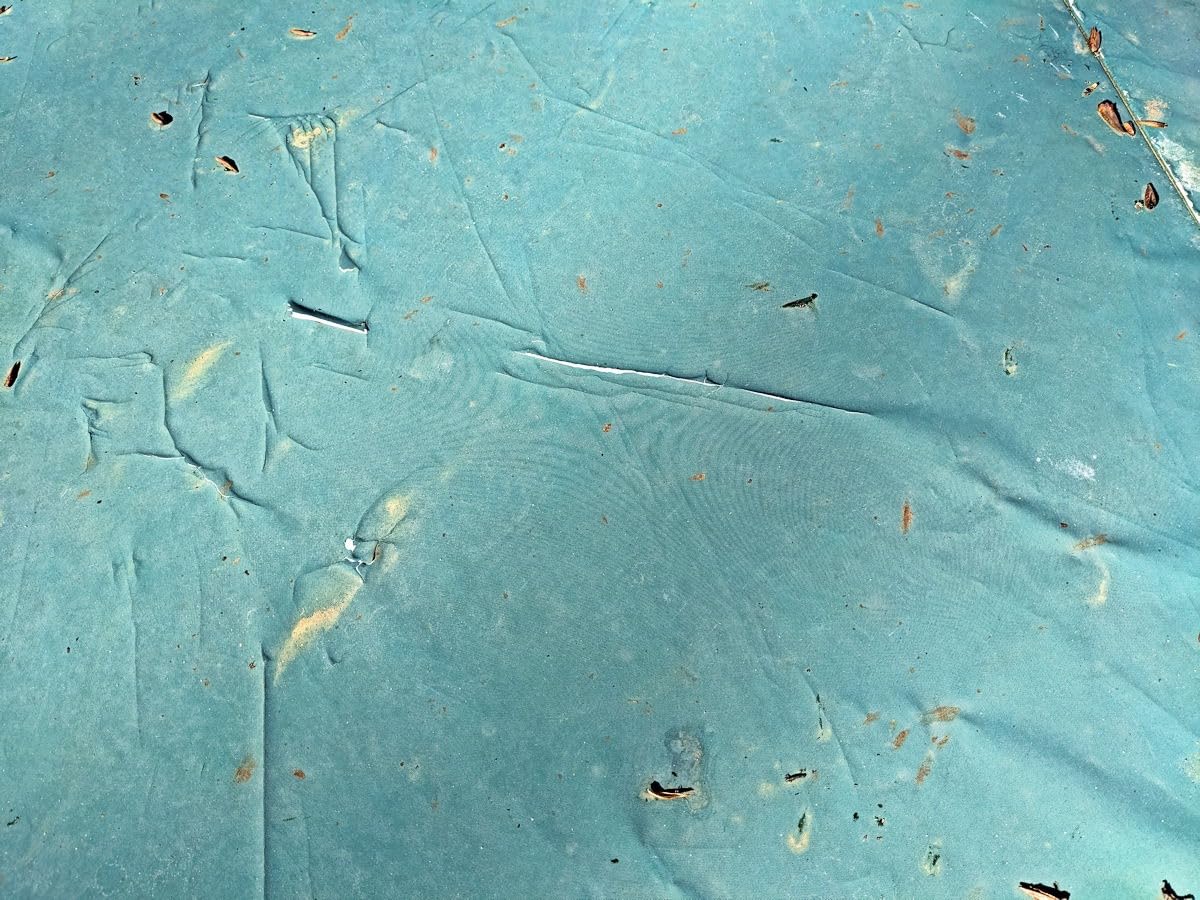
It fits square tubs up to 84 inches wide and deep by 14 inches high, and blocks UV damage to both the hard cover and the spa shell year-round. The size range covers square, rectangular and round tubs, and it weighs 4.3 pounds.
This is a middle-of-the-road performer on rating, and it carries the shortest warranty here at two years. For a tub that will not be touched until spring, that is an acceptable trade.
Best when the tub is dormant all winter
Storage is harder than people expect. Leaves, ice, hail and UV all attack a parked tub for five months, and a taut vinyl cap with an elastic hem deflects all of it without any hardware that can fail. There is no wind rating issue because nothing needs to be fastened.
It is also the least fiddly option. No ratchets to reset after a freeze, no buckles to re-thread, nothing to check after a storm.
Where it falls short
The 14 inch height is the real constraint. It will not clear a taller hard cover or raised cover-lifter hardware, so it is the wrong fit if your installation has height above the tub lip. Measure the drop before you buy.
At 4.3 pounds the vinyl outer is heavier than the polyester caps, and it is limited to square tubs up to 84 inches. If your spa is larger, this is not the option.
9. Enzeno 86 Inch 420D Waterproof Cap – Best Lightweight Option
Enzeno Outdoor SPA Hot Tub Cover Waterproof Square 86 x 86 inch fit 84 x 84 or 83 x 83 or 82 x 82 or 7 ft x 7 ft 420D Heavy Duty Cub Hot Tub Lid Protectors Protective Cover Cap
86x86 inch square
Nano PU coating at 15000 pa
Heat-sealed seam tape
Stereo air vents
1.31 kg
Pros
- Very light at 1.31 kg for easy handling
- Heat-sealed seams rated to 15000 pa
- Upgraded stereo vents cut condensation
- Two center buckles plus full drawstring
- Silver nano UV coating underneath
Cons
- 420D fabric is lighter than 600D rivals
- No insulation of its own
- Only six rectangular sizes available
Weight is the reason to pick this. At 1.31 kg it is roughly a third the mass of the vinyl caps, and in a snow climate where you are lifting an object off a frozen tub, that difference is felt immediately.
The waterproofing is genuinely better than the fabric weight suggests. A nano PU coating plus heat-sealed seam tape carries a 15,000 pa water pressure rating, and heat-sealed seams do not fail at a stitch line the way stitched-only seams tend to.
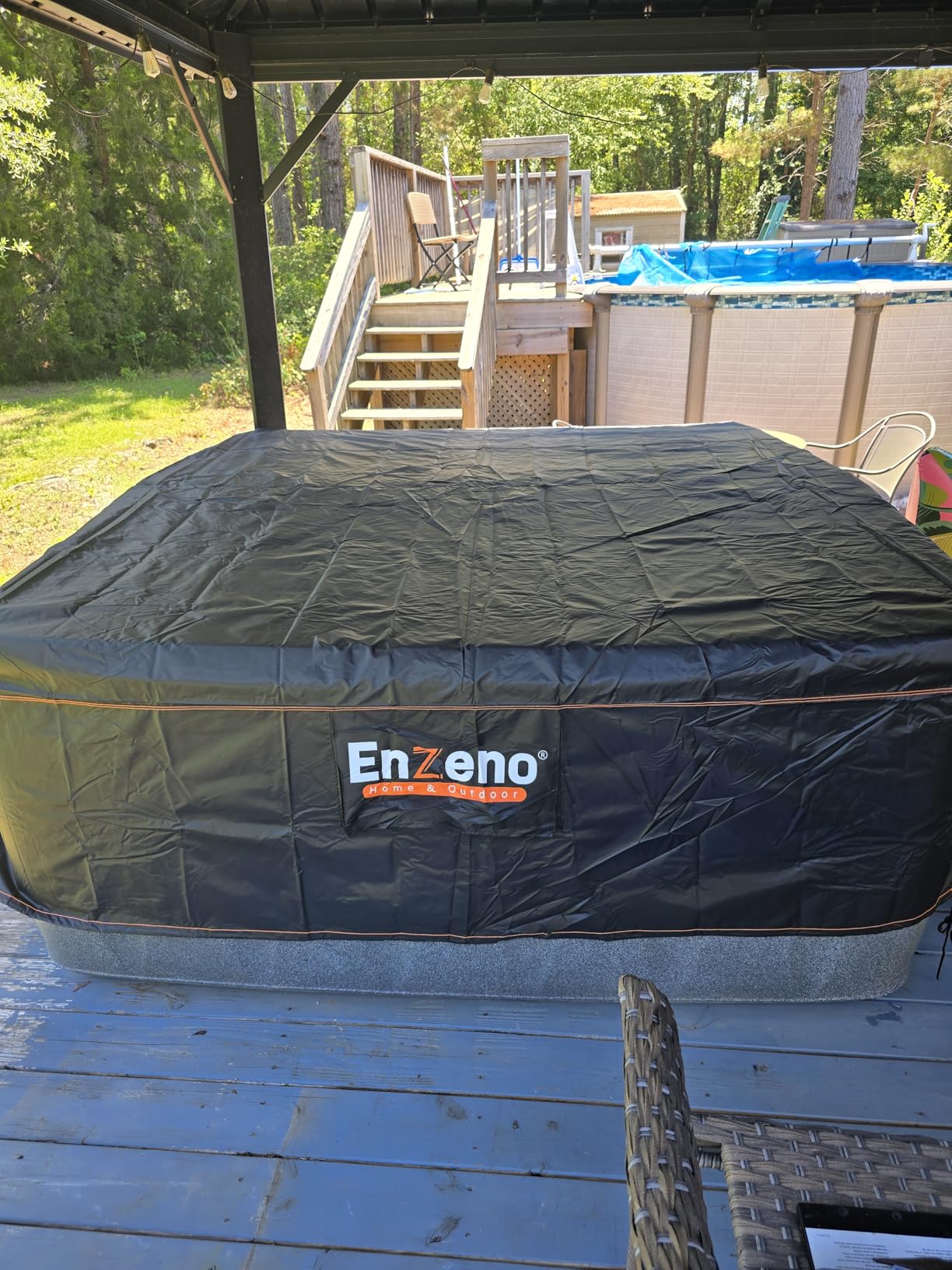
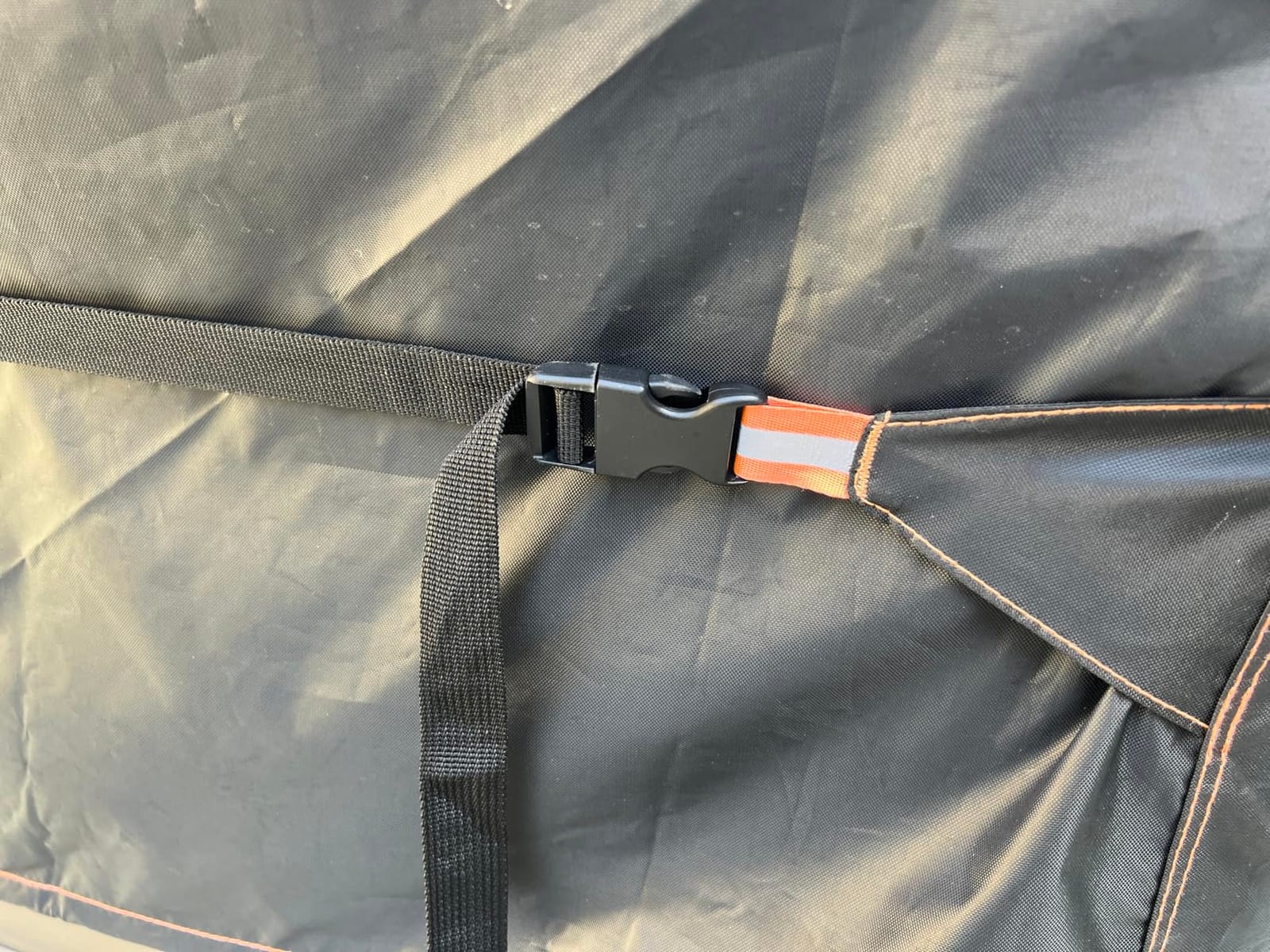
Second-generation stereo vents increase airflow and cut internal condensation, which is the main source of mildew under a cap that sits for months. Two woven strap buckles at the center plus a full-perimeter drawstring hold it in place.
It fits 7 by 7 foot, 82, 83 and 84 inch square tubs and several rectangular sizes, and there is a side waterproof zipper for handling and storage. A silver nano UV coating on the underside adds sun protection.
Best for one-person handling in the cold
Lifting a wet or snow-laden cover alone is a real injury risk, and owners chasing motorized systems usually start from exactly that experience. A lighter top layer cuts the weight you are moving at the moment when your hands are cold and your grip is worst.
The vents are the second reason. Condensation under a cap that sits on a warm tub for five months is what drives mold, and stereo venting addresses it more directly than heavier material does.
Where it falls short
420D Oxford is lighter and less tear-resistant than the 600D fabric used by several rivals. If the cover will rub against a sharp cabinet corner or sit under trees with branches dropping on it, expect a shorter life.
As with the other caps, it provides no insulation and needs a hard insulated cover underneath. Only six rectangular sizes are offered, so verify your dimensions before ordering.
10. QH.HOME 85 Inch Cap with Ratchet Tie-Down – Best Wind Restraint
QH.HOME Waterproof Hot Tub Cover 85 x 85 with Ratchet Tie-Down System
85x85 inch square
360 degree ratchet locking
600D composite canvas
Reinforced seam sealing
1.88 kg
Pros
- Ratchet system prevents wind lift and flapping
- 600D composite canvas with good tear resistance
- Seamless top with reinforced seam sealing
- Upgraded dual air vents
- Tear UV and wind resistant
Cons
- Not insulated
- Smallest review base in the roundup
The ratchet tie-down is the whole idea here. Elastic cords are the standard on cheap caps, and they are the first thing to fail in wind. Ratcheting applies steady mechanical tension that a cord cannot hold, so the cap stays planted and stops flapping.
That flapping is more than noise. Every cycle works the seams and the fabric, and a cover that moves in the wind abrades against itself until it fails. Owners who switch to a ratchet system typically stop seeing the cap on the neighbor’s lawn.
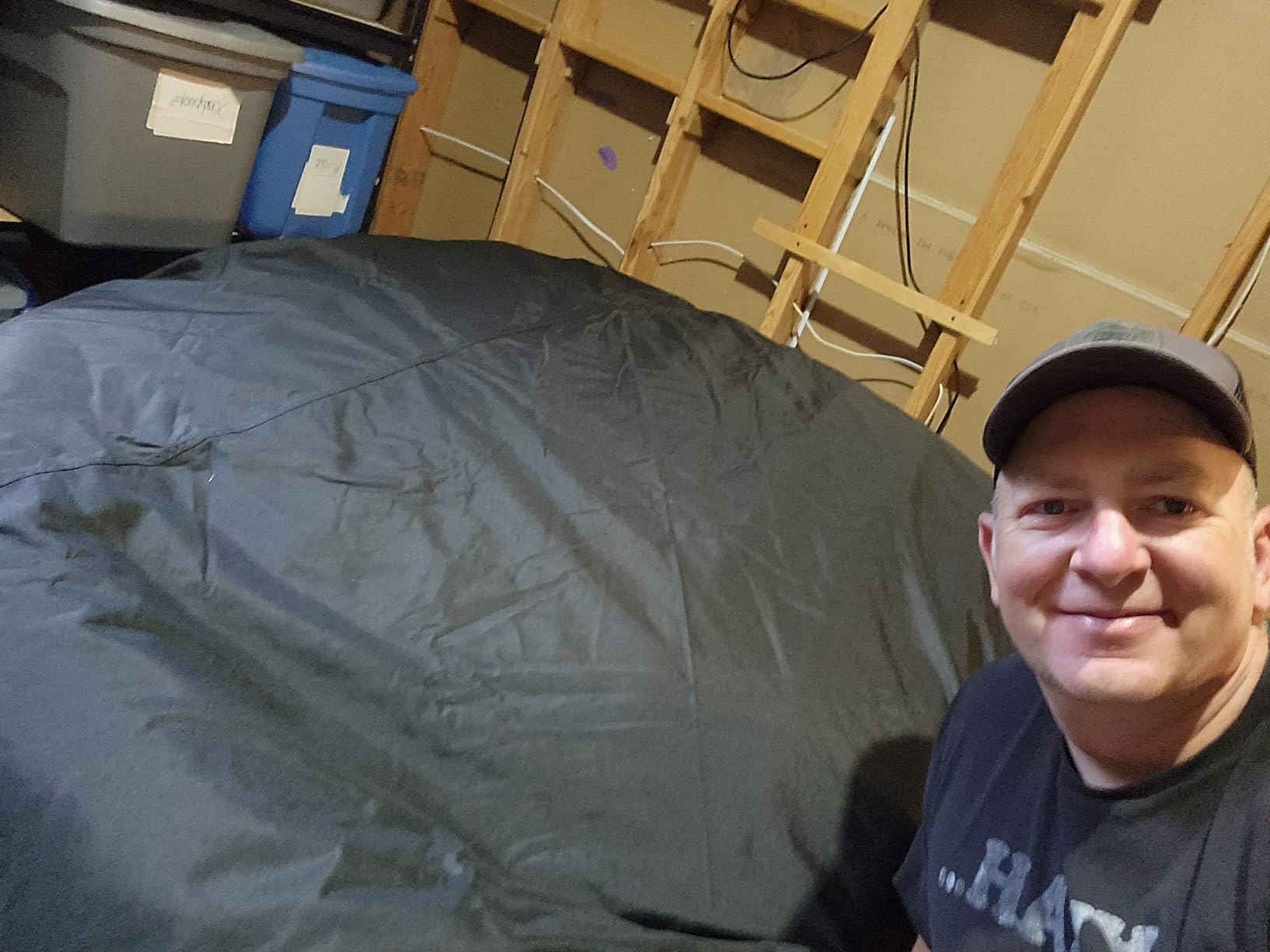
The shell is 600D polyester composite canvas with a polyurethane coating, and the top is seamless with reinforced seam sealing for leak protection. Weights sit at 1.88 kg, still on the light side for a 600D fabric.
Upgraded dual air vents limit moisture buildup, and it is listed as tear, UV and wind resistant. Sizing covers tubs from 76 to 95 inches plus several rectangular formats.
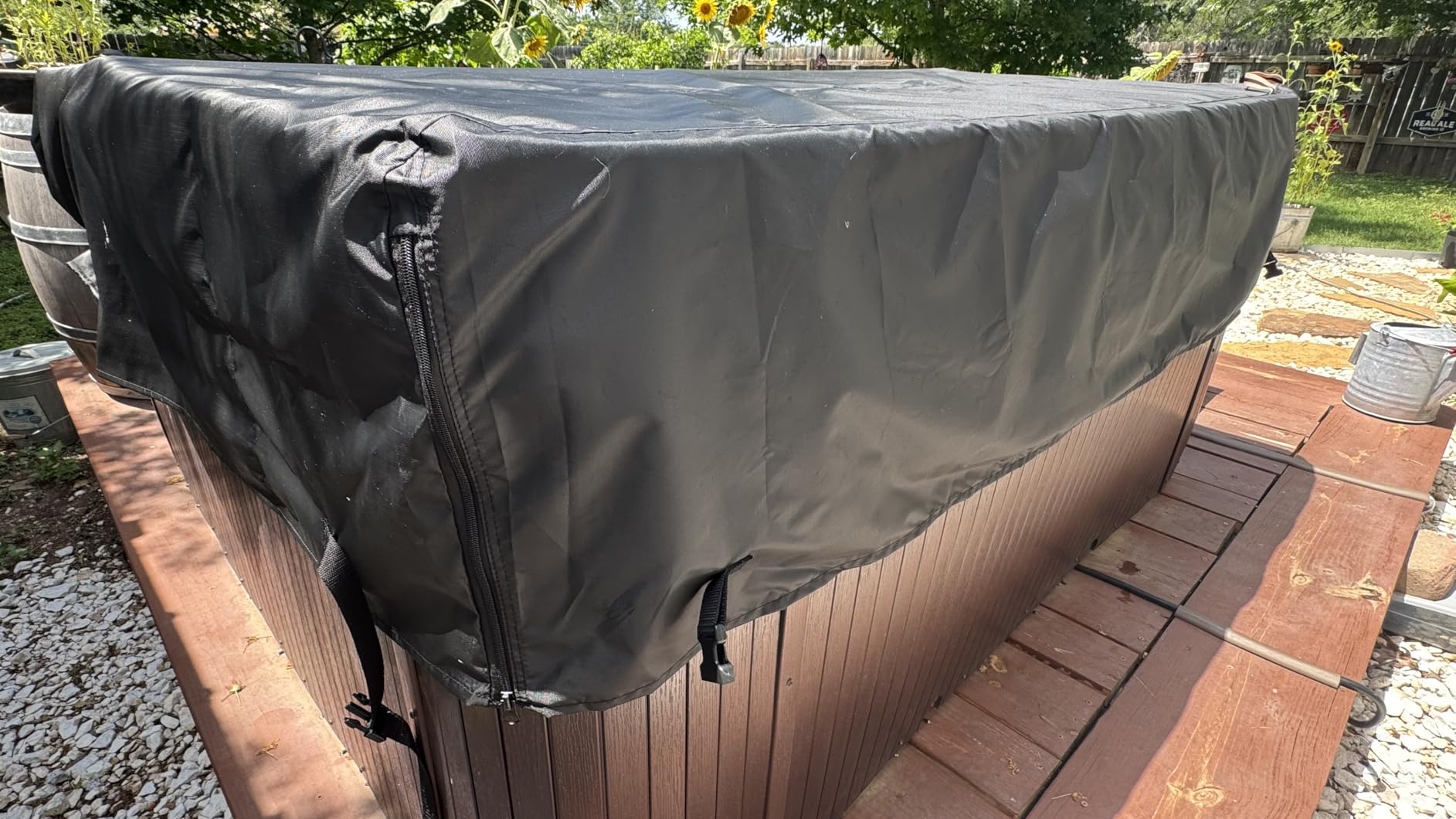
Best when wind is the bigger threat than snow
Along a lakefront, on an exposed corner lot or anywhere with a steady prevailing wind, restraint is the deciding factor. A 360 degree ratchet locking system is the most aggressive tie-down in this roundup, and it addresses the specific complaint owners raise about elastic-cord caps.
A 600D composite canvas also holds up better under tension than a 420D fabric would, which matters because ratchets concentrate force at the anchor points. The reinforcement and the fabric weight are matched to the hardware.
Where it falls short
It is not insulated, so like the fabric caps it needs a hard insulated cover below it. Sizing tops out at 95 inches, so very large spas are out of range.
With 274 reviews this has the smallest review base in the roundup, which means the least long-term durability evidence. That is not a dealbreaker for a fabric layer, but it is a reason to expect a shorter life than the high-volume caps.
What Makes a Hot Tub Cover Snow-Rated?
A snow-rated hot tub cover is one built on a rigid or high-density 2 lb per cubic foot foam core with a 4 to 6 inch tapered profile and a sealed vapor barrier, so it supports the weight of wet snow without bowing or collapsing onto the tub. Density adds compressive strength, taper sheds meltwater, and the barrier keeps water out of the foam.
That is the short version. The longer version matters because most covers never state any of those three numbers, which is why snow-load failures are so common.
Snow load math in plain terms
Snow load is measured in pounds per square foot. Fresh powder sits near 10 to 15 pounds per square foot per inch of depth, while wet, compacted snow runs far higher. A 7 by 7 foot spa has roughly 49 square feet of surface, so every inch of wet snow at 20 pounds per square foot adds close to 1,000 pounds.
That load does not distribute the way a person standing on the cover does. It concentrates in the middle, over the unsupported span, and it acts downward for months without relief. A cover with a weak core dishes there first, and once dished it never recovers.
The pool and spa forum consensus worth knowing is simple: snow on a filled tub floats and mostly leaves the cover alone, while an empty tub lets the weight pull down on springs and straps until they tear out. Keeping water in the tub is a genuine load-management decision.
Why 2 lb foam beats 1 lb foam for snow
Owners on hot tub forums make a point that almost no retailer repeats: moving from 1 lb to 2 lb foam adds roughly 30 percent more compressive strength but only a modest gain in R-value. If your concern is collapse rather than heat loss, density is the specification to spend on.
Taper works alongside it. A 4 to 6 inch taper puts the thickest section over the center span where the load lands, and slopes toward the edge so meltwater runs off rather than pooling and refreezing.
Matching Cover Architecture to Your Snowfall
There is no single best hot tub cover for heavy snow, because heavy snow is a range. Map your site to a tier and the decision gets much easier.
100+ inches annually, lake-effect zones. This is the only tier where we would insist on a rigid or high-density foam cover as the primary layer. Specify 2 lb foam in a 6-4 taper, budget for a cover lifter, and clear snow on a schedule rather than letting it accumulate.
60 to 100 inches, Northeast and Midwest. A 4 to 6 inch taper with a solid vapor barrier handles most storms if you clear them. Add ratchet or buckled straps, and consider a floating blanket underneath so meltwater never sits on the foam.
40 to 60 inches, Upper Midwest and Rockies. A good foam soft cover with 4 inch taper and a sealed wrap is generally enough if you clear after each significant snowfall. Fabric caps over a hard cover work well here.
Minimal snow, freeze-thaw cycles. Freeze-thaw is harder on covers than steady snow, because ice expands into every stitch hole. Focus on sealed seams, UV protection and fabric that stays flexible in cold, and do not worry about load ratings.
Exposure matters as much as totals. An open yard with no windbreak turns a moderate snowfall into a cover-flying event, and a lakefront property gets wind off the water all winter. In those situations, buy restraint first and insulation second.
Measuring Your Tub and Sizing Rules
Custom covers are built to your numbers, and off-the-shelf covers are built to standard footprints. Either way, measure the tub rather than the old cover.
Measure length and width across the widest points of the tub at the top rail, then measure the height from the top of the cabinet down to where the cover skirt needs to end. For custom shapes, note the corner radius and whether the top has any raised hardware or a cover lifter attached.
To be clear about the question people ask most: it is fine for a cover cap to run a little large. An oversized fabric protector simply drapes a little looser and still sheds water and UV. It is not fine for an insulated foam cover to be oversized, because a loose skirt lets cold air circulate around the spa and the taper stops shedding properly.
Custom foam covers are built to plus or minus half inch tolerance, so precision measurement matters. Both custom covers here will build square, rectangular and specialty shapes, so an unusual tub does not rule out a custom order.
Straps, Ties and How a Cover Survives Wind
Snow is a vertical load. Wind is a horizontal one, and wind is what actually sends covers flying. Owners in icy-weather threads on r/hottub converge on the same restraint list.
Elastic cords are the baseline and the weakest. They work in mild conditions and fail in a real gust, which is why two of the caps here use multiple buckled straps instead.
Ratchet tie-downs apply steady mechanical tension that a cord cannot hold, and they stop the flapping that wears seams out over a season. Buckled straps with high and low anchor points are the middle ground, and corner buckles are what stop a square cover lifting diagonally off a square tub.
Springs under the cabinet lip work well for soft covers on tubs without side access, but they are the first thing to tear out on an empty tub under snow load. Safety clips and keyed locks are a separate concern: they stop a child getting under a cover, and they should be fitted regardless of snow.
Our practical rule is simple. If your tub drains or runs low in winter, add restraint. If it stays full, restraint matters less and insulation matters more.
Snow Removal Protocol and Winter Maintenance
No cover in this roundup is designed to be left under a full season of untouched snow. The ones that survive are the ones owners clear on a rhythm.
Clear after each significant snowfall rather than letting it build. A roof rake or a long-handled plastic shovel works; a metal shovel edge on a vinyl or fabric surface is how you cut a cover. Push, do not drag, and never stand on the cover to reach the middle.
Do not use a snow blower near the tub. Flying ice chips damage vinyl, straps and cabinet trim in a single pass, and the trim is what holds the springs on many installations.
Clear standing water and debris off the cover surface as soon as you see it. Weight left sitting on foam breaks it down, and cracked foam is the first step in a chain that ends with a collapsed cover. This is the single most repeated maintenance warning from dealers and owners alike.
On the tarp question, the honest answer is usually yes if you have a fabric cap already and you are in a place with sustained wind. A second layer stops the cap abrading and flapping. It does not add meaningful insulation, and a loose tarp in wind is its own hazard, so ratchet it down or skip it.
Watch for replacement signals. Waterlogged foam that no longer rebounds, a sagging middle that never comes back up, cracked vinyl, or stitching that has separated at the taper seam. Any of those mean the core has lost its compressive strength and it is time for a new cover.
One safety note that no competitor addresses: lifting a frozen, snow-laden cover alone is how people hurt their backs. A cover lifter, a second person or a motorized system is worth the cost precisely on the morning after a big storm.
Do You Need to Winterize Your Hot Tub?
Not always, and the decision is more about your pipes than your cover. The key rule is that a hot tub with water in it expands as that water freezes, which relieves pressure on the plumbing. The risk of an empty tub is not the ice, it is the water left in the lines and the fittings.
If you keep water in, the cover question largely answers itself. The load of accumulated snow floats on the water rather than pulling down on the cover, and the water itself resists the weight. This is the configuration most owners in snowy regions prefer.
If you drain for winter, drain it properly. Blow out the lines, add non-toxic antifreeze to the plumbing where it is designed to be used, and leave the tub open to air rather than sealing a dry tub with a tight cover. Trapped air in a sealed dry tub is what causes pressure problems.
For operating temperature, most hot tub electronics are rated to around minus 10 F for short stretches, and holding water at spa temperature through a hard freeze is a real energy cost. If you want to soak in January, budget for a foam cover with a proper taper and an R-value in the high teens, and expect that to be the difference between a tub you use and one you look at.
Our general winter setup advice, if you want the seasonal side of things sorted alongside the hardware, is in our snow plow reviews and snow tire guides, since the tub and the driveway are cleared on the same morning.
Frequently Asked Questions
What are the best hot tub covers for winter?
The best covers for winter are insulated foam covers with a 4 to 6 inch taper and a sealed vapor barrier, ideally built on 2 lb per cubic foot foam. In heavy snow regions add a fabric protector over the top for UV and wear, and ratchet or buckled straps so wind cannot lift it. A floating spa blanket underneath reduces evaporation and slows snow melt on the hard cover.
What is the best way to enclose my hot tub for winter?
Start with a hard or high-density foam cover as the primary layer, since it is the only thing rated to carry snow load. Add a track or slide rail system if lifting a frozen cover alone is a safety concern for you. Add a fabric cap on top for UV and abrasion, and clear snow after each storm rather than letting it accumulate.
Can you go in a hot tub while it’s snowing?
Yes, soaking in the snow is one of the better reasons to own a spa. The water is well above freezing and the cover is already protecting the shell. The one caution is that the air temperature is cold, so plan a short soak rather than a long one, and watch the cover condition before you lift it since a snow-loaded cover is heavier than you expect.
What is a good hot tub blanket for winter?
A 16 mil LDPE floating bubble blanket is the best all-round winter blanket because the heavy bubble construction resists cracking through freeze-thaw cycles. It floats on the water, so it never carries snow load, and it cuts evaporation substantially while slowing snow melt on the hard cover above it. Expect to replace it every 12 to 18 months in a cold climate.
What is the best hot tub cover for snowy conditions?
A custom foam cover built on 2 lb per cubic foot high-density foam in a 6-4 or 5-3 taper, wrapped in marine-grade vinyl with zero water absorption. That combination is the only one rated to hold wet snow without bowing. Add a fabric protector over the top for UV and wear, and clear snow on a regular schedule.
Is it okay if the hot tub cover is too big?
For a fabric cover protector, slightly oversized is fine. It simply drapes a little looser and still sheds water, debris and UV. For an insulated foam cover, oversized is a problem because a loose skirt lets cold air circulate around the spa and the taper stops shedding meltwater properly. Measure the tub itself, not the old cover.
Should I put a tarp over my hot tub cover?
Sometimes. A tarp or second fabric layer helps if you already have a cover cap and live somewhere with sustained wind, because it stops the cap abrading and flapping. It adds no meaningful insulation. In an exposed site, a loose tarp becomes a sail of its own, so either ratchet it down properly or skip it and invest the money in restraint straps instead.
How cold is too cold for a hot tub in winter?
Most hot tub electronics are rated to around minus 10 F for short periods, so the practical limit is the cold stretch rather than the season total. If you want to soak through January, a foam cover with a 4 to 6 inch taper and an R-value in the high teens makes the difference between a tub you use and one you look at from the window.
Final Verdict
For most readers in a genuine snow belt, The Cover Guy Premium custom cover is the pick. It is the only option here that lets you specify 2 lb high-density foam in a deep taper, and that is the specification that decides whether a cover survives wet snow or dishes out in the middle. MySpaCover is the alternative if the five-year warranty matters more to you than the ability to choose your exact taper.
Everything else in this roundup is a layer, not a load-bearing structure. Add the ULTCOVER or Kipiea cap over an existing hard cover, drop the MADHOLLY blanket inside a filled tub, and pick the QH.HOME ratchet cap if wind is your main worry. Built in the right layers, those three together handle more of a northern winter than any single cover on the market.
Clear the snow before it accumulates, keep the water in the tub over winter, and tie the cover down properly. That routine matters more to how your spa survives 2026 than the label on the box does.