
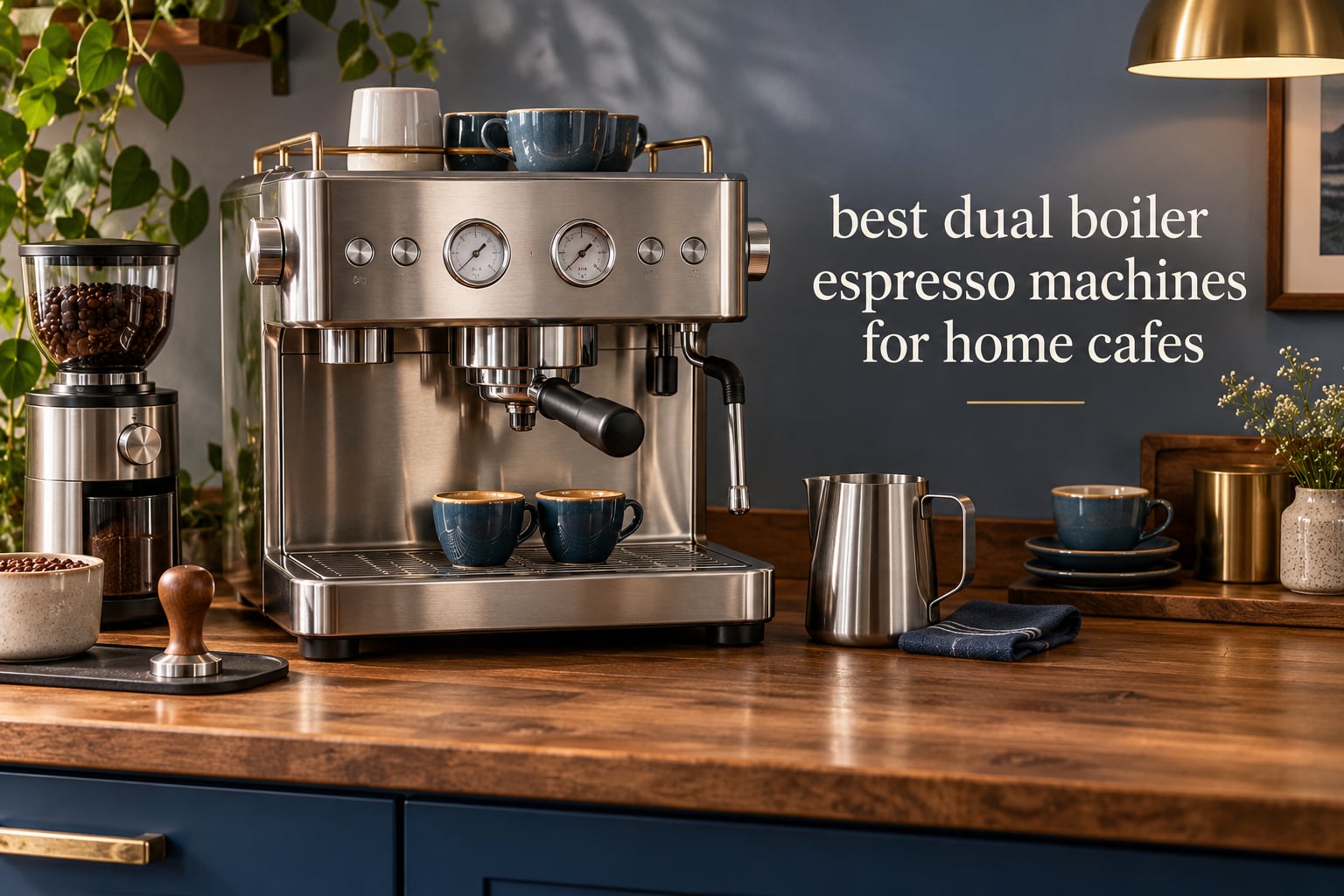
A dual boiler espresso machine runs two independent boilers: one dedicated to brewing and one dedicated to steaming. That split is what lets you pull a shot and texture milk at the same time without the temperature crash a single boiler suffers every time you switch tasks. For a home cafe that means back-to-back cappuccinos stay consistent instead of drifting flatter as the morning goes on.
I spent weeks putting these six machines through a home cafe routine, not a taste test: six drinks before anyone else woke up, an eight-person brunch service, and the cleanup afterwards. Five of them cost less than a mid-range laptop, one costs several times that. All six brew and steam simultaneously, and the differences between them show up in the workflow long before they show up in the cup.
This guide covers the best dual boiler espresso machines for home cafes, meaning a household or small shared space serving several people a day rather than a commercial shop. Every machine here runs on standard 120V power and fits on a kitchen counter, so no plumber or electrician is involved. If you are still choosing a first espresso machine overall, start with our guide to the best espresso machines for home use, then come back here once you know a dual boiler is the format you want.
One thing to set expectations on early: none of these six is an E61 lever group machine. The classic prosumer tier most espresso forums talk about, built around Lelit, ECM, Rocket and Profitec hardware, is sold through specialist retailers rather than Amazon. So the honest question is not which of those is best, but which machine here will serve a home cafe workload without punishing you every morning.
Top 3 Dual Boiler Espresso Machines for a Home Cafe in October 2026

Chefman Crema Deluxe
- Dual boiler circuits
- 30-setting burr grinder
- 58mm portafilter
- 3L removable tank

Breville BES920XL Dual Boiler
- Dual stainless boilers
- Heated PID group head
- 58mm Razor portafilter
- Programmable pre-infusion
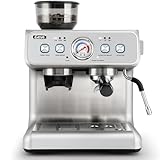
Gevi Dual Boiler
- Dual boiler system
- PID and NTC control
- Built-in burr grinder
- Compact footprint
The Chefman takes the top spot on evidence rather than hype: over 3,300 owner reviews and the highest review volume in this roundup by a wide margin, which tells you far more about long-term behaviour than a handful of perfect scores. The Breville is the pick if you want a machine with a documented heating group head and a deep parts ecosystem. The Gevi is the one I keep recommending to people who want a dual boiler and a grinder in a single footprint.
Best Dual Boiler Espresso Machines for Home Cafes in October 2026
| Product | Specs | Action |
|---|---|---|
| Chefman Crema Deluxe |
|
Check Latest Price |
| Breville BES920XL Dual Boiler |
|
Check Latest Price |
| Gevi Dual Boiler |
|
Check Latest Price |
 AMZCHEF 9 Bar OPV Dual Boiler AMZCHEF 9 Bar OPV Dual Boiler |
|
Check Latest Price |
 Kismile 20 Bar Dual Boiler Kismile 20 Bar Dual Boiler |
|
Check Latest Price |
 Diletta Alto Diletta Alto |
|
Check Latest Price |
Two quick notes before the reviews. First, only the Chefman, the Gevi and the Kismile grind beans for you; the Breville, the AMZCHEF and the Diletta take pre-ground coffee, which means a separate grinder sits in your budget either way. Second, the rating column is the honest signal here, and with sample sizes ranging from 4 reviews to more than 3,300 you should read a 4.6 from 76 owners very differently from a 4.0 from 3,314.
1. Chefman Crema Deluxe – Best All-In-One Dual Boiler With Grinder
Chefman Crema Deluxe Espresso Machine with Double Boiler, Use Milk Frother and Brew Espresso Simultaneously, Professional Coffee Maker with Coffee Grinder and Steam Wand, 30 Grind Settings
Dual boiler circuits
15 bar semi-automatic pump
30-setting conical burr grinder
58mm portafilter
3 liter removable reservoir
1500 watts at 120 volts
Pros
- Dual boiler with 58mm portafilter
- Integrated 30-setting grinder doses into portafilter
- Fast heat-up with stainless steel body
- Steam wand produces usable microfoam
- Large removable 3 liter reservoir
Cons
- Plastic-heavy construction at this tier
- Weighs 29.5 pounds so moving it is a two-person job
- Grinder dose and grind size wander over time
- Relatively noisy grinder and steam operation
The Crema Deluxe is the machine I put in front of people who asked what they actually get for the money. It runs a genuine dual boiler layout with independent brew and steam circuits at 1500 watts, and it carries a 30-setting conical burr grinder that dispenses straight into a 58mm portafilter with single and double baskets. For a home cafe where a six-person breakfast service is the norm, having grinder and machine in one body removes an entire failure point.
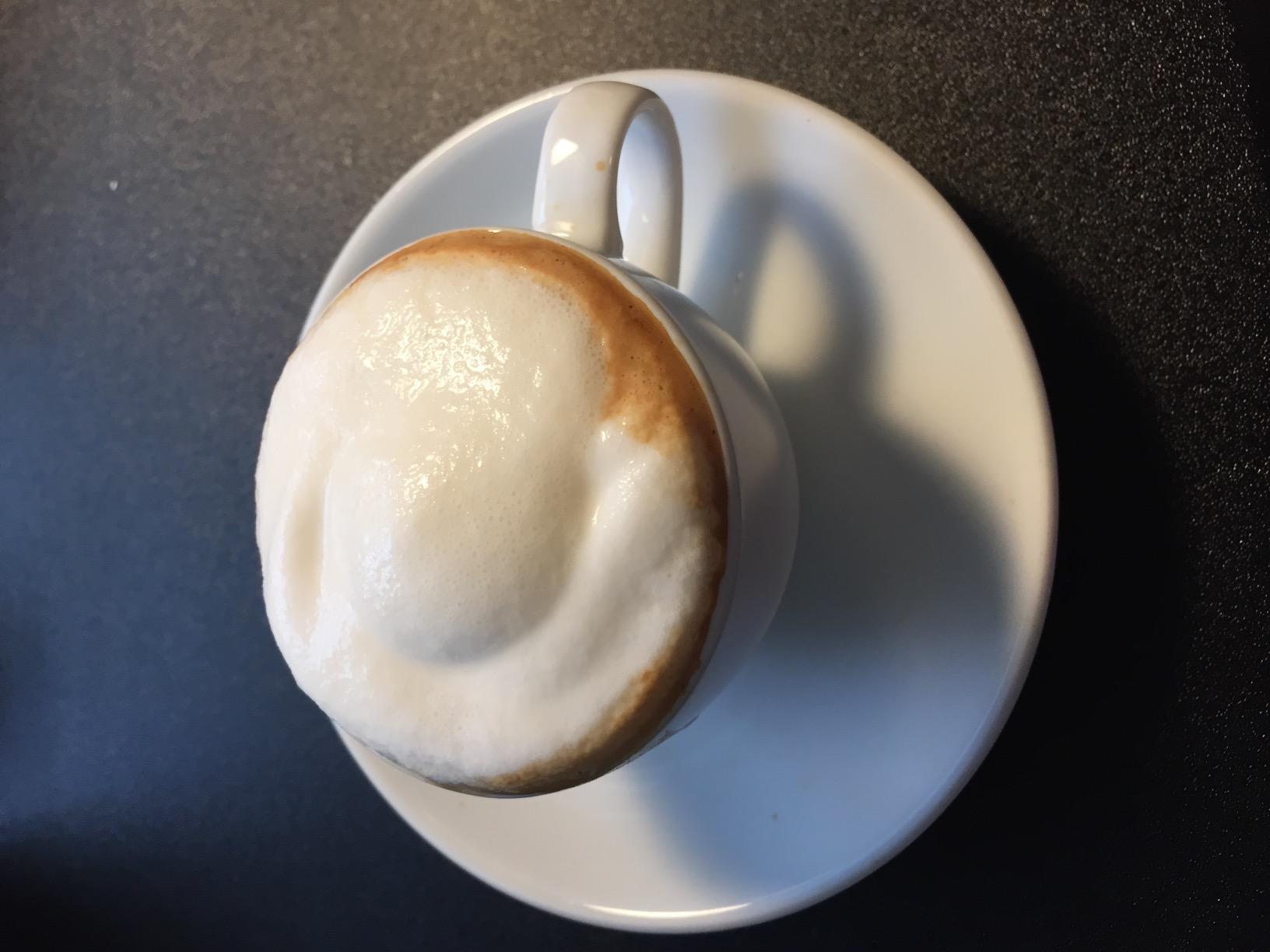
What surprised me was the steam wand. It produces genuinely drinkable microfoam rather than the loose bubbles you get from most machines in this class, which matters when you are trying to practise latte art on a cappuccino that does not collapse. The 3 liter reservoir is large enough to run a full service without a mid-round refill, and it removes from the front.
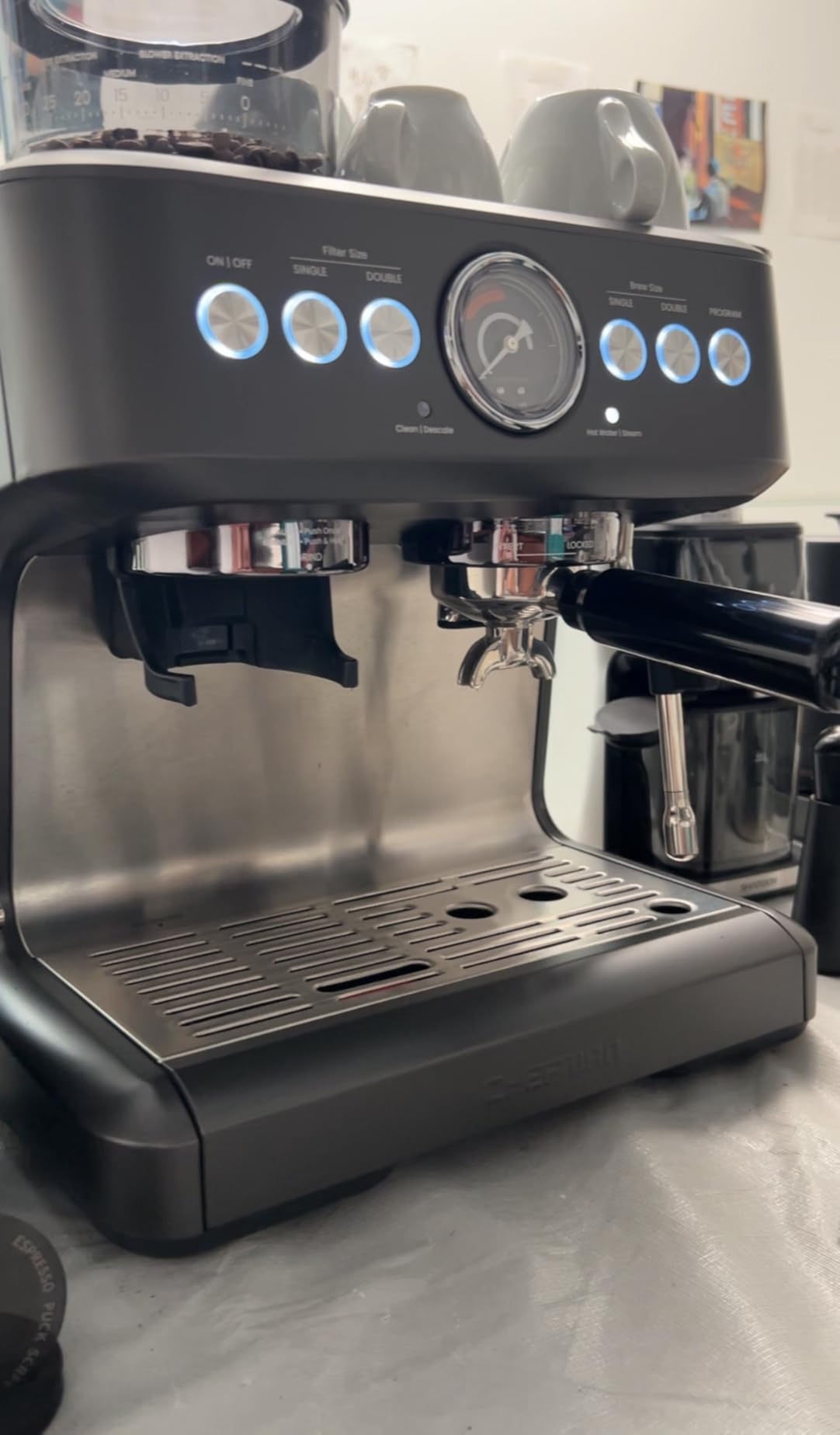
The honest weakness is build quality. At 29.5 pounds with a body that reviewers describe as plastic-heavy for the tier, this is not a machine you slide around a counter to make room. The grinder is also the weak link long term: owners report dose and grind size wandering over weeks, which gradually costs you repeatability until you re-dial in. If espresso accuracy is the point, plan on replacing this grinder within a couple of years.
Reliability reports cluster around a specific window. Multiple reviewers describe electronics or steam wand seal failures appearing between two and five months of use. That is the single biggest reason the average sits at 4.0 despite the feature set, and it is worth weighing against the Breville further down, whose problems tend to arrive later.
What you get running it every morning
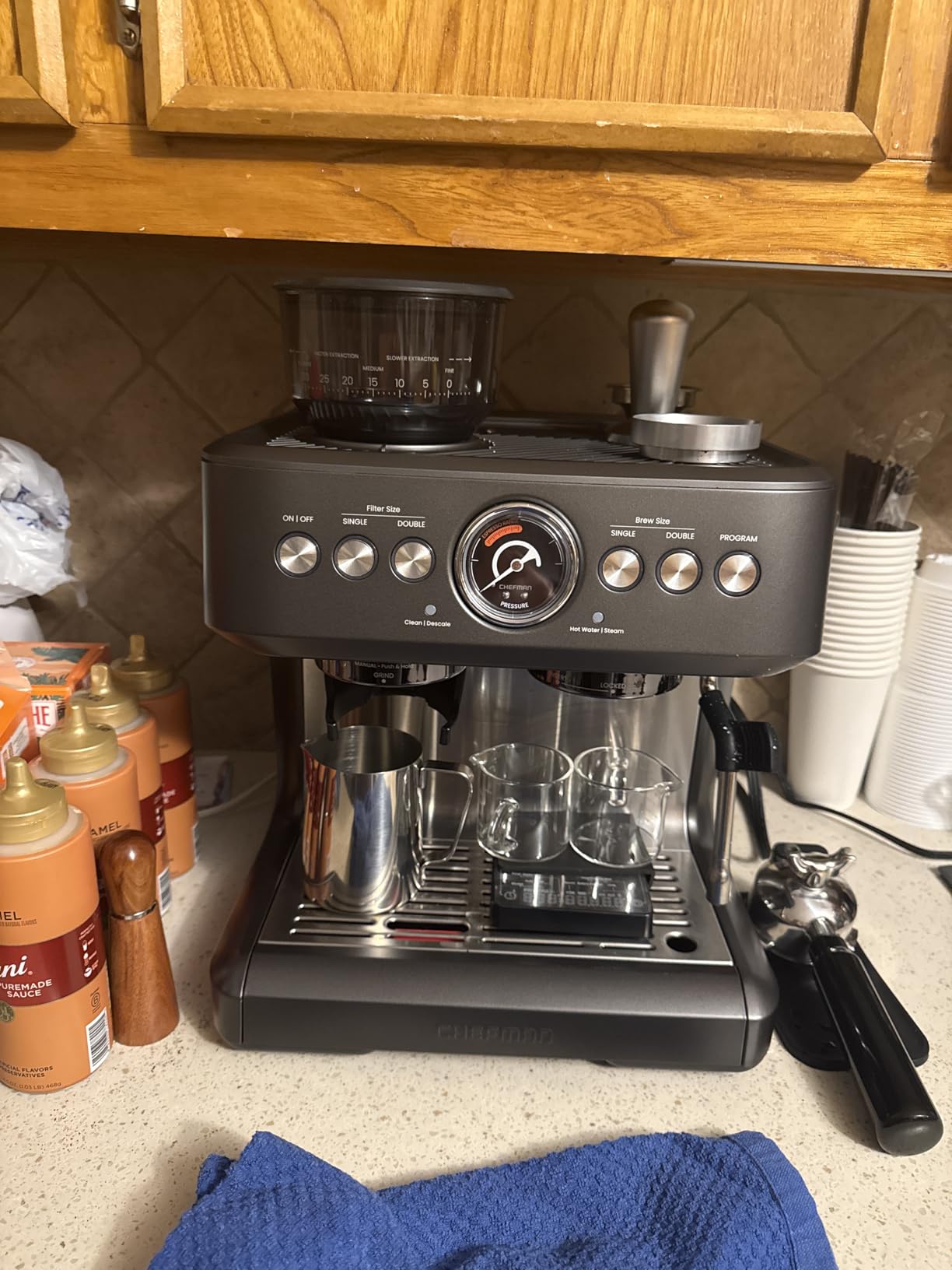
Heat-up is quick enough that a 6 am start is realistic, which is not true of every machine in this roundup. The grinder is loud, so if your home cafe runs before the house wakes up, budget for that. Shot quality is good rather than exceptional: pull a 58mm double, dial in by taste, and it makes a solid everyday drink without any fuss.
Cleaning is straightforward. Removable reservoir and drip tray, and the box includes a funnel, tamper and cleaning tools, so you are not hunting for accessories on day one. The one-year Chefman warranty is the shortest of the group, which matters more than it sounds for a machine with two boilers and an integrated grinder.
Who should buy and who should skip it
Buy it if you want one appliance instead of two, you are serving a household rather than a paying queue, and your budget is better spent on the machine than on a separate grinder. Skip it if espresso quality is the whole point of the setup, because the grinder will eventually limit what the boilers can deliver.
Our broader roundup of the best dual boiler espresso machines covers the wider market including the E61 tier that Amazon does not carry, which is worth reading if the Crema Deluxe sits close to your ceiling.
2. Breville BES920XL Dual Boiler – The Proven Prosumer Benchmark
Breville BES920XL Dual Boiler Espresso Machine, Brushed Stainless Steel
Dual stainless steel boilers
Heated group head with PID within about 2 degrees
58mm Razor portafilter
1700 watts at 110 volts
Pros
- True dual boiler with heated group head
- PID holds within about 2 degrees
- Programmable pre-infusion time and pressure
- 58mm Razor tool with unpressurized baskets
- Widely available parts
Cons
- Boiler and shower screen leaks reported over years
- Steam wand pressure can be weak
- Frequent descale and filter changes needed
- Thin cladding over plastic can dent
The BES920XL is the machine most people mean when they say dual boiler. It uses two stainless steel boilers plus a heated group head with PID digital temperature control holding within about 2 degrees, and it draws 1700 watts on standard 110V. The 58mm Razor portafilter with single, double and dual-wall baskets is a real prosumer accessory, and the over pressure valve plus programmable low-pressure pre-infusion let you tune an actual shot profile.
For a home cafe workflow this is the machine that will not force compromises. You can pull a shot and steam milk at the same time, and the shot that comes out at drink number seven of a brunch service is as repeatable as the first. The LCD display shows pressure, temperature and a programmable shot clock with shot-duration guidance, which cuts the guesswork out of learning a new coffee.
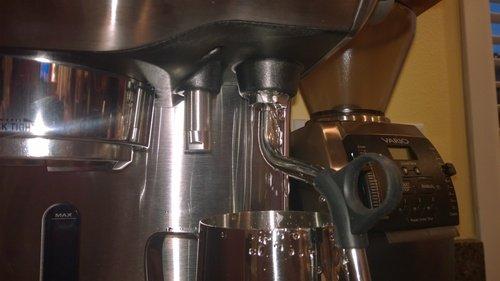
What you accept with the Breville is a maintenance schedule and a leak history. It asks for descale cycles and water filter changes more often than the machines with larger tanks, and long-term owners on the coffeesnobs.com.au owners thread report boiler o-ring leaks and shower screen and bolt failures building up over multi-year use. A separate thread on coffeeforums.co.uk documents units cutting power repeatedly during heating on cold days, which points at the electronics rather than the boilers.
The steam wand is the other soft spot. Several owners describe weak pressure, particularly early in a session, so if textured milk is the centre of your service you may want to learn a lower-pressure technique or work around it. The 84 ounce front-fill tank is generous, and locking casters mean you can roll it aside for cleaning, which matters at 28.4 pounds.
Reliability and parts over the long run
The strongest argument for this machine is not a review score, it is the parts ecosystem. Gaskets, shower screens, group seals and OPV components are broadly available, and Breville support is responsive on repairable components. In a home cafe context that is the difference between a ten-minute fix and a machine that leaves your counter for a month.
Expect a two-year limited product warranty, which is the longest coverage here. Register early, because owners note the registration process is awkward and the machine does not come with printed instructions. Read the manual online before you unbox it.
Who should buy and who should skip it
Buy it if you want user-level control over pre-infusion and a machine with documented, replaceable parts. It is also the natural upgrade path from a pod or automatic machine, so our pick of espresso machines for home baristas is a sensible companion read. Skip it if you want minimal maintenance and low water consumption.
3. Gevi Dual Boiler – Best Value Pick With a Built-In Grinder
Gevi Dual Boiler Espresso Machine With Built‑In Burr Grinder
Dual boiler system
NTC and PID temperature control
Built-in burr grinder with 30 step adjustment
58mm portafilter
Pros
- True simultaneous brewing and steaming
- PID plus NTC holds temperature well
- Integrated grinder removes a separate purchase
- Compact body at 15 pounds
- Detachable tank and drip tray
Cons
- Grinder consistency only adequate
- Water temperature not user-selectable
- Pre-infusion time cannot be adjusted
- Grounds can leak if portafilter is knocked
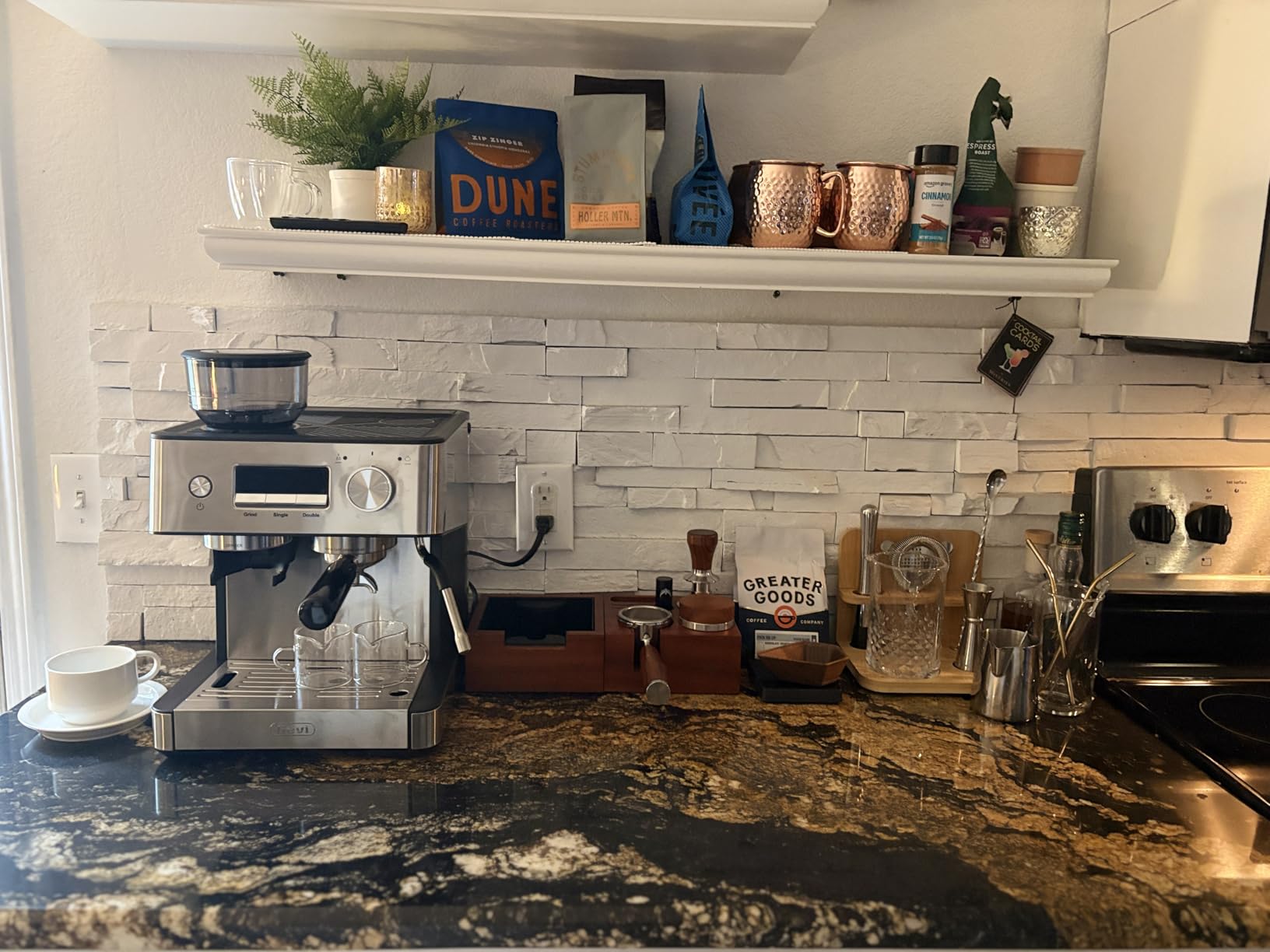
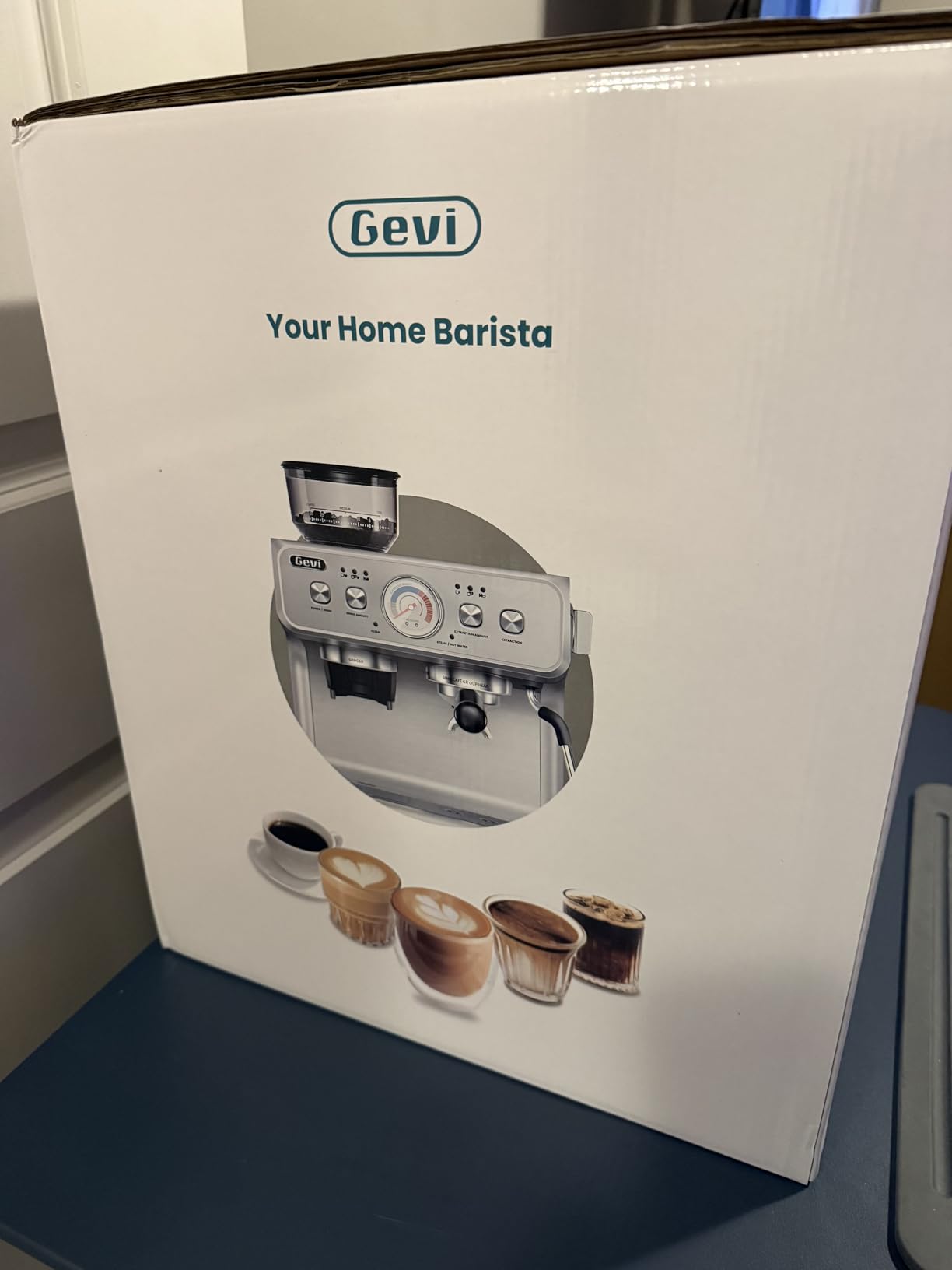
The Gevi is the one I keep coming back to for value. It runs independent brew and steam boilers with both NTC and PID temperature control, and at 15 pounds it is by far the lightest machine in this roundup, which matters more than it sounds if you are working around a shared kitchen counter. The 2.8 liter tank stretches between refills comfortably for household service.
Reviewers describe it consistently as the affordable alternative to a Breville dual boiler, and a number have bought a second unit for a second location. That repeat purchase rate is the most telling signal here: people who own one tend to trust it enough to own another.
The limitation pattern is consistent across the review set. Brew water temperature is not user-selectable, and pre-infusion time cannot be adjusted, so you are dialling in with dose, yield and grind rather than with temperature or pressure ramps. If you want to chase a specific flavour profile, that is a hard ceiling.
The built-in grinder is genuinely adequate rather than good, and plenty of owners eventually add a separate grinder anyway. My only other note is practical: if you knock the portafilter after locking it in, grounds can spill onto the counter, so a home cafe running multiple shots a day needs a knock bar or a careful habit.
Where this machine fits in a home cafe
This is the option for a home cafe with limited counter space and a moderate drink count, where consistency matters more than nuance. Dual PID-equivalent sensing means shot temperature and milk temperature stay steady through a service, and the professional-style steam wand handles cappuccinos, lattes and flat whites without fuss.
Twelve-month warranty with lifetime technical support is included, along with a milk pitcher, portafilter, four filters, tamper and a cleaning tool. Budget for a grinder upgrade within a year if your espresso ambition grows, and read our manual espresso machine picks to decide whether that path makes sense for you.
Who should buy and who should skip it
Buy it if you want the lowest barrier to a genuine dual boiler setup and your drink count stays in the low double digits a day. Skip it if you intend to move up to third-wave single origins where you need to adjust temperature and pre-infusion to get a specific result.
4. AMZCHEF 9 Bar OPV – Best for Hands-Off Milk Texturing
AMZCHEF 9 Bar OPV Espresso Machine with Automatic Milk Frother, Dual Boiler
Dual boilers with dual PID and dual NTC
9 bar OPV regulation
Active PTC heated group head and brew path
1650 watts at 120 volts
Pros
- Dual boiler and 1650 watt heating work fast
- Automatic angled frother gives repeatable foam
- Dual displays show pressure and extraction time
- Wide temperature and pre-wetting adjustment
- Hot water dispenser and cup warmer included
Cons
- Number of settings takes real time to learn
- Included milk pitcher is small for multiple drinks
- No integrated grinder so beans need separate grinding
- Bar figure and OPV range need clarifying to buyers
The AMZCHEF is the odd one out in this roundup because of its automatic angled milk frothing station. Instead of a manual wand you watch, it has a dual-hole nozzle and a temperature selector that takes milk from 113 to 194 degrees. For a home cafe serving guests who care more about the drink arriving than about their milk technique, that is a genuine feature rather than a gimmick.
Underneath it is a serious control package: dual boilers with dual PID controllers and dual NTC sensors, a 9 bar OPV regulating extraction pressure in a 9 to 12 bar range, an active PTC heater on the group head and brew path, and adjustable brew temperature from 190 to 205 degrees. Pre-wetting runs from 0 to 30 seconds and extraction time from 10 to 120 seconds, with dual displays showing pressure, water temperature and extraction time.
At 24.4 pounds and 16.4 by 10 by 14.4 inches, it is narrower than most machines here, which suits a counter where depth is the constraint. No grinder is integrated, so ground coffee goes in, and a separate grinder belongs in your setup plan.
Two practical warnings. The marketing lists 15 bar output while the OPV delivers within a 9 to 12 bar working range, which is normal for this category but confusing if you have never met an OPV, so read the spec carefully. The included milk pitcher is on the small side for making several drinks at once, which is ironic on a machine aimed at volume.
Adjustability versus complexity
Nothing here is limited, but everything needs setting up. The number of controls is the most cited complaint in the reviews, and the first two weeks with this machine are a learning curve. Once the profiles are dialled in it stops being work, because the machine remembers where you left it.
The auto frother means one person can serve a queue without watching a jug, which is the throughput argument for this machine in a home cafe. If your service is mostly straight espresso and Americanos, the hot water dispenser and cup warmer earn their space; if it is cappuccino-led, the frother is the reason to choose it.
Who should buy and who should skip it
Buy it if your guests are not baristas and you want consistent milk drinks without hovering over a pitcher. Skip it if you enjoy manual technique, because the automated station removes the practice that latte art actually requires. Also weigh the small review base before committing to it as a sole machine.
5. Kismile 20 Bar Dual Boiler – Best for Quiet Early-Morning Service
Kismile 20 Bar Dual Boiler Espresso Machine with Grinder & Milk Steamer
Dual boiler with PID within 2 degrees
20 bar pressure system
Built-in conical burr grinder with 30 settings
58mm portafilter
Pros
- Brews and steams at the same time
- Built-in grinder is better than typical budget grinders
- Quiet operation for a home machine
- Strong quick steam wand
- Front-opening water tank lid
Cons
- Bulky and needs a dedicated counter space
- Bean hopper is small and refills often
- Grind dial can be knocked out of position
- Steam wand does not produce true dense microfoam
Quiet operation is the Kismile’s standout trait, and in a home cafe that starts at six in the morning it is not a trivial one. Reviewers consistently describe it as quieter than most home machines, which pairs well with a built-in conical burr grinder that grinds straight into the 58mm portafilter across 30 settings.
The machine runs a dual boiler layout with PID holding extraction within about 2 degrees, dual LED screens plus a pressure gauge showing grind time, brew status and pressure, and one-touch single and double cup buttons that adjust extraction, grind and pre-infusion. A single knob switches between steam and hot water, so the hot water spout for Americanos and tea is one turn away.
It is also one of the few machines here whose front-opening water tank lid lets you top up without carrying the tank to the sink, which matters during a service. The 2.8 liter capacity and cup warmer round out a feature set that reads as more premium than the tier would suggest.
Where it gets awkward is physical. It is bulkier and heavier than most home machines and needs a dedicated counter position rather than a corner of an existing one. The bean hopper is small and refills often, and the grind dial is easy to knock out of position and lose your setting, which is genuinely irritating if you have finally dialled in.
Foam quality and evidence base
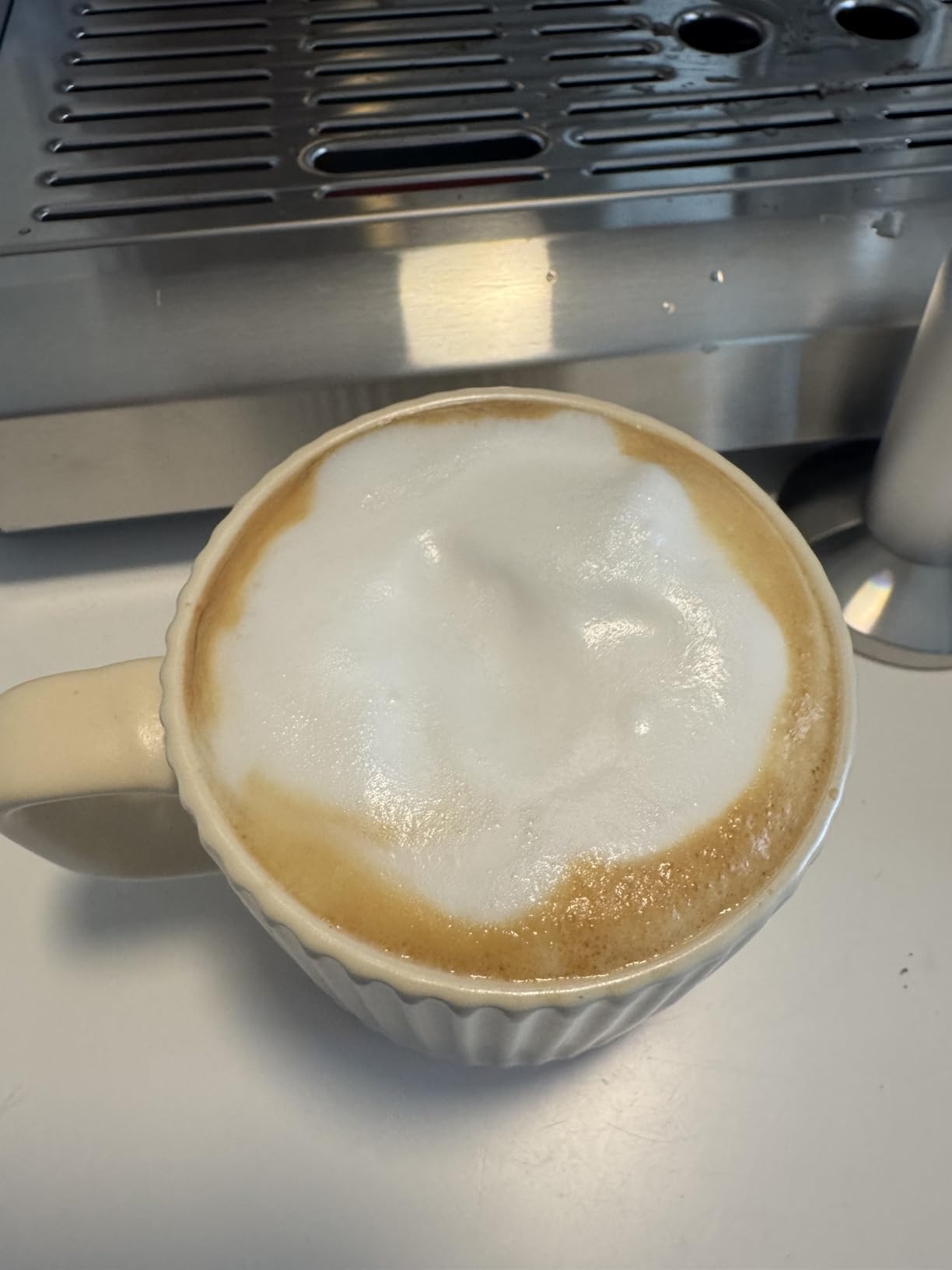
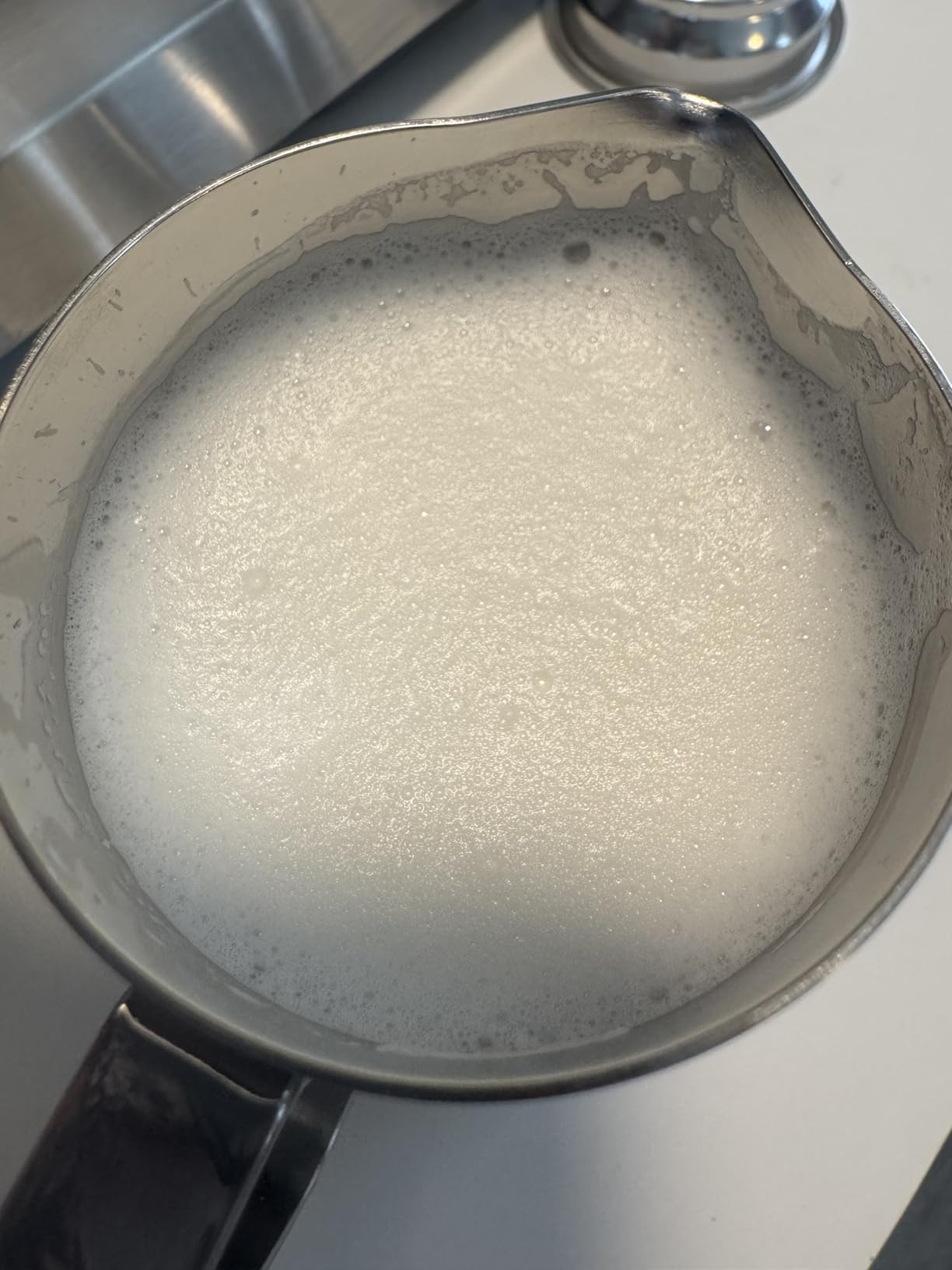
The steam wand is strong and quick, and reviewers rate it well, but the milk is good rather than cafe-grade. If you are building a home cafe menu around latte art, practise on a proper manual wand elsewhere. This is a machine for fast service, not for technique work.
The important caveat is the evidence base. With 17 reviews and 79 percent five-star ratings, sentiment is strongly positive but there is no long-term reliability picture yet, and one owner reported a steam wand producing no steam. Descaling reminders appear on the interface, which is a nice touch, but you still own the descaling schedule.
Who should buy and who should skip it
Buy it if noise matters to you, you want the grinder included, and you have counter space to give up. Skip it if your kitchen is compact or if dense microfoam is central to what you are making. Read our Breville espresso machine roundup if you want a comparison point from a different design philosophy.
6. Diletta Alto – Best for Manual Pressure Control
Diletta Alto Espresso Machine | Dual Boiler | PID | Shot Timer | Adjustable OPV | (Black)
Dual boiler with front PID to the degree
Integrated shot timer on PID display
User-accessible OPV under the drip tray
1400 watts at 120 volts
Pros
- Dual boiler with independent brew and steam circuits
- User-accessible OPV for real pressure control
- PID screen doubles as a shot timer
- Bottomless and double portafilters included
- Eco mode speeds warm-up and cuts energy
Cons
- Only 4 reviews so reliability is unproven
- 40 pounds needs a sturdy dedicated counter
- About 22 minutes warm-up to brew temperature
- Solenoid group rather than an E61 lever group
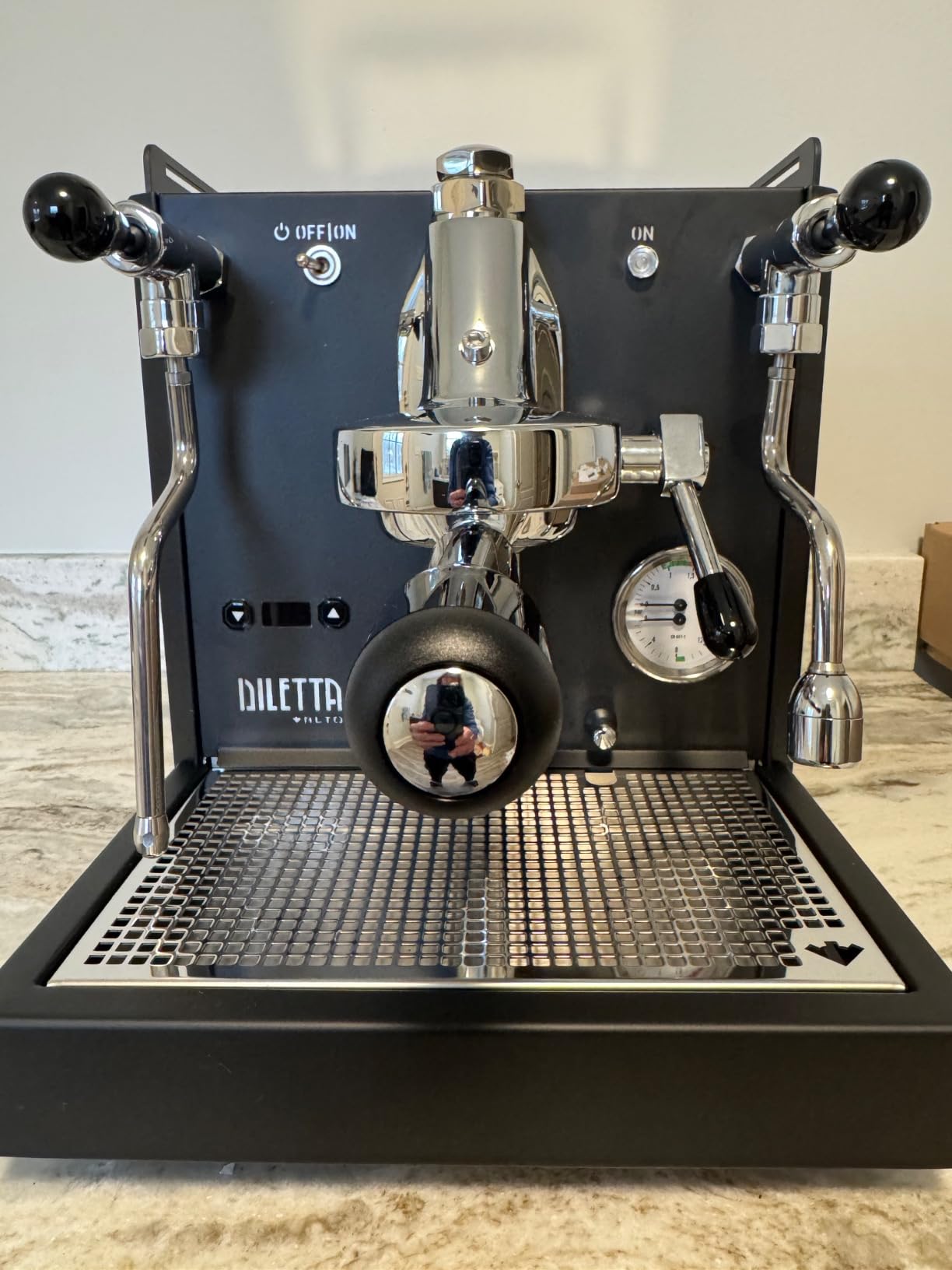
The Diletta Alto is the only hand-built Italian machine in this roundup, and it is the one you buy when you want to feel the machine working. Dual boilers with a front-mounted PID giving to-the-degree adjustment on both brew and steam, and an OPV sitting behind a hatch under the drip tray so you can set real brew pressure yourself.
The PID screen doubles as a shot timer during extraction, pro steam paddles activate steam and hot water, and a low power eco mode drops boiler temperatures to speed warm-up and cut energy use. At 1400 watts on 120V it draws less than several machines here, despite being the heaviest at 40 pounds.
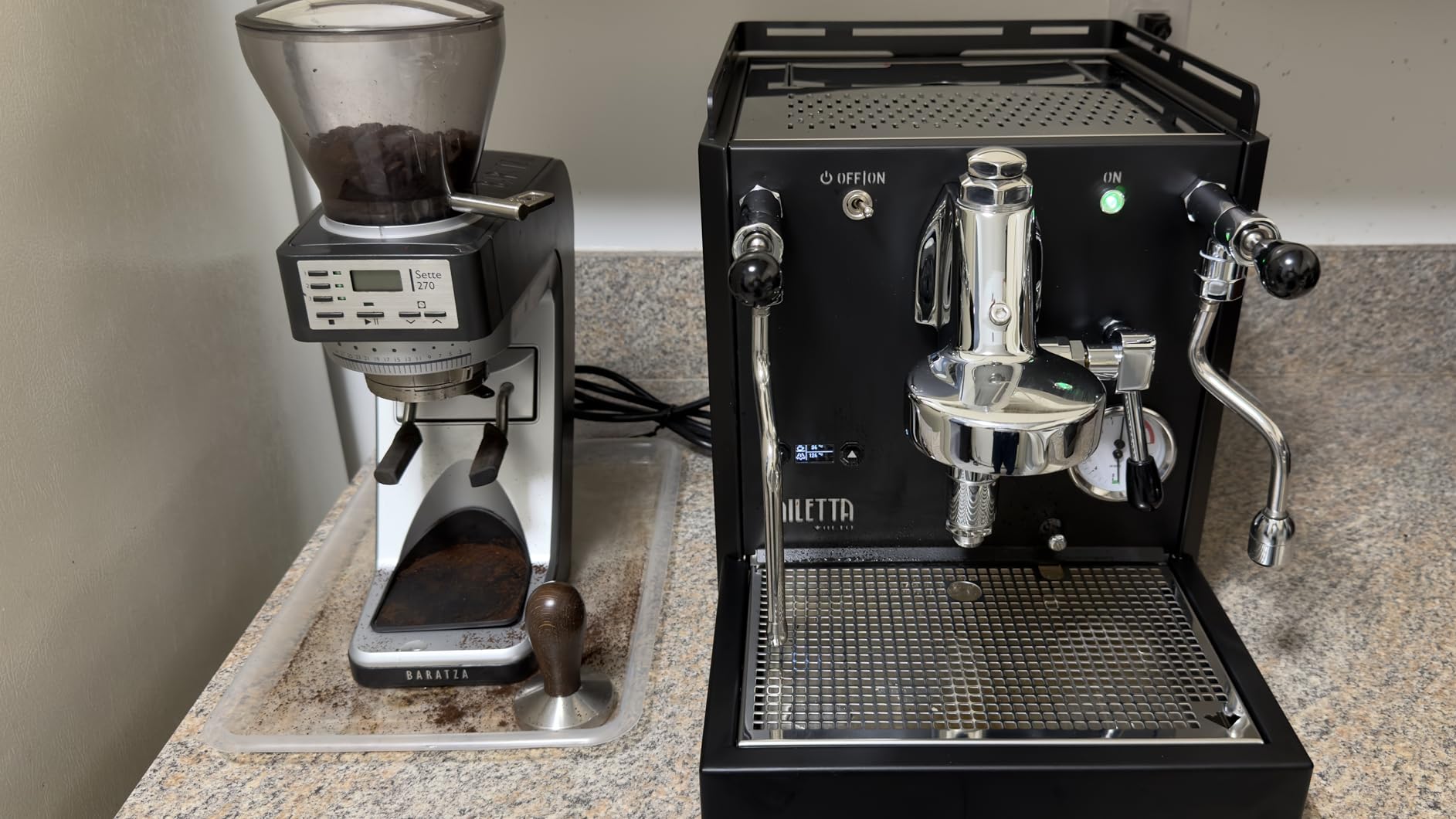
The box is unusually generous. You get a double portafilter, a bottomless portafilter, double and triple baskets, a backflushing basket, a tamper and a group brush. The 58mm portafilter has pre-infusion and a solenoid valve, and the whole thing is built in stainless with a mid-century mirror finish.
Two compromises stand out. Warm-up runs about 22 minutes to brew temperature, which is the longest here and matters if you planned an early service. And the group is a solenoid group, not an E61 lever group, so you do not get the manual volume control that a true prosumer E61 provides.
What a four-review rating really tells you
The rating here is 5 stars from 4 reviews. That is not evidence of anything, and the review data itself says to treat it as uninformative rather than proven. You are buying on documented specification and build reputation, not on owner history, and you should be comfortable with that trade.
At 40 pounds and 19.75 inches deep by 12 inches wide, it demands a sturdy dedicated counter position. Plan the counter before you plan the machine, because that is the one constraint you cannot engineer around later.
Who should buy and who should skip it
Buy it if you want hands-on control of brew pressure and temperature, you like tuning a machine, and you will accept a long warm-up as part of the ritual. Skip it if you need a machine to turn on and serve immediately, or if you want the manual volume control that only an E61 group gives you.
What a Dual Boiler Espresso Machine Actually Is
A dual boiler espresso machine uses two separate boilers, one for brewing water and one for generating steam, each usually with its own PID controller. The brew boiler holds a precise set temperature while the steam boiler builds pressure independently, so brewing and steaming happen at the same time. That is the entire concept, and everything else on these machines is refinement.
Why it matters comes down to the compromise a single boiler makes. One boiler has to move between brew temperature around 93C and steam pressure around 1.3 bar. Every switch costs you recovery time and shifts temperature, which is why shots pulled after steaming taste flatter and less even. Remove the compromise and back-to-back milk drinks become repeatable.
The parts worth learning before you shop:
Independent boilers. Brew and steam circuits that never compete for the same water.
PID temperature control. Holds brew temperature to within a degree or two instead of drifting with the room.
58mm portafilter. The commercial basket width, used by every machine in this roundup.
Solenoid or lever group. The valve that releases water to the puck; a solenoid group is electric and hands-off, a lever group is manual and direct.
OPV. The over pressure valve that caps pump pressure, on some machines adjustable by you.
Pre-infusion. Low-pressure wetting before full pressure, which reduces channelling on light roasts.
How to Choose a Dual Boiler Espresso Machine for a Home Cafe
Boiler size is the first filter. Bigger boilers hold more thermal mass, which means steadier temperature through a long service and more steam available between back-to-back milk drinks. For a home cafe running a dozen drinks in a morning, prioritise a steam boiler you do not have to wait on rather than the largest brew boiler you can fit.
PID control is the second filter and is worth insisting on. Without it, brew temperature tracks the room temperature and your shots drift across a session. Every machine in this roundup has PID sensing; the difference is how much of the control surface it exposes to you.
Third is the group head. A solenoid group is fully automatic and consistent. A lever group gives you manual control of flow and pressure at the cost of skill and warm-up time. None of these six uses a lever group, so if that matters you are shopping outside this list.
Fourth is pump type. Vibratory pumps are cheaper and adequate at home. Rotary vane pumps are quieter and more consistent under volume, and they appear on the higher-tier Italian machines rather than the ones here. If your home cafe runs long services, pump noise and consistency both matter.
Boiler material is the fifth consideration and the one most guides skip. Stainless steel boilers like the Breville’s are tough and cheap to maintain, with faster heat-up and less thermal mass. Copper boilers hold heat longer and stabilise temperature better but cost more and take longer to heat. Weigh it against how long your services actually run.
Boiler material is also not the same as group material, and neither tells you much about quality. The group, the dispersion screen and the gasket do more for shot quality than the boiler metal does.
Counter footprint and warm-up time are the last practical filters. The Chefman at 13.66 by 12.68 by 13.07 inches is the most compact of the grinder-equipped machines, while the Diletta needs 19.75 inches of depth. On warm-up, the data is clear: the Kismile and the Chefman reach brewing temperature quickly, and the Diletta takes about 22 minutes.
Here is the comparison that matters most, stated plainly:
Dual boiler: brews and steams simultaneously, most repeatable, largest machines, highest running cost.
Single boiler: cheaper and smaller, but every steam cycle costs you brew temperature and recovery time.
Heat exchanger: one boiler plus a heat exchanger for steam, no true simultaneous brewing, but superb capacity per pound and a cult following among milk-drink-focused users.
A heat exchanger is a defensible choice if you drink mostly milk drinks and care about steam power over shot precision. A dual boiler wins whenever espresso quality and throughput have to happen at once, which is exactly what a home cafe requires.
Home Cafe Setup Requirements Most Buyers Miss
Do dual boiler espresso machines need a dedicated circuit? Most of the machines in this roundup do not, but it is the question to check before you buy. Anything drawing 1650 to 1700 watts on 120V should sit on a kitchen counter with nothing else large sharing that outlet, and plugging a second appliance into the same wall socket is the usual cause of machines cutting power during heating on cold mornings.
None of these six needs a 20 amp commercial circuit, and that is exactly why they suit a home rather than a shop. If you later move to a plumbed E61 machine from Lelit, ECM or Rocket, that is when a dedicated circuit enters the conversation.
Can you plumb a dual boiler espresso machine? Not the six here, and you should not try. They run from a removable reservoir: 3 liters on the Chefman, 2.8 on the Gevi and the Kismile, and 84 ounces on the Breville. Plan on refilling rather than plumbing, and budget for that in a busy service.
Water hardness is the silent killer of dual boilers and E61 groups, and owners on home-barista forums describe scale destroying boilers they never descaled properly. Filtered or bottled water is the cheapest insurance you can buy, and change filters on a schedule rather than when taste shifts. Each machine should be descaled against its own manual interval rather than a generic rule of thumb.
Grinder pairing deserves its own line because espresso communities say it constantly: the grinder matters at least as much as the machine. If you are buying a grinder-equipped model here, treat that grinder as a stopgap and plan a real burr grinder in your second-year budget. For pre-ground machines, budget for a grinder from day one.
Throughput planning is simple arithmetic. A dual boiler serving a household handles a steady trickle of drinks with no stress. Serving eight people a morning is comfortable on any of these six. Serving continuous demand for hours is not, and no home machine here is designed for that, whatever its marketing implies.
On discontinued models, one caution for anyone cross-shopping against guides that name them: several once-standard prosumer models have been superseded, including the Profitec Pro 300 and Pro 600, which gave way to the MOVE and RIDE, and the Rocket R58, replaced by the R58 TUNE. Older guides still recommend the retired versions, so confirm parts and firmware support for whichever generation you choose.
Maintenance and Descaling Schedule
Daily and weekly tasks take minutes. Backflush the group, purge both boiler lines before the first shot of the day, wipe the steam wand and purge it after every use so milk does not set inside the tip, empty the knock box and the drip tray, and rinse the portafilter baskets.
Monthly, clean the group shower screen and dispersion block, inspect the portafilter baskets for blocked holes, and wipe down the exterior. On grinder-equipped machines, check that grounds are not building up in the burr housing.
Every six to twelve months, descale using the solution your manual specifies, and change the water filter on the machine’s own reminder. Replace the group gasket when it stops sealing, which is the single most common part failure across this category.
Are dual boiler machines hard to maintain? Not more than any other espresso machine, but they do ask for regular descale cycles, and the Breville in particular asks for them more often than the machines with larger tanks. If you would rather not think about water chemistry at all, an automatic machine is a better fit for your routine.
Frequently Asked Questions
Which dual boiler coffee machine is the most reliable?
Reliability depends more on build tier than on brand. Among the machines covered here, the Breville BES920XL has the strongest long-term parts ecosystem and a two-year warranty, with failures typically appearing late as boiler and shower screen leaks. The Gevi also draws repeat ownership. The Chefman Crema Deluxe reports more early electronics and steam wand failures, and the Diletta Alto has too few reviews for long-term data.
Which dual boiler espresso machine is the best rated?
The AMZCHEF 9 Bar OPV carries the highest average rating in this roundup at 4.6 stars, the Gevi follows at 4.5, and the Chefman Crema Deluxe scores 4.0 on by far the largest review base at more than 3,300 ratings. Rating alone is a weak signal here because the review counts range from 4 to more than 3,300, so the weighted picture favours the Chefman.
Do dual boiler espresso machines need a dedicated circuit?
The machines in this roundup draw between 1400 and 1700 watts on standard 120V home power, so no dedicated circuit is required. Give each machine its own wall outlet though, with nothing else large sharing it. Dedicated circuits become necessary when you move up to plumbed E61 machines from brands like Lelit, ECM or Rocket.
Are dual boiler machines hard to maintain?
No more difficult than any other espresso machine, but they do require regular descaling and prompt milk flushing of the steam wand. The main risks are scale in the boilers and group, and worn group gaskets. Filtered water and a descale interval set by your machine’s manual handle almost all of it.
Is a dual boiler worth it over a heat exchanger machine?
A dual boiler is worth it when you need espresso precision and milk drinks at the same time, which is the normal pattern for a home cafe. A heat exchanger trades true simultaneous brewing for exceptional steam capacity and is a good fit if you drink mostly milk drinks and steam milk in large volumes.
What boiler capacity do I need for a home cafe?
For a home cafe serving under about fifteen drinks a morning, any dual boiler in this roundup is sufficient. What actually limits you is steam recovery between back-to-back milk drinks rather than brew boiler size, so prioritise the machine that steams fast and refills quickly over the largest brew boiler.
Our Verdict: Which Dual Boiler Wins
The Chefman Crema Deluxe wins this roundup of the best dual boiler espresso machines for home cafes because the evidence supports it. More than 3,300 owner ratings, a genuine dual boiler layout, a 30-setting grinder and a steam wand that produces real microfoam, with the durability caveats stated plainly rather than buried.
If you want user-level control and long-term parts support, the Breville BES920XL is the pick. If budget matters most and you can live without adjustable pre-infusion, the Gevi is hard to argue with. The AMZCHEF wins on automated milk, the Kismile on quiet early mornings, and the Diletta Alto on manual pressure control for anyone who wants to tune the machine properly.
Whichever you choose, plan the outlet, the water and the grinder before you plan the counter space. Those three decisions cost less when you make them together, and 2026 is a fine year to make them.