
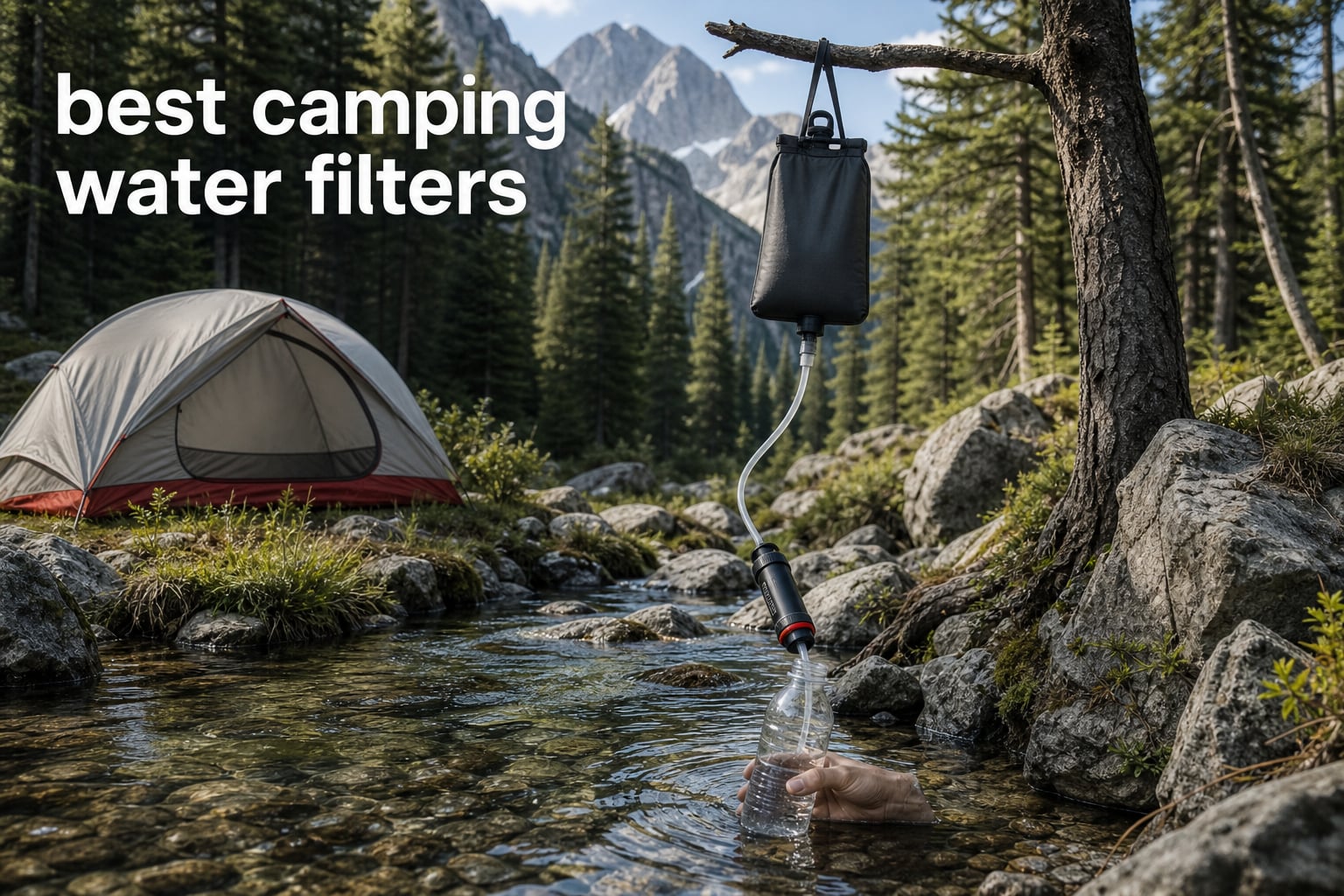
Finding the best camping water filters starts with an uncomfortable truth: clear-looking creek water is not proof that it is suitable to drink. A portable treatment system gives hikers, tent campers, and emergency planners a practical way to manage uncertain water, but its job changes with the contaminants you may face.
I look for three things before recommending a backcountry water filter: what the maker says it removes, how much water it can process for the people on the trip, and whether the format suits the way you actually collect water. A tiny squeeze system can be a smart solo companion, while a six-liter gravity system makes more sense when several people are filling bottles at camp.
The eight products below cover those different jobs. They include hollow-fiber filters for bacteria and protozoa, gravity-fed systems for camp chores, hand pumps, and press-style portable water purifiers that state virus removal in their product information.
One point matters before any comparison: a filter and a purifier are not interchangeable labels. If virus removal, chemicals, heavy metals, or a questionable travel water source are part of your decision, read the stated removal claims rather than assuming every hiking water filter handles the same threats.
I also would not treat a long stated service life as permission to ignore care. Forum discussions repeatedly flag slower flow after sediment exposure, fragile squeeze bags, and worry after a filter has frozen, so this guide gives those issues the same attention as capacity and pack weight.
The Top 3 Picks Cover Most Camping Water Needs (September 2026)
The Sawyer Squeeze is my overall pick for a compact, simple system with a durable two-liter CNOC bladder, a stated service life up to 100,000 gallons, and a carry weight under six ounces. The Platypus GravityWorks is the better match when a group needs a hands-free six-liter clean-water reserve, while the Platypus QuickDraw makes the strongest low-weight case at 3.36 ounces.
Choose the GRAYL UltraPress or GeoPress instead when the product’s stated virus-removal capability is relevant to the source water. A press purifier is not the lightest option for long mileage, but it shortens the path from filled bottle to drinkable water and avoids carrying hoses or a separate reservoir.


These Are the Best Camping Water Filters in 2026
This short overview puts the tradeoffs in one place. It is a starting point rather than a substitute for checking the product instructions, water-source conditions, and local public-health guidance before a trip.
Use capacity and rate as planning numbers, not promises for every creek. Sediment, water temperature, setup, and maintenance can change how quickly any water filtration system produces water.
| Product | Specs | Action |
|---|---|---|
| Sawyer Squeeze Water Filtration System |
|
View Product Details |
 Platypus GravityWorks Group Filter Platypus GravityWorks Group Filter |
|
View Product Details |
 GRAYL UltraPress Titanium Purifier GRAYL UltraPress Titanium Purifier |
|
View Product Details |
 TRAILGO Pro Hand Pump Filter TRAILGO Pro Hand Pump Filter |
|
View Product Details |
 GRAYL GeoPress 24 oz Purifier GRAYL GeoPress 24 oz Purifier |
|
View Product Details |
 MSR MiniWorks EX Filter MSR MiniWorks EX Filter |
|
View Product Details |
 Membrane Solutions 6L Gravity Pro Membrane Solutions 6L Gravity Pro |
|
View Product Details |
| Platypus QuickDraw Ultralight 1L |
|
View Product Details |
1. Sawyer Squeeze Is the Best Overall Lightweight Camping Filter
Sawyer Squeeze Water Filtration System, Cnoc Premium 2 Liter Bladder, Clear
2 liter CNOC bladder
Under 6 ounces
Up to 100000 gallons
Pros
- Lightweight setup
- Durable wide-mouth bladder
- Long stated service life
- Easy cleaning
- Individual testing stated
Cons
- Manual operation
- No virus-removal claim
The Sawyer Squeeze system earns its place here because its parts line up with a practical solo or two-person routine. The included CNOC two-liter bladder has a wide mouth for filling, and the complete system is stated to weigh less than six ounces.
Sawyer says its hollow-fiber filter removes harmful bacteria, protozoa, cysts, sediment, and 100% of microplastics. That is a strong fit for typical backcountry water treatment where those stated contaminants are the concern, but the supplied information does not state virus removal.
The package includes a cleaning coupling and syringe, which is important because a filter that is easy to backflush is more likely to stay in service. I would rinse off grit before packing it, then use the supplied cleaning parts when the effort or flow starts to change.
The 2-Liter Bladder Makes Water Collection Less Fiddly
A broad, flexible reservoir is easier to fill from a shallow stream than a narrow bottle opening. The TPU pouch is described as BPA- and PVC-free, and that wider mouth makes it more useful when the water source is slow or awkward.
Forum users often praise squeeze systems for low carry weight while warning that stock bags can fail. This kit’s CNOC bladder is described as extra-durable TPU, yet I would still avoid overfilling it, protect it from sharp gear, and carry a compatible backup container on a long trip.
The 100,000-Gallon Claim Favors Frequent Backcountry Use
Sawyer states that the reusable Squeeze can last up to 100,000 gallons, an unusually large claimed lifespan for this category. That figure has value only when the filter is cleaned and stored as directed, so it should inform long-term planning rather than replace regular care.
Keep hollow-fiber filters from freezing after they have been wetted. A freeze can damage fibers in a way that is hard to see, so I would keep a used filter in an inside pocket or sleeping bag in cold conditions and replace it when damage is suspected.
2. Platypus GravityWorks Is the Best Hands-Free Group Camp System
Platypus GravityWorks Group Camping Water Filter System, 6-Liter
6 liter dual reservoirs
Gravity fed
1.75 L per minute
Pros
- Hands-free filtration
- Large group capacity
- Fast stated flow
- Separate clean reservoir
- Replaceable cartridge
Cons
- Needs a hanging point
- Heavier than solo filters
The Platypus GravityWorks changes the routine from treating one bottle at a time to filling a six-liter dirty reservoir, hanging it, and letting gravity do the work. Its clean and dirty bags separate untreated and treated water, a simple distinction that reduces mix-ups at a busy campsite.
Platypus lists a maximum flow rate of 1.75 liters per minute and a cartridge life up to 1,500 gallons. Those figures make it the most natural pick for family camping, base camps, and meal prep where several people need water without taking turns on a pump.
The manufacturer states removal of 99.9999% of bacteria and 99.9% of protozoa, including giardia and cryptosporidium. That information speaks directly to familiar waterborne risks, though it does not make the product a stated virus purifier.
The 6-Liter Reservoirs Serve a Camp Rather Than One Hiker
A six-liter system gives a group enough treated water to refill bottles and start dinner without repeating the collection process after every task. I would fill the dirty bag before camp chores, hang it from a secure branch or other approved point, and let filtration happen while tents go up.
Gravity systems work best when there is a clean place to suspend them and enough time to wait. They are less convenient on a brief roadside stop or above treeline where there is no suitable support, so a small bottle filter can still be useful as a companion.
The Separate Bags Help Manage Clean and Dirty Water
The kit includes a clean bag, dirty bag, tubing, and microfilter. Keeping those sides distinct matters because a clean reservoir can be contaminated again if the dirty-side hose, cap, or hands touch its opening.
Before packing, drain water from the lines and follow the product’s cleaning directions. If flow slows, stop assuming that more height alone will solve it; inspect the setup, clean as instructed, and avoid forcing dirty water through a system that needs attention.
3. GRAYL UltraPress Titanium Is the Most Capable Compact Travel Purifier
GRAYL UltraPress Titanium Water Purifier & Filter Bottle, Olive Drab
16.9 ounce titanium bottle
10 second claim
Virus removal stated
Pros
- Virus removal stated
- Fast press process
- Titanium body
- Filters chemicals
- No hoses or batteries
Cons
- Small bottle capacity
- Manual pressing
The GRAYL UltraPress Titanium is not a conventional squeeze filter. You fill its outer cup, press the inner section down, and drink from a 16.9-ounce bottle; GRAYL says this process can purify that volume in as little as 10 seconds.
Its product information states removal of 99.9% of viruses, 99.9999% of bacteria, and 99.9% of protozoan cysts. It also states reduction of particulates, microplastics, VOCs, PFAS, chemicals, pesticides, and heavy metals, which is why I would consider it for travel or higher-uncertainty sources rather than only routine hiking streams.
The CP4 Grade 1 titanium body and 14.1-ounce listed weight make this a durable but substantial item for one-person use. It trades ultralight efficiency for a compact all-in-one treatment process with no pump, hose, battery, or chemical dose to manage.
The Press Design Gives a Direct Fill-Press-Drink Routine
The key advantage is simplicity at the water source: fill, press, and drink from the same vessel. That approach is useful when you do not want to hang bags, connect tubing, or wait for a gravity system to finish.
Its 16.9-ounce capacity sets the limit. I would see it as a personal bottle for frequent refills, not as the only water-production tool for a family campsite or a long dinner-and-dishes session.
The Titanium Construction Makes Sense for Hard-Use Trips
Titanium is the defining material difference in this UltraPress version. A rigid bottle can be easier to protect in crowded luggage or a packed gear bin than a soft reservoir, although it occupies more fixed volume when empty.
Press force also deserves a dry run before departure. Fill the bottle with ordinary water at home and practice keeping the cups aligned on a stable surface, because a press system is most pleasant when the technique is familiar.
4. TRAILGO Pro Is the Strongest Hand-Pump Option for Preparedness
Trailgo Pro Portable Water Filter for Camping – Water Purifier Survival
3 stage filtration
1.5 L per minute
3000 liter filter life
Pros
- Three filtration stages
- Group-oriented stated flow
- Long stated life
- Complete carry kit
- Emergency-ready format
Cons
- Four-pound weight
- Hand pumping required
The TRAILGO Pro is a four-pound, hand-operated system built around a more traditional pump workflow. It includes the filter body, pre-filter, inlet and outlet tubes, clamps, instructions, and a carry bag, so it makes more sense for a vehicle-supported camp or preparedness kit than for minimal-mileage hiking.
Its stated filtration layout has a five-micron pre-filter, PP cotton stage, and a 0.01-micron ultrafiltration membrane. TRAILGO says it filters bacteria, protozoa, cysts, microplastics, sediment, and cloudiness, while listing a capacity of 3,000 liters.
The specified maximum flow is 1.5 liters per minute for four to six people. Unlike a gravity setup, that water requires someone to pump, but the tradeoff is more control over collection and output when no suspension point is available.
The Pump Format Works When Hanging a Reservoir Is Impractical
A pump system can draw water through inlet tubing from a low source and send treated water through the outlet route. That is helpful at shorelines where the water is below camp or when branches and elevated anchors are absent.
I would lay out the tubes, clamps, and carry bag before the trip and label which end is intended for untreated water. Organized setup is more than convenience here; it helps avoid crossing the dirty and clean sides during a rushed refill.
The Three-Stage Setup Calls for Sediment Awareness
A pre-filter and PP cotton stage are useful details for cloudy water, yet very silty sources still deserve patience. Letting visibly muddy water settle first, when safe and practical, can reduce the burden on a treatment system and may help preserve flow.
The stated 3,000-liter life is a planning figure, not a diagnostic tool. If pumping suddenly feels abnormal, output drops, or any part is cracked, stop and follow the maker’s inspection and replacement guidance rather than guessing that the system is still performing normally.
5. GRAYL GeoPress Is the Best Larger-Capacity Press Purifier
GRAYL GeoPress 24 oz Water Purifier & Water Filter Bottle, Black Camo
24 ounce press bottle
Virus removal stated
65 gallon cartridge
Pros
- Larger bottle capacity
- Pathogen removal stated
- Filters chemicals
- No hoses or batteries
- Replaceable cartridge
Cons
- 15.9-ounce carry weight
- Cartridge rated for 65 gallons
The GRAYL GeoPress uses the same broad fill-press-drink idea as the UltraPress but holds 24 ounces, or 710 milliliters. That extra capacity makes its one-bottle routine more appealing when you want a larger drink before walking on or when a smaller vessel means too many refills.
GRAYL states removal of viruses including Rotavirus, Norovirus, and Hepatitis A, along with bacteria such as E. coli and Salmonella and protozoa including Giardia and Cryptosporidium. The product information also lists particulates, microplastics, VOCs, PFAS, chemicals, pesticides, herbicides, and heavy metals among what it filters.
The GeoPress has a listed weight of 15.9 ounces and a replaceable cartridge rated for 65 gallons, or 250 liters. It is a purposeful choice for a traveler or camper who needs its stated purification scope, rather than a substitute for a high-volume group system.
The 24-Ounce Bottle Reduces Refill Interruptions
For a solo user, 24 ounces is a meaningful step up from the smaller UltraPress bottle. It can cover a longer walking stretch or provide enough water for a short break without immediately returning to the source.
The fixed bottle shape still takes room in a pack even when empty. I would account for that bulk, especially when every liter of pack space is shared with food, insulation, and a shelter.
The Cartridge Life Needs a Replacement Plan
A 65-gallon stated cartridge life is much shorter than the claimed service lives of some hollow-fiber systems in this roundup. That does not make it a poor choice; it reflects a different cartridge and a broader stated list of removal targets.
Write the cartridge start date and track approximate use during travel or frequent outings. Keep a replacement available for extended trips where obtaining one could be difficult, and do not keep using a cartridge past the maker’s stated schedule.
6. MSR MiniWorks EX Is the Best Traditional Ceramic Pump Filter
MSR MiniWorks EX Backpacking and Camping Water Filter
Ceramic and carbon
1 L per minute
2000 liter cartridge
Pros
- Ceramic and carbon media
- Wide-mouth compatibility
- NSF P231 stated
- Field-oriented pump format
- Replaceable cartridge
Cons
- Manual pumping
- Slower stated flow
The MSR MiniWorks EX gives campers a classic pump format with a ceramic and activated-carbon filter rather than a squeeze pouch or press bottle. It is listed at 16 ounces and delivers water at a stated rate of one liter per minute, so it prioritizes a familiar, deliberate process over maximum speed.
MSR says the filter removes bacteria, protozoa, organic compounds, and particulate, and that it meets NSF protocol P231 for 99.9999% bacteria and 99.9% protozoa removal. The product also states that the carbon-and-ceramic cartridge treats up to 2,000 liters.
Compatibility is an important practical strength: the MiniWorks EX is designed to work with a variety of wide-mouth water bottles and hydration bladders. I favor that kind of connection flexibility when a group already has compatible containers and wants to avoid adding another reservoir style.
The Ceramic and Carbon Media Address Taste Along With Particulate
MSR describes the result as clean, taste- and odor-free water. Activated carbon is the notable component here for campers who care about the character of water after treatment, not simply whether a bottle has been filled.
This remains a manual pump with a stated one-liter-per-minute output. That pace is reasonable for personal hydration or a patient pair, but it can become a chore when several thirsty people are waiting after a hot day.
The Wide-Mouth Compatibility Fits Existing Camp Containers
A filter that connects with wide-mouth bottles and hydration bladders can simplify a gear list. Instead of decanting water through an extra container, you can plan around the bottles and bladders already used for drinking and storage.
Check each container’s opening and the manufacturer’s connection instructions before relying on that setup. A loose or improvised fit is not a field repair, and it raises the chance of spills or contamination at the clean-water end.
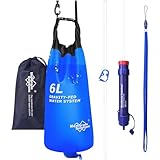
7. Membrane Solutions 6L Gravity Pro Is a Capable Large-Bag Gravity Filter
Membrane Solutions 6L Gravity Water Filter Pro for Group Camping
6 liter gravity bag
0.1 micron
4 stage filtration
Pros
- Six-liter group bag
- 0.1-micron membrane
- Activated carbon stage
- No pumping
- Long stated filter life
Cons
- 0.5 L per minute flow
- Needs suspension
The Membrane Solutions 6L Gravity Water Filter Pro is another group-oriented gravity option, but its product information focuses on a four-stage arrangement and a 0.1-micron hollow-fiber membrane. The six-liter hanging bag is designed for three to six people, which makes its capacity useful for a camp meal stop or emergency water reserve.
The listed media include coconut-shell activated carbon and dual PP pre-filters. Membrane Solutions states that the system reduces chlorine, sediment, and odor from lakes, rivers, and streams, and carries NSF/ANSI 42, 372, and 401 certifications.
Its stated rate is up to 500 milliliters per minute, far below the faster Platypus gravity system’s listed rate. I would plan on it as a set-it-up-and-wait system, not the right answer when a group needs several liters in a hurry.
The 0.1-Micron Four-Stage Design Supports Camp Water Planning
The 0.1-micron hollow fiber, carbon, and pre-filter stages give this model a clearly described treatment sequence. This type of detail is useful because it tells you that the system is intended to address more than visible grit, while its exact stated claims still set the boundary of what to expect.
A six-liter bag also lets one person take responsibility for collection while others handle shelter or food. Its collapsible design can pack down after the reservoir is drained, a benefit over rigid containers for a car camp or a shared backpacking load.
The Slower Flow Requires More Time at Camp
At the listed 0.5 liters per minute, a full six-liter bag can take meaningful time to process. Start the system soon after reaching camp instead of waiting until every bottle is empty, and keep the clean side protected while you wait.
The manufacturer states a filter life up to 1,320 gallons, or 5,000 liters. Dirty water conditions can still make maintenance necessary, so rinse and service the system according to its directions rather than treating the large number as a maintenance-free promise.
8. Platypus QuickDraw Is the Best Fast Ultralight Squeeze Filter
Platypus Quickdraw Ultralight 1 Liter Backpacking Water Filter System, ConnectCap & DrinkCap
3.36 ounces
3 L per minute squeezed
1 liter reservoir
Pros
- Very low weight
- Fast stated squeeze flow
- 28mm bottle connection
- Backflush capable
- Individually tested filter
Cons
- One-liter reservoir
- No virus-removal claim
The Platypus QuickDraw is the lightest product in this lineup at a listed 3.36 ounces, or 95 grams. Its one-liter reservoir, wide mouth, and handle aim squarely at hikers who want to collect, squeeze, drink, and get moving without carrying a full group system.
Platypus lists a maximum rate of three liters per minute when squeezed and 1.75 liters per minute in a gravity setup. The hollow-fiber filter is stated to remove 99.9999% of bacteria and 99.9% of protozoa, and to meet NSF and EPA P231 protocol.
For someone comparing the best camping water filters for a light overnight or thru-hike setup, that blend of low weight and stated flow rate is compelling. It is not a stated virus purifier, so source risk still decides whether this filter type is appropriate.
The 28mm ConnectCap Helps With Bottle-Based Carry Systems
The ConnectCap is designed to thread the clean side directly onto 28mm water bottles. That can simplify a hiking system for people who already use compatible bottles and prefer to avoid drinking from a soft bag after every collection.
Confirm bottle compatibility before leaving home, since similar-looking threads are not always interchangeable. Carry the dirty-side caps as well; keeping the intake and clean outlet covered is a straightforward way to protect the setup in a dusty pack pocket.
The Fast Flow Still Depends on Routine Cleaning
QuickDraw offers shake-to-clean and backflush cleaning options. That flexibility matters because the major complaint in filter forums is not usually that a new filter is slow, but that flow drops after repeated exposure to sediment and delayed maintenance.
Notice the baseline flow on the first few uses, then compare it later instead of relying on memory. A change is a cue to clean as directed, inspect for damage, and review the manufacturer’s replacement guidance; visual clarity of the output alone cannot verify filter condition.
Choose a Camping Water Filter by Water Risk and Trip Style
The first decision is not brand; it is the water you expect to use. A backpacking water filter based on hollow fiber, ceramic, or similar physical media is commonly chosen for stated bacteria and protozoa reduction, while a portable water purifier may also state virus reduction and additional chemical-contaminant filtering.
Read the product claim line by line. The UltraPress and GeoPress expressly state virus removal, while the Sawyer, GravityWorks, QuickDraw, MiniWorks, and other filter systems here state different removal scopes; none should be assumed to offer a claim that is not listed in its own documentation.
Pick a Capacity That Matches the Number of People
Solo hikers usually benefit from a bottle, squeeze bag, or one-liter reservoir because it keeps carry weight and pack volume down. A 16.9-ounce UltraPress, 24-ounce GeoPress, one-liter QuickDraw, or two-liter Sawyer system deals with personal water in small batches.
For a group, choose systems designed around shared output. The GravityWorks and Membrane Solutions models both use six-liter reservoirs, while the TRAILGO pump is listed for four to six people at 1.5 liters per minute.
Capacity also affects camp habits. If everyone waits until bottles are empty, even a capable filter can feel slow; collect water early, set up a dedicated clean-water location, and have each person bring a bottle for treated water.
Use Stated Flow Rate as a Time-Planning Tool
Flow ratings are most useful when you translate them into the next task. A stated three-liter-per-minute squeeze rate helps a moving hiker, a stated 1.75-liter-per-minute gravity rate can keep a group supplied, and a stated 0.5-liter-per-minute gravity rate asks for more patience.
Those are manufacturer figures, not a guarantee under every condition. Cold water, fine sediment, a partially clogged membrane, a low hanging position, and a poorly routed tube can all slow real output.
Do a full setup test at home with clean water. Time how long it takes to fill your usual bottle, check that caps and threads are compatible, and decide whether the system’s routine feels reasonable before it becomes your only treatment plan outdoors.
Maintain the Filter Before Flow Becomes a Problem
Maintenance starts at the water source. Avoid scraping the intake through mud when possible, keep dirty and clean components separate, and clean or backflush only as the product instructions direct.
Every listed filter has a different cleaning pathway: Sawyer includes a syringe and coupling, QuickDraw can be shake-cleaned or backflushed, and the pump and gravity systems have their own components and procedures. Use the maker’s directions rather than borrowing a technique from a different filter type.
Do not use a clear bottle of output as a performance test. Look instead for physical damage, unexpected change in flow, compromised connections, a cartridge past its stated life, or a filter that has frozen after use, then follow the manufacturer’s replacement or service guidance.
Protect Wet Hollow Fibers From Freezing
Freezing is one of the most serious cold-weather concerns for hollow-fiber systems. Once a filter has been wet, freeze damage can be internal and difficult to detect, so place it in an inside pocket while moving and in a sleeping bag overnight when temperatures could drop below freezing.
Start a cold trip with a dry, correctly stored filter whenever possible. If a used hollow-fiber filter may have frozen, treat the situation as a reason to follow the brand’s safety instructions or replace the unit, not as something a quick visual check can clear.
Use a Purifier When the Product’s Stated Scope Fits the Risk
International travel, disaster response, and water sources with higher pathogen uncertainty can change the decision. The GRAYL UltraPress and GeoPress explicitly list virus reduction along with bacteria and protozoa, whereas the non-GRAYL products in this guide have different stated claims.
No camping device is permission to drink from industrial runoff, water with an obvious chemical spill, or a source restricted by local guidance. Follow alerts, choose the cleanest available collection point, and carry a backup treatment plan suited to the conditions.
Carry a Backup Plan for Long or Remote Trips
A backup does not need to duplicate the main system. It can be a second compatible container, a spare cartridge where the maker recommends one, a way to boil water when appropriate, or a second treatment method selected for the expected risk.
For a multi-day trip, I pack the cleaning item that belongs to the chosen filter, study the connection points, and know the stated capacity before leaving. The right wilderness water filter is the one you can keep protected, clean, and correctly used throughout the trip.
These Camping Water Filter FAQs Give Direct Answers
What is the best water filter for camping?
The Sawyer Squeeze is the best overall choice here for a light, compact setup with a two-liter bladder and a stated service life up to 100,000 gallons. Choose the Platypus GravityWorks for hands-free six-liter group filtration, or a GRAYL UltraPress or GeoPress when the product’s stated virus-removal capability fits your water-risk plan.
How do I choose a camping water filter?
Start with the source risk, then match capacity and treatment speed to the trip. Pick a small squeeze or bottle system for solo hiking, a six-liter gravity system for camp groups, and a purifier with stated virus removal when that claim matters. Check the stated contaminants removed, weight, container compatibility, maintenance needs, and cold-weather limits before leaving.
Can you use tap water filters for camping?
Do not assume a household tap-water filter is suitable for backcountry use. Camping filters are designed around stated outdoor-water claims and portable collection methods, while a tap filter may not be intended for bacteria, protozoa, viruses, sediment-heavy water, or field conditions. Use a product according to its own stated scope and instructions.
What is the difference between water filters and purifiers?
A camping filter commonly uses media such as hollow fiber or ceramic to address stated bacteria, protozoa, and sediment-related concerns. A purifier may have broader stated claims, including virus reduction. Compare the manufacturer’s actual contaminant claims rather than relying on the label, because capability differs by product.
The Right Choice Depends on Your Water Plan
The best camping water filters are not a single category winner for every trip. Pick the Sawyer Squeeze when low carry weight, a durable two-liter bladder, and a huge stated service life matter most; pick the GravityWorks when a group wants six liters of hands-free output; and pick the QuickDraw when a 3.36-ounce system and fast stated squeeze flow fit the plan.
For travel or uncertain sources where virus reduction is part of the requirement, the GRAYL UltraPress and GeoPress have explicit stated virus-removal claims. The TRAILGO, MSR MiniWorks EX, and Membrane Solutions system remain sensible choices for their pump, ceramic-carbon, and large gravity-bag formats when those designs better fit camp logistics.
Before your 2026 trip, read the product manual, test the entire setup with clean water, protect wet hollow fibers from freezing, and build a backup plan. A few minutes of preparation turns a water treatment system from an item in the pack into a tool you can use with confidence.