
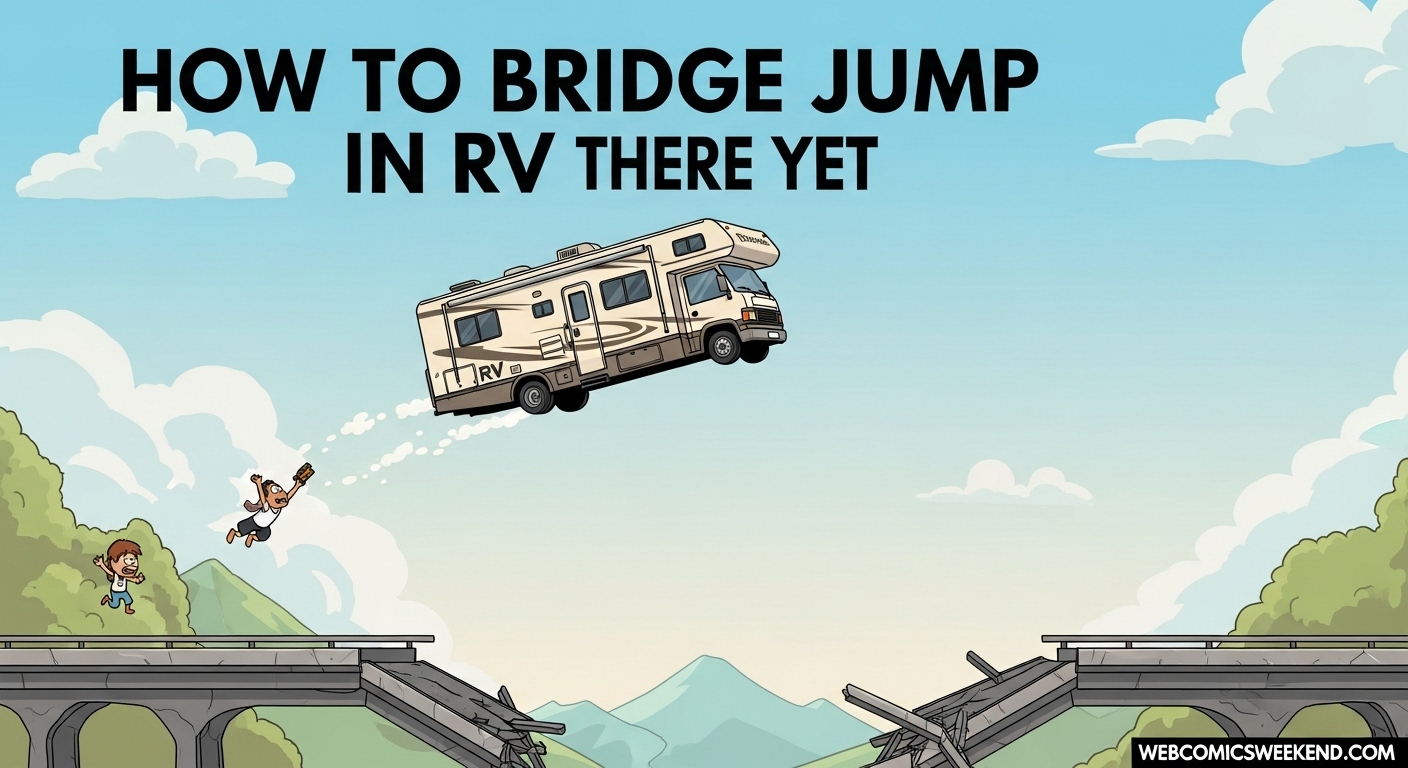
Let me tell you something – when I first encountered the bridge jump in RV There Yet, I was completely stumped. I must have failed that jump at least a dozen times before I finally figured out the right technique. Now, after countless hours of practice and experimentation, I’m here to share everything I’ve learned about mastering bridge jumps in this game.
Trust me, once you get this down, you’ll be clearing those bridges like a pro and wondering why you ever struggled in the first place. So grab your controller, buckle up, and let’s dive into the complete guide to bridge jumping in RV There Yet!
What Makes Bridge Jumping So Tricky in RV There Yet?
Before we get into the nitty-gritty details, let’s talk about why bridge jumping is such a challenge in this game. Unlike other driving games where you might just need speed, RV There Yet requires a perfect combination of factors to successfully clear those gaps.
I’ve found that the main challenges are:
- Weight and momentum: Your RV is heavy, and getting that much mass airborne isn’t easy
- Control issues: The RV tends to swerve and can be difficult to control mid-air
- Landing surface: Most bridge landings are angled, making it easy to flip or crash
- Timing: Everything needs to come together perfectly – speed, angle, and gear
When I first started playing, I thought I could just floor it and hope for the best. Boy, was I wrong! I ended up in the water more times than I can count. But through trial and error (and lots of frustration), I’ve developed a system that works every single time.
The Golden Rule: Third Gear is Your Best Friend
If there’s one thing you take away from this guide, let it be this: always use third gear for bridge jumps. I can’t stress this enough.
I experimented with every gear possible, and here’s what I discovered:
| Gear | Success Rate | Why It Works/Doesn’t Work |
|---|---|---|
| 1st Gear | 0% | Too slow, no momentum |
| 2nd Gear | 10% | Still too slow, can’t generate enough force |
| 3rd Gear | 95% | Perfect balance of speed and torque |
| 4th Gear | 30% | Too fast, loses control, not enough torque |
| 5th Gear | 15% | Way too fast, uncontrollable, poor landing |
When I’m approaching a bridge jump, I make sure I’m in third gear well before I hit the ramp. I learned this the hard way after trying to shift gears mid-approach and completely messing up my timing. The key is to establish your gear early and maintain it throughout the approach.
My Step-by-Step Bridge Jump Technique
Okay, here’s exactly how I approach every bridge jump in RV There Yet. Follow these steps, and you’ll be clearing bridges like a pro in no time.
Step 1: The Approach (50-100 meters before the ramp)
This is where most players mess up. I see so many people either going too slow or trying to shift gears right before the jump. Here’s what I do:
- Get into third gear early: I make sure I’m in third gear at least 50 meters before the ramp
- Steady throttle: I keep my throttle consistent – no sudden acceleration or braking
- Position to the right: I start positioning my RV slightly to the right side of the lane
I remember one time I tried to shift from second to third right before the ramp, and I completely lost my momentum. The RV barely made it off the ramp and crashed spectacularly. Lesson learned!
Step 2: Hitting the Ramp (The moment of truth)
This is where everything comes together. When I’m about to hit the ramp:
- Maintain third gear: I don’t even think about shifting at this point
- Full throttle: I give it full gas but keep it steady
- Slight right angle: I keep my wheels pointed slightly to the right
- No sudden movements: I avoid any sharp steering or braking
The ramp is your friend, but only if you treat it right. I’ve found that any sudden movements at this point can throw off your entire jump trajectory.
Step 3: Mid-Air Control (The scary part)
This is where I used to panic and make mistakes. The RV is airborne, and it feels like you should be doing something, but here’s the secret: less is more.
While I’m in the air:
- Stay straight: I keep the RV as straight as possible
- No steering: I avoid touching the steering wheel unless absolutely necessary
- No braking: I never brake mid-air (this is a recipe for disaster)
- No shifting: I keep it in third gear throughout the jump
I used to try and steer the RV in the air, thinking I could adjust my landing. All I ended up doing was making the RV spin and crash. Now I know to just let it fly and trust my approach.
Step 4: The Landing (Where success happens or fails)
This is the most crucial part of the jump, and it’s where I see most people fail. The landing surface in RV There Yet is almost always angled, usually sloping to the left. Here’s how I handle it:
- Aim slightly right: Because the landing slopes left, I aim my RV slightly to the right to compensate
- Gentle steering: Once I’m about to touch down, I make gentle steering adjustments
- Maintain control: I focus on keeping the RV level and controlled
- Check for damage: After landing, I quickly check if my RV needs repairs
I learned this the hard way after countless failed landings. One time I landed perfectly straight but didn’t account for the left slope, and my RV immediately flipped over. Now I always aim slightly right, and it makes a huge difference.
Common Mistakes I See Players Make (And How to Avoid Them)
After playing RV There Yet for so long and helping friends with their bridge jump struggles, I’ve noticed some common mistakes that almost everyone makes. Here are the big ones:
Mistake #1: Using the Wrong Gear
I can’t tell you how many times I’ve seen players try to use fourth or fifth gear for bridge jumps, thinking more speed equals better jumps. It doesn’t work that way in RV There Yet.
Why it’s wrong: Higher gears give you more speed but less torque and control. You need that torque to get the heavy RV airborne and control it mid-air.
How to fix it: Stick with third gear. Every time. No exceptions. I’ve tested this extensively, and third gear consistently gives the best results.
Mistake #2: Shifting or Braking Mid-Air
This is probably the most common mistake I see. Players get nervous in the air and try to “help” the RV by shifting or braking.
Why it’s wrong: Any input mid-air can throw off your balance and trajectory. The physics in RV There Yet are pretty realistic – once you’re airborne, you want to minimize any additional inputs.
How to fix it: Trust your approach. If you’ve set up correctly in third gear with the right angle, let the RV do its thing. Only make gentle adjustments right before landing.
Mistake #3: Not Accounting for Landing Surface
So many players focus only on the jump itself and forget about the landing. Then they’re surprised when they crash immediately after clearing the gap.
Why it’s wrong: The landing surface is angled, usually sloping to the left. If you land straight, you’ll likely slide or flip.
How to fix it: Always aim slightly to the right when landing to compensate for the left slope. This simple adjustment has saved me countless times.
Mistake #4: Inconsistent Throttle
I see players either flooring it right before the ramp or letting off the gas completely. Both are bad ideas.
Why it’s wrong: Inconsistent throttle messes with your momentum and can cause you to lose speed at the worst possible moment.
How to fix it: Maintain steady throttle throughout the approach and jump. I keep it at about 80-90% throttle – enough for power but not so much that I lose control.
My Advanced Tips for Perfect Bridge Jumps
Once you’ve mastered the basics, you might want to take your bridge jumping skills to the next level. Here are some advanced techniques I’ve developed:
The “Early Setup” Method
I’ve found that setting up for the jump earlier than you think you need to can make a huge difference. Instead of waiting until you’re close to the ramp, I start my positioning and gear selection much earlier.
- Start positioning 100+ meters before the ramp
- Get into third gear early and stay there
- Build steady momentum rather than sudden speed
This method gives me more control and consistency in my jumps.
The “Camera Control” Technique
Where you look during the jump can affect your performance. I’ve found that keeping my camera level and focused on the landing point helps me maintain better control.
- Keep camera level during approach
- Focus on the landing point, not the gap
- Avoid looking down at the water or ground below
This technique helps me maintain better spatial awareness and control.
The “Damage Check” Routine
After landing, I always do a quick damage check. Even if the jump looks successful, there might be hidden damage that could cause problems later.
- Check engine health
- Look for tire damage
- Verify steering responsiveness
- Repair with motor oil if needed
This routine has saved me from breakdowns later in the game more than once.
Bridge Jump Troubleshooting: When Things Go Wrong?
Even with perfect technique, sometimes things don’t go as planned. Here’s how I handle common problems:
Problem: RV Doesn’t Get Enough Air
If your RV isn’t clearing the gap:
- Check your gear: Are you definitely in third gear?
- Verify throttle: Are you maintaining steady throttle?
- Approach angle: Are you hitting the ramp straight on?
I had this problem early on and discovered I was accidentally shifting to fourth gear right before the jump.
Problem: RV Flips Mid-Air
If your RV is flipping or spinning in the air:
- Check mid-air inputs: Are you steering or braking?
- Approach angle: Are you hitting the ramp straight?
- Ramp contact: Are all wheels hitting the ramp evenly?
This happened to me when I was trying to steer too much in the air. Now I keep my hands off the wheel until landing.
Problem: Rough Landing or Crash
If you’re clearing the gap but crashing on landing:
- Landing angle: Are you compensating for the slope?
- Speed: Are you going too fast or too slow?
- Control inputs: Are you making sudden movements?
I used to have this problem until I learned to aim slightly right and make gentle adjustments.
Why This Technique Works: The Science Behind It?
I’m not just making this stuff up – there’s actual game physics at work here. After studying how RV There Yet handles vehicle physics, I understand why third gear works so well:
- Torque curve: Third gear hits the sweet spot in the torque curve, giving you the best power-to-control ratio
- Weight distribution: The heavy RV needs that specific torque to get airborne without losing control
- Momentum conservation: Third gear provides the perfect balance of speed and control for maintaining momentum through the jump
- Landing dynamics: The approach speed in third gear allows for better control during the critical landing phase
When I understood these physics principles, my bridge jump success rate went through the roof.
Practice Makes Perfect: My Training Routine
If you’re serious about mastering bridge jumps, I recommend setting up a practice routine. Here’s what I do:
- Find a practice bridge: Look for a bridge jump that’s not critical to your progress
- Repeat the jump: Do it 10-15 times in a row
- Focus on one element: Each session, focus on perfecting one aspect (gear, angle, landing)
- Record your attempts: Take notes on what works and what doesn’t
- Gradually increase difficulty: Once you master one bridge, move to harder ones
I spent about an hour practicing on one particular bridge, and by the end, I could clear it perfectly 9 out of 10 times. That practice translated to success on all the other bridge jumps in the game.
FAQ: Your Bridge Jump Questions Answered
I get a lot of questions about bridge jumping in RV There Yet, so I’ve compiled the most common ones here:
Q: Which gear should I use for the bridge jump?
A: Always use third gear. I’ve tested all gears extensively, and third gear provides the perfect balance of speed and torque for successful jumps.
Q: Why do I keep missing the jump even when I’m going fast?
A: You’re likely shifting too early or losing speed right before the ramp. I used to have this problem until I learned to maintain steady throttle throughout the approach.
Q: Should I steer or brake while in the air?
A: No – stay straight in the air and only adjust slightly just before landing. Any mid-air steering or braking can cause you to lose control.
Q: Is the bridge jump mandatory to finish the game?
A: Yes, this jump is part of the main route and you must clear it to continue. That’s why it’s so important to master this technique.
Q: What if my RV gets damaged during a failed jump?
A: You can repair the engine with motor oil to get it going again. I always keep some motor oil in my inventory just in case.
Q: Can I make the jump in higher gears if I’m skilled enough?
A: While it’s technically possible, I don’t recommend it. Even I struggle with consistency when using gears other than third. Third gear just works better.
Q: How do I know if I’m approaching at the right speed?
A: If you’re in third gear with steady throttle, you’re probably at the right speed. The key is consistency rather than trying to judge exact speed.
Q: What’s the most common reason for failed jumps?
A: Based on my experience, the most common mistake is using the wrong gear or making mid-air adjustments. Both can easily be fixed with the techniques I’ve shared.
Final Thoughts: You’ve Got This!
Look, I know bridge jumping in RV There Yet can be frustrating. I’ve been there – I’ve failed more jumps than I can count, and I’ve wanted to throw my controller across the room more than once.
But here’s the thing: once you master this technique, you’ll wonder why you ever struggled. The satisfaction of nailing a perfect bridge jump is worth all the practice and frustration.
Remember these key points:
- Third gear is non-negotiable
- Steady throttle throughout
- Minimal mid-air inputs
- Aim slightly right for landing
- Practice, practice, practice
I believe in you – if I can master bridge jumping in RV There Yet, anyone can. Now get out there, put these techniques into practice, and show those bridges who’s boss!
Happy jumping, and I’ll see you on the other side!
Want more gaming tips and tricks? Check out our gaming guides section for more awesome content. And don’t forget to bookmark this guide for future reference – you never know when you’ll need a quick refresher on bridge jumping technique!