
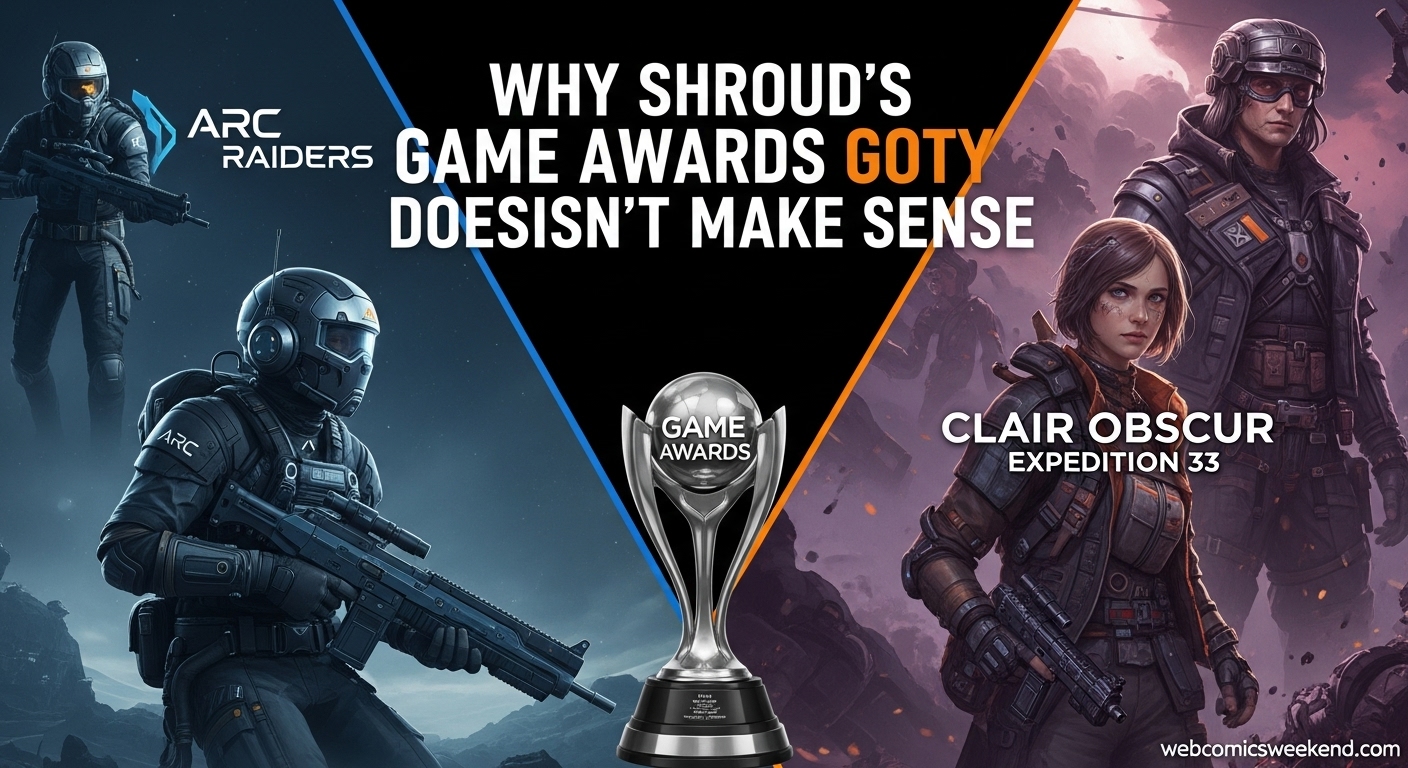
I’ve been following gaming news for years, but when I saw Shroud’s recent rant about The Game Awards, I couldn’t help but shake my head. As someone who’s been in the gaming community since the early 2000s, I’ve seen my fair share of controversial takes, but this one really takes the cake. Let me break down why Shroud’s criticism of The Game Awards and his push for ARC Raiders over Clair Obscur: Expedition 33 just doesn’t add up.
The Context: What Shroud Actually Said?
Before I dive into why his logic is flawed, let me recap what actually happened. During a recent Twitch stream, Shroud went on a passionate rant about The Game Awards 2026, telling his viewers:
“We gotta make sure that this game wins game of the year, by the way. Do not let that Expedition game win Game of the Year. Do not let it. Absolutely do not. We all have to band together to make this game win. Us multiplayer gamers are the minority, okay. We are the minority being multiplayer gamers, but I believe we can win. I believe. You just need to tell everybody. I’ve never voted for anything ever, but I think I’m going to vote this year for this game.”
He didn’t stop there. Shroud also claimed that “All the fucking awards are rigged anyway, who cares?” and suggested there should be separate categories for single-player and multiplayer games.
As someone who’s been watching The Game Awards since they started in 2014, I can tell you this kind of criticism misses the point entirely. Let me explain why.
The “Multiplayer Gamers Are Minority” Fallacy
First off, Shroud’s claim that “multiplayer gamers are the minority” is just factually wrong, and I think he knows it. When I look at the gaming landscape in 2026, what do I see? I see games like Fortnite, Roblox, Counter-Strike, and League of Legends dominating player counts and cultural impact.
According to recent research, while there’s a generational split in gaming preferences, multiplayer games absolutely dominate in terms of active player numbers. Younger gamers especially gravitate toward multiplayer experiences, and even older gamers who prefer single-player titles often engage with multiplayer games socially.
But here’s the thing: even if multiplayer gamers were somehow in the minority (which they’re not), that wouldn’t mean multiplayer games deserve special treatment at awards shows. The Game Awards are supposed to recognize excellence in gaming, not represent the majority player base. If that were the case, we’d just give every award to the most popular free-to-play mobile game and call it a day.
There’s Already a Multiplayer Category!
This is where Shroud’s criticism really falls apart for me. He’s acting like multiplayer games get completely ignored at The Game Awards, but that’s just not true. There’s already a “Best Multiplayer Game” category that’s been around since 2015!
Let me show you the recent winners:
| Year | Best Multiplayer Game Winner |
|---|---|
| 2024 | Helldivers 2 |
| 2023 | Baldur’s Gate 3 |
| 2022 | Splatoon 3 |
| 2021 | It Takes Two |
| 2020 | Among Us |
| 2019 | Apex Legends |
| 2018 | Fortnite |
| 2017 | PlayerUnknown’s Battlegrounds |
| 2016 | Overwatch |
| 2015 | Splatoon |
When I look at this list, I see some of the most influential and beloved multiplayer games of the past decade getting the recognition they deserve. Games like Fortnite, Apex Legends, and Overwatch didn’t just win the multiplayer category – they defined entire genres and influenced countless other games.
Shroud’s argument that multiplayer games don’t get recognition is simply false. They get their own dedicated category where they compete against other multiplayer games on equal footing. That’s exactly how it should be.
The Historical Context: Why Single-Player Games Often Win GOTY
I’ve been watching The Game Awards since the beginning, and I can tell you that single-player games do tend to win the overall Game of the Year award more often than competitive multiplayer games. But there’s a good reason for that, and it’s not some conspiracy against multiplayer titles.
Let me break down the GOTY winners since 2014:
| Year | Game of the Year Winner | Type |
|---|---|---|
| 2024 | Astro Bot | Single-player |
| 2023 | Baldur’s Gate 3 | Co-op RPG |
| 2022 | Elden Ring | Single-player with co-op |
| 2021 | It Takes Two | Co-op only |
| 2020 | The Last of Us Part 2 | Single-player |
| 2019 | Sekiro: Shadows Die Twice | Single-player |
| 2018 | God of War | Single-player |
| 2017 | The Legend of Zelda: Breath of the Wild | Single-player |
| 2016 | Overwatch | Competitive multiplayer |
| 2015 | The Witcher 3: Wild Hunt | Single-player with co-op |
| 2014 | Dragon Age: Inquisition | Single-player with co-op |
When I look at this list, I notice something interesting. Out of 11 winners, only one (Overwatch in 2016) is a purely competitive multiplayer game. But does that mean the awards are biased against multiplayer games? Not at all.
The reality is that single-player games often have the advantage when it comes to narrative depth, artistic vision, and critical reception. Games like The Witcher 3, God of War, and Baldur’s Gate 3 didn’t just sell well – they pushed the boundaries of what games can do as an art form. They delivered complete, polished experiences that resonated with both critics and players.
That’s not to say multiplayer games can’t be artistic or innovative. Of course they can! But competitive multiplayer games often focus on different strengths: replayability, community building, and competitive balance. These are valuable qualities, but they’re different from what typically defines a Game of the Year winner.
ARC Raiders vs. Expedition 33: A Tale of Two Games
Let me talk about the two games at the center of this controversy: ARC Raiders and Clair Obscur: Expedition 33.
From what I’ve seen and played, ARC Raiders is a fantastic extraction shooter from Embark Studios (the team behind Battlefield). It’s gotten great reviews and has built a strong community. As someone who’s spent way too many hours in extraction shooters, I can appreciate what ARC Raiders brings to the table.
On the other hand, Clair Obscur: Expedition 33 is a single-player JRPG from Sandfall Studio that’s been getting rave reviews for its storytelling, art direction, and emotional impact. When I played through the demo earlier this year, I was blown away by the attention to detail and the mature, complex narrative.
Both games are excellent in their own ways. But here’s the thing: they’re completely different types of games trying to accomplish completely different things. ARC Raiders is about tension, teamwork, and high-stakes gameplay loops. Expedition 33 is about character development, world-building, and emotional storytelling.
Comparing them directly for Game of the Year is like comparing a blockbuster action movie to an intimate indie drama. Both can be great, but they’re great in different ways.
The “Rigged Awards” Argument
I need to address Shroud’s claim that The Game Awards are “rigged.” This is something I hear every year from fans whose favorite games don’t win, and it’s gotten really old.
The Game Awards use a voting system that combines votes from gaming media (90 international publications) and influencers with public fan voting. The jury vote actually has more weight in the final decision, which makes sense if you think about it. These are people who play hundreds of games every year and have the context to make informed comparisons.
Is the system perfect? No, but it’s far from “rigged.” Geoff Keighley and his team have been transparent about how the voting works, and they’ve even considered making it more fan-focused in the future.
When I hear someone like Shroud, who has millions of followers, claim the awards are rigged just because his preferred game might not win, it feels irresponsible. It undermines the hard work of developers and the legitimacy of the entire awards process.
What Shroud Gets Right And Why It Still Doesn’t Help His Argument?
Look, I’m not here to completely tear down Shroud. He makes one valid point: there could be value in having more specific categories to recognize different types of games.
When I think about it, maybe splitting the “Best Multiplayer Game” category into “Best Competitive Multiplayer” and “Best Cooperative Multiplayer” could make sense. Games like It Takes Two and Baldur’s Gate 3 (which won the multiplayer category in their respective years) are very different from competitive shooters like Apex Legends or Counter-Strike.
But that’s a conversation about category refinement, not about creating separate GOTY awards. The Game of the Year should remain exactly what it is: recognition for the single best game of the year, regardless of genre or platform.
Why This Matters to Me as a Gamer?
I’ve been playing video games since I was a kid, and I’ve seen the industry evolve in amazing ways. One of the best developments has been the growing recognition of games as legitimate art forms. The Game Awards play a big role in that, giving developers the recognition they deserve for pushing the medium forward.
When I see influential figures like Shroud dismiss the entire process as “rigged” and push for tribalistic “us vs. them” mentalities, it worries me. Gaming should be about celebrating all types of games and the diverse experiences they offer. There’s room for single-player epics, competitive shooters, indie darlings, and everything in between.
I love multiplayer games as much as anyone. Some of my best gaming memories come from late-night sessions with friends in games like Counter-Strike, Fortnite, and more recently, multiplayer games like Steal a Brainrot. But I also appreciate the storytelling and artistic vision that goes into single-player masterpieces.
The Bigger Picture: What This Says About Gaming Culture?
This whole controversy with Shroud highlights something that’s been bothering me about gaming culture lately. There’s this growing trend of treating gaming like a zero-sum game where only one type of experience can be “the best.”
When I look at communities around games like Plants vs Brainrots or Fisch, I see players who are just excited about the games they love, regardless of genre or platform. That’s the spirit I wish we saw more of in the broader gaming conversation.
The Game Awards aren’t perfect, but they represent an important step forward for gaming as an art form. They give developers a platform to showcase their work and get recognized for their creativity and innovation. That’s something worth celebrating, not tearing down.
My Final Thoughts
At the end of the day, I think Shroud’s criticism of The Game Awards doesn’t make sense because it’s based on false premises and misunderstandings about how the awards work. Multiplayer games do get recognition, just in their own category. Single-player games tend to win GOTY because they often excel in the areas that define a “game of the year” contender.
But more importantly, this whole debate misses the point. The Game Awards should be about celebrating the best in gaming, regardless of genre or platform. There’s no reason why we can’t appreciate both ARC Raiders and Clair Obscur: Expedition 33 as excellent games in their own right.
I’ll be watching The Game Awards 2026 with excitement, cheering for all the nominees and appreciating the incredible work that developers put into these games. And I hope you’ll join me in celebrating gaming in all its forms.
FAQ: Shroud’s Game Awards Criticism
Why does Shroud think The Game Awards are rigged?
Shroud claimed The Game Awards are “rigged” during his stream, suggesting that single-player games always win Game of the Year regardless of quality. However, there’s no evidence to support this claim, and the awards use a transparent voting system combining media and fan votes.
Is there really a separate category for multiplayer games?
Yes! The Game Awards have had a “Best Multiplayer Game” category since 2015. Games like Fortnite, Apex Legends, and Overwatch have all won in this category, showing that multiplayer games do get recognized.
Have any competitive multiplayer games won Game of the Year?
Only one purely competitive multiplayer game has won Game of the Year: Overwatch in 2016. However, several co-op games like It Takes Two and Baldur’s Gate 3 have also won the top prize.
What’s the difference between Game of the Year and Best Multiplayer Game?
Game of the Year recognizes the single best game overall, considering factors like innovation, storytelling, and impact on the industry. Best Multiplayer Game specifically honors excellence in multiplayer game design and community building.
Why do single-player games often win Game of the Year?
Single-player games tend to win Game of the Year more frequently because they often excel in narrative depth, artistic vision, and complete, polished experiences – qualities that define many “game of the year” contenders.
Does public voting determine The Game Awards winners?
No, public voting only accounts for a portion of the final decision. The majority of the voting weight comes from an international jury of gaming media and influencers.
When are The Game Awards 2026 happening?
The Game Awards 2026 will take place on December 11, with nominees expected to be announced in mid-November.
Can I vote for The Game Awards?
Yes! Fans can vote in all categories, including Game of the Year, through The Game Awards website. However, as mentioned, fan votes are combined with jury votes to determine the winners.
Remember to bookmark this page for more gaming news and analysis throughout 2026!