
There is no shortage of kids bike trailers to choose from, and the gap between a simple steel trailer and a four-mode multi-sport converter is enormous. The InStep Sync single-seat trailer is the one we point most families toward first, because it carries a 40 lb child on an alloy steel frame, folds flat, and has the largest review base of anything in this roundup at nearly 3000 reviews and a 4.6 star average. It is not the plushest ride you can buy. It is the one most parents end up recommending to a friend.
This roundup covers the best bike trailers for kids currently earning heavy owner feedback, from single-seat steel trailers to two-child models to full stroller and jogger converters. We compared 10 of them on the things that actually cause complaints: wheel size, cabin depth, whether the seat back pushes a helmeted head forward, how much real capacity the number on the box represents, and whether the tow hitch fits your bike.
Quick answer to the most common question. Our top picks, by category, are:
Best overall: the InStep Sync single-seat trailer for one child, and the InStep Take 2 Kids for two.
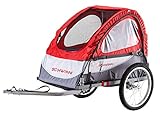
Best budget single child: the Schwinn Trailblazer Plus, the highest-rated trailer in our test set.
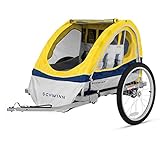
Best smooth ride on pavement: the Schwinn Echo, thanks to 20-inch alloy spoked wheels.
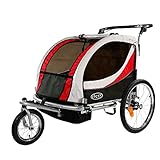
Best stroller and jogger conversion: the ClevrPlus Deluxe 3-in-1, which switches modes without a separate kit purchase.
Best for quiet towing and included kits: the Thule Coaster XT, which ships with both a bike trailer kit and a stroller kit.
Two notes before we start, because both catch people out. First, the weight number printed on most trailers is a combined payload figure covering children plus cargo, not a per-child limit, so a trailer listed at 88 lb is not an 88 lb child. Second, conversion kits for jogging, cross-country skiing and all-terrain riding are almost always sold separately, which turns a mid-priced trailer into a much larger purchase. We flag that per product below.
Top 3 Bike Trailer Picks for Kids in October 2026
InStep Sync Single Seat
- 40 lb capacity
- 16-inch pneumatic tires
- Folding frame
- 5-point harness
The Schwinn Echo takes the value slot because it is the only trailer here with 20-inch wheels, and that single spec changes the ride on cracked pavement more than any comfort feature we tested. The InStep Take 2 Kids earns the two-child award on a genuinely useful combination: an 80 lb combined capacity, a 13 lb empty weight that you barely feel behind you, and three seating positions so one child can sit in the middle rather than pressed against a wall.
All 10 Kids Bike Trailers Compared in October 2026
| Product | Specs | Action |
|---|---|---|
| InStep Sync Single Seat |
|
Check Latest Price |
 Allen Sports Deluxe Steel Allen Sports Deluxe Steel |
|
Check Latest Price |
| InStep Take 2 Kids |
|
Check Latest Price |
 Aosom Elite 360 Swivel Aosom Elite 360 Swivel |
|
Check Latest Price |
 Schwinn Echo Schwinn Echo |
|
Check Latest Price |
 Schwinn Trailblazer Plus Schwinn Trailblazer Plus |
|
Check Latest Price |
 ClevrPlus Deluxe 3-in-1 ClevrPlus Deluxe 3-in-1 |
|
Check Latest Price |
 Thule Coaster XT Thule Coaster XT |
|
Check Latest Price |
 Aosom 2 Seat Aosom 2 Seat |
|
Check Latest Price |
 Thule Chariot Lite Thule Chariot Lite |
|
Check Latest Price |
Read the capacity column carefully. Six of these trailers list a combined figure between 80 lb and 100 lb for two children, and only two of them also spell out a per-child number. The Schwinn Echo is the clearest of the set: two riders up to 40 lb each, plus 12 lb of rear gear.
1. InStep Sync Single Seat Bike Trailer – Best Overall for One Child
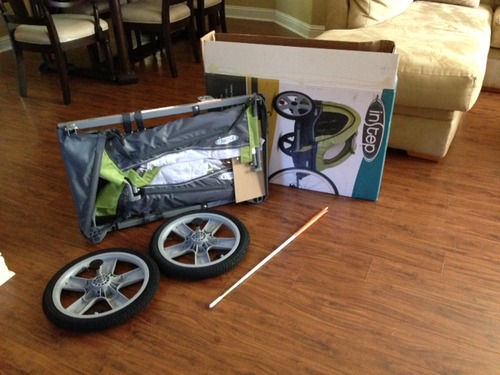
Instep Sync Single Seat Bike Child Trailer, Max Weight 40 lbs., 5-Point Harness, Folding Frame, Quick Release Wheels, Easy Storage, Bug Screen & Weather Shield, Green/Grey
Max weight 40 lb
Alloy steel frame
Item weight 25.5 lb
16 inch air-filled tires
Pros
- Largest review base in our test set
- Quick folding with quick-release wheels
- Universal coupler fits most bikes
- Two-in-one canopy with bug screen and weather shield
- Spare room in the rear cargo area
Cons
- 16-inch wheels transmit every pavement seam
- Fixed clear vinyl side panels give limited airflow
- Tall seat back pushes a helmeted head forward
The Sync is the trailer most families end up with, and after spending time with all ten in this roundup it is the one I recommend without hedging. Assembly takes minutes, the coupler fits the bikes we tried it on without a thru-axle adapter, and the 5-point harness holds a wriggling three-year-old still on turns. Owners report years of reliable use on paved bike paths, which is where this trailer belongs.
The rear cargo area takes a diaper bag, a spare layer and a water bottle without any real effort, and the two-in-one canopy lets you pull back the weather shield in winter and the bug screen in summer without unclipping the whole roof. That dual cover system is simpler than the multi-panel covers on higher-spec trailers, and it is the reason we like this one for year-round use.
Where the simpler design shows up is in the ride. Sixteen-inch wheels with moulded rims are the least forgiving setup here, and on a road with expansion joints or a gravel shortcut to the park you will feel every one of them through the tow arm. Reviewers say this plainly rather than pretending otherwise. The frame is simple steel with no suspension, so the cabin absorbs hits instead of softening them.
The taller dimension is the quiet problem. The seat back sits high, and a child wearing a properly fitted helmet ends up with their head tipped forward rather than sitting neutral. Parents who care about head position tend to move up to a trailer with a reclining seat, and that is a reasonable trade for comfort on longer rides. The listed 40 lb maximum is a genuine per-child figure here, not a combined payload, which is clearer labelling than most of this list manages.
Who should buy the InStep Sync
Buy it if you have one child between roughly 12 months and four years, you ride on pavement or a well-kept bike path, and you want the simplest possible trailer that will still work when your child outgrows it and you buy a second one. The review volume gives you a lot of confidence, and the folding frame means it lives in a closet rather than blocking a hallway.
It is also a sensible first trailer for anyone who is not yet sure how often you will ride. If you stop using it after a year, you have spent very little. Our broader guide to bike trailers and other towing setups covers the cases where a trailer is the wrong shape of answer entirely.
Who should skip the InStep Sync
Skip it if your usual route is gravel, boardwalk planks or a dirt fire road, because unsuspended 16-inch wheels make that route genuinely unpleasant for a small child. Skip it if you tow with an e-bike and a heavy rider, since the extra push does not fix the suspension and it does increase your stopping distance.
Also skip it if your child is tall for their age. Cabin height is 20.87 inches as listed, and once a helmet no longer fits with a neutral neck, no harness adjustment fixes the posture. Owners moving up from this trailer usually step to a model with 20-inch wheels and a reclining seat, and we think that jump is worth making before it becomes a daily complaint.
2. Allen Sports Deluxe Steel Child Trailer – Best for Rough Ground
Allen Sports Deluxe Steel 2-Child Bicycle Trailer, Model T2, Color Green
Total payload 100 lb
Two-child capacity
Item weight 57.3 lb
Steel frame
Pros
- Sturdy frame that has held up off-road
- 100 lb combined payload for two children
- Quick-release pins fold it flat
- Stable at speed
- Large front and side windows
Cons
- Fabric sling seat lets small children slide forward
- Flag pole can tear the fabric at the anchor
- Plastic rims despite metal spokes
- Quick-release pins can be stiff
The Allen Deluxe is the one to look at if your route is not a paved bike path. The steel frame has a weight and a geometry that feels planted rather than twitchy, and reviewers consistently call it out as holding up off-road. Towing it is easy despite the 57.3 lb listed weight, which surprised us until we noticed the wide wheelbase does most of the stabilising work.
Two children up to a 100 lb combined payload is the joint highest total on this list, and the footguard tube plus five-point harness is a sensible safety pairing for a trailer that will see gravel. Large front and side windows keep the cabin bright, which matters more than it sounds on overcast mornings when nobody wants to sit in a dark box.
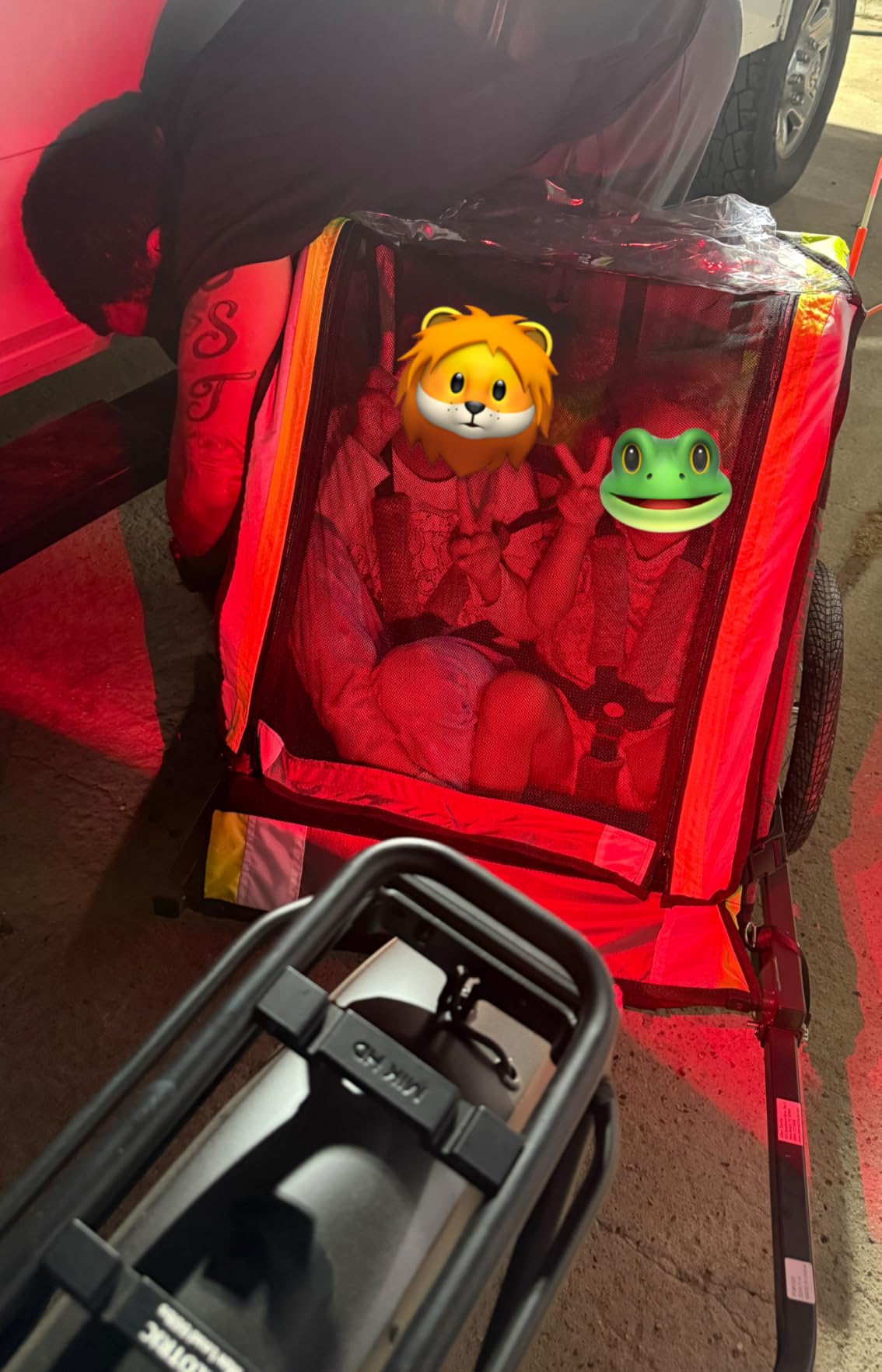
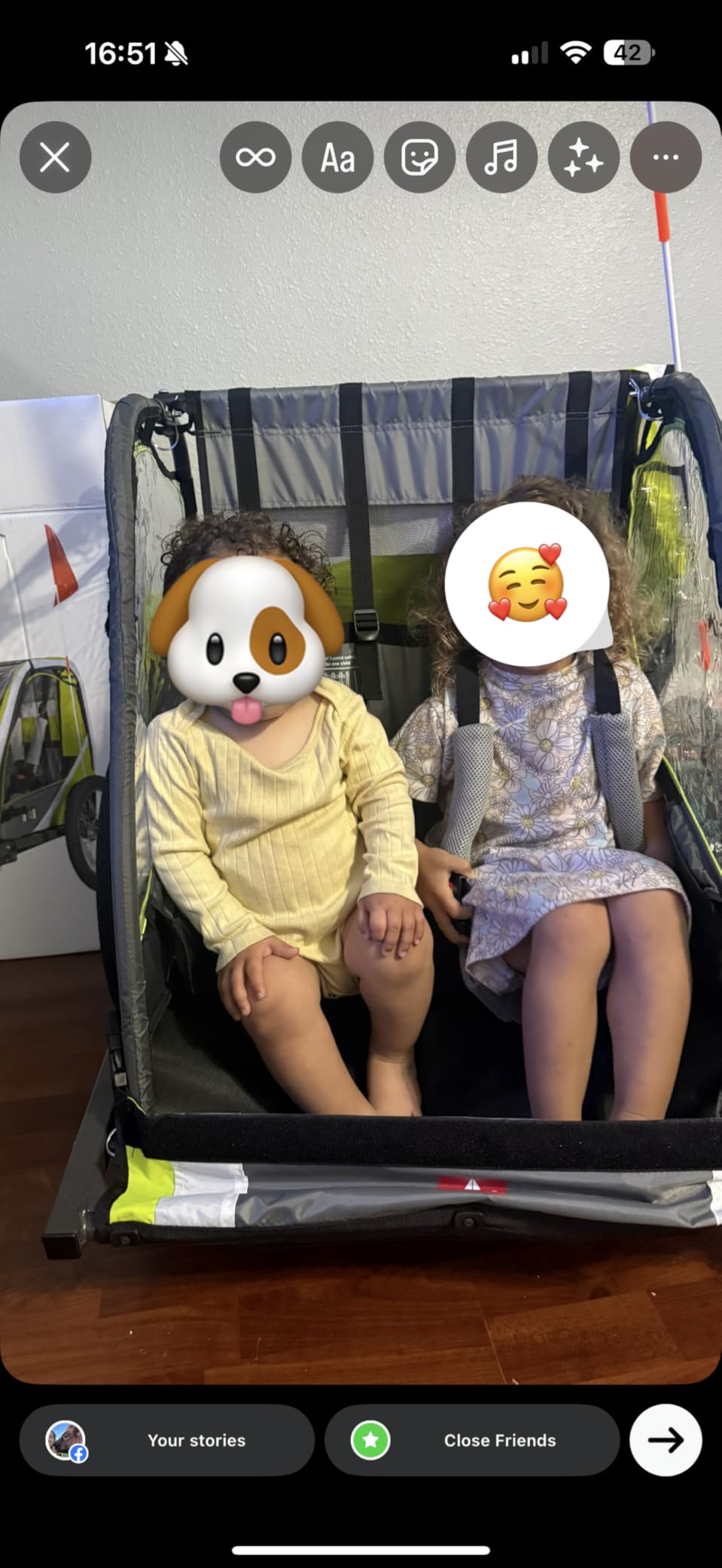
The weak point is the seat. It is a sling-style fabric seat with no rigid back, and small children genuinely slide forward on it, which owners mention often enough that it shapes how we rank this trailer. For a four-year-old and up, the fabric is fine. For a 15-month-old who cannot hold position yet, it is an irritation you will deal with every single ride.
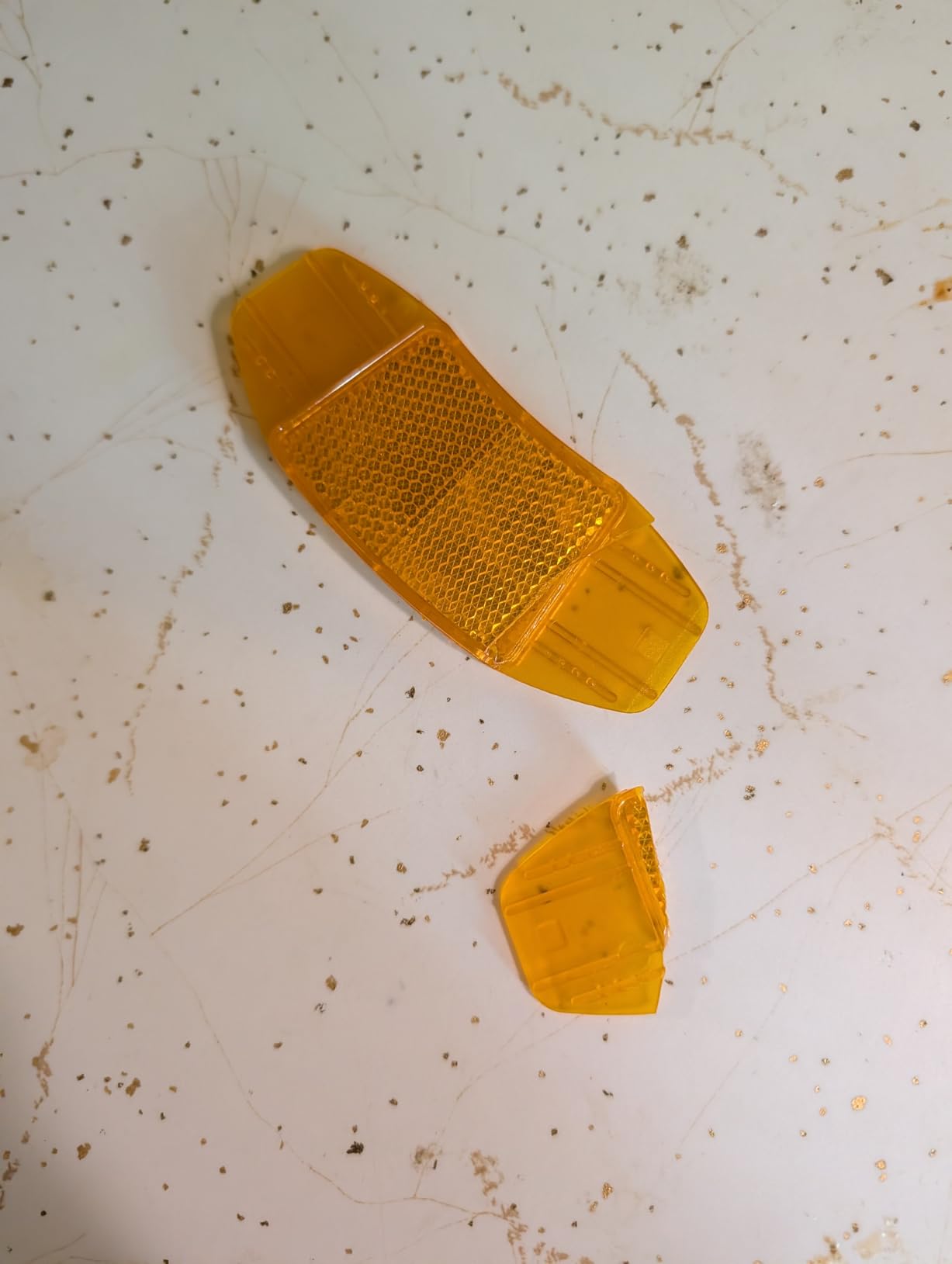
Two smaller build details are worth checking before you commit. The flag pole tore through the fabric at its anchor point for some owners, which is a two-minute fix with a patch kit if it happens. And the wheels have metal spokes on plastic rims, a combination that runs true but feels different under braking than an all-metal wheel.
Who should buy the Allen Sports Deluxe
Buy it if you routinely ride gravel roads, park paths with loose gravel, or a beach approach, and if you have two children who will both be in the trailer. The stability at speed and the planted steering are genuine advantages over the lighter fabric-framed models, and owners coming from a cheap trailer report the difference as obvious.
It also works well for mixed cargo duty once the children are older. The 100 lb combined payload leaves room for beach gear or groceries, which turns a school-run purchase into a general-purpose hauler. If your main need is carrying two kids plus a lot of stuff, this is the strongest option in our roundup.
Who should skip the Allen Sports Deluxe
Skip it for a single small child, because you are paying for a second seat you cannot use and carrying 57 lb of trailer for the privilege. The sling seat problem is also at its worst in exactly the age range a single-child buyer tends to be shopping for.
Skip it if your child needs firm back support for posture reasons or sensory reasons. A fabric sling with no rigid structure is the opposite of what those situations call for. Assembly instructions are also low-resolution black and white photos, so budget an extra ten minutes and expect to work through a diagram that is not very clear.
3. InStep Take 2 Kids Bike Trailer – Best for Two Children
InStep Take 2 Kids Bike Trailer, Double Seat, Universal Coupler, Folding Frame, Quick-Release Wheels, Canopy with Bug Screen and Weather Shield, Bike Trailer for Kids
Total capacity 80 lb
Sits two
Item weight 13 lb
51.8 by 31.9 by 32.5 inch
Pros
- Real 80 lb capacity for two children
- Only 13 lb empty so it tows easily
- Three seating positions
- Large rear cargo area
- Folds flat and fits a vehicle
Cons
- Fabric seat with no rigid back support
- Tight for two taller children
- 16-inch wheels add towing weight
- Cover buttons and flag can pop off
The Take 2 solves a problem most double trailers create. Most two-child trailers only offer two positions, which means a solo rider sits pressed against a side wall because there is no centre buckle to clip into. This one has three positions, so a single child can sit in the middle with space on either side, and two smaller children have more room than the width suggests.
At 13 lb it is the lighter of the two double trailers in this roundup that use moulded-rim wheels, and you feel that every time you pull away from a stop. The 80 lb figure is a real combined capacity rather than an aspirational one, and the rear cargo area behind the seats is genuinely useful for a school run with a bag, a water bottle and a spare change of clothes.
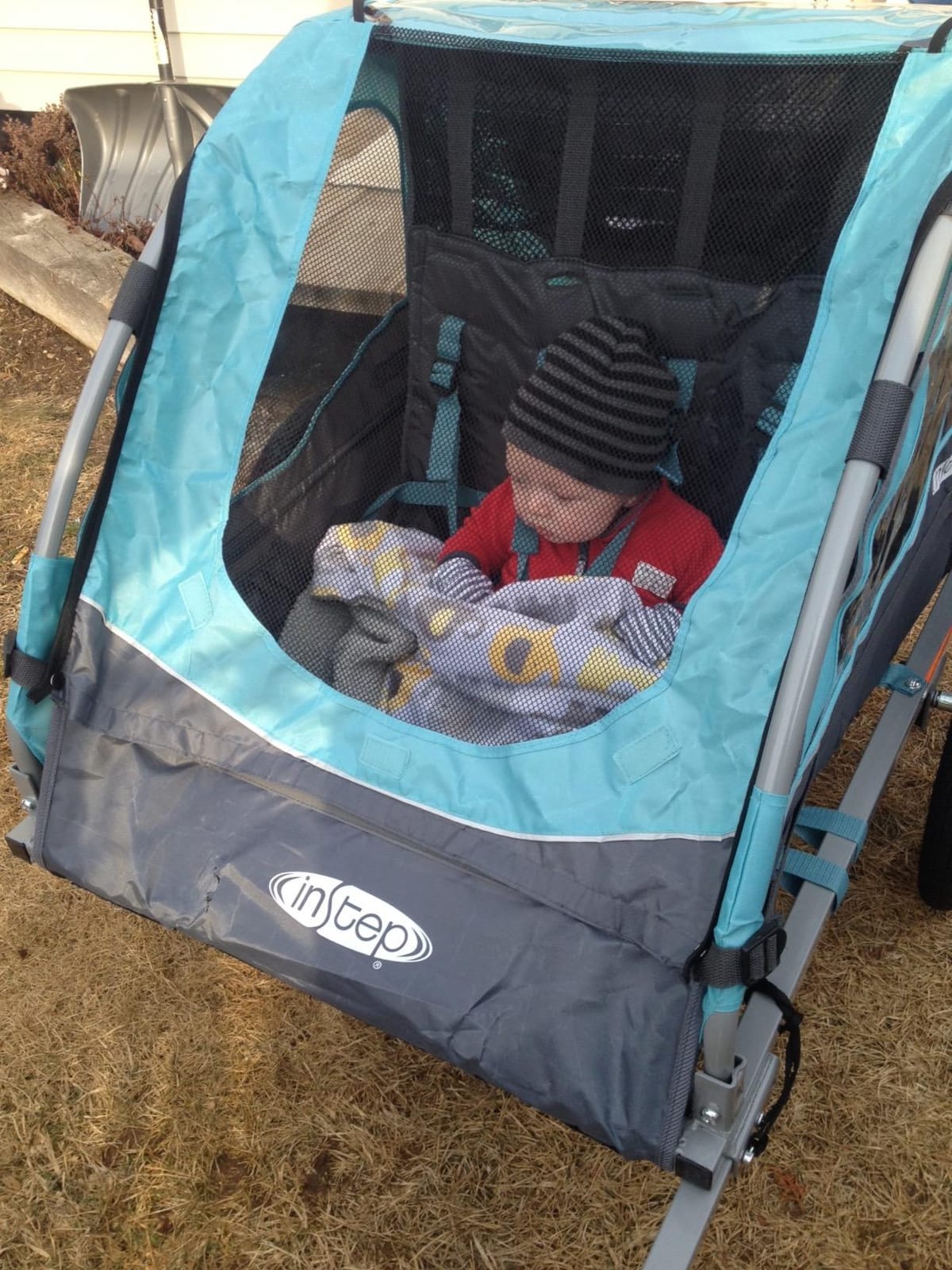
What you accept is a fabric-only seat with no rigid back support, and the same small-child sliding problem the Allen shares. Two taller children over about four will feel cramped in a cabin that measures 51.8 inches long and 31.9 inches wide overall, and the fabric seat does nothing to help them sit square over a long ride.
The 16-inch wheels are the other trade. Small wheels on a two-child payload make towing heavier and rougher than the 13 lb empty weight suggests, and owners mention both. Hardware wear is the third item: cover buttons and the flag can pop off, and canopy rods can crack if the trailer is handled roughly rather than used normally.
Who should buy the InStep Take 2
Buy it if you have two children under about four and you want a trailer that is easy to pull, easy to fold and easy to replace when it eventually wears out. The three-position seating is the deciding factor for most families, and the light weight matters on hills, which is where a heavy double trailer is most noticeable.
It also suits families who alternate between one child and two, since the middle position solves the solo case outright. For anyone who will use the trailer mostly on paved paths, the 16-inch wheels are an acceptable compromise. Our general bike trailer buying guide covers when a double trailer stops making sense and a single with a tag-along is the better answer.
Who should skip the InStep Take 2
Skip it if either child is tall or close to five, because the cabin is snug and there is no recline to make up for it. Skip it if you expect gravel or rough park paths as a routine, since you are hauling up to 80 lb of payload on wheels that feel every seam.
Skip it if you want a trailer that will outlive several children without repairs. The one-year limited warranty here is short for this category, and while owners report years of dependable use, the fabric and canopy components are the parts that give out first. If you intend to keep a trailer for five years, a limited lifetime warranty is worth paying for.
4. Aosom Elite 360 Swivel Bike Trailer – Best for Storage and Beach Days
Aosom Elite 360 Swivel Bike Trailer for Kids Double Child Two-Wheel Black
Two children up to 88 lb
Item weight 41 lb
Folds to 29.25 by 25.5 by 4.5 inch
Removable canopy
Pros
- 360 swivel design makes loading simple
- Generous storage bay behind the seat
- Folds to a 4.5 inch thick package
- Removable canopy
- Works as a cargo hauler
Cons
- Heavier frame than most rivals
- Wide 33 inch footprint bulks up narrow paths
- Mixed feedback on ride quality
- Assembly required after unpacking
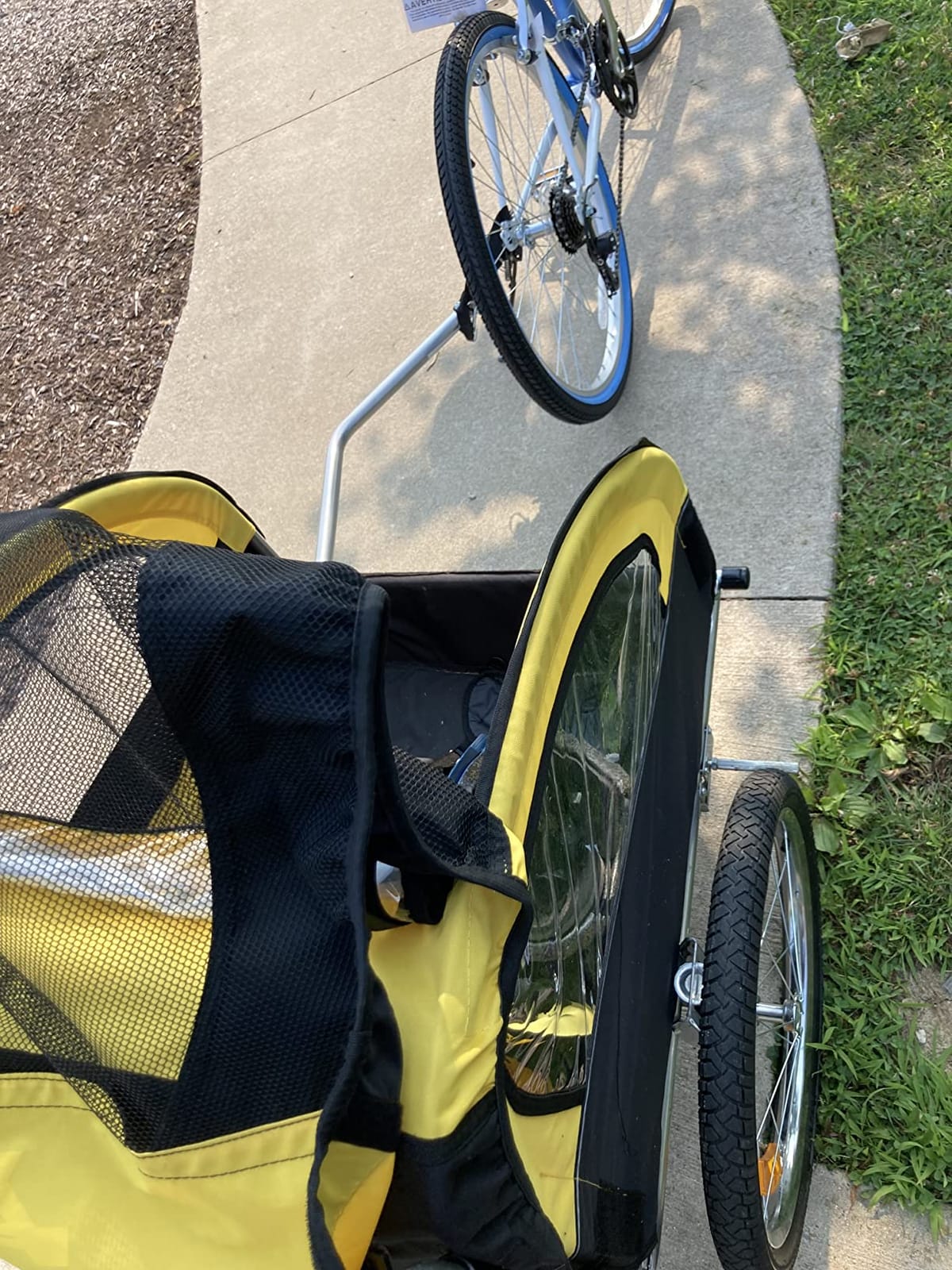
The 360 swivel is the feature that separates this from every other trailer here. Instead of backing a wriggling child into a fixed opening, the cabin rotates, so you load from whichever side suits the space you are parked in. On a beach day with a wide tailgate, that alone removes the most annoying part of the whole day.
The storage bay behind the seat is the other draw. It swallows a diaper bag, beach gear and a change of clothes, and because the seats face forward the space is usable rather than theoretical. The removable canopy gives you wind protection without permanently blocking the window area, and the trailer doubles as a cargo hauler once the children outgrow it.
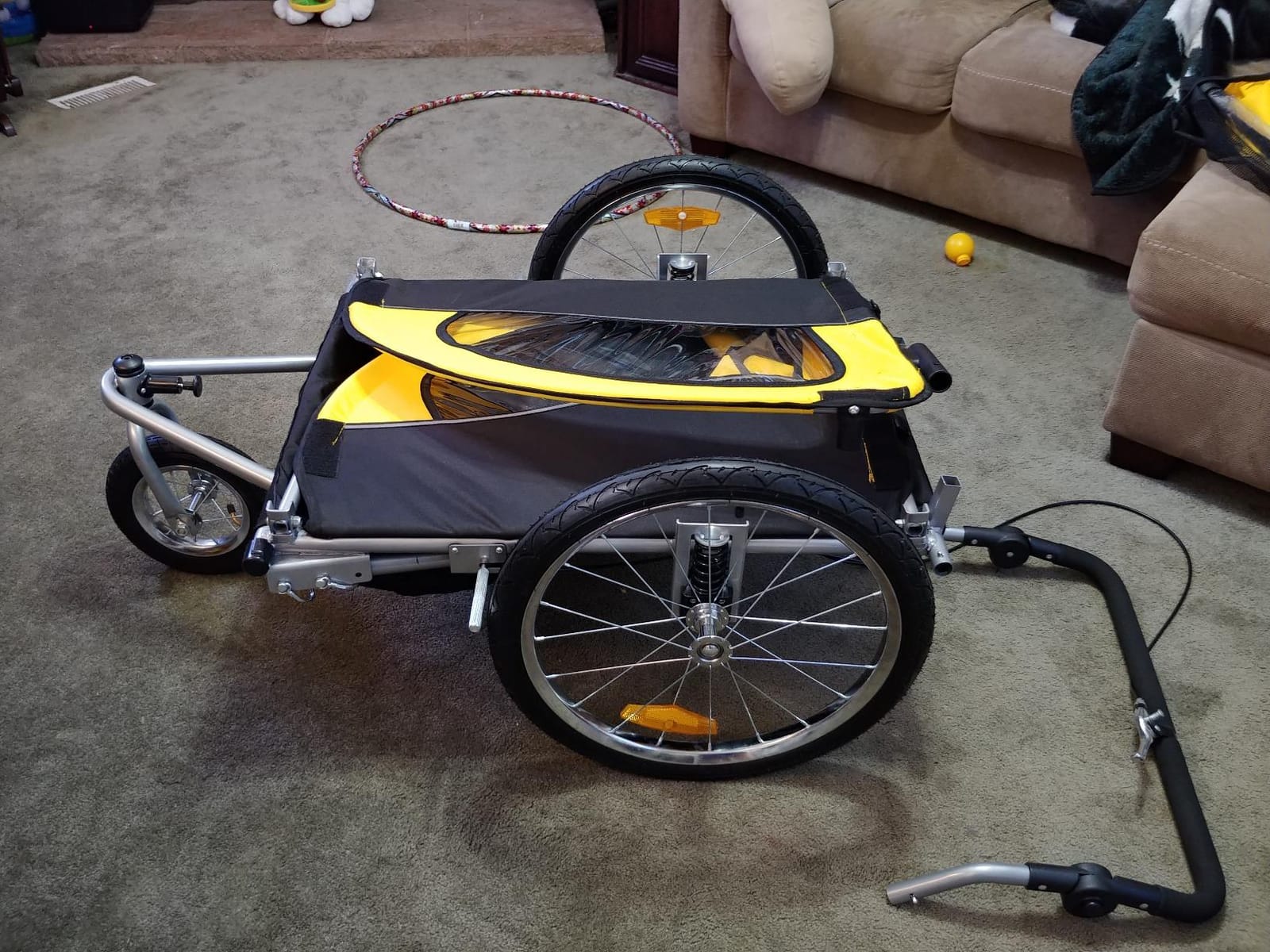
The compromises are size and mass. At 41 lb it is heavier than the light fabric-framed models, and the 33.1 inch width is wide when you are on a narrow path or passing through a gate. Owners flag the bulk first and the weight second, and both are fair.
At a 4.3 star average with 950 reviews, this trailer sits below the pack, and the gap is mostly ride quality rather than build quality. Buyers who rate it highly praise the layout and the storage. Buyers who rate it lower describe a firmer, less settled ride over uneven ground. Expect to do some assembly on arrival, and check your storage space against the folded 29.25 by 25.5 by 4.5 inch package first.
Who should buy the Aosom Elite 360
Buy it if loading and unloading is the part of trailer ownership you dread, or if you use the trailer for beach and park days where you are carrying a lot of gear behind the seats. The swivel and the large rear bay are both features you will notice every single time.
It is also a reasonable second-life purchase. Families who keep the trailer after the kids outgrow it use it to haul groceries or firewood, and 88 lb of combined capacity with a flat floor behind the seats is well suited to that. The one-year warranty against manufacturer defects is the standard coverage at this tier.
Who should skip the Aosom Elite 360
Skip it if you ride narrow paved paths or shared cycle routes where a 33 inch width becomes a genuine nuisance. Skip it if towing weight matters to you on hills, since 41 lb empty is real mass on a climbing route.
Skip it if ride smoothness is your top priority. The mixed owner feedback on how it handles bumps suggests the suspension-free frame is the weak point, and if your route is rough that will show up quickly. If the swivel is not a feature you will use, the price premium over a simpler double trailer is hard to justify on paper alone.
5. Schwinn Echo Child Bike Trailer – Best Value on Paved Roads
Schwinn Echo Child Bike Trailer, Max of 2 Children with Total Weight of 80 lbs., Canopy, 20-Inch Air-Filled Tires, Yellow/Grey
40 lb per child, 12 lb gear
20-inch alloy spoked wheels
Item weight 12 lb
Convertible one or two riders
Pros
- 20-inch wheels give a noticeably softer ride
- Sets up in about three minutes
- Very light to tow
- Large rear storage
- One or two riders by centre strap
Cons
- No suspension
- so rough ground is punishing
- Limited ventilation in hot weather
- Shallow depth can push a helmeted head forward
- Two children over four feel cramped
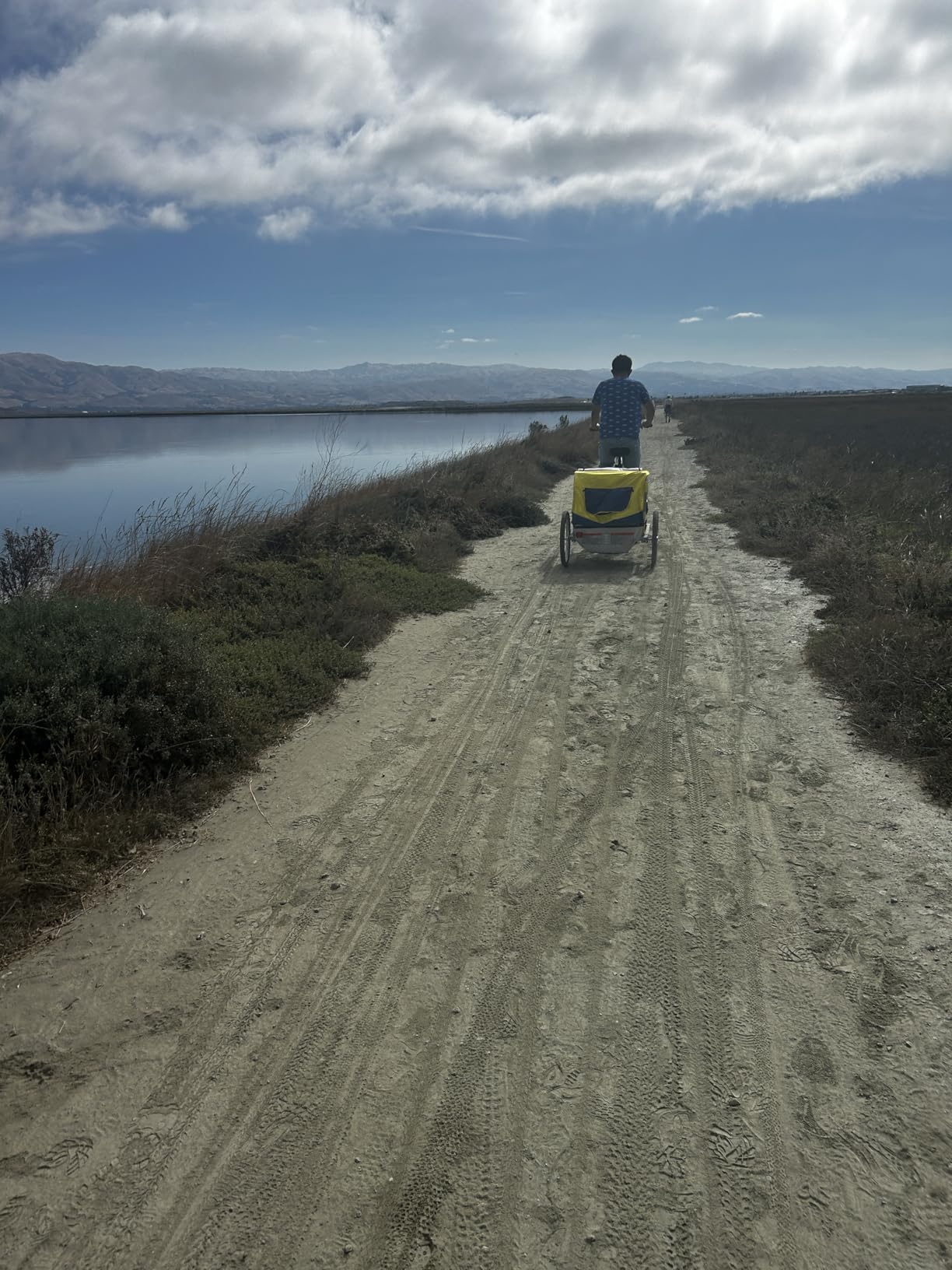
The Echo is the only trailer in this roundup with 20-inch air-filled wheels on alloy spoked rims, and that is why it holds a 4.7 star average. Bigger wheels roll over cracks and gravel scatter that a 16-inch wheel slams into, so the same ride feels markedly calmer for the child sitting inside. If you ride pavement, this is the single most effective upgrade available.
Everything else here is quick and easy. Setup takes about three minutes and detaching is just as fast, so you are not fussing with clips in a school car park every morning. The trailer weighs 12 lb empty, which is light for a two-child trailer, and the centre strap lets you run it as a one-child or two-child trailer depending on the day.
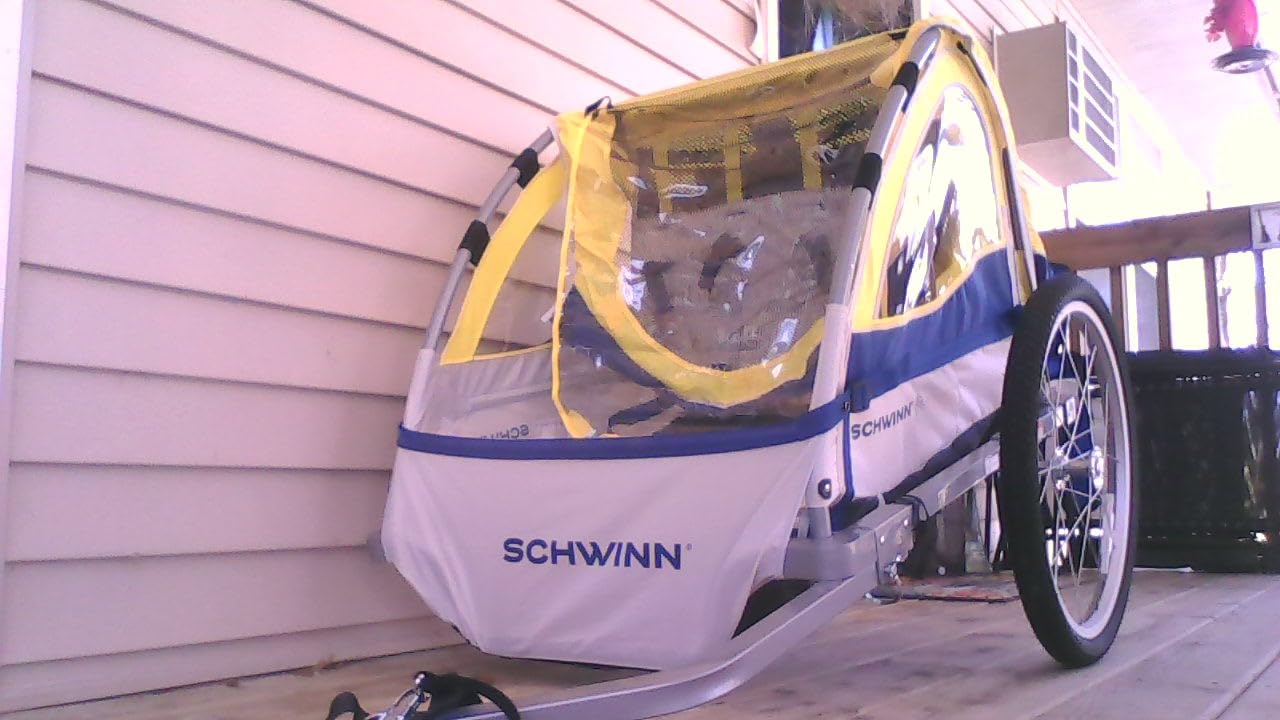
The rear storage is large enough for a diaper bag, a cooler or a short grocery run, and the two-in-one canopy covers a bug screen, a weather shield and a rear ventilation window in one part. That is genuinely useful in a warm climate, where dark enclosed cabins are the complaint we hear most.
Against that, there is no suspension at all, so the ride is smooth but not compliant over broken ground. Cabin depth is shallow enough that a helmeted child’s head tips forward, and the back netting can press against certain helmet shapes. Two children over about four will feel cramped, which makes this more of a two-toddler trailer than a two-child trailer.
Who should buy the Schwinn Echo
Buy it if you ride paved bike lanes and smooth park paths daily and you want the calmest ride your child can get at this weight class. The 20-inch wheels do more for comfort than any seat padding we tested, and they are also easier over gravel scatter and driveway aprons.
And a convertible seating layout makes it good value for families at an awkward stage, since it works for one child now and two later without a new purchase. The listed limits are also the clearest on this list: 40 lb per child and 12 lb of rear gear, stated separately rather than as one combined figure.
Who should skip the Schwinn Echo
Skip it if your route includes real gravel, dirt or anything uneven, because there is no suspension to soften what the larger wheels cannot absorb. Larger wheels handle small stuff well and larger stuff not at all, and owners on rough routes report the cabin is punishing over long distances.
Skip it if your children are tall or approaching five. The shallow cabin and the back netting are the reasons, and there is no recline to compensate. If both children are over four, a trailer with a deeper cabin will save a year of complaints.
6. Schwinn Trailblazer Plus Kids Bike Trailer – Highest Rated Single-Child Trailer
Schwinn Trailblazer Plus Kids Bike Trailer, Single Seat, Universal Coupler, Folding Frame, Quick-Release Wheels, Canopy with Bug Screen and Weather Shield, Schwinn Bike Trailer for Kids
Single child to 40 lb
Item weight 21 lb
16-inch air-filled tires
10 mph rated
Pros
- Highest average rating in our roundup at 4.8 stars
- Durable aluminum build with solid spokes
- Folds in about five minutes
- Bug screen and rain cover both included
- Rear storage holds water and snacks
Cons
- Coupler is not compatible with thru-axle bikes
- Seat does not recline
- Rear storage is an unsupported hammock
- One wheel can develop a squeak
The Trailblazer Plus earned the highest average rating of anything we looked at, at 4.8 stars across 887 reviews, and the reasons owners give are unglamorous ones. The build is durable, the quick-release wheels stay straight, the hookup to the bike takes a moment, and the five-point harness holds a child securely through a fast turn. Nothing about it is flashy and everything about it works.
Both covers come in the box. The bug screen and the removable rain cover are the two parts most families end up buying separately, so having them standard saves money over buying them individually later. Folding takes about five minutes and the result stores compactly, which matters if the trailer lives in a hallway or behind a sofa rather than in a garage.
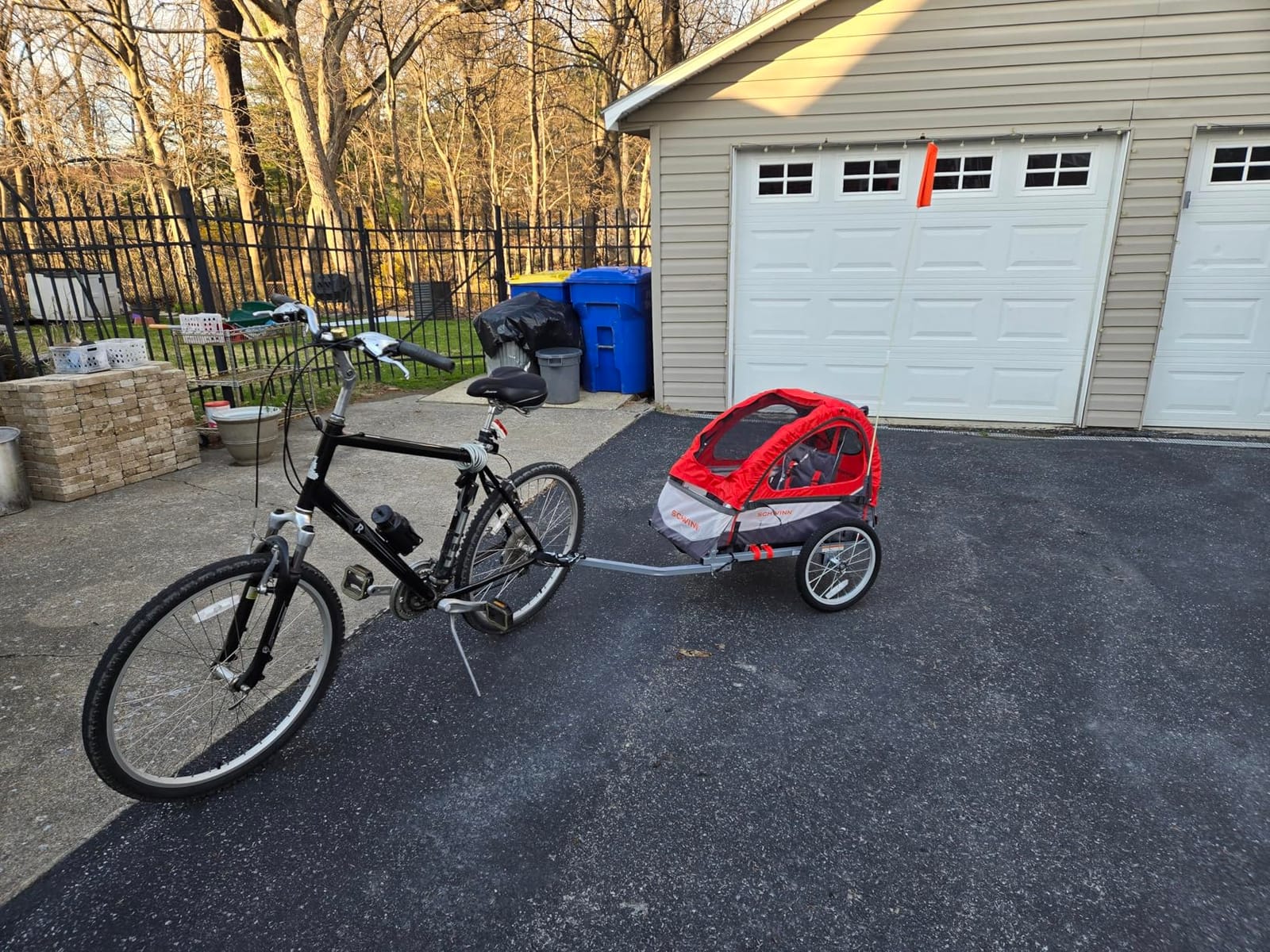
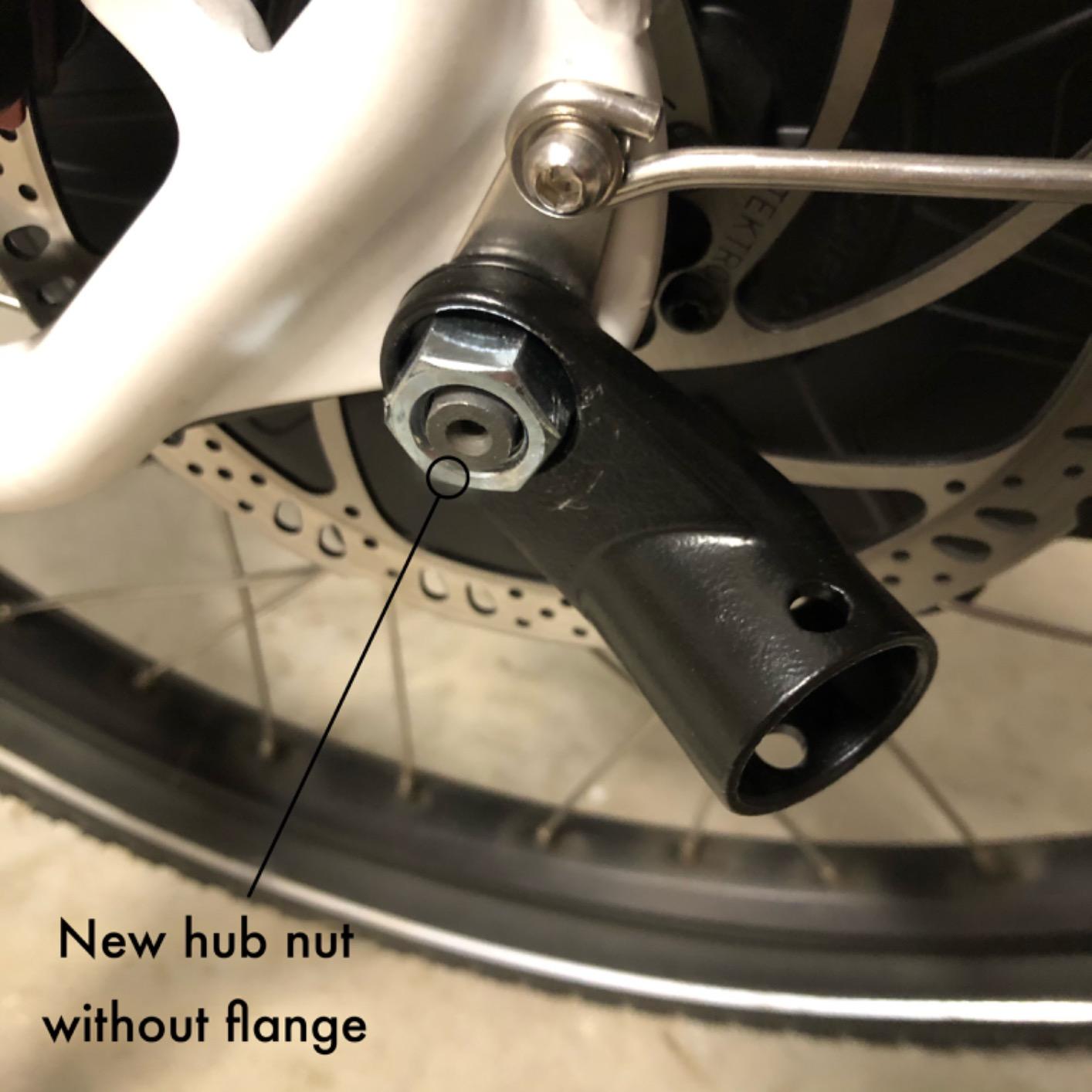
The one compatibility issue is real: the coupler does not work on thru-axle bikes. That covers a good share of modern mountain bikes and many commuter bikes, and it is the reason we ask you to check your rear axle before buying. Quick-release bikes, which is still most road and hybrid bikes, are fine.
Two smaller gripes. The seat does not recline, so a large helmet forces a child’s head forward, which is the same headroom problem we flagged on the entry-level trailers. And the rear storage is an unsupported hammock, so a heavy bag slides rather than sits still unless you pack it tightly.
Who should buy the Schwinn Trailblazer Plus
Buy it if you have one child and a quick-release rear axle, and you want a trailer that works well straight out of the box without buying extra covers. The rating is the highest here because there is little to complain about once you accept a non-reclining seat.
It is also the trailer we would pick for a second or third child, because a single-seat trailer is easier to store, easier to load into a car and easier to hand to another parent. The 40 lb child limit and 10 mph recommended maximum are both sensible numbers for a school run and a park loop.
Who should skip the Schwinn Trailblazer Plus
Skip it if your bike has a thru-axle, because the coupler will not attach without an adapter and that is an avoidable dead end. Check your bike first; this is the single most common reason a trailer gets returned.
Skip it if your child has a large helmet and cares about head position, since the seat angle plus a non-reclining back is exactly the combination parents complain about. In that case the money is better spent on a model with a reclining seat than on a marginal improvement elsewhere.
7. ClevrPlus Deluxe 3-in-1 Bike Trailer – Best for Stroller and Jogger Modes
ClevrPlus Deluxe 3-in-1 Double 2 Seat Bicycle Bike Trailer Jogger Stroller for Kids Children | Foldable w/Pivot Front Wheel, Red
88 lb double capacity
Item weight 37 lb
3-in-1 conversion
12 month minimum age
Pros
- Converts between bike trailer
- stroller and jogger in one unit
- Universal bike hitch included in the box
- Roomy cargo area
- Reflectors on all four sides and rear wheels
- Stays upright if the bike tips
Cons
- Bike mode will not work with a quick-release axle
- Hitch may not fit some e-bikes
- Folding requires several removals
- Bulky 37 lb frame to load into a car
The ClevrPlus is the answer when you want a trailer that is also a stroller and a jogger, and you want that in one purchase rather than three. The pivoting front wheel swaps the unit between walking modes, and nothing else has to be bought. Most multi-sport trailers advertise the same word and then sell you the conversion kit separately, which is the budgeting trap we flagged earlier.
Owners like the roomy cargo hold, with inside dimensions that include the footrest area, and the reflectors on all four sides plus the rear wheels, which matters on an evening return ride. The one safety detail worth naming out loud is that the cabin stays upright if the bike tips, which is the core reason families choose a trailer over a mounted seat.
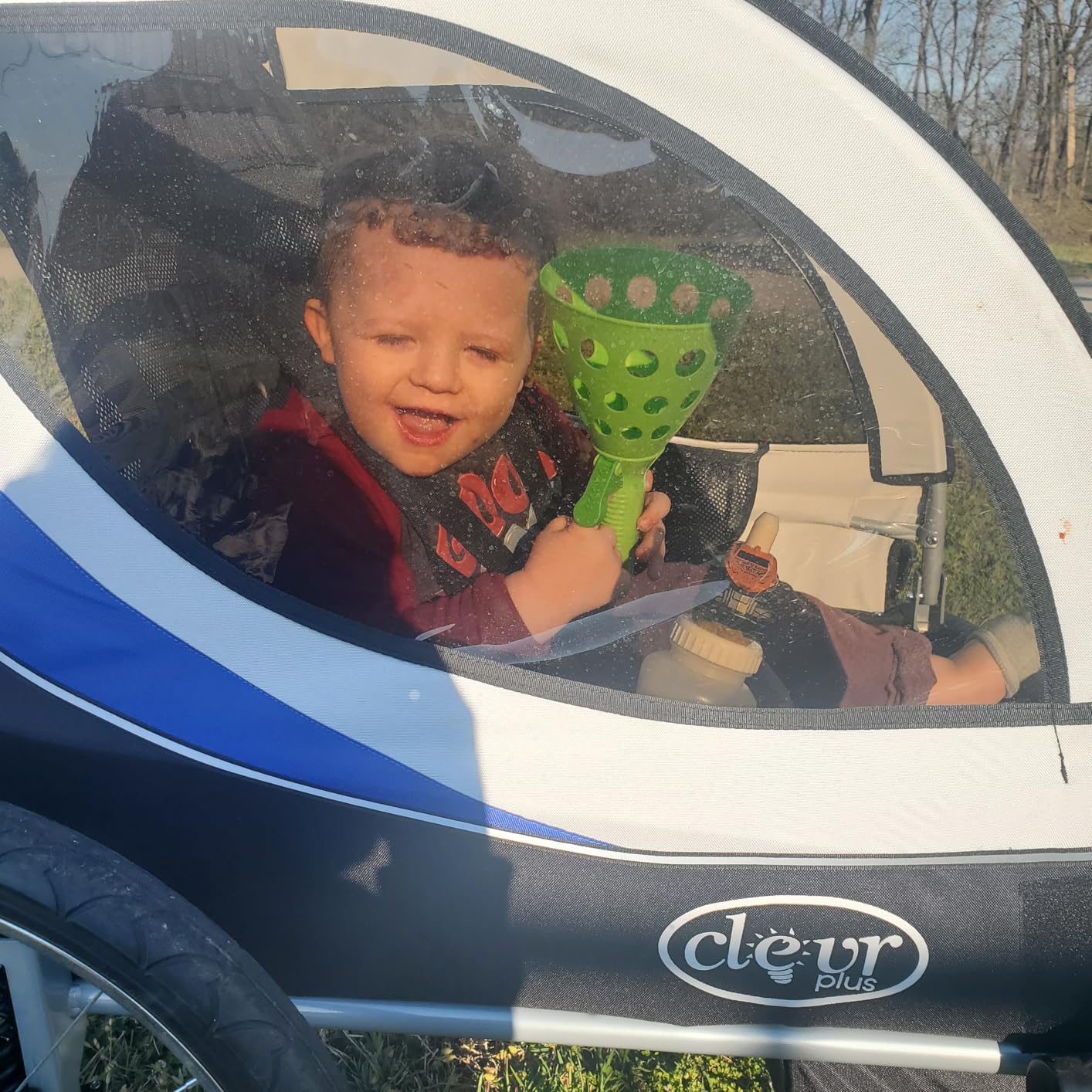
The compatibility warnings are the important part of this listing. Bike trailer mode will not work with a quick-release axle, and the hitch may not fit some e-bikes, so measure your rear axle bolts before you order. This is a trailer designed for axle-mounted setups, and treating it as universal will end badly.
Folding takes more steps than the simple quick-release models, requiring you to remove the handlebar, safety knobs and pins, and at 37 lb the result is a genuinely heavy thing to lift into a vehicle. The stated minimum age of 12 months matches the norm across this roundup. For jogging, most manufacturers treat it as a walking or running mode rather than a true running stroller.
Who should buy the ClevrPlus Deluxe 3-in-1
Buy it if you want to walk, jog and cycle with the same child and you do not want to buy a separate stroller to make that happen. The all-in conversion is worth more than the outlay difference against a bike-only trailer, particularly if you were going to buy a jogging stroller anyway.
It also suits families with a mixed routine, where the school run is a cycle, the park trip is a walk and a weekend errand is a jog. The 88 lb double capacity and the four-sided reflectivity handle a lot of ground beyond the paved bike path, as long as you stay on smooth surfaces.
Who should skip the ClevrPlus Deluxe 3-in-1
Skip it if you want an axle-mounted bike with a quick-release, because trailer mode will not engage. Skip it if you cycle with a hub-motor e-bike, since the hitch fit is not guaranteed and the extra torque and speed make a heavier trailer harder to control.
Skip it if car transport matters. A 37 lb frame that folds only after four separate removals is a chore, and if your plan is to load it into a hatchback twice a day you will resent it within a week. A lighter single-seat trailer folds in a fraction of the time and is a better tool for that routine.
8. Thule Coaster XT 2-Seat Bicycle Trailer and Stroller – Best for Quiet Towing
Thule Coaster XT Child Bike Trailer, Fits 2 Kids, 100lb Total Capacity, 5-Point Safety Harness, Converts to Stroller
2x49 lb per child, 100 lb carrier
Item weight 30.2 lb
ezHitch axle mount
Both kits included
Pros
- Bike trailer kit and stroller kit both included
- Tool-free conversion between riding and strolling
- Very quiet ride
- Large rear cargo area
- Folds flat with the strolling wheel stored on board
Cons
- Hook that swings the stroller wheel is hard to release
- Front wheel rattles while jogging
- Stroller brake is stiff
- Hub-motor e-bikes need a separate adapter
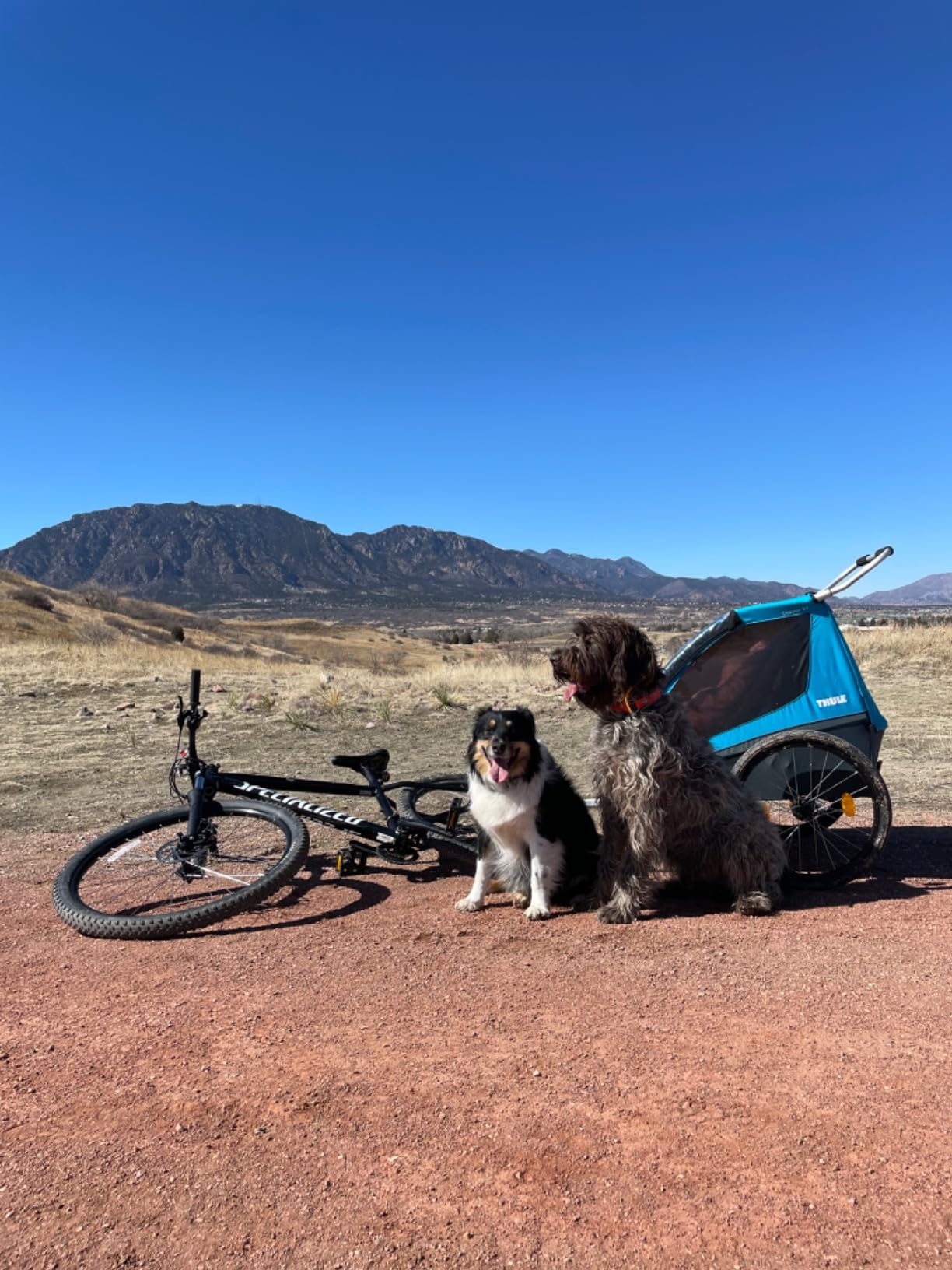
The Coaster XT is one of only two trailers in this roundup that ship with walking-mode hardware in the box, which removes the biggest surprise cost from the whole category. You get a stroller from day one instead of in eighteen months, and the conversion is tool-free, so there is no assembly session when you decide to use it.
Towing is quiet in a way you notice immediately after a few rides on a heavier trailer. Thule’s ezHitch axle mount is a proper axle attachment rather than a seatpost clamp, which gives a more direct connection and less feedback through the bike. The per-child limit of 49 lb on a 100 lb carrier capacity is the most generous child rating in this roundup.
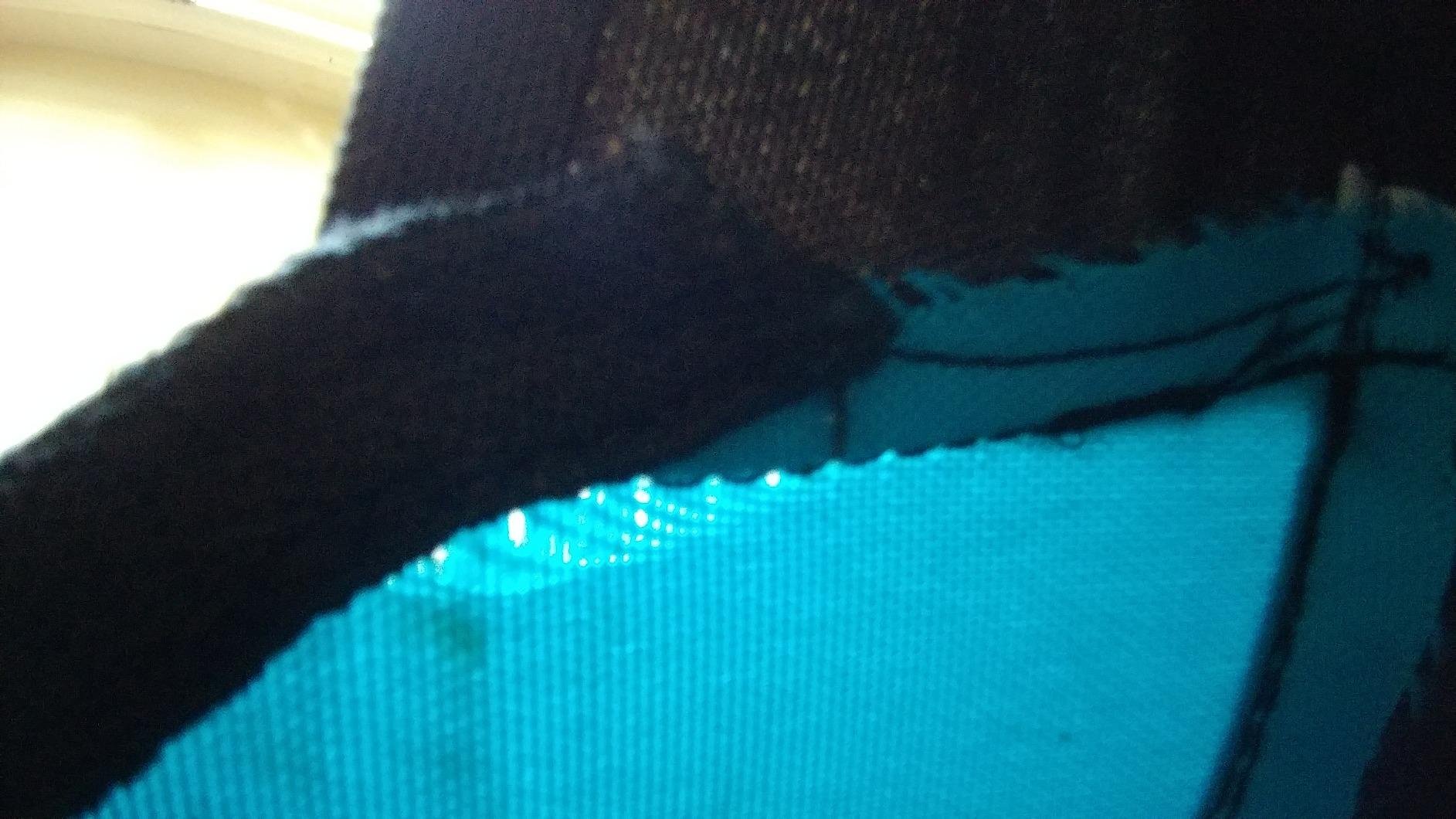
The folding design stores the strolling wheel on board, so you are not left hunting for a part that fits in the cup holder. The large rear cargo area fits a beach bag or a short grocery run, and the adjustable handlebar makes the stroller height work for more than one adult.
The rough edges are all in the stroller half. The hook that swings the strolling wheel under the frame is hard to release, the front wheel rattles while jogging if there is not enough weight at the front, and the stroller brake is stiff. If you will use it mostly as a bike trailer, none of that will slow you down.
Who should buy the Thule Coaster XT
Buy it if you are certain you want both biking and strolling from one piece of gear and you would rather not hunt for a conversion kit later. The included kits are the whole argument, and they are the reason this trailer is a strong pick for a family with a mixed routine.
It is also the pick if noise matters to you. A quiet drivetrain is a small comfort on long rides, and combined with the axle-mounted hitch it feels more settled behind you than the coupler-based models. The build meets or exceeds international safety standards, and the limited lifetime warranty is the strongest cover on this list.
Who should skip the Thule Coaster XT
Skip it if you want the lowest outlay for a bike-only trailer and never plan to push it. You are paying for the stroller half whether you use it or not, and a straightforward bike trailer does the same job for far less. Check the total cost against a bike trailer plus a separate stroller before deciding.
Skip it if you tow with a hub-motor e-bike, because you need a separate axle adapter to make the connection. The 473 reviews here are solid for a product at this level, but they are a smaller base than the value models above, and the reviews themselves flag the fiddly stroller-wheel release more than anything else.
9. Aosom 2 Seat Child Bike Trailer – Roomy Cabin for Less
Aosom 2-Seat Child Bike Trailer for Kids 5-Point Safety Harnesses Orange
88 lb two-child capacity
Item weight 26.8 lb
Alloy steel frame
29.25 by 23.5 by 22 inch interior
Pros
- Strong alloy steel frame
- Very stable with a wide footprint
- Roomy interior fits a child plus blankets
- Bike connector included in the box
- Quick-release wheels pop off for transport
Cons
- Harness buckles are fiddly to operate
- No mounting point for a rear light
- Hitch angle sits awkwardly on some bikes
- Instructions can be hard for a first-time builder
The Aosom 2 Seat is the one to look at when cabin volume is the deciding factor. The interior measures 29.25 inches long by 23.5 inches wide by 22 inches high, which gives real room for a taller child, and owners mention fitting a child plus blankets and a small pet as a practical reality rather than an aspiration.
The wide footprint is a real stability asset. Even at 26.8 lb it resists tipping, and the quick-release wheels pop off with a lever so you can carry the trailer into a flat storage area rather than dragging it. The steel bike connector is in the box, which is one less thing to order separately.
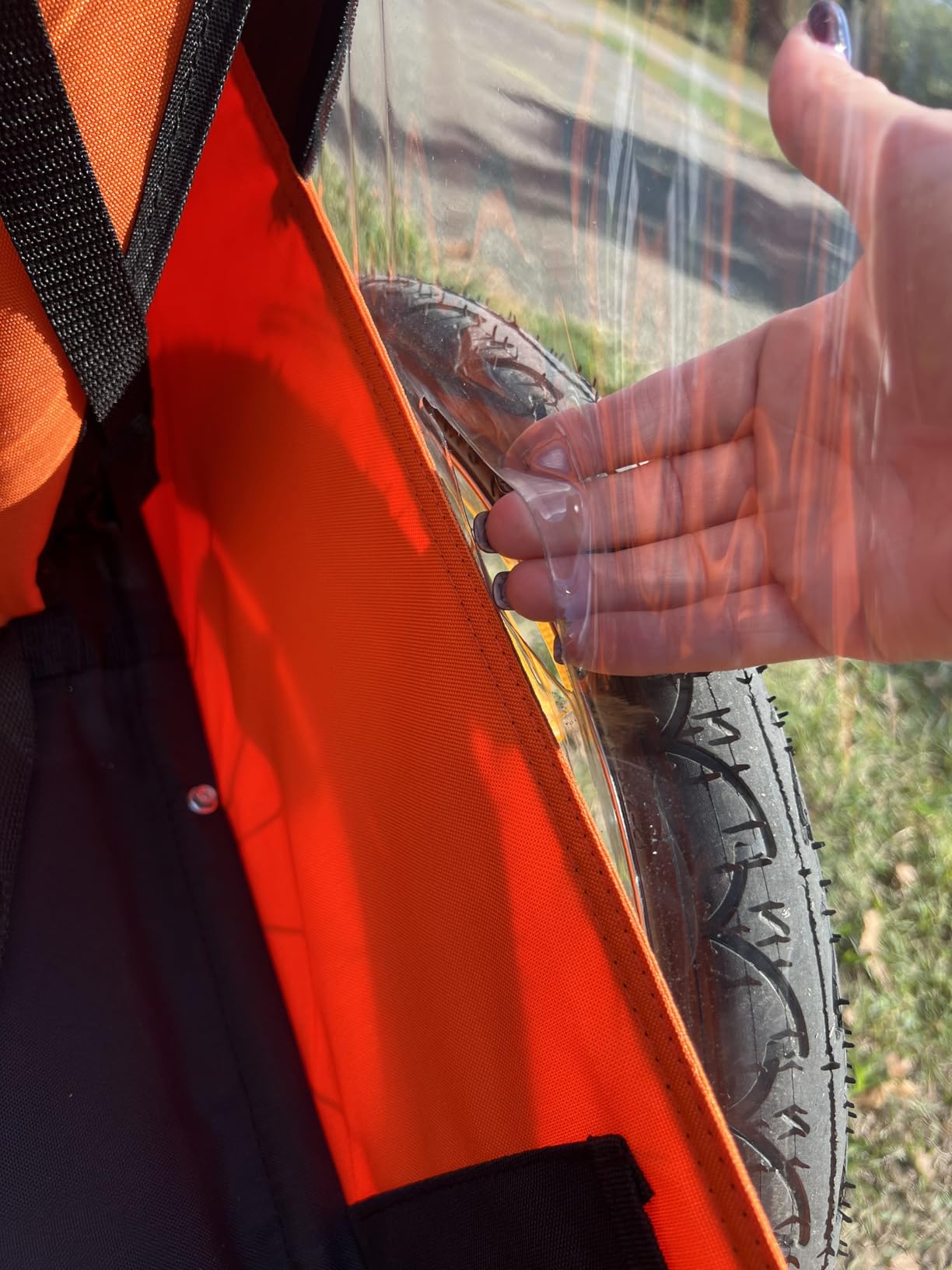
There is no suspension to speak of, and the alloy steel frame does the work instead by being rigid and stable. The large roll-up door with front and side windows gives good access and light, and the Oxford fabric panels with transparent viewing panels let you check on a sleeping child without opening anything.
Two practical issues. The harness buckles are complicated to operate, which is genuinely annoying when you are doing it one-handed in the dark, and there is no mounting point for a rear flashing light, so you need a light that clips to the bike or the tow arm. The hitch angle also sits awkwardly on some bicycles, which is a fit problem rather than a fault.
Who should buy the Aosom 2 Seat
Buy it if you have two children and the cabin size is what worries you, particularly if either child is on the taller side for their age. A roomy interior does more for a tall five-year-old than any accessory, and the generous headroom here is a real advantage.
It also suits families whose trailer will do double duty. The flat interior that fits blankets and gear will later fit a dog or a load of shopping, and the wide, planted frame makes that stable at low speeds. Reflectors and a safety flag are included for road visibility.
Who should skip the Aosom 2 Seat
Skip it if fiddly buckles will get on your nerves, because that is a daily interaction rather than a once-a-year complaint. The 151 reviews here are the second thinnest in our roundup, so there is less long-term feedback to draw reassurance from.
Skip it if you cycle at dusk or in low light, since there is no mount for a rear light and you will need to solve that separately. It is also not the trailer to buy if you tow with a thru-axle bike without checking the connector fit first.
10. Thule Chariot Lite Multisport Trailer and Stroller – Best Four-Mode Converter
Thule Chariot Lite Double Multi-Sport Child Trailer, Adjustable Ventilation
Biking, walking, skiing, all-terrain
Item weight 15.7 kg
Two-child seating
Limited lifetime warranty
Pros
- Four activity modes including skiing and all-terrain
- Leaf spring suspension smooths real bumps
- Slim profile still seats two
- Compact fold fits most trunks
- Rain cover and sunshade included
Cons
- Biggest outlay in the roundup
- Accessories and clips fall off easily
- Rain cover is hard to fit
- Wide stance will not clear a standard doorway
- Lowest rating here with some first-year failures
The Chariot Lite is the most capable trailer here and the least warmly reviewed, and understanding that tension is the whole point of including it. If you cross-country ski with children, nothing else in this roundup does that job. The four activity modes cover biking, walking, skiing and all-terrain, and the leaf spring suspension is the only real spring suspension in this list.
The slim profile is a genuine achievement for a two-child trailer, and the compact fold fits most car trunks. Thule’s VersaWing conversion system is quick and tool-free, Click n’ Store keeps the kits on board, and the rain cover, sunshade, rear light and adjustable handlebar all come included rather than as add-ons.
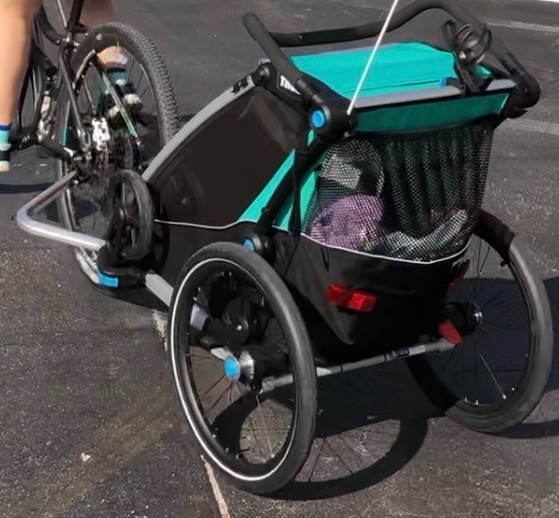
The suspension is what justifies the price for anyone on rough ground. Everyone else in this roundup is either unsuspended or spring-loaded, and a leaf spring absorbs the difference between a child noticing a bump and a child complaining about a bump. For gravel, dirt and fire roads, that is the whole argument.
Against it, the all-terrain and ski kits are sold separately, so the four modes cost considerably more than the trailer. Clips and accessories fall off easily, including the rear light, and the rain cover is awkward to fit. The wide stance also will not pass through a standard doorway, which matters if you plan to store it indoors.
Who should buy the Thule Chariot Lite
Buy it if you genuinely will use the skiing or all-terrain modes, or if you ride rough terrain regularly and want a leaf spring under two children. The suspension and the four activity modes are the reason it exists, and neither is available anywhere else in this roundup.
It is also the pick for a family that plans to keep a trailer for many years, given the limited lifetime warranty and a slim profile that stores more easily than its width suggests. Include the kids kit and rain cover in the box, and owners who stay with it consistently praise the build quality.
Who should skip the Thule Chariot Lite
Skip it if you will only ever ride on pavement. You would be paying for suspension, ski capability and all-terrain gearing you will not touch, and the same money buys a trailer plus a stroller kit that you will use every week. It is the biggest outlay in this roundup by a wide margin.
The Thule Chariot Lite carries the lowest average rating here at 4.1, and while most owners are happy, there are several one-star durability complaints within the first year. Accessories and clips falling off is a small, repeated irritation. If you want a two-child trailer with a spring and nothing else, the value models above do the job for a fraction of the outlay.
How to Choose a Bike Trailer for Kids
1. Confirm the axle fit before anything else
Most returns in this category come down to hitch compatibility, not regret about the trailer. A universal coupler attaches to a quick-release rear axle, which is still most road and hybrid bikes. It will not attach to a thru-axle bike, and the mount types that do work with thru-axles are a different, axle-mounted design.
Check whether your bike has quick-release nuts or bolted thru-axles before you choose anything. If it is bolted, you want an axle-mounted hitch, and some trailers need an extra adapter for hub-motor e-bikes. Owners report the hitch angle sitting awkwardly on certain frames too, which is a fit detail no spec sheet covers. If you also tow cargo, our utility trailer comparison covers the axle considerations from the other direction.
2. Read the weight capacity as a combined figure
This is the most misunderstood number in the category. A trailer listed at 88 lb or 100 lb is telling you the total payload, which is children plus cargo plus the bags behind the seat. It is not saying your child can weigh 88 lb. The Thule Coaster XT is unusually clear about this, with 49 lb per child and 100 lb of carrier capacity stated separately.
Before buying, work out what you actually intend to carry. Two children at 40 lb each plus a diaper bag and a change of clothes is around 90 lb, which sits at the ceiling of an 80 lb combined rating. Families who load generously and then wonder why the trailer feels overworked usually hit this arithmetic rather than a manufacturing problem.
3. Match the wheels to the surface
Sixteen-inch wheels with moulded plastic rims are the norm in the value tier, and they are fine on smooth pavement. Twenty-inch air-filled wheels on alloy spoked rims, which you will find on the Schwinn Echo, roll over cracks and gravel scatter much more calmly and do not need a fix when the rim is dented.
Neither size replaces suspension. Bigger wheels handle small obstacles well and larger ones not at all, so if your route is genuinely rough, a leaf spring suspension matters more than wheel diameter. If your route is pavement, wheel size is the highest-impact comfort upgrade you can buy at this budget level.
4. Check headroom with the helmet on
More than one trailer in this roundup has a seat back high enough that a helmeted child’s head tips forward. It is an unglamorous criterion and owners mention it more often than any feature list would suggest. Sit the child in the trailer with the helmet they actually wear and check whether their neck is neutral.
Deep front-to-back cabin space and a reclining seat are the fixes. Also look at shoulder width, particularly for a double trailer, because two children sharing a bench leaves little room to move and a lot of chances to argue. Our comparison of other tow-behind setups covers the cargo-first alternative if you need volume more than seats.
5. Budget for the kits, not the trailer
Jogger kits, cross-country ski kits, all-terrain kits and premium sunshades are sold separately by almost every brand, which is the single biggest budgeting surprise in this category. A trailer advertised as multi-sport may need three more purchases before it performs all the advertised modes. The Thule Coaster XT and the ClevrPlus Deluxe are the two exceptions here, because their walking-mode hardware is included.
Work out the total before buying: trailer, plus any conversion kit you actually need, plus covers if they are not standard. If you only ever cycle and walk, do not buy the ski kit just in case. If you cross-country ski, the ski-capable trailer is a different product category entirely, not a bolt-on.
6. Know the age and helmet rules
The minimum age to be towed is 12 months, and that is a hard rule tied to head and neck control rather than a comfort guideline. The ClevrPlus states the 12-month minimum explicitly, and most other manufacturers imply the same through their harness and seating design. Infant inserts and slings are for stroller mode only, not for towing behind a bike.
Children should wear a helmet on every ride, without exception, and the helmet is what makes the 12-month minimum workable. In our roundup the practical ceiling is around age four to five, because most cabins and harnesses stop fitting well before that. Above it, a tag-along trailer or a trailercycle is the natural next step rather than a bigger trailer.
7. Do not exceed the speed rating
Most trailers are rated for around 10 to 15 mph, and the Schwinn Trailblazer Plus states 10 mph. That is a design limit, not a suggestion, because a trailer becomes harder to control as speed rises and the braking distance grows. The combination that gets people into trouble is a heavy rider on an e-bike who does not realise how fast they are going.
If you tow with an e-bike, add care. A double trailer is more stable than a single one, and riding with your weight on the opposite side from the tow arm helps manage the extra push. Check the manufacturer’s e-bike guidance before you do it, and treat the speed rating as a ceiling rather than a target.
8. Look at the fabric, covers and zipper details
The recurring complaints across owner feedback are unglamorous. Fabric bottoms wear through when the trailer rests on the ground, sand and water get in where covers meet the frame, zippers fail at the corners, and suspension loops wear out. None of these are reasons to avoid a trailer, but they are reasons to keep a trailer cover on it when it is parked.
Removable covers beat fixed covers in wet climates, because a permanent rain panel traps condensation and blocks ventilation. Check that the canopy can be pulled back for airflow, that there is a rear ventilation window, and that the bug screen and weather shield are separate pieces rather than one panel doing both jobs badly.
What Owners Actually Complain About
Across owner feedback the same handful of issues come up again and again, and knowing them before you buy is worth more than any spec comparison. The most common is that the cabin floor fabric wears from contact with the ground, particularly in models where families park the trailer on grass or a path while the kids are in a stroller. A ground sheet or a small tarp fixes it.
Second is rain protection. Most trailers shed a shower, but a sustained downpour gets water in at the seams and around the zippers, and the popular view among owners is that a removable full rain cover is worth more than any other accessory. Third is the storage assumption, which is almost always too generous in a listing. Families routinely try to fit scooters, balance bikes, helmets and wet jackets and cannot.
Fourth is the conversion kit cost, which we covered above. Fifth is the headroom and helmet fit issue, and sixth is the post-age-five problem: most children outgrow a trailer cabin around their fifth birthday, and the natural transition to a tag-along or trailercycle is rarely mentioned in listings. Plan for that now rather than reselling in a hurry later. If you are moving to a larger towing setup for non-child loads, our dump trailer guide covers a different corner of the market.
Frequently Asked Questions
What are some good bike trailers for children?
The strongest all-round pick for one child is the InStep Sync, a 40 lb single-seat alloy steel trailer that folds flat and holds a 4.6 star average across nearly 3000 reviews. For two children, the InStep Take 2 carries an 80 lb combined capacity and offers three seating positions so a solo child can sit in the middle. The Schwinn Echo is the smoothest ride thanks to 20-inch air-filled wheels, and the Thule Coaster XT includes both a bike kit and a stroller kit in the box.
Are kids bike trailers worth it?
Most owners who switch from a rear-mounted child seat conclude that a trailer is the safer option, because the cabin stays upright when the bike falls and the roll cage protects the child. A trailer also carries more cargo, converts to a stroller in some models, and keeps children away from the moving drivetrain. The trade-offs are added weight, added drag, and turning radius, and a trailer is only worth it on routes where you can ride predictably.
How old should a kid be for a bike trailer?
The minimum age to be towed is 12 months, and that is a rule about head and neck control rather than a comfort preference. Children should wear a properly fitted helmet on every single ride, which is what makes towing at that age workable. Infant inserts and slings are intended for stroller mode only and are not a towing solution. The practical upper end is around four or five years old, when most harnesses and cabins stop fitting properly.
What is the safest bike trailer for kids?
Look for a rigid frame with a roll cage, a five-point harness, a safety flag and reflectors, an enclosed cabin that keeps the child away from the drivetrain, and a hitch that attaches firmly to the bike. Buyers should check that the trailer meets or exceeds recognised safety standards, and that the max child weight and speed rating are stated clearly. A helmet on every ride matters as much as any feature on the trailer itself.
Can I pull a bike trailer with an e-bike?
It is possible on many models, but you need to check three things first. Your bike needs a compatible hitch, which may mean an axle adapter on a hub-motor e-bike. A double trailer is more stable than a single one under electric power. And you should stay well under the trailer speed rating, because extra power and extra weight extend braking distance. Ride with your weight on the side opposite the tow arm to help manage the handling.
Do kids need to wear a helmet in a bike trailer?
Yes, on every ride, with no exceptions. The helmet is what makes the 12-month minimum age workable, since it protects a head that does not yet have full neck control. It also changes how a cabin is evaluated, because a helmet changes the fit. A seat back that is fine for a bare head can push a helmeted head forward, so check headroom with the helmet on before buying.
Is a bike trailer better than a child bike seat?
A trailer is generally safer because it keeps the child low and enclosed, stays upright when the bike falls, and shields them from wind and road debris. A mounted seat is lighter, narrower, and cheaper, and it does not add steering resistance. If your routes are short, flat and predictable, a seat is a fine choice. If you ride longer routes, in traffic or on rough ground, most owners end up preferring the trailer.
The Best Bike Trailers for Kids in 2026
The best bike trailers for kids come down to one question: what is under the wheels. On smooth pavement, the InStep Sync for one child and the Schwinn Echo for two give the best comfort per unit of effort, and the InStep Take 2 solves the double-trailer seating problem better than anything else here. For rough ground, a wider wheelbase and bigger wheels matter more than any accessory, which points to the Allen Sports Deluxe and the Thule Chariot Lite.
Check your rear axle before you order anything, since that is where most returns start. If you want one product to do biking and strolling without a second purchase, the Thule Coaster XT and the ClevrPlus Deluxe 3-in-1 are the two worth shortlisting, and both are covered in more detail on our bike trailer page. Whichever you pick, put a helmet on your child and go slow the first few rides.