
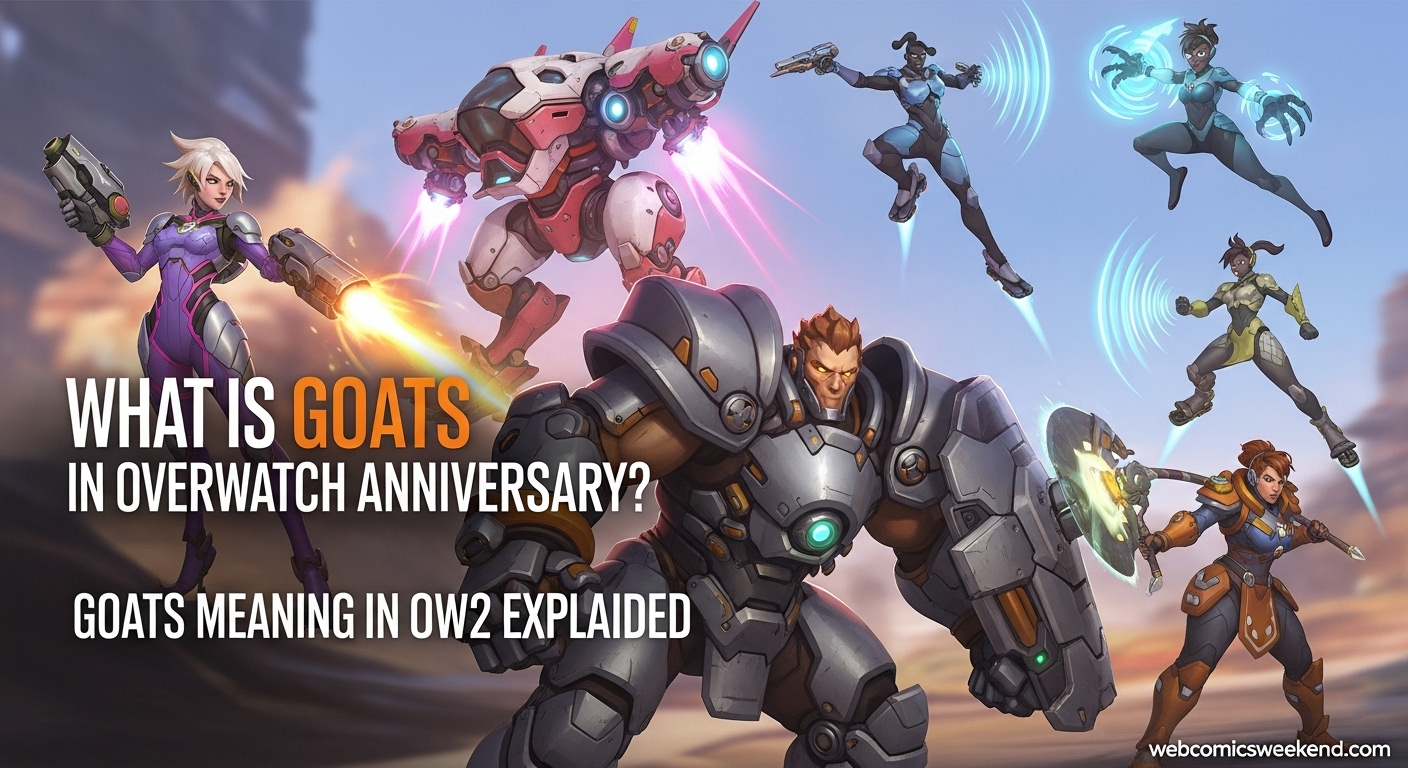
Hey there, fellow Overwatch enthusiast! If you’ve been playing Overwatch 2 during the Anniversary event, you’ve probably heard everyone talking about “GOATS” and wondered what the heck people are referring to. Trust me, I was right there with you when I first jumped into the Overwatch Classic mode and saw teams running three tanks and three supports. I was like, “Wait, where are all the damage dealers? Is this some kind of joke?”
Well, let me tell you – GOATS is no joke. It’s actually one of the most infamous and revolutionary team compositions in Overwatch history, and Blizzard has brought it back for the Overwatch Anniversary 2026 event. As someone who’s been playing Overwatch since the early days, I’ve seen metas come and go, but GOATS? That’s the stuff of legends. Let me break down everything you need to know about this crazy composition that once dominated the competitive scene.
The Origins: Where Did GOATS Come From?
Picture this: It’s 2018, and we’re in the middle of Overwatch Contenders Trials. There’s this team called GOATS (which stands for “Greatest Of All Time” – yeah, they were pretty confident, huh?) that’s about to get eliminated from the tournament. They’re desperate, down to their last chance, and they decide to throw out the conventional wisdom about team compositions.
Instead of running the standard 2-2-2 setup (two tanks, two damage, two supports), they go all-in on something completely different: three tanks and three supports. And get this – it actually worked! Not only did they win that match, but they went on to make an incredible loser’s bracket run and won the entire tournament using this unconventional setup.
I remember watching those matches and being absolutely blown away. Here was this team that nobody expected to do anything, and they were dominating with a composition that seemed to break all the rules. The name “GOATS” stuck, and soon everyone was calling this composition the “GOATS meta.”
What Does GOATS Actually Stand For?
Now, here’s where it gets interesting. While the team GOATS stood for “Greatest Of All Time,” the composition itself has been interpreted in a couple of different ways. Some people say GOATS stands for “Go All Tanks And Supports,” which makes perfect sense when you look at the composition. Others just keep it as the team name that popularized it.
Honestly, I think both interpretations work. The team certainly thought they were the greatest of all time when they invented this composition, and the strategy does involve going all-in on tanks and supports. Either way, the name has become legendary in the Overwatch community.
The Classic GOATS Composition: Who’s in the Dream Team?
When I first started playing GOATS back in the day, I was amazed at how specific the optimal composition was. The classic GOATS lineup wasn’t just any three tanks and three supports – it was a carefully curated group of heroes that worked together perfectly:
The Tank Line:
- Reinhardt: Your main tank with the massive shield. I loved playing Reinhardt in GOATS because you could just hold that shield up forever while your supports kept you alive.
- Zarya: The flex tank who could bubble herself and her teammates. Zarya was absolutely crucial in GOATS because she could build charge incredibly quickly with all the damage coming in.
- D.Va: The off-tank who could dive into the backline and eat important abilities with Defense Matrix. D.Va was my personal favorite because you could be so aggressive knowing you had tons of healing backing you up.
The Support Line:
- Lucio: The speed boost king. Lucio was essential in GOATS because his speed boost allowed the whole team to stay together and engage or disengage as a group.
- Brigitte: The front-line support who could bash enemies and provide armor. Brigitte was probably the most important hero in the GOATS composition – she was basically a fourth tank with how much survivability she provided.
- Zenyatta: The damage-dealing support with Discord Orb. Zenyatta was crucial because his Discord Orb allowed the team to actually kill things despite having no dedicated damage dealers.
I remember running this exact composition so many times, and it felt nearly unkillable when played correctly. The synergy between these heroes was just incredible.
Why Was GOATS So Dominant?
Let me tell you, playing against a well-coordinated GOATS team was absolutely frustrating. I’ve been on both sides of this composition, and I can tell you firsthand why it was so dominant:
1. Insane Sustain: With three supports constantly healing and three tanks with massive health pools, GOATS teams could absorb an incredible amount of damage. I’ve been in fights where we used all twelve ultimates (six from each team) and still didn’t get a single kill. It was both hilarious and terrifying at the same time.
2. Ultimate Economy: Because GOATS teams took so little damage (thanks to shields, armor, and constant healing), they could build ultimates incredibly quickly. I remember building Zarya’s Graviton Surge twice in a single fight on more than one occasion. When you can use multiple ultimates in quick succession, it’s almost impossible for the enemy team to recover.
3. Crowd Control Galore: Between Reinhardt’s Earthshatter, Zarya’s Graviton Surge, D.Va’s Self-Destruct, Brigitte’s Shield Bash, and Lucio’s Boop, GOATS teams had incredible crowd control. I loved coordinating these abilities with my team – there was nothing more satisfying than landing a perfect Graviton Surge into Earthshatter combo.
4. No Weak Points: Traditional compositions have clear weak points you can target, but GOATS? Every hero was tanky and self-sufficient. As a damage player trying to fight against GOATS, I felt completely useless – I’d dump my entire magazine into a tank, only for their supports to heal them back to full health before I could reload.
The Playstyle: How GOATS Actually Worked?
Playing GOATS was completely different from any other composition I’ve experienced in Overwatch. Instead of the usual strategy of having damage dealers focus on eliminating key targets, GOATS was all about playing as a single, cohesive unit.
I remember my team spending hours practicing our positioning and movement. The key was to stay close together – like, REALLY close. We’d move as a tight ball, with Reinhardt leading the way, Zarya and D.Va flanking slightly, and the supports tucked safely in the middle. Lucio would keep us all moving at the same speed, and we’d engage or disengage as a group.
The strategy was basically to outlast the enemy team. We’d absorb their damage, build our ultimates faster than them, and then unleash a devastating combo that they couldn’t possibly survive. It wasn’t about flashy plays or individual skill – it was about teamwork, coordination, and patience.
I’ll be honest, it wasn’t always the most exciting composition to play or watch. Some of our matches would drag on for what felt like forever, with both teams just poking at each other until someone made a mistake. But when it worked? Man, it was beautiful to watch.
The Evolution of GOATS: Variations and Adaptations
As GOATS became more popular, teams started experimenting with different variations. I tried out several of these myself, and each had its own strengths and weaknesses:
Sombra GOATS: This was probably the most popular variation. Instead of running Zarya, teams would bring in Sombra for her ability to hack enemies and disable their abilities. I actually preferred this version because Sombra added some much-needed burst damage and could punish teams that got out of position.
Moira GOATS: Some teams would run Moira instead of Zenyatta for even more healing output. I found this version to be incredibly tanky but sometimes struggled to actually kill enemies without Zenyatta’s Discord Orb.
Roadhog GOATS: Occasionally, teams would substitute Roadhog for one of the other tanks. I never personally liked this variation as much because Roadhog didn’t provide the same team utility as the other tanks, but his hook could be devastating if you landed it.
Ana GOATS: Before Brigitte was introduced, some teams ran Ana instead of her. Ana’s Biotic Grenade and Nano Boost were incredibly powerful, but she was much more vulnerable than Brigitte.
Why Did Everyone Hate GOATS?
Look, I’ll be the first to admit that GOATS wasn’t exactly the most viewer-friendly composition. As much as I enjoyed playing it, I completely understand why so many people in the community hated it:
1. It Was Boring to Watch: Let’s be real here – watching two GOATS teams fight each other was like watching paint dry. The matches would drag on forever with minimal kills, and the action was hard to follow for casual viewers. I remember watching Overwatch League matches where the crowd would actually boo when teams switched to GOATS.
2. It Made DPS Players Obsolete: As someone who primarily played DPS heroes, I was frustrated when GOATS became dominant. Suddenly, my favorite heroes were completely unviable, and I had to learn to play tanks or supports if I wanted to stay competitive.
3. It Felt Unfair: Playing against GOATS often felt hopeless. No matter how well you played or how many shots you landed, the GOATS team would just heal through everything. I’ve never felt more powerless in Overwatch than when I was trying to break through a well-coordinated GOATS composition.
4. It Stifled Creativity: Because GOATS was so dominant, teams felt pressured to run it even if they didn’t want to. The meta became stale, with almost every team running the exact same composition in every match.
How Blizzard Finally Killed GOATS?
Blizzard tried several times to nerf GOATS and bring balance back to Overwatch, but nothing seemed to work. They buffed heroes that were supposed to counter GOATS (like Reaper), they nerfed key GOATS heroes (like Brigitte), but the composition remained dominant.
Finally, in August 2019, Blizzard announced the biggest change in Overwatch history: Role Queue. This new system forced teams to run exactly two tanks, two damage dealers, and two supports, making the 3-3 GOATS composition impossible in standard play.
I remember the community’s reaction when this was announced. Some people were ecstatic, while others were worried that it would limit strategic diversity. As someone who had grown tired of GOATS, I was personally thrilled. I couldn’t wait to go back to playing my favorite DPS heroes without feeling like I was hurting my team.
GOATS in Overwatch 2 Anniversary: The Return
Fast forward to 2026, and Blizzard has brought back GOATS as part of the Overwatch Anniversary event. When I first heard about this, I was both excited and nervous. Excited to relive the nostalgia of one of Overwatch’s most infamous metas, but nervous about having to face those unkillable tank compositions again.
The Overwatch Classic: GOATS mode is available from September 30 to October 7, 2026, and it’s exactly what you’d expect – a throwback to the GOATS era with 6v6 matches and no role queue restrictions. The hero pool is limited to what was available during the original GOATS meta, which means:
Available Tanks:
- D.Va
- Orisa
- Reinhardt
- Roadhog
- Winston
- Wrecking Ball
- Zarya
Available Damage:
- Ashe
- Bastion
- Cassidy
- Doomfist (note: he’s a damage hero in this mode with only 250 health)
- Genji
- Hanzo
- Junkrat
- Mei
- Pharah
- Reaper
- Soldier: 76
- Sombra
- Symmetra
- Torbjorn
- Tracer
Available Supports:
- Ana
- Brigitte
- Lucio
- Mercy
- Moira
- Zenyatta
I’ve been playing this mode quite a bit since it launched, and I have to say – it’s been a blast from the past. There’s something incredibly satisfying about running the classic GOATS composition again, even if it’s just for a limited time.
My Personal Experience with GOATS
Let me share a personal story about my time with GOATS. Back in 2019, I was part of a semi-competitive team that was trying to climb the ranks. We were stuck in Diamond and couldn’t seem to break through to Master. Our team composition was all over the place, and we kept losing to teams that were running GOATS.
Finally, our team leader decided we should try running GOATS ourselves. I was skeptical at first – I had always been a damage player, and the idea of playing tank or support didn’t appeal to me. But I was willing to try anything to get over that Diamond plateau.
We spent weeks practicing the GOATS composition. I learned to play Zarya (which quickly became my new favorite hero), and we worked on our coordination and communication. At first, it was rough – we kept getting picked off because we weren’t staying close enough together, and our ultimate combos were poorly timed.
But slowly, we started to improve. We learned to move as a single unit, to coordinate our abilities, and to build our ultimates efficiently. And then something amazing happened – we started winning. Not just occasionally, but consistently.
We climbed from Diamond to Master in just a couple of weeks, and eventually made it to Grandmaster. I had never been ranked that high before, and it was all thanks to mastering the GOATS composition. Looking back, it was one of the most rewarding experiences I’ve had in Overwatch.
Tips for Playing GOATS in the Current Anniversary Event
If you’re planning to try out the GOATS mode during the Overwatch Anniversary event, let me share some tips I’ve learned from my experience:
1. Communication is Key: GOATS lives and dies by communication. You need to constantly call out your position, your cooldowns, and when you’re planning to engage. I use my microphone more in GOATS than in any other composition.
2. Stay Together: I can’t stress this enough – if you’re not within healing range of your supports, you’re playing GOATS wrong. The whole team should move as a single unit, like a giant death ball rolling across the map.
3. Master Your Ultimate Combos: The difference between a good GOATS team and a great one is ultimate usage. Practice combos like Graviton Surge into Earthshatter, or Self-Destruct into Graviton Surge. These can win team fights by themselves.
4. Be Patient: GOATS isn’t about making flashy plays – it’s about outlasting your opponents. Don’t force engagements if you don’t have ultimates or cooldowns. Sometimes the best play is to just hold your ground and wait for the enemy to make a mistake.
5. Know Your Role: Each hero in the GOATS composition has a specific job. Reinhardt shields the team, Zarya bubbles key targets, D.Va eats enemy abilities, Lucio provides speed boost, Brigitte bashes key targets, and Zenyatta discords the priority target. Make sure you understand your role and stick to it.
The Legacy of GOATS
Love it or hate it, there’s no denying that GOATS left an indelible mark on Overwatch history. It was more than just a team composition – it was a cultural phenomenon that spawned countless memes, debates, and even its own chapter in esports history.
I think what made GOATS so special was how completely it changed the way people thought about Overwatch. Before GOATS, everyone assumed that the 2-2-2 composition was the only viable way to play. GOATS proved that with enough creativity and coordination, you could break the mold and create something entirely new.
Even though GOATS is no longer viable in standard play (thanks to Role Queue), its influence can still be felt in the game today. Many of the balance changes and hero reworks we’ve seen over the years were direct responses to the GOATS meta. And the fact that Blizzard brought it back for the Anniversary event shows that they recognize its place in Overwatch history.
Is GOATS Coming Back Permanently?
This is a question I’ve seen a lot in the community lately, and honestly, I don’t think GOATS will ever return as a permanent part of standard Overwatch. The Role Queue system is here to stay, and for good reason – it creates more balanced and varied gameplay.
However, I wouldn’t be surprised if Blizzard continues to bring back GOATS as a limited-time mode during special events. It’s a great way for newer players to experience this piece of Overwatch history, and it’s a fun nostalgia trip for veterans like me.
My Final Thoughts on GOATS
After spending hundreds of hours playing GOATS, both during its original run and now in the Anniversary event, I have mixed feelings about it. On one hand, I appreciate the creativity and coordination it required. There’s something beautiful about a well-executed GOATS composition, with all six heroes moving in perfect harmony.
On the other hand, I understand why so many people hated it. It wasn’t always fun to play against, and it definitely wasn’t exciting to watch. The game is more varied and interesting now with Role Queue.
But you know what? I’m glad GOATS existed. It pushed the boundaries of what was possible in Overwatch, forced Blizzard to make important changes to the game, and gave us one of the most memorable metas in gaming history. And now, with the Overwatch Anniversary event, we all get to relive those glory days, if only for a short time.
So if you haven’t tried the GOATS mode yet, I highly recommend giving it a shot. Round up five friends, pick the classic composition, and see if you can dominate like the GOATS team did back in 2018. Who knows? You might just discover a new appreciation for this infamous piece of Overwatch history.
FAQ Section
What does GOATS stand for in Overwatch?
GOATS originally stood for “Greatest Of All Time,” which was the name of the team that popularized this composition. Some people also interpret it as “Go All Tanks And Supports,” which describes the composition itself.
When was GOATS meta dominant in Overwatch?
GOATS was most dominant throughout 2019, though it originated in late 2018. It remained the primary meta until Blizzard introduced Role Queue in August 2019.
What heroes are in the classic GOATS composition?
The classic GOATS composition consists of Reinhardt, Zarya, and D.Va as tanks, with Lucio, Brigitte, and Zenyatta as supports.
Why was GOATS so overpowered?
GOATS was overpowered because it combined incredible sustain (three supports constantly healing) with massive health pools (three tanks), making the team nearly unkillable. They could also build ultimates extremely quickly due to taking minimal damage.
How did Blizzard stop the GOATS meta?
Blizzard eventually stopped the GOATS meta by introducing Role Queue in August 2019, which forced teams to run exactly two tanks, two damage dealers, and two supports, making the 3-3 GOATS composition impossible.
Is GOATS available in Overwatch 2?
GOATS is not available in standard Overwatch 2 matches due to Role Queue, but Blizzard has brought it back as a limited-time mode during the Overwatch Anniversary 2026 event.
What’s the difference between GOATS and other tank-heavy compositions?
Unlike other tank-heavy compositions, GOATS specifically runs no damage dealers at all – just three tanks and three supports. Other tank-heavy compositions might run two tanks and still include damage heroes.
Can GOATS work in the current Overwatch 2 meta?
No, GOATS cannot work in the current Overwatch 2 meta because Role Queue restricts teams to exactly two tanks, two damage dealers, and two supports.
What made Brigitte so important in GOATS?
Brigitte was crucial in GOATS because she could provide massive healing, armor packs, and crowd control with Shield Bash, all while being tanky enough to survive on the front line. She was essentially a fourth tank.
How long will the GOATS mode be available during Overwatch Anniversary?
The Overwatch Classic: GOATS mode is available from September 30 to October 7, 2026, as part of the Overwatch Anniversary event.
Looking for more great gaming content? Check out our other articles on Fortnite strategies and Battlefield 6 optimization tips. And don’t forget to bookmark this page for future updates on Overwatch events and metas!